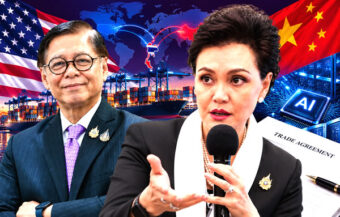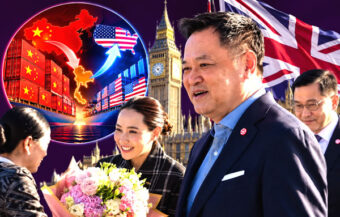
Bangkok’s US trade bargain faces a tariff squeeze as Jamieson Greer targets industrial overcapacity. Suphajee wants a 19% ceiling, but Section 301 cases, Thailand’s surging trade surplus and Chinese-linked supply chains could drive US tariffs higher.
Thailand’s trade talks with Washington face a dangerous new twist as US Trade Representative Jamieson Greer prepares tougher action on industrial overcapacity. Commerce Minister Suphajee Suthumpun is racing to secure a deal and hold Thailand’s tariff burden near 19%. Yet Washington has guaranteed no ceiling. A 12.5% Section 301 tariff already applies over forced-labour controls, while another investigation targets Thai manufacturing. With its US trade surplus soaring and Chinese-linked supply chains under scrutiny, Thailand now risks additional tariffs despite offering billions in US purchases.
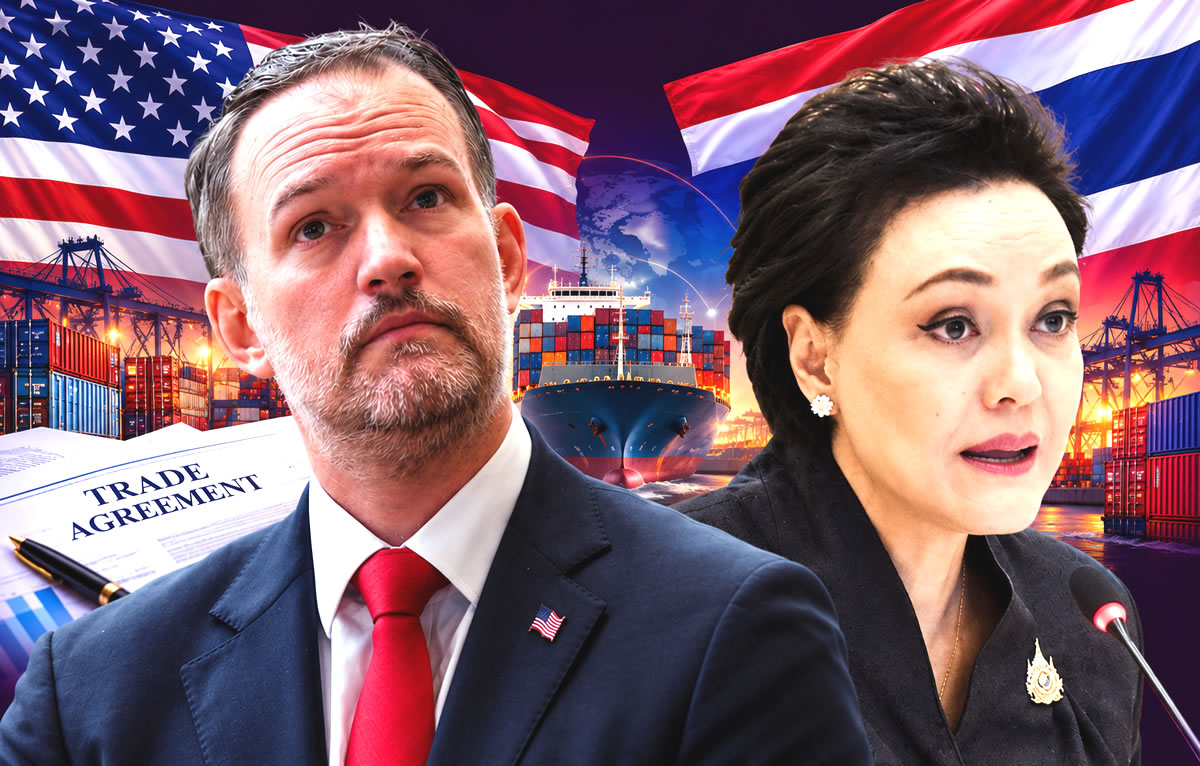
US Trade Representative Jamieson Greer has sharply raised the stakes for Thailand’s unfinished trade negotiations with Washington. His October 1 warning on global industrial overcapacity comes at a difficult moment for Commerce Minister Suphajee Suthumpun.
She is racing to secure a US trade agreement while seeking an effective ceiling on Thailand’s mounting tariff exposure. Crucially, Greer is simultaneously pushing Washington towards stronger trade action.
Speaking at the G20 trade ministers’ meeting in Milwaukee, Greer warned that structural excess production required action. Moreover, he argued that existing trade remedies were no longer adequate. “Nearly all countries agree that this is an issue that requires action,” Greer said. Yet the G20 failed to agree on collective measures against excess industrial capacity. Even so, Greer made clear that Washington would continue pursuing the issue beyond Milwaukee.
Thailand faces wider US tariff exposure as Suphajee seeks a firm ceiling through unfinished trade deal
His intervention matters directly to Bangkok because Thailand already faces a Section 301 investigation on precisely that issue. Thailand is among only 16 economies targeted over structural excess manufacturing capacity. In parallel, Suphajee is trying to complete an Agreement on Reciprocal Trade, or ART, with Washington. The US investigation could produce additional tariffs outside that agreement.
That distinction is now critical. Suphajee is no longer negotiating merely for one headline tariff rate. Instead, she must secure predictable market access while containing several American tariff pressures. Thailand wants its eventual burden kept within the previously negotiated 19% range. Equally important, Bangkok wants treatment comparable with neighbouring exporters. A substantially higher rate could quickly cost Thai manufacturers American orders and investment.
Washington has not guaranteed that ceiling. At the same time, its Section 301 machinery continues moving on separate fronts. Thailand already faces duties arising from Washington’s forced-labour investigation. Separately, the structural excess-capacity case is approaching a decision. Washington is also scrutinising Chinese-linked supply chains and possible illegal transshipment through third countries.
These are distinct trade issues. Taken together, however, they create the possibility of cumulative tariff exposure for Thai exporters. The ART rate may therefore not represent the final duty paid at America’s border. That problem has become central to Suphajee’s negotiations and explains the urgency surrounding the talks.
Suphajee seeks 19% tariff ceiling and regional parity as Washington prepares another trade decision
On September 30, Suphajee said the principal negotiating terms were essentially complete. Technical details and wording remained under discussion. As a result, Thai negotiators continue working with Washington while another US tariff decision approaches. Suphajee expects decisions before November, while Washington recently indicated an announcement could come during early October.
Thailand has two principal objectives. First, Bangkok wants the eventual tariff burden within the previous 19% range. Second, it wants treatment comparable with competing countries. The second objective carries enormous commercial importance because Thailand does not sell into America alone. Its factories compete directly with Vietnam, Malaysia, Indonesia and other Asian manufacturing centres.
A nominally acceptable tariff could still hurt Thailand if regional competitors receive substantially better treatment. For that reason, Suphajee is negotiating for both a ceiling and competitive parity. Yet the final outcome does not rest solely with USTR. Suphajee has stressed that President Donald Trump will also play a significant role. That adds another uncertainty as negotiations move towards their final stages.
Greer widens excess capacity pressure as US scrutiny reaches Thailand and other export-driven economies
Greer’s October 1 intervention has intensified those pressures. Washington argues that structural overproduction can overwhelm international markets. According to Greer, production encouraged beyond domestic demand eventually spills across borders. Surplus goods can then pressure manufacturers and workers elsewhere.
“When non-market policies and practices allow production to expand far beyond domestic demand, the consequences spill across borders,” Greer said. “Excess production flows into global markets, putting pressure on producers and workers elsewhere.”
China remains the principal target of that criticism. Nevertheless, Washington’s investigation extends far beyond China. Thailand, Vietnam, Malaysia, Indonesia, Singapore and Cambodia are included. Japan, India, South Korea, Taiwan and Bangladesh are also targeted. Elsewhere, the European Union, Switzerland, Norway and Mexico face investigation.
Washington is therefore examining a large section of the manufacturing system surrounding China. It is also scrutinising other heavily export-dependent economies. Notably, Greer has focused on Chinese electric vehicle production and intense domestic competition. Chinese businesses describe that competition as “neijuan”.
Washington broadens excess capacity test beyond idle factories to trade surpluses and state support
Greer sees the underlying problem differently. “They call the resulting effect ‘neijuan,’ but the root of the problem is excess production capacity.” He also said China became defensive when the issue surfaced during G20 discussions. Washington believes Beijing understands that it forms part of a much larger international problem. US countermeasures could emerge within weeks, leaving Suphajee little room for delay.
The threat becomes more serious because Washington defines excess capacity broadly. It does not simply mean factories standing half empty. USTR says large or persistent manufacturing trade surpluses can indicate structural excess production. Underused or unused manufacturing capacity provides another possible indicator.
Beyond that, Washington is examining policies which encourage production beyond domestic demand. These can include subsidies and subsidised lending. Wage suppression and weak labour protections can also enter the calculation. Other factors include inadequate social safety nets, market barriers and state-controlled commercial activity. Financial policies and other government interventions may also come under examination.
Washington is thus looking far beyond traditional dumping disputes. Instead, it is examining the economic structures supporting large export industries. That creates several vulnerabilities for Thailand, particularly its rapidly increasing trade surplus with America.
Thailand’s soaring US trade surplus adds pressure as Bangkok offers major concessions under trade deal
Thailand ranked 11th among countries running US trade surpluses during the second quarter of 2025. By the end of 2025, it had climbed to seventh place. During the first six months of 2026, Thailand moved to fifth. Inevitably, that rapid rise has become a major negotiating problem for Suphajee.
Washington wants to reduce its bilateral trade deficit. Therefore, Thailand’s growing surplus increases the pressure from America. Suphajee has acknowledged the difficulty directly. Thailand must demonstrate sincerity in managing and creating a more balanced trading relationship, she said. In response, Bangkok is seeking more American imports while protecting access for Thai exporters.
The ART was originally intended to provide a framework for doing precisely that. Thailand negotiated around a 19% reciprocal US tariff. In return, Bangkok offered extensive access to its domestic market. Thailand agreed to eliminate tariffs on approximately 99% of American goods. Those concessions covered extensive ranges of industrial, agricultural and food products.
As part of this, Bangkok offered major commercial purchases from America. Planned agricultural purchases were worth approximately $2.6 billion annually. Energy purchases were envisaged at approximately $5.4 billion each year. Thailand also proposed purchasing 80 American aircraft worth about $18.8 billion. Clearly, the agreement involved far more than adjustments to customs rates.
Section 301 complicates Thai trade bargain as forced-labour tariffs add another layer of US pressure
Bangkok also made commitments covering labour protections, environmental enforcement and economic security. In addition, Thailand agreed to cooperate against unfair third-country trade practices and duty evasion. Those were substantial commitments. Yet Washington’s expanding use of Section 301 has complicated the original bargain.
The ART does not extinguish America’s ability to investigate separate Thai trade practices. Washington instead retains Section 301 as an independent enforcement mechanism. Thailand can agree market-opening concessions under the ART, while America can investigate another practice separately. Following an adverse determination, that process can produce additional trade measures.
Thailand has already experienced that problem through the forced-labour case. Washington examined whether trading partners adequately prevented imports produced using forced labour. The United States subsequently imposed additional Section 301 tariffs. Some economies received a 10% rate, while others faced 12.5%.
Thailand received the 12.5% rate. Notably, more than 2,000 Thai products were exempted, significantly reducing the impact across overall exports. Bangkok nevertheless wants better treatment. Thailand is preparing legislation concerning imports involving forced labour. With that change, officials hope the tariff can eventually fall towards 10%.
Separate Section 301 cases raise cumulative tariff risk as Thailand seeks an effective US ceiling
Success on forced labour would not settle Thailand’s wider exposure. On another front, the structural excess-capacity case remains separate. Vice Commerce Minister Kirida Bhaopitchir has publicly explained how different Section 301 cases can accumulate. She described forced labour as one case and excess capacity as another.
“And then they can charge us with cases, they can be as many cases as they want,” Kirida said. She also provided a simple hypothetical example. If one case produced 12.5%, another case could add a further 6%. That possibility explains why Suphajee’s search for an effective ceiling has become so important.
Thailand is not merely negotiating whether Washington writes 19% into an agreement. Bangkok must consider the combined effect of the ART and applicable Section 301 duties. Product exemptions further complicate the calculation. Likewise, other US trade remedies can affect individual products differently.
There is therefore no single tariff which necessarily describes every Thai export entering America. Still, cumulative Section 301 duties create a broader problem for Bangkok. Thailand wants certainty over how high its overall exposure can climb. That certainty has yet to emerge from the negotiations.
The Department of Foreign Trade has estimated that combined tariffs should ideally remain around 19% to 20%. That estimate covers forced-labour and excess-capacity measures. Washington has not publicly guaranteed such a ceiling. The difference is fundamental: Bangkok has an objective, while Washington retains considerable discretion.
Suphajee seeks tariff certainty as Washington weighs action against three major Thai industrial sectors
Suphajee is consequently attempting something unusually difficult. Thailand is offering concessions through the ART while seeking limits on separate American tariff actions. There has been progress, and the principal terms are largely settled. However, the remaining questions increasingly concern what Thailand will actually pay after other US measures are considered.
Following earlier talks with Greer, Suphajee said the main ART terms had been agreed. Technical teams were instructed to complete the remaining details quickly. Importantly, Washington also offered assurances concerning the excess-capacity investigation. Suphajee said US officials promised resulting tariffs would be fair and competitive.
That assurance matters, but fair and competitive treatment is not necessarily a guaranteed ceiling. Greer’s October 1 comments make that distinction increasingly important. Washington now says conventional trade remedies cannot adequately address structural excess production. Accordingly, America is considering broader action against economies it believes contribute to the problem.
For Thailand, the investigation focuses particularly on three major industrial groups. Automobiles and automotive parts form one group, while machinery and components form another. Rubber and rubber products make up the third major group. Earlier Thai manufacturing figures showed capacity utilisation below 60%, causing concern in Washington.
Thailand challenges US capacity concerns with fresh factory data showing utilisation of 75% to 90%
Those figures suggested significant unused industrial capacity. They also raised questions about whether Thailand was producing considerably more than domestic demand required. Bangkok disputes the usefulness of those national figures for factories serving America. In response, the Commerce Ministry collected fresh data from major exporters.
Officials focused specifically on companies selling into the US market. The exercise covered automotive manufacturing, machinery and components, and rubber-related production. The work took between one and two months. Significantly, the resulting picture differed substantially from the earlier national statistics.
Thai officials say those factories operate at approximately 75% to 90% capacity. Bangkok argues that older national figures distorted actual industrial conditions. Some calculations included industries which had already stopped operating. Newer manufacturing businesses, by contrast, were missing.
Thailand is now revising its Manufacturing Production Index. Suphajee could not wait for that broader statistical overhaul. Instead, officials gathered targeted data and submitted it directly to Washington. Thailand wants those figures considered before America makes its excess-capacity decision.
Chinese investment and transshipment concerns add another challenge to Thailand’s US trade negotiations
Bangkok’s argument is straightforward. Major Thai factories serving America are operating at relatively high capacity. They are not simply vast platforms carrying unused production capability. Even so, utilisation rates are only one part of Washington’s case.
Thailand’s rapidly growing US trade surplus remains another concern. Meanwhile, Washington is increasingly focused on Chinese production moving through third countries. That creates another sensitive challenge for Suphajee because Chinese investment has expanded substantially across Thai manufacturing.
Automotive production has attracted particularly large investments. Electronics and other industrial sectors have also received Chinese capital. Meanwhile, American tariffs on China have altered supply chains throughout Asia. In turn, Washington is increasingly alert to Chinese goods entering America through third countries.
Chinese ownership does not automatically constitute illegal transshipment. A product can legitimately be manufactured in Thailand using Chinese capital, technology or components. The critical question concerns origin. Goods claiming Thai origin must satisfy the applicable requirements.
Washington nevertheless wants stronger enforcement. Thailand has intensified checks against false certificates of origin. Officials have also supplied Washington with information about inspections against illegal transshipment. Significantly, this issue reaches directly into the ART.
Thailand faces four separate US trade pressures as Suphajee seeks predictable access and tariff limits
The proposed agreement requires Thailand to cooperate against unfair third-country trade practices. It also includes commitments concerning duty evasion and economic security. Suphajee must therefore address several American concerns simultaneously.
First comes Thailand’s rapidly growing trade surplus. Second comes forced labour, where Washington has already imposed Section 301 duties. Third comes structural excess manufacturing capacity, now elevated by Greer’s October 1 warning. Finally, third-country trade remains under scrutiny, with Chinese-linked supply chains particularly sensitive.
These issues are legally and commercially distinct. Collectively, however, they increasingly shape Thailand’s attempt to secure predictable US market access. That makes the tariff ceiling central to the negotiations.
A trade agreement offers less certainty if separate measures can later raise tariffs across important product categories. Yet that does not make the ART commercially worthless. The agreement can still secure market access and product exemptions. It can also influence Washington’s treatment of Thailand under separate trade actions.
The forced-labour case already demonstrates that relationship. Economies meeting particular American requirements received lower Section 301 treatment. Suphajee therefore has strong reasons to complete the ART. Completion alone, however, does not provide a blanket shield against future Section 301 action.
Bangkok seeks a 19% tariff benchmark as Greer pushes Washington towards stronger trade enforcement
That is the unresolved weakness hanging over the negotiations. Thailand wants something approaching an effective overall ceiling. Washington has instead offered assurances about fairness and competitiveness. Those concepts are not necessarily identical.
For Bangkok, 19% remains the critical benchmark. Increasingly, it represents more than the original reciprocal tariff figure. It now represents Thailand’s attempt to contain its total US tariff exposure within a commercially manageable range.
Regional parity matters almost as much. If Vietnam receives materially better treatment, American importers could switch suppliers. The same danger applies with Malaysia, Indonesia and other manufacturing competitors. Suphajee therefore needs both a manageable ceiling and comparable regional treatment.
Greer, meanwhile, is pushing Washington towards stronger trade enforcement. He wants tougher responses to structural industrial overcapacity. More fundamentally, he says existing remedies have failed to solve the problem. The G20’s inability to agree has not softened that position.
On the contrary, Washington appears prepared to proceed independently. At Milwaukee, trade ministers also discussed forced labour. That issue has already produced direct consequences for Thailand.
Section 301 powers complicate Thai trade deal as forced-labour and excess-capacity cases accumulate
In July, Washington imposed additional tariffs of 10% or 12.5% on imports from 60 countries and territories. The US said those economies had taken insufficient action against forced labour. Thailand fell into the higher tariff category.
The parallel is important. Washington has already demonstrated its willingness to use Section 301 across one broad policy issue. It is now moving through another investigation concerning excess capacity.
For Suphajee, that raises a difficult longer-term question. Completing the ART settles negotiated commitments, but it does not end Washington’s Section 301 powers. The statute can address different practices through separate investigations. For Thai exporters, the commercial impact can still accumulate.
That makes the current negotiations substantially more complicated than their original design. Suphajee must secure the ART while protecting exemptions already obtained under the forced-labour case. Bangkok also wants the existing 12.5% tariff reduced towards 10%.
Then comes the excess-capacity decision. Thailand has supplied fresh factory data showing utilisation around 75% to 90%. Washington must decide whether that evidence answers its broader concerns. Separately, transshipment scrutiny remains active.
Suphajee battles several US trade fronts while Thailand seeks certainty over its final tariff burden
Suphajee is therefore negotiating across several fronts at once. She is trying to secure market access while containing Section 301 exposure. She must also preserve Thailand’s competitiveness against neighbouring exporters. Alongside that, Bangkok must demonstrate progress on forced labour and origin enforcement.
Above all, Suphajee needs greater certainty over the combined tariff burden. Without that certainty, the headline ART rate does not necessarily reveal what Thai exporters will ultimately pay. That is what makes Greer’s October 1 intervention particularly significant.
His comments were not merely another attack on Chinese industrial policy. Thailand is already formally inside Washington’s excess-capacity investigation. Greer’s warning therefore reaches directly into Suphajee’s negotiations.
The two developments are increasingly intertwined. Greer is seeking greater American freedom to respond to what Washington considers distorted production and trade. Suphajee is seeking greater certainty over how those responses affect Thailand. Their objectives collide inside the unfinished trade negotiations.
Bangkok has already offered extensive concessions. Thailand has proposed near-total tariff elimination for American goods. It has also proposed billions of dollars in agricultural and energy purchases. Furthermore, Thailand envisages buying 80 American aircraft.
Thailand’s concessions fail to secure a tariff ceiling as Washington expands its trade enforcement drive
Thailand has also offered commitments on labour protections, environmental enforcement and economic security. Despite those concessions, Bangkok still lacks a publicly guaranteed ceiling on its overall tariff exposure. That is now the central problem facing Suphajee.
The original trade framework envisaged a relatively straightforward bargain centred around a 19% tariff. Since then, the landscape has changed considerably. Thailand now faces an existing Section 301 tariff, while another Section 301 investigation approaches a decision.
Meanwhile, Chinese-linked supply chains remain under close American scrutiny. Washington is also developing a broader argument against export-heavy manufacturing economies. Suphajee is thus trying to complete one trade bargain while the American trade system around it changes.
The agreement remains important. However, the real prize is no longer simply securing Washington’s signature on the ART. Bangkok needs enough certainty to stop separate measures pushing Thai exporters beyond the competitive range originally envisaged.
Thailand’s 19% tariff target faces growing uncertainty as Greer pushes tougher US trade measures
That is why the 19% ceiling has become so important. It is no longer merely the headline tariff around which the original negotiations were constructed. Instead, it increasingly represents Bangkok’s attempt to contain overall US tariff exposure.
Greer’s October 1 warning suggests that task is becoming harder. Suphajee must finish the agreement while Washington prepares another potentially significant tariff decision. Simultaneously, she must defend Thailand’s trade surplus, manufacturing structure and Chinese-linked supply chains.
The proposed US-Thai trade agreement was intended to provide greater certainty. Instead, it approaches completion with several major US tariff risks unresolved. For Thailand, the final question is therefore much larger than the ART’s headline tariff.
The agreement may establish the bilateral bargain on paper. What Suphajee still needs is a ceiling on what Thai exporters actually pay.
Join the Thai News forum, follow Thai Examiner on Facebook here
Follow Thai Examiner on Google here
Receive all our stories as they come out on Telegram here
Follow Thai Examiner here
Further reading:
Mixed messages from Thai government on a US Thai trade deal despite Commerce Minister’s optimism
Paying AI users in Thailand had a nightmare week online just as the government waded into the market