Anutin faces a southern backlash. Over 500 vehicles have signed up for a planned 1,000-vehicle march on Government House. Nationalist Sondhi Limthongkul pledges ฿100,000 as soaring costs, weak tourism and shrinking business credit fuel public anger.
Prime Minister Anutin Charnvirakul faces a growing revolt from conservative southern Thailand as economic hardship and government scandals mount. A 1,000-vehicle convoy led by Krabi kamnan Mano Khrueakaeo plans to descend on Government House on Thursday, November 5. Veteran nationalist Sondhi Limthongkul has pledged ฿100,000 and urged nationwide protests. Meanwhile, soaring fuel costs, weak wages, falling tourism and shrinking bank credit are hammering ordinary Thais. Police corruption probes, foreign business controversies and a stalled ฿224.5 billion railway add to Anutin’s troubles. Yet the Prime Minister insists he is not worried.
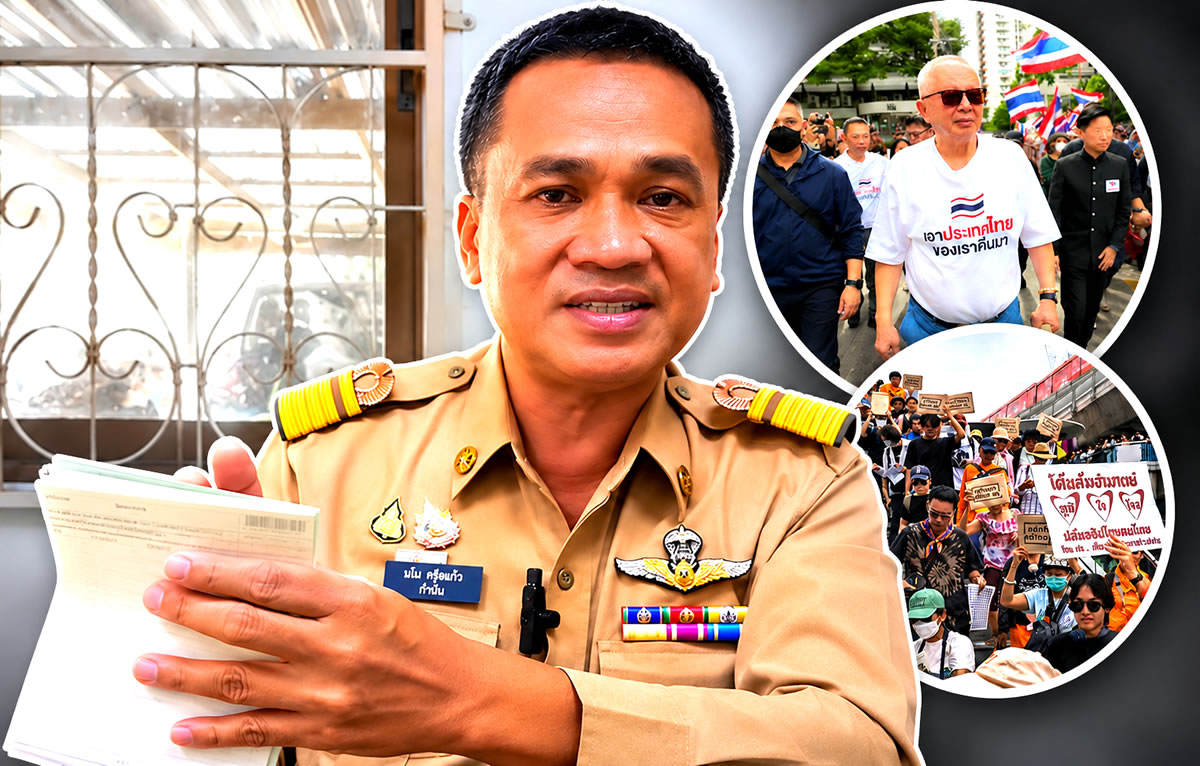
Prime Minister Anutin Charnvirakul faces mounting public discontent as economic hardship spreads and controversies engulf his government. A convoy of up to 1,000 vehicles is preparing to descend on Government House on Thursday, November 5.
Significantly, the protest is emerging from conservative southern Thailand, rather than the traditional parliamentary opposition. Veteran nationalist activist Sondhi Limthongkul has pledged financial support and urged nationwide participation.
Meanwhile, rising living costs, disappointing tourism and shrinking small-business lending are squeezing ordinary Thais. Corruption investigations, foreign business disputes and stalled infrastructure projects are adding to the government’s problems.
Krabi kamnan leads planned 1,000-vehicle convoy to Bangkok as rising living costs fuel public anger
The demonstration is being organised by Mano Khrueakaeo, the kamnan of Krabi Noi subdistrict in Krabi province. He plans to mobilise truck drivers, local residents and people struggling under current economic conditions.
By Monday, November 2, more than 500 vehicles had reportedly registered. Organisers are targeting 1,000, although actual participation remains unconfirmed. Their complaints centre on expensive fuel, inadequate wages, consumer prices and mounting financial hardship. Additionally, they are demanding action over suspected corruption in local government recruitment.
The convoy will assemble at Khuan Nong Hong intersection in Cha Uat district of Nakhon Si Thammarat. From there, participants will travel north towards Bangkok, campaigning along the route. Planned stops include Surat Thani, Chumphon and Phetchaburi. Ultimately, the procession is scheduled to reach Government House on Thursday. Organisers intend to present their economic grievances directly to the government.
The location carries political significance. Southern Thailand has repeatedly provided the foundations for major conservative protest movements. Krabi, in particular, has longstanding conservative political traditions.
Conservative southern political networks form the backdrop to Krabi headman’s growing economic protest
The Democrat Party has maintained extensive networks across the region for decades. More recently, Bhumjaithai has also developed political interests in southern provinces. However, the current mobilisation is not being organised by an opposition parliamentary party. Instead, a serving local administrative leader is directing the campaign.
Mano has previously participated in demonstrations against government policies and major development projects. Notably, he opposed the proposed land bridge across the Kra Isthmus.
That scheme has generated disputes over economic benefits, environmental consequences and the effects on local communities. This time, his campaign focuses on immediate household pressures. Fuel prices, wages and everyday expenditure dominate the organisers’ demands.
The movement has also attracted financial backing. By Sunday, November 1, Mano reported donations totalling approximately ฿570,000. Subsequent reports placed contributions above ฿800,000 by Monday. The funds are intended to help cover transport expenses, particularly fuel. At the same time, organisers continued recruiting vehicles and supporters for the journey north.
Sondhi Limthongkul has promised ฿100,000 towards the convoy’s fuel costs. Furthermore, he has invited citizens dissatisfied with Anutin’s administration to join the procession. His appeal extends beyond Krabi to communities throughout Thailand.
Sondhi’s backing brings memories of earlier southern protest movements before the 2014 military coup
The veteran activist has participated in several major political campaigns, including the People’s Alliance for Democracy. His support introduces a nationally recognised political figure into a protest initially organised around local economic grievances.
Southern Thailand has previously played a central role in national political confrontations. The People’s Democratic Reform Committee protests associated with Suthep Thaugsuban drew substantial support from the region.
Those demonstrations preceded the military coup of May 2014. Indeed, the organisers have selected Khuan Nong Hong, a location associated with the earlier protest movement. Nevertheless, the present campaign has not announced comparable political objectives. Its stated demands concern economic hardship, government administration and suspected corruption.
Sondhi’s financial support does not establish that he controls the convoy. Mano remains its publicly identified organiser. Even so, Sondhi’s invitation to supporters nationwide has expanded the campaign’s declared reach. The planned procession now involves more than complaints from a single southern community.
Phuket nationalist rally attacks government over fuel costs and suspected illegal foreign businesses
The announcement followed a nationalist gathering in Phuket on Saturday, October 31. Sondhi addressed the event at Saphan Hin Peninsula under the banner United Power of the Nation: Reclaiming Our Thailand.
Speakers criticised government performance, expensive fuel and the treatment of unlawful foreign business activities. During his address, Sondhi announced the ฿100,000 contribution. He also urged people affected by government policies to join Mano’s protest.
The Phuket meeting exposed another source of political controversy. The Phuket Land Protection Group demanded stronger action against foreign investors suspected of breaching Thai law. Its representatives claimed unlawful commercial activities were damaging local businesses and communities.
They also accused authorities of failing to enforce existing regulations effectively. Separately, the group raised concerns about foreign conduct and its effects on Phuket’s tourism industry.
The campaigners highlighted the case of Rabbi Yosef Chaim Kantor, the longtime head of Chabad in Thailand. Prime Minister Anutin’s administration recently revoked his Thai citizenship. The decision has prompted disputes involving citizenship, national security and foreign commercial interests.
The Phuket group demanded further legal action and the closure of Chabad Houses nationwide. However, those demands remain allegations and political positions advanced by the group.
Phuket activists demand Chabad closures as Bangkok’s Khao San Road police bribery scandal widens
The organisation had previously protested against an Israeli celebration at Chabad House in Patong on September 11. It cited concerns about national security, foreign business activities and inappropriate behaviour by some visitors.
Its latest demands therefore extend an existing local dispute into the wider controversy surrounding government administration. The group’s complaints have also become part of the nationalist campaign gathering support for the southern convoy.
On another front, Anutin’s government is dealing with a corruption investigation affecting Bangkok’s nightlife industry. A police bribery scandal around Khao San Road has exposed serious problems with entertainment licensing.
Only four of more than 30 surveyed venues reportedly possessed the required entertainment licences. Subsequently, a midnight closing crackdown triggered complaints from business operators and workers dependent on tourism.
The restrictions struck one of Bangkok’s best-known international nightlife districts. Businesses complained about lost revenue, reduced trading hours and threats to employment. Meanwhile, police corruption allegations complicated efforts to resolve the licensing dispute. Officers face disciplinary and criminal investigations over suspected wrongdoing. The controversy has also exposed problems extending well beyond Khao San Road.
Bangkok nightlife licensing crisis deepens as Thailand’s ฿224.5 billion airport railway remains stalled
Prime Minister’s Office Minister Paradorn Prissananantakul joined Bangkok Governor Chadchart Sittipunt and senior police officers for urgent discussions. Metropolitan Police Bureau Chief Police Lieutenant General Siam Boonsom also attended the wider meeting. Officials examined possible changes to entertainment licensing and operating hours. One proposal involves a 15-day Khao San–Rambuttri trial scheme with stricter safety controls.
The scale of the problem is substantial. Officials have identified more than 1,000 similar entertainment businesses across Bangkok. Furthermore, 22 provinces reportedly lack designated entertainment zones.
The dispute therefore extends into wider questions about outdated regulations, enforcement and tourism administration. For businesses already facing weaker visitor spending, the licensing crackdown has introduced another immediate difficulty.
Infrastructure policy presents a separate challenge. Thailand’s ฿224.5 billion three-airport high-speed railway remains stalled after seven years without construction. The CP Group-linked consortium has sought to terminate its 2019 contract. However, the State Railway of Thailand refuses to accept its withdrawal. Financing difficulties and outstanding payments have deepened the dispute.
Banks have rejected fresh financing for the project. In addition, more than ฿10 billion in Airport Rail Link payments remains outstanding. Prime Minister Anutin has warned that the dispute could end in court. No replacement agreement has been approved. Meanwhile, officials are considering a slower railway alternative.
Three-airport rail dispute threatens industrial plans as weak growth and bank lending squeeze businesses
The original project was designed to connect Don Mueang, Suvarnabhumi and U-Tapao airports. It also forms a central component of the Eastern Economic Corridor development programme. Democrat Party spokesman Pasin Pitutecha has demanded accountability over the stalled scheme. He has warned that the dispute threatens the wider industrial development programme. Questions remain over financing, contract obligations and the consequences of prolonged delays.
These controversies are unfolding against a difficult economic background. The Bank of Thailand has identified subdued consumption, weaker foreign tourism and rising energy costs. Household debt remains another constraint on spending. Consequently, many lower-income families face pressure from essential expenditure and limited income growth. The difficulties resemble cost-of-living problems affecting households elsewhere in the world.
Thailand’s central bank forecasts economic growth of 2.4% in 2026 and 2.1% in 2027. Yet those figures conceal substantial differences between industries. Technology-related exports have performed strongly, particularly in sectors benefiting from international demand. However, the benefits remain concentrated within a relatively narrow section of the economy. Many smaller domestic businesses face markedly different conditions.
Bank lending to small enterprises continues to contract across most sectors. In contrast, lending to larger corporations has increased. The divergence affects businesses dependent on working capital, short-term finance and regular customer spending. Smaller operators must contend with reduced access to credit while managing wages, supplies and other operating expenses.
Small firms face shrinking bank credit while rising fuel costs and weaker tourism hit Thai households
For companies already experiencing weak sales, restricted financing adds another obstacle. Banks are withdrawing credit from parts of the economy where businesses remain heavily dependent on borrowing.
Meanwhile, larger corporations continue attracting additional lending. The central bank’s assessment therefore identifies a clear divide between different parts of Thailand’s business sector.
Households face their own financial constraints. Debt repayments, transport expenses and essential purchases absorb significant portions of limited incomes. Higher fuel prices also affect distribution costs and the prices of goods and services. As a result, wage earners and lower-income families face additional pressure on everyday budgets. These are among the complaints driving Mano’s planned demonstration.
Foreign tourism has added to the economic difficulties. Visitor numbers have disappointed expectations during 2026, affecting businesses dependent on international arrivals. Hotels, restaurants, retailers and transport operators remain exposed to weaker tourist spending.
Southern Thailand is particularly dependent on tourism employment and commercial activity. Accordingly, changes in visitor numbers can affect entire networks of local businesses.
Disappointing foreign tourism and uneven economic growth intensify pressure on Thailand’s small firms
The effects extend beyond hotels and travel companies. Suppliers, food businesses, drivers and smaller retailers also depend on visitor expenditure. Weaker tourism therefore affects businesses that may have little direct involvement with international travel.
Competition from other regional destinations has intensified the pressure. At the same time, restricted lending makes it harder for smaller operators to manage financial shortfalls.
The Bank of Thailand’s assessment highlights the uneven nature of economic activity. Stronger technology exports have not produced equivalent improvements throughout the domestic economy. Instead, household spending remains subdued while smaller enterprises face tighter financing conditions. These findings closely match the economic grievances identified by the southern protest organisers.
Fuel costs are particularly prominent in Mano’s campaign. Higher prices directly affect drivers and transport operators participating in the convoy. They also increase expenses for businesses moving goods across the country.
For households, transport costs compete with food, debt repayments and other necessities. The organisers are demanding urgent government action over these pressures.
Low wages and suspected recruitment corruption fuel convoy demands as Anutin says he is not worried
Limited wages form another central complaint. Mano has linked economic hardship to the difficulty of meeting living expenses with existing earnings. Meanwhile, rising consumer prices have reduced the spending power of households already facing financial constraints. The demonstration is therefore focused on everyday economic conditions rather than a single government project.
The protest also includes complaints about suspected corruption in local government recruitment. This adds an administrative dispute to the economic demands. However, the allegations remain separate from the confirmed financial pressures identified by the central bank. Organisers have nevertheless included both issues in their planned campaign towards Government House.
Prime Minister Anutin addressed the demonstration while visiting Nong Khai province on Monday, November 2. He said he was not worried about the planned procession. Furthermore, he insisted that his government was working hard and acting in the public interest. He also acknowledged the constitutional right of citizens to demonstrate.
The Prime Minister stressed that protesters must respect the rights of others and remain within the law. In response to the organisers’ plans, he said police and administrative authorities should communicate with participants.
He indicated that his administration was prepared to hear their concerns. Anutin also dismissed suggestions that a politically motivated demonstration presented a particular problem for his government.
More than 500 vehicles register for southern protest as Sondhi urges wider participation across Thailand
His remarks came as organisers continued recruiting vehicles and collecting financial contributions. By Monday, reported donations had risen above ฿800,000. More than 500 vehicles had also reportedly registered. However, the target of 1,000 remained unconfirmed. The actual number travelling to Bangkok will become clear when the procession begins.
Participation by additional political groups also remains uncertain. Sondhi has publicly called for nationwide involvement, but the extent of any response has not been established. Nevertheless, his financial commitment has already connected the southern campaign with a prominent nationalist activist. Mano continues to lead preparations for the convoy.
The planned route passes through several provinces with established histories of political mobilisation. Organisers intend to campaign during stopovers before reaching Bangkok.
Their journey will take the economic complaints from Krabi and neighbouring southern communities directly towards the national government. The demonstration is scheduled to culminate at Government House on Thursday.
The political background distinguishes this campaign from a conventional opposition demonstration. It is being organised by a serving kamnan from a traditionally conservative southern province. Moreover, the wider region has longstanding links with conservative parties and street protest movements. However, organisers have not established that participants represent any particular party or parliamentary bloc.
Southern protest links economic hardship with wider government controversies and growing public discontent
The distinction is important because the declared grievances are economic and administrative. They concern fuel costs, wages, consumer prices, restricted finances and suspected corruption.
At the same time, Sondhi’s involvement has introduced wider criticism of government performance and foreign business enforcement. Those issues were prominent at the Phuket gathering preceding the convoy announcement.
Anutin’s administration is consequently facing complaints on several fronts. The southern convoy is demanding relief from economic hardship. Separately, corruption investigations are affecting Bangkok’s entertainment industry. The Chabad citizenship dispute has drawn nationalist campaigners into another confrontation. Meanwhile, the three-airport railway project remains trapped in a major contractual and financing dispute.
The economic figures provide additional context. Growth is forecast to continue, but domestic demand remains weak. Smaller businesses are experiencing contracting credit while larger companies attract increased lending. Foreign tourism has also underperformed expectations. For many households, rising expenses and limited income growth remain immediate concerns.
Krabi convoy prepares to confront Anutin at Government House as economic grievances drive protest
Against this backdrop, the southern demonstration is proceeding towards its scheduled date. Organisers have reported substantial donations and hundreds of vehicle registrations. Sondhi has promised financial support and invited additional participants from across Thailand. The government, for its part, has said it will listen while insisting that protesters obey the law.
Friday protests by anti IMF World Bank activists continue after overnight camp event in central Bangkok
Prime Minister Anutin talks of an economy driven by ‘quality growth’ at the Bangkok IMF World Bank forum
By Thursday, November 5, Mano intends to bring the convoy to Government House. The demonstration will place complaints about fuel prices, wages, living costs and suspected administrative corruption before the Prime Minister.
Its actual size and wider participation remain to be established. However, preparations are continuing as Anutin’s government confronts economic pressures and a series of unresolved controversies.
Join the Thai News forum, follow Thai Examiner on Facebook here
Follow Thai Examiner on Google here
Receive all our stories as they come out on Telegram here
Follow Thai Examiner here
Further reading:
Thailand’s once mighty tourism industry is failing but now faces further damage from overvalued baht