Thailand’s drug crisis sees Anutin act with new bills targeting yaba dealers, extending police detention to seven days and expanding investigations. With 1.5 million yaba users and prisons holding 301,020 inmates, the crackdown follows record seizures.
Prime Minister Anutin Charnvirakul has launched a sweeping crackdown on Thailand’s drug trade, proposing tougher trafficking laws and seven-day police detention. The move follows a deadly police confrontation and comes amid a deepening national narcotics crisis. With 1.5 million yaba users, more than 203,000 drug arrests in eight months and nearly one billion pills seized, Thailand faces mounting pressure. Meanwhile, drug cases are flooding the courts, prisons hold 301,000 inmates and industrial-scale methamphetamine production across the border in Burma continues unabated. Under the proposed laws, possession of just a few pills could bring serious trafficking charges.
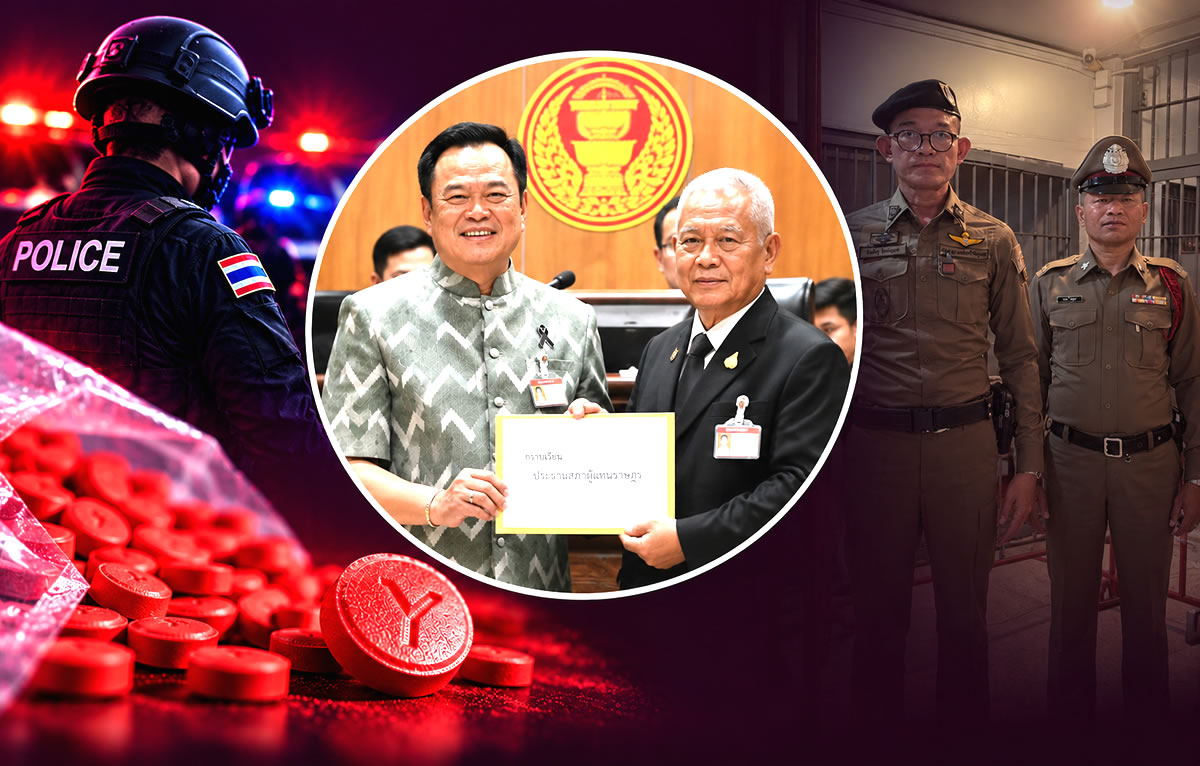
Prime Minister Anutin Charnvirakul launched a major legislative crackdown on Thailand’s narcotics trade on Wednesday, 21 October. He submitted two bills to Parliament seeking tougher penalties, longer police detention periods and expanded investigative powers.
Crucially, the legislation would make it easier to prosecute suspects carrying small quantities of drugs as traffickers. The move comes amid rising methamphetamine addiction, soaring narcotics prosecutions and renewed prison overcrowding.
Already, approximately 70% of Thailand’s prisoners are incarcerated for drug offences. At the same time, industrial-scale methamphetamine production in neighbouring Burma continues to supply Thailand’s illegal drug market.
Anutin submits two bills to Parliament targeting drug possession and extending police detention
Anutin, who also serves as Interior Minister, presented the legislation to House Speaker Sophon Sarum. Lawmakers from his ruling Bhumjaithai Party accompanied him. The two bills would amend Thailand’s Narcotics Code and the legislation governing criminal proceedings in drug cases.
Together, they would increase penalties, expand police powers and tighten the treatment of illegal possession. In addition, investigators would gain wider access to communications information, while enforcement against online narcotics activity would intensify.
The central change concerns the legal treatment of drug possession. Under the proposals, possession above the recognised personal-use threshold would create a presumption of intent to distribute.
Consequently, suspects carrying small quantities of illegal drugs could face more serious criminal charges. The proposed measures would also extend special police detention periods from three days to seven. This would give investigators additional time to pursue suppliers and trafficking networks.
One yaba pill remains the personal-use threshold as new regime tightens possession and trafficking laws
Thailand already operates a strict personal-use threshold for methamphetamine. Since June 2024, possession of no more than one yaba tablet weighing 100 milligrams has qualified for the personal-consumption presumption. For crystal methamphetamine, the corresponding threshold is 20 milligrams.
Previously, regulations introduced in February 2024 recognised up to five methamphetamine tablets. However, the government reduced that limit to one tablet four months later, tightening the treatment of possession.
The threshold does not legalise possession. Instead, it helps determine whether suspects qualify for treatment rather than criminal prosecution. Police can also pursue trafficking charges where evidence establishes an intention to sell.
Now, Anutin’s proposals would introduce a statutory presumption of distribution above the prescribed personal-use limit. As a result, suspects carrying only a few methamphetamine tablets could face substantially more serious criminal charges.
The proposals would also give police more time to investigate narcotics suspects. Under the amendments, the maximum special detention period would rise from three days to seven.
The government says investigators need additional time to identify suppliers, examine communications and establish links with larger criminal networks. Accordingly, officers would have longer to investigate suspected trafficking operations before the relevant detention deadline expires.
Police seek wider access to communications as tougher penalties target online drug activity and children
On another front, the Narcotics Suppression Bureau would receive expanded powers to obtain communications and other information. Officers could apply to the Criminal Court for permission to access material through different communications channels.
The provisions would cover information relevant to narcotics investigations, including electronic records and communications. Court approval would remain part of the proposed investigative procedure.
The bills also propose tougher penalties for specified drug offences involving computer systems. Separately, criminals using children to commit narcotics offences would face increased punishment.
Officials would also gain powers to suspend the distribution of online material encouraging drug consumption or remove such content. Furthermore, the Office of the Narcotics Control Board (ONCB) would receive wider access to centralised government information systems. These powers would support criminal investigations, prosecutions and rehabilitation programmes.
As part of the package, the government wants families and caregivers to have greater access to addiction treatment. One provision would allow those responsible for suspected drug users to request treatment voluntarily on their behalf. The government has also proposed establishing a rehabilitation centre in every district. Thus, the legislation combines expanded enforcement with additional treatment provisions.
Anutin cites Phetchaburi drug clash as Burma meth networks expand cross-border supply
Anutin said the changes were necessary to strengthen narcotics suppression and close legal loopholes. He confirmed that the government was intensifying operations involving police, ONCB officials, local administrators and military personnel.
The Prime Minister also cited a deadly confrontation during an anti-narcotics operation in Phetchaburi on Tuesday night, 20 October. He said the government wanted to prevent further deaths during operations against suspected traffickers.
“We do not want to rely on luck to avoid losses,” Anutin said. In response, he announced approval for four additional X-ray vehicles for the Royal Thai Police. The equipment would support narcotics enforcement operations. House Speaker Sophon also backed stronger legislation, describing Thailand’s drug situation as a crisis causing widespread hardship. He said the proposals reflected cooperation between the government and Parliament.
The legislative offensive follows enormous methamphetamine seizures across Thailand and neighbouring countries. Much of the supply originates in Burma, particularly Shan State.
The United Nations Office on Drugs and Crime (UNODC) identifies the region as a major centre of industrial-scale methamphetamine production. Political instability following Burma’s February 2021 military coup helped criminal organisations expand production. Subsequently, trafficking networks developed alternative routes to move narcotics across international borders.
Record meth seizures and more than 203,000 arrests expose the scale of Thailand’s drug trade
Thailand remains both a major destination for methamphetamine and a transit country supplying other markets. The scale of the regional trade is reflected in record drug seizures. In 2024, East and Southeast Asian countries confiscated 236 tonnes of methamphetamine.
That represented a 24% increase compared with the previous year. Notably, Thailand alone seized approximately one billion methamphetamine tablets during 2024.
The Thai government has since reported another substantial increase in narcotics enforcement. Between 1 October 2025 and 31 May 2026, police and other agencies arrested 203,637 drug offenders. That represented a 20.36% increase compared with the corresponding eight months a year earlier. During the same period, officers seized more than 997 million methamphetamine tablets. They also confiscated 39.4 tonnes of crystal methamphetamine.
In parallel, government figures recorded operations targeting 16,419 drug networks through raids and searches. The Royal Thai Government released the figures on 5 July 2026. They reveal the scale of enforcement operations already underway before Wednesday’s legislative proposals. The government says transnational criminal organisations increasingly employ sophisticated smuggling methods and international financial networks.
Government targets smuggling networks as surveys reveal 1.5 million yaba users and rising consumption
Its anti-narcotics strategy combines police investigations, military border operations, intelligence gathering and international cooperation. The campaign also targets government officials involved in narcotics trafficking. Additionally, police and military personnel continue operations against smuggling networks and drug distribution organisations. The latest figures show that arrests and seizures remain exceptionally high.
Thailand’s domestic consumption figures reveal another dimension of the crisis. A nationwide ONCB household survey conducted in 2024 estimated that 1.9 million people had used illicit drugs. The estimate covered people aged between 12 and 65 during the preceding year. It excluded cannabis and kratom. Of those surveyed, approximately 1.5 million people were estimated to have used methamphetamine tablets, commonly known as yaba.
The survey also identified approximately 330,000 frequent drug users. Separately, an estimated 220,000 users were experiencing mental health problems. These figures reveal the scale of drug dependence and associated psychiatric problems across Thailand. The government has identified drug-related mental health cases as a priority in its national narcotics strategy. Its proposed rehabilitation expansion is intended to increase treatment access across the country.
The UNODC’s 2025 regional report also identified a substantial increase in methamphetamine tablet consumption. Its analysis of national household surveys found that past-month consumption increased fourfold between 2016 and 2024. Moreover, the UNODC identified a relationship between increased methamphetamine availability and domestic consumption. The findings establish the expansion of Thailand’s methamphetamine market over the past decade.
Drug-related psychiatric problems grow as Thai courts handle 440,069 narcotics cases in a single year
Methamphetamine dependence is associated with psychiatric emergencies, family disruption, financial problems and certain forms of criminal behaviour. In this context, the government has included drug-related psychiatric cases in its national narcotics strategy.
The ONCB estimates that 220,000 drug users experience mental health problems. Frequent drug consumption also affects approximately 330,000 people. Meanwhile, police are making hundreds of thousands of narcotics arrests as criminal prosecutions increase sharply.
Thailand’s criminal courts have recorded a substantial rise in drug cases. According to the International Federation for Human Rights (FIDH), 382,800 drug cases reached courts of first instance during 2024. That number increased to 440,069 in 2025. The rise amounted to approximately 15% in a single year. Furthermore, methamphetamine and amphetamine offences accounted for almost 97% of drug-related cases brought before those courts in 2025.
The number of methamphetamine and amphetamine cases increased from 371,505 in 2024 to 428,642 in 2025. These figures confirm that methamphetamine dominates Thailand’s narcotics caseload. They also show that prosecutions were increasing substantially before Anutin submitted Wednesday’s legislation. FIDH linked the increase in prosecutions and convictions to the reduction in the personal-consumption threshold during June 2024.
That decision reduced the quantity of methamphetamine recognised under the presumption of personal use. Consequently, people carrying quantities previously covered by that presumption faced different legal consequences. The proposed legislation would now introduce a further presumption of intent to distribute. Against this background, Thailand’s prison system is already experiencing renewed overcrowding.
Thailand’s prisons exceed official capacity by 52,690 as drug offences account for 70% of prisoners
According to the World Prison Brief, the country held 301,020 prisoners in December 2025. Official prison capacity stood at 248,330. Therefore, the prison population exceeded stated capacity by approximately 52,690 people.
That represented an occupancy rate of 121.2%. The figures confirm that Thailand’s correctional system was operating substantially above its official capacity. Moreover, the prison population has increased again following a major decline earlier this decade.
FIDH and Thailand’s Union for Civil Liberty published their latest prison report in March 2026. They found that prisoner numbers had risen for a second consecutive year. Approximately 70% of prisoners were incarcerated for drug-related offences. Furthermore, the number of prisoners held for narcotics offences increased after three years of decline. The findings place Wednesday’s proposed legislation against an already overcrowded prison system.
Thailand has previously recorded even higher incarceration levels. According to selected World Prison Brief figures, the country held 315,012 prisoners in 2014. The population stood at 300,868 in 2016. However, it subsequently climbed to 366,316 in 2018. By 2020, Thailand still held 358,369 prisoners. The numbers then declined substantially.
In 2022, the prison population fell to approximately 260,400. That decline coincided partly with reforms intended to reduce imprisonment for drug consumption and expand treatment options. Nevertheless, prisoner numbers subsequently increased again. By December 2025, the total had reached 301,020. Consequently, Thailand was moving back towards the higher incarceration levels recorded before those reforms.
From treatment reforms to one-pill limits, Thailand tightens narcotics rules amid rising imprisonment
The country’s drug laws have undergone several significant changes during this period. The 2021 Narcotics Code introduced alternatives to imprisonment and placed greater emphasis on rehabilitation.
It also sought to distinguish more clearly between drug consumers and traffickers. However, methamphetamine consumption continued on a substantial scale. The government subsequently tightened the personal-use threshold during 2024.
Initially, regulations recognised up to five methamphetamine tablets under the presumption of personal consumption. That limit was reduced to one tablet in June. The change preceded a sharp increase in narcotics cases reaching the courts during 2025. At the same time, the prison population continued rising. The latest proposals would tighten the treatment of possession further.
A 2024 study by the International Drug Policy Consortium documented the scale of drug-related incarceration. It found that 206,080 prisoners were incarcerated for drug offences at the beginning of that year. They represented 74.5% of the prison population. The study identified Thailand’s longstanding punitive drug policies as a major contributor to its high imprisonment rate.
New possession presumption and seven-day detention powers strengthen prosecution powers
Those figures demonstrate that drug offences accounted for a substantial majority of prisoners before the latest increase. In addition, the FIDH report recorded rising drug-related imprisonment after three years of decline.
The increase coincided with the higher number of cases entering Thailand’s criminal courts. Now, the proposed possession provisions would introduce another significant change to narcotics enforcement.
People carrying quantities above the personal-use threshold could face a presumption of intent to distribute. The change would strengthen the legal position of prosecutors pursuing possession-for-sale cases.
Separately, the government is seeking broader powers to investigate organised trafficking networks. The proposed seven-day detention period would more than double the existing three-day maximum under the relevant special procedure.
Investigators would also gain additional access to communications information through court-approved applications. The government says these changes would help officers identify suppliers and pursue wider criminal organisations.
Drug trafficking investigations increasingly involve electronic financial transactions, communications systems and international criminal networks. Furthermore, the proposed legislation would strengthen penalties for specified offences involving computer systems.
It would also increase punishment for criminals involving children in narcotics activity. The proposed powers over online content would extend enforcement into digital communications. Officials could suspend distribution of material encouraging drug use or remove it. The ONCB would receive wider access to government information systems. These provisions would support investigations, prosecutions and rehabilitation programmes.
Police drug arrests and record meth seizures expose trafficking routes from Burma and domestic demand
The proposed legislation therefore covers more than street-level possession and trafficking. It also addresses information gathering, online activity, criminal networks and treatment. Meanwhile, the government’s enforcement operations continue across Thailand.
The latest official figures show more than 203,000 drug offenders arrested during the eight months ending in May 2026.
During that period, methamphetamine tablet seizures approached one billion. Those figures followed approximately one billion tablets seized during 2024. The UNODC has also documented record methamphetamine seizures across East and Southeast Asia.
In addition, its research identifies Shan State in Burma as a principal production centre. Thailand’s position alongside important trafficking routes places it directly within the regional narcotics trade.
Domestically, household surveys show extensive drug consumption. Court records also establish rising narcotics prosecutions. Prison statistics confirm renewed overcrowding and a substantial increase in prisoner numbers since 2022. Together, these figures establish the background to Anutin’s latest legislative offensive.
Parliament considers tougher drug penalties and wider police powers as public consultation gets underway
The government is seeking stronger enforcement powers while retaining measures for addiction treatment. Police would receive additional investigative time, while prosecutors could benefit from the proposed possession presumption.
Narcotics investigators would also gain wider access to communications information through court-approved procedures. Penalties would increase for specified offences, including those involving children and computer systems.
Officials would also receive powers over online material encouraging drug consumption. Caregivers could request treatment for people suspected of drug use. The government has separately proposed rehabilitation centres in every district. These measures form part of a wider national campaign against trafficking and drug consumption.
The bills now face public consultation and parliamentary scrutiny. House Speaker Sophon has accepted them for consideration and indicated that Section 77 consultation requirements must be followed. Accordingly, the proposed changes cannot take effect until the necessary legislative process is completed. No commencement date has been announced.
For now, Thailand continues operating under its existing narcotics legislation. That includes the one-tablet personal-use threshold introduced in June 2024. The new proposals come as methamphetamine and amphetamine offences account for almost 97% of drug cases reaching courts of first instance. Meanwhile, approximately seven in ten prisoners are incarcerated for drug offences.
Prison overcrowding and soaring yaba consumption frame Anutin’s latest crackdown on narcotics trafficking
Thailand’s prison population has also climbed to more than 301,000, exceeding official capacity by over 52,000. At the same time, the government reports hundreds of thousands of drug arrests and seizures approaching one billion methamphetamine tablets over eight months. The ONCB’s household survey estimates that 1.5 million people used yaba during 2024.
Furthermore, UNODC research shows that past-month methamphetamine tablet consumption increased fourfold between 2016 and 2024. These figures establish the scale of Thailand’s domestic narcotics problem alongside the industrial-scale trafficking trade operating from Burma.
A kingdom suffering from a rising mental health crisis linked to drugs and depression suffers mayhem
฿500 million drug bust in Loei points us to Thailand’s unbearable problem across its northern border
Anutin’s two bills now place tougher possession rules, longer detention periods and wider police powers before Parliament. The proposed amendments would strengthen criminal enforcement while retaining provisions for rehabilitation. Their final scope will depend on parliamentary approval and the wording eventually enacted.
The latest court and prison figures show that Thailand is already processing substantially more drug cases. The government’s legislative initiative arrives amid rising prosecutions, renewed prison overcrowding and record regional methamphetamine seizures. For Thailand’s police, prosecutors and prison system, the proposed changes represent another substantial tightening of the country’s narcotics laws.
Join the Thai News forum, follow Thai Examiner on Facebook here
Follow Thai Examiner on Google here
Receive all our stories as they come out on Telegram here
Follow Thai Examiner here
Further reading:
A kingdom suffering from a rising mental health crisis linked to drugs and depression suffers mayhem
Murder suspected by police in Pakkred, Nonthaburi. Wealthy barber charged with premeditated killing