Airport nightmare in Bangkok. A China Airlines Boeing 737-800 gets stuck in sinking pavement for nearly four hours. Five flights are hit, 116 passengers evacuated and regulators launch checks as Suvarnabhumi plans another ฿210 billion expansion push.
A China Airlines passenger jet sank into collapsing pavement at Bangkok’s Suvarnabhumi Airport on Wednesday night, trapping the aircraft for nearly four hours. All 116 passengers were evacuated as five flights faced disruption. By Thursday, officials blamed heavy rainfall and rising groundwater. However, the incident has revived serious questions about Thailand’s ฿120 billion airport, opened in 2006. Runway cracks in 2007 and major subsidence in 2012 had already exposed infrastructure problems. Now, aviation regulators have ordered sweeping inspections of runways and taxiways. The fresh failure comes as Airports of Thailand prepares another ฿210 billion expansion, including a fourth runway.
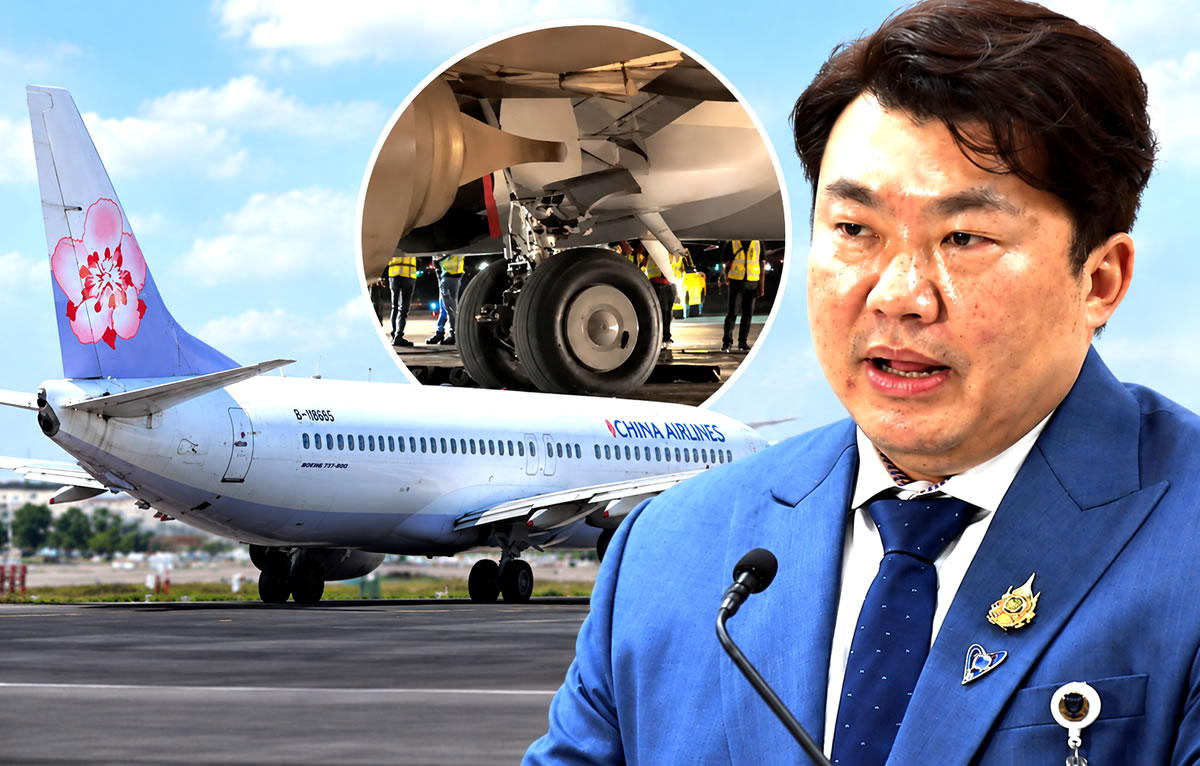
A China Airlines passenger jet became trapped in a subsiding runway surface at Bangkok’s Suvarnabhumi Airport on Wednesday evening. The emergency disrupted five flights and forced the evacuation of 116 passengers.
Recovery crews then spent nearly four hours freeing the Boeing 737-800. By Thursday, airport authorities blamed heavy rainfall and rising groundwater for weakening the pavement. The incident has revived scrutiny of Thailand’s principal international airport, built for approximately ฿120 billion before opening in 2006.
Similar pavement failures struck in 2007 and 2012, despite extensive repairs and subsequent infrastructure investment. Aviation regulators have since ordered wider inspections as Airports of Thailand (AOT) advances further expansion plans exceeding ฿210 billion.
China Airlines jet sinks into damaged Suvarnabhumi pavement as crews evacuate 116 passengers safely
The incident occurred at approximately 7.25 pm on Wednesday, 28 October, at Suvarnabhumi Airport in Samut Prakan province. China Airlines flight CI840 was preparing to depart for Kaohsiung International Airport in Taiwan.
The Boeing 737-800, registered B-18665, was approaching runway 02R through taxiway E21. However, the pavement beneath its main landing gear deteriorated. The wheels sank into the damaged surface, leaving the jet immobilised. As a result, other aircraft were unable to proceed normally towards their departure runway.
Photographs circulated by aviation monitoring page Outsider’s Aviation showed the aircraft stranded on the pavement. Its main landing gear was trapped in the damaged surface. Airport authorities immediately deployed firefighters, rescue personnel, maintenance engineers and specialist recovery teams.
At the same time, ground crews brought heavy equipment and recovery vehicles to the scene. The aircraft was carrying 116 passengers and eight crew members. Airport officials began transferring passengers to the terminal at 9.02 pm.
Within 14 minutes, all 116 passengers had been evacuated safely. Yet the aircraft remained immobilised as engineers continued their recovery operation. Crews worked to release the landing gear from the damaged pavement without causing further damage. Finally, at approximately 11.10 pm, engineers freed the Boeing 737-800.
Five flights disrupted as stranded China Airlines aircraft blocks taxiway and forces flight diversions
The aircraft had remained trapped for nearly four hours. Initial examinations found no damage to the aircraft. Nevertheless, China Airlines arranged additional technical inspections before returning the jet to service.
The runway obstruction also disrupted four other departures. Ground crews had to redirect aircraft already approaching the affected area. The Ministry of Transport identified five flights affected by the incident.
They included services operated by China Airlines, Thai Vietjet, Thai Airways and China Southern Airlines. Thai Vietjet flight TVJ2308 was scheduled to depart for Phuket. The ministry identified its aircraft as a Boeing 737-800. Separately, Thai Airways flight TG349 was bound for Islamabad, Pakistan, using an Airbus A350-900.
China Southern Airlines flight CZ364 was preparing to depart for Guangzhou, China, using an Airbus A321neo. Thai Airways flight TG317, bound for Mumbai, India, was also affected. That service was operating a Boeing 777-200.
All four aircraft were unable to continue along their intended taxiway routes. Consequently, ground personnel moved them backwards individually using aircraft towing vehicles. The manoeuvres allowed the aircraft to take alternative routes towards runway 02L. The operation delayed departures while recovery teams remained at the damaged section.
According to the Ministry of Transport, the disruption delayed affected flights by approximately two hours. The five services were not all cancelled. China Airlines, however, faced a longer interruption.
Its Kaohsiung departure was postponed until Thursday morning. The airline cited the damaged airport pavement and restrictions on night-time operations at Kaohsiung International Airport. Accordingly, passengers received hotel accommodation, meals and ground transport. The airline subsequently arranged onward departures beginning Thursday morning.
Airport officials blame heavy rainfall and groundwater after aircraft becomes trapped near runway
In parallel, Aeronautical Radio of Thailand coordinated aircraft movements with AOT. Controllers redirected departures through alternative taxiways and runways. Deputy Transport Minister Siripong Angkasakulkiat said officials had contained the disruption.
He also reported that further significant delays had been prevented. Even so, the incident temporarily obstructed operations at Thailand’s principal international aviation gateway. Suvarnabhumi handles long-haul international flights, regional services, domestic operations and substantial cargo traffic. Its runways regularly accommodate aircraft considerably larger than the stranded China Airlines jet.
The Boeing 737-800 is a standard narrow-body commercial aircraft. By comparison, Suvarnabhumi routinely handles heavy wide-body passenger jets and cargo aircraft. The failure therefore focused attention on the condition of pavement supporting ordinary commercial aircraft operations.
On Thursday, airport authorities issued an explanation identifying exceptionally heavy rainfall as a factor behind the subsidence. According to AOT, accumulated surface water and rising groundwater levels had weakened parts of the airport’s operating surfaces. The pavement subsequently failed beneath the China Airlines aircraft, trapping its main landing gear.
The explanation placed groundwater and drainage conditions at the centre of the investigation. Suvarnabhumi was constructed on former marshland east of Bangkok.
Accordingly, extensive ground preparation and drainage infrastructure formed essential parts of its original development. The site required specialised engineering to support heavy aircraft, terminal buildings and other aviation facilities.
Engineers reopen runway after overnight repairs as aviation regulator orders wider safety checks
The latest incident again exposed pavement deterioration as an operational problem two decades after the airport opened. Deputy Transport Minister Siripong said officials were examining the wider condition of the airport’s infrastructure. Their investigation also covers whether substantial repairs are necessary.
Throughout Wednesday night, airport engineers worked to restore the damaged section. According to AOT’s official statement, runway 02R/20L reopened at 6.30 am on Thursday, 29 October. The reopening followed emergency repairs and safety inspections.
Later, Deputy Prime Minister and Transport Minister Phiphat Ratchakitprakarn described additional checks on the affected pavement. His Thursday statement referred to further surface-density inspections near taxiway E21. He also identified approximately 6 pm as the target for reopening the affected section.
The statements described different stages and schedules for restoring operations. AOT reported that the runway had reopened early Thursday. By contrast, the minister referred to further verification work later that day. The Civil Aviation Authority of Thailand (CAAT) also ordered broader inspections of the airport’s infrastructure.
The regulator directed attention towards runways, taxiways and aircraft parking areas. Furthermore, it recommended non-destructive inspection technology to assess pavement conditions without extensive drilling or excavation.
Suvarnabhumi faces renewed scrutiny over runway cracks and groundwater problems first reported in 2007
Such equipment can identify deterioration beneath airport surfaces, including moisture-related weaknesses and defects affecting supporting layers. The investigation therefore extends beyond the pavement damaged beneath the China Airlines aircraft.
Inspectors will assess whether other operating surfaces require additional engineering examinations or repairs. Notably, the incident follows earlier pavement problems during Suvarnabhumi’s 20-year operating history. The airport officially opened on 28 September 2006. Its development followed years of construction, delays, political controversy and substantial expenditure.
The original project represented an investment of approximately ฿120 billion, although subsequent cost estimates and adjustments varied. Suvarnabhumi was intended to provide Thailand with a modern international aviation hub.
Its infrastructure was designed to accommodate heavy commercial aircraft and growing passenger traffic. Construction required extensive drainage systems, ground preparation and specialised pavement engineering. Despite that investment, serious problems emerged within months of the airport opening.
In early 2007, engineers investigated approximately 100 cracks affecting runways and taxiways. Reports at the time linked some damage to underground water seepage.
Investigators also examined construction materials, engineering design and workmanship. The defects attracted considerable attention because the airport had only recently entered commercial service. Contemporary reports described damage affecting approximately 78,000 square metres of runway, taxiway and related surfaces.
Repair estimates ranged from ฿300 million to ฿500 million. In response, AOT faced questions about responsibility for the repairs. The extent of insurance coverage also became an issue. An investigation led by engineer Tortrakul Yomnak concluded that much of the damage was superficial.
Previous runway subsidence in 2012 disrupted 200 aircraft movements and forced 11 flight diversions
Nonetheless, the episode established an early history of pavement deterioration and groundwater concerns at Suvarnabhumi. The latest failure has returned attention to those findings. In both cases, water beneath or around airport pavement featured in explanations of the deterioration.
The incidents, however, occurred nearly two decades apart. The earlier findings do not establish an identical engineering cause. Suvarnabhumi subsequently experienced another serious runway subsidence incident in July 2012. On that occasion, a section of the western runway sank by five centimetres.
The affected area measured approximately 60 centimetres by 60 centimetres. Despite its relatively small size, the damage caused widespread disruption. Approximately 200 aircraft movements were affected, while 11 aircraft were diverted to other airports. The diversions included flights redirected to Don Mueang, U-Tapao and Chiang Mai.
Airport management attributed the 2012 problem to normal wear and tear. Airline representatives, however, questioned the quality of construction materials and engineering techniques used. The Airline Operators Committee subsequently called for thorough inspections to prevent further disruption.
The 2012 incident involved the western runway, which had experienced heavy use. Wednesday’s failure occurred near runway 02R, the former western runway redesignated after the introduction of the third runway.
The latest incident therefore places renewed attention on the condition of Suvarnabhumi’s original airfield infrastructure. Since opening, the airport has undergone substantial expansion. Billions of baht have been invested in additional aviation facilities. AOT has developed new passenger infrastructure, aircraft facilities and runway capacity.
Airport expansion adds third runway as Thailand advances further investment exceeding ฿210 billion
The SAT-1 satellite terminal formed a major part of the expansion programme. Its development increased the airport’s capacity to accommodate passengers and aircraft. Further investment included construction of a third runway, which officially entered service on 1 November 2024.
The new runway measures 4,000 metres and lies west of the original airfield. It was designed to increase potential aircraft-handling capacity from 68 to 94 movements per hour. Earlier AOT plans placed the investment at approximately ฿21.8 billion. Later project estimates were higher.
The additional runway increased operational flexibility by providing another route for aircraft movements. That capacity became relevant during Wednesday’s disruption. Other aircraft were redirected towards runway 02L while recovery crews worked near runway 02R. On another front, further expansion proposals have become considerably more ambitious.
In 2026, the Thai government reported that AOT was advancing a development programme exceeding ฿210 billion. The proposals include a new South Terminal and further development of the airport’s eastern facilities. They also envisage a fourth runway and substantially greater passenger-handling capacity.
The programme forms part of efforts to expand Suvarnabhumi’s role as a regional aviation hub. Yet the airport’s underlying ground conditions remain an important element of the proposed developments. AOT has explicitly acknowledged that Suvarnabhumi was constructed on former swamp land vulnerable to subsidence.
South Terminal plans include ground improvements as engineers examine airport pavement weaknesses
Accordingly, the proposed South Terminal includes an initial phase devoted to ground improvement and foundation preparation. These works address engineering requirements associated with constructing major facilities on the site. The latest pavement failure has returned attention to groundwater management and the structural strength of existing airport surfaces.
Airport runways and taxiways consist of layered structures designed to distribute heavy aircraft loads. Their performance depends on surface strength and the condition of supporting materials.
The stability of the underlying ground is equally important. In addition, drainage systems protect pavement structures from excessive moisture. When water accumulates beneath pavement, supporting materials can lose strength. Repeated aircraft movements can then contribute to deformation, cracking or localised subsidence. Heavy rainfall and rising groundwater can increase these pressures.
The effects depend on pavement condition, drainage performance and the strength of underlying materials. AOT identified rainfall and groundwater as factors in Wednesday’s incident.
Against that background, CAAT’s wider inspection order places additional attention on the airport’s structural condition. Engineers will examine the affected pavement and its supporting layers. The investigation also covers nearby operating surfaces. Drainage performance near runway 02R and taxiway E21 forms part of the engineering assessment.
Maintenance records and pavement strength face scrutiny after runway failure disrupts departures
Previous maintenance and inspection records are relevant to establishing the history of the affected pavement. The investigation will determine whether the damaged section requires more extensive repairs.
Meanwhile, officials must assess the structural strength of the repaired surface before determining further engineering requirements. Substantial reconstruction would involve additional work and operational coordination. Any major repairs would also need scheduling around aircraft movements to limit disruption.
The incident has already demonstrated the commercial consequences of an unexpected runway obstruction. Aircraft delays can affect fuel consumption, ground handling, crew schedules and subsequent flights.
Airlines may also incur accommodation, meal and transport costs when passengers face overnight delays. China Airlines incurred those obligations after postponing flight CI840. Additionally, the carrier arranged technical examinations of the recovered aircraft. AOT was responsible for restoring the affected pavement and coordinating the safe resumption of operations.
Air traffic authorities, meanwhile, redirected other departures through alternative routes. The incident demonstrated how damage affecting a limited section of pavement can disrupt several flights. It also highlighted the operational importance of alternative taxiways and additional runway capacity.
Transport Minister Phiphat’s intervention placed the investigation under direct government scrutiny. CAAT subsequently widened the examination to include other parts of the airport’s airfield infrastructure. The regulator’s recommended technology can identify subsurface weaknesses that ordinary visual inspections might miss.
Officials consider further repairs as fresh runway incident revives two decades of pavement concerns
Separately, Deputy Transport Minister Siripong directed attention towards the possibility of more extensive repairs. The findings will determine the damage’s extent and the engineering work required. The investigation comes almost exactly 20 years after Suvarnabhumi began commercial operations.
During that period, the airport has received substantial additional investment and undergone major expansion. Its original infrastructure, however, has also experienced several documented pavement failures.
The first major problems emerged within months of opening in 2006. Engineers subsequently investigated approximately 100 cracks during 2007. Five years later, runway subsidence disrupted approximately 200 aircraft movements and forced 11 diversions.
This week, another pavement failure immobilised a commercial passenger aircraft and disrupted five departures. The latest incident involved a Boeing 737-800 operating a routine international service to Taiwan. Its main landing gear sank into the pavement while approaching runway 02R through taxiway E21.
The aircraft remained trapped for nearly four hours. During that period, 116 passengers were evacuated and other departures were redirected. Emergency crews eventually recovered the aircraft shortly after 11 pm Wednesday. By Thursday morning, AOT had reported the runway reopened following repairs and safety checks.
Further inspections were then ordered as officials examined the damaged surface and surrounding infrastructure. CAAT has extended its attention to runways, taxiways and aircraft parking areas.
Investigation into runway subsidence continues as airport pursues major expansion and further repairs
The investigation will examine pavement strength, groundwater conditions and the extent of any additional deterioration. In parallel, AOT continues preparing major expansion projects, including the proposed South Terminal and fourth runway.
Those developments follow billions of baht already invested in Suvarnabhumi since its opening. The airport’s original construction cost approximately ฿120 billion. Further projects have added new terminals, aviation facilities and runway capacity.
The latest incident adds another pavement failure to a history extending from 2007 through 2012 and into 2026. The immediate emergency ended with the safe evacuation of passengers and recovery of the China Airlines aircraft.
Thai Airways now says baggage failure was five times worse than admitted. Board orders compensation
Thai Airways admits it got it wrong as Suvarnabhumi Airport public areas are swamped by a baggage flood
Airport operations subsequently resumed while authorities arranged further engineering examinations. CAAT’s findings and AOT’s assessments will determine the extent of any additional repairs.
The results will also establish whether the damaged section requires permanent reconstruction or further maintenance work. Twenty years after Suvarnabhumi opened, the investigation has again centred on the condition of its original operating surfaces. This time, the failure trapped an international passenger aircraft, disrupted five departures and triggered another examination of Thailand’s principal airport.
Join the Thai News forum, follow Thai Examiner on Facebook here
Follow Thai Examiner on Google here
Receive all our stories as they come out on Telegram here
Follow Thai Examiner here
Further reading:
Thai Airways now says baggage failure was five times worse than admitted. Board orders compensation
Thai Airways boss fired by the board chaired by Finance Ministry chief on Friday over baggage crisis
Government takes a stronger hand as Thai Airways crisis at Suvarnabhumi Airport worsened Wednesday
Bangkok airports open and flights running but there are delays and baggage issues at Suvarnabhumi
Engineers work through night after Sunday’s fire on Bangkok’s Blue Line saw more damage than thought
Arrested man linked with Chatuchak building collapse now tells police he is a Chinese state employee