Exam scandal leaves 5,925 people linked to irregular scores effectively still in their positions. Deputy Interior Minister Worasit denies dumping the cases on local authorities as appointments face reviews and investigators pursue possible corruption.
Nearly 6,000 people linked to irregular local government examination scores remain effectively untouched in their positions as the scandal moves into a critical new phase. Deputy Interior Minister Worasit Liengprasit says the 5,925 cases cannot simply be removed centrally. Instead, local bodies must take personnel action after receiving verified information and guidelines from Bangkok. Meanwhile, criminal liability requires separate investigation, leaving appointments under review while the government insists responsibility has not been passed down the line.
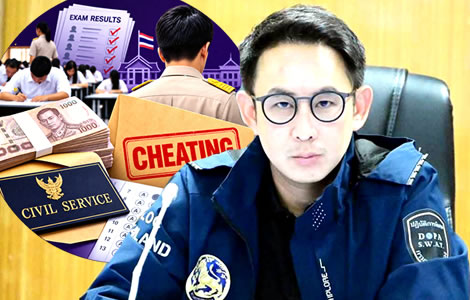
Deputy Interior Minister Worasit Liengprasit has rejected claims that 5,925 disputed examination cases are being dumped on local authorities. Instead, he said the central government remains responsible for verifying the information and setting clear guidelines. Local administrative organisations (LAOs) must then handle personnel matters falling within their legal powers. Crucially, they will not decide who cheated or who must leave government service.
Mr Worasit addressed the controversy on August 17 following questions about responsibility for the 5,925 cases. The names emerged from irregularities detected in civil service and local government employee recruitment examination scores.
Notably, inclusion on the list does not establish fraud, corruption or another criminal offence. It identifies people whose examination scores showed irregularities requiring further examination.
Central government retains control as local bodies act only within their legal personnel powers now
In response, Mr Worasit drew a firm line between central and local responsibilities. The central government must verify information, establish criteria and issue guidelines. Local bodies subsequently deal with personnel matters within their statutory authority. They are not being handed thousands of names and asked to determine guilt.
“Let me be clear, this isn’t about passing the buck to local authorities,” Mr Worasit said. “The central government verifies the information, sets the guidelines, and provides the processed data.” Once that work is completed, local authorities must exercise their existing legal responsibilities.
At the same time, Mr Worasit warned against confusing those separate functions. “It’s crucial to differentiate roles; otherwise, it will seem like everything is being dumped on local authorities, even though each level of the bureaucracy has different powers and responsibilities,” Mr Worasit said.
The distinction runs through the entire examination case. One process concerns the detection and verification of irregular scores. Another concerns the employment status of candidates already appointed. Separately, investigators must determine whether criminal offences or corruption occurred. Each process involves different agencies, powers and procedures.
Exam score irregularities began with central verification before relevant agencies were ordered to act
Importantly, the 5,925 cases did not originate with local administrative organisations. Instead, problems emerged during verification of data from the competitive examination process. Officials found irregularities in examination scores and referred the information for review. The relevant committee then determined the next steps and forwarded information to appropriate agencies.
Mr Worasit said the Interior Ministry could not uncover irregularities and then take no action. Otherwise, questions would arise over why improperly obtained scores remained inside the system. In turn, the ministry would face questions about appointments based upon those results. Once irregularities were identified, he said, they had to be corrected.
Even so, Mr Worasit stressed that corrections must follow established procedures. Decisions could not be driven by emotion. Nor could responsibility for the entire system be placed on one official or agency. Rather, several administrative and investigative processes must move forward simultaneously.
On one front, the government must correct the list of successful candidates. On another, agencies must address people already appointed using problematic examination results. In parallel, information must be submitted to agencies responsible for criminal investigations. These are distinct processes and cannot be collapsed into one decision.
List of 5,925 does not establish criminal guilt as appointments face separate administrative reviews
As part of this, Mr Worasit stressed that the 5,925 names do not constitute a criminal blacklist. Being listed does not automatically mean somebody committed fraud or participated in corruption. Instead, the list records people whose examination scores contained irregularities. Relevant agencies must investigate the circumstances surrounding those results.
Whether anybody carries criminal liability is consequently a matter for investigators and the justice system. Likewise, involvement in corruption must be established through the appropriate legal process. Personnel status, however, raises a separate administrative question. Some affected candidates have already been appointed to government positions.
Where appointments are concerned, agencies must determine whether candidates were legally entitled to those positions. If somebody lacked that entitlement from the beginning, their official status must be corrected under law. Mr Worasit said examination errors or corruption could not create permanent entitlement within the civil service.
“My principle is very simple: anyone who obtained their rights illegally must rectify the situation,” Mr Worasit said. He also stressed that candidates who succeeded legitimately must be treated differently. “Anyone who passed the exam based on their own abilities and was not involved in any corruption must receive justice.”
Meanwhile, officials implementing personnel decisions must receive clear instructions. They cannot be expected to resolve the wider examination case themselves. “And officials who acted according to orders must adhere to clear guidelines. We will not allow honest people to be the victims of others’ corruption,” Mr Worasit said.
Local bodies did not identify irregular scores and will act only after receiving central guidelines
For local administrative organisations, the boundary is particularly clear. LAOs did not verify the examination results or identify the original score irregularities. Furthermore, they will not independently determine whether particular candidates obtained improper scores. That work belongs to other parts of the process.
Once verified information reaches them, however, LAOs must exercise their existing personnel powers. The central government must first provide the necessary information, criteria and guidelines. Local agencies then handle matters falling within their legal responsibilities. Mr Worasit said that division could not reasonably be described as abandoning responsibility.
More broadly, responsibility extends across several levels of government. Central government is responsible for the information and guidelines. Relevant committee members are responsible for their resolutions and procedures. Parent agencies, in turn, must perform duties falling within their respective authority.
“If asked who is responsible, he would answer that every level must take responsibility for their own part,” Mr Worasit said. “The central government is responsible for the information and guidelines.” He said committee members were responsible for their resolutions and processes.
Interior Ministry opens score reviews as candidates affected by revised exam results seek redress
Parent agencies must likewise act according to their authority. “This is the system, not about passing the buck to one person,” Mr Worasit said. His comments directly challenged suggestions that local organisations were being left to resolve the fallout alone.
Beyond the 5,925 cases, the Interior Ministry is also dealing with candidates affected by the revised successful-candidate list. Some candidates may have lost opportunities because of irregular examination results. Accordingly, the ministry has opened an official channel for affected candidates to request reviews of their scores.
The review period runs from August 13 through August 31, 2026. Candidates whose names disappeared from the new list can request verification of their results. Through that process, they can check their examination information using official channels.
Mr Worasit said the government must examine both sides of the examination fallout. “We shouldn’t just focus on those who have problems, but also on those who have lost opportunities because of this.” The revised results may affect candidates who prepared for the examinations without involvement in wrongdoing.
Honest candidates receive score reviews while disputed appointments face separate investigations
Against that backdrop, he highlighted candidates who studied and competed honestly. “Those who studied honestly for the exam shouldn’t become victims of cheating.” Therefore, score verification is proceeding alongside action involving the 5,925 disputed cases.
The ministry is effectively dealing with several groups at once. First are candidates whose examination scores showed irregularities. Second are people already appointed using results now under review. Third are candidates whose opportunities may have been affected by irregular scores elsewhere.
Alongside those administrative cases, investigators must establish whether crimes or corruption occurred. They must also determine who, if anyone, was responsible. The existence of an irregular score alone does not answer those questions. Nevertheless, appointments based on problematic scores may still require separate personnel action.
For those already appointed, the stakes are significant. A finding that someone lacked entitlement from the outset could require correction of their employment status. However, that administrative finding is distinct from establishing criminal liability. Mr Worasit repeatedly stressed the need to keep those processes separate.
Government targets candidate lists, appointments and criminal probes as exam irregularities widen
In practical terms, the government faces three immediate tasks. It must correct the successful-candidate list, review appointments and send relevant information for criminal investigation. At the same time, it must process score-review requests from candidates affected by the revised list.
Mr Worasit said the operation extends beyond simply deleting 5,925 names. Instead, the ministry is seeking to restore accuracy, transparency and accountability to the local recruitment examination process. Those involved in corruption must also be pursued through the relevant legal procedures.
“I don’t see this as simply addressing the 5,925 people involved and being done with it,” Mr Worasit said. He said the government must address the root causes behind the examination problems. Future candidates, he added, should not face manipulated results.
Moreover, he said examination scores should not be bought or sold. Connections or money should not provide privileges candidates did not earn. Those issues form part of the wider response to the irregularities uncovered during examination-data verification.
For now, however, the immediate work remains divided across different administrative and investigative channels. The successful-candidate list must be corrected through the relevant procedure. Existing appointments must be handled under personnel rules. Criminal evidence must be handled separately before being moved to investigators.
Candidates can seek score checks as central and local agencies divide responsibility for disputed cases
Simultaneously, candidates affected by the revised results can request score verification until August 31. That process gives people omitted from the new list an official mechanism to challenge or check their scores. It also broadens the ministry’s response beyond those linked to irregular results.
Taken together, the measures leave several parts of government carrying defined responsibilities. Central government controls verification, processed information, criteria and guidelines. Committees handle their formal resolutions. Parent agencies and LAOs act within their respective powers. Investigative bodies determine whether criminal liability exists.
Mr Worasit said this structure was central to understanding the 5,925 cases. The Interior Ministry would not shield people who improperly obtained rights within the system. Equally, he said, candidates who acted honestly should not be caught by action against others.
“The Ministry of Interior will not protect the wrongdoers, but will not harm the honest,” Mr Worasit said. Local officials, meanwhile, would not be left with thousands of cases but no operating framework. Central government must provide clear information and guidelines before personnel action proceeds.
“We will not allow those who have obtained their rights illegally to remain in the system,” Mr Worasit said. “And at the same time, we will not allow local officials to bear the burden without clear guidelines.”
Interior Ministry says each agency must act within its powers as all 5,925 cases now move forward
Ultimately, the dispute turns on the division of responsibility across the government system. The Interior Ministry says the 5,925 cases have not simply been transferred to local bodies. Rather, each agency must handle the part falling within its existing powers.
As the process advances, central government remains responsible for verified information and guidelines. LAOs must then address personnel matters within their authority. Investigators separately determine whether corruption or criminal offences can be proven.
Local government examination fraud probe rolls on. Anti corruption commission and police pursue cases
Two officials face serious criminal charges in exam scandal. Reports suggest 100 people may be called in
Meanwhile, the examination fallout remains active for candidates outside the 5,925 cases. Those omitted from the revised list have until August 31 to seek score verification. Existing appointments linked to problematic scores also remain subject to the relevant review procedures.
Mr Worasit said the ministry would pursue the process through its conclusion. However, he insisted responsibility would remain divided according to legal authority. Local organisations would not determine guilt or investigate the examination irregularities themselves. They would act on verified information and clear central guidelines within their own powers.
Join the Thai News forum, follow Thai Examiner on Facebook here
Receive all our stories as they come out on Telegram here
Follow Thai Examiner here
Further reading:
Ex PM and Democrat Party leader urges politicians implicated in Senate Collusion files to come clean
Opposition and People’s Party leader attacks ‘blue regime’ on the 12th anniversary of the 2014 coup