Thailand’s opposition leader has launched a blistering attack on the post-coup “blue regime”, accusing elites, courts and the Senate of crushing dissent and monopolising power as constitutional tensions and a Senate election police probe deepen political turmoil.
Thailand’s post-coup order erupted back into focus on Friday as opposition leader Natthaphong Ruengpanyawut launched a blistering attack on the “blue regime” he says still controls the country through courts, the Senate and institutions created by the 2017 constitution. His intervention came amid deepening constitutional conflict, fears over expanding Senate power and a simmering Senate collusion investigation. Marking 12 years since the 2014 coup, Natthaphong accused entrenched elites of suppressing dissent through lawsuits, party dissolutions and institutional pressure while monopolising both political and economic power.
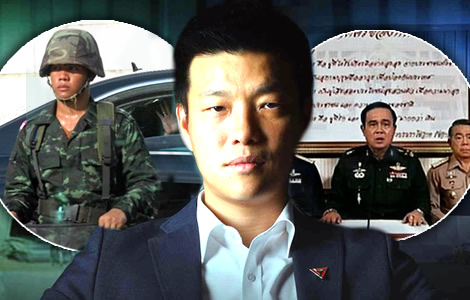
Twelve years after the 2014 coup d’état, Thailand’s opposition leader launched a fierce attack on the political order created under military rule. On Friday, Natthaphong Ruengpanyawut accused entrenched elites of continuing to dominate the country through institutions established by the 2017 constitution.
The anniversary marked 12 years since General Prayut Chan Ocha seized power on May 22, 2014, amid political paralysis, rival street protests and escalating unrest. Consequently, military forces moved into Bangkok and removed the elected government from office. Prayut later established the National Council for Peace and Order, or NCPO, which governed Thailand under military authority for years.
Although direct military rule formally ended, Natthaphong argued that the structures built after the coup still dominate Thai politics. Furthermore, he claimed the political system had become more sophisticated and more deeply entrenched.
Opposition leader says post-coup ‘blue regime’ still suppresses dissent through legal measures today
The People’s Party leader delivered the remarks in a lengthy Facebook statement posted on Friday afternoon. Natthaphong currently serves as leader of the opposition in the House of Representatives. Throughout the statement, he repeatedly described the current political order as a “blue regime”.
According to him, the regime emerged directly from the 2017 constitution drafted during military rule. Moreover, he argued that the charter fundamentally reshaped Thailand’s institutions to protect elite interests above public accountability.
“Even though it’s been 12 years since we last saw tanks on the streets, the movement to seize power from the people hasn’t stopped,” Natthaphong wrote. He argued that political suppression had become “more intense and subtle” since the coup.
Instead of soldiers and military crackdowns, he pointed to courts, agencies and legal processes. According to his statement, at least 200 lawsuits have been filed to silence citizens and political opponents. Meanwhile, he claimed peaceful demonstrations had been suppressed at least 74 times.
Natthaphong accuses courts and Senate of protecting elite interests over public freedoms in Thailand
The House of Representatives member also stated that at least seven major political parties had been dissolved. Consequently, Natthaphong argued that those developments reflected systematic political control rather than isolated incidents.
Furthermore, he accused the Constitutional Court, independent agencies and the Senate of undermining democratic principles. According to Natthaphong, those institutions no longer function to protect public sovereignty or civil freedoms.
Instead, he alleged they now preserve the interests of a narrow elite detached from ordinary citizens. Under the current structure, he argued, the public cannot effectively scrutinise or remove those institutions.
As a result, power remains concentrated among unelected figures and connected political networks. Natthaphong repeatedly attacked what he described as a small and unaccountable elite controlling Thailand’s future. “They restructured political institutions and the legal system so that the country’s future would be determined by a small elite,” he stated.
Opposition attacks elite control over state appointments, corruption and stalled reforms nationwide
Moreover, Natthaphong accused powerful groups of monopolising both politics and economic influence. He alleged that key appointments remain firmly controlled by establishment interests. Those appointments include constitutional court judges, independent organisations, military commanders, judges and senior civil servants.
In addition, he claimed the political system protects major business interests through state policy and government spending. According to his statement, ordinary citizens increasingly carry economic burdens while politically connected corporations continue benefiting from state support. Meanwhile, he argued that corruption and inequality continue to worsen every year under the existing political structure.
Natthaphong also criticised the broader performance of the state under the post-coup system. He argued that structural reforms repeatedly stall despite years of political promises. Furthermore, he claimed the justice system lacks public credibility and independence.
He also described education and human development as lagging behind while political monopolisation expands. According to Natthaphong, politics under the current structure lacks both the will and capacity to respond to public demands. Consequently, he argued, public frustration continues building across multiple sectors of society.
Fresh constitutional rewrite fears emerge as Senate powers face renewed national scrutiny debate
The remarks came as constitutional reform returned to the centre of Thai politics this week. Earlier, the Bhumjaithai Party-led government moved forward with efforts to formulate a new constitution.
However, the initiative immediately triggered concerns among critics and opposition supporters. Many fear conservative forces could use the process to strengthen Senate powers further. The Senate remains one of the most controversial institutions established under the 2017 constitution.
Under the charter, senators were initially appointed rather than elected. Importantly, the upper chamber received significant authority over the selection of the prime minister. Consequently, critics have long accused the Senate of functioning as a safeguard for establishment interests.
Natthaphong’s statement reflected growing concern surrounding the constitutional drafting process. He warned that existing power structures could survive any constitutional rewrite unless the system changes fundamentally.
Natthaphong warns entrenched elites still dominate courts, politics and state institutions in Thailand
Furthermore, he argued that institutions linked to the “blue regime” remain insulated from meaningful accountability. “Those in power in the blue regime don’t necessarily make decisions in the best interest of the majority because they are not accountable to the people,” he wrote.
According to Natthaphong, opponents who challenge elite interests risk obstruction through institutional and legal mechanisms. He specifically referred to the courts, independent organisations, the Senate and the judicial process itself. Moreover, he claimed individuals confronting the establishment often face political isolation or destruction.
Despite his criticism of state institutions, Natthaphong argued that political change remains possible through public mobilisation. He contrasted establishment control over institutions with what he described as “the power of the people”.
According to his statement, those in power control legal mechanisms, political rules and state structures. However, he argued they cannot monopolise public hope or political aspirations. “Our playing field is a political arena of hope and a field for winning the hearts of the people,” he wrote. He added that no political regime can prevent citizens from seeking a better future.
Post-coup tensions deepen as reform battles revive fears of renewed political turmoil across the country
Consequently, Natthaphong called for unity behind demands for a new constitution that genuinely reflects public interests. He urged supporters to demonstrate the strength of the electoral majority and push for democratic reform. He also called for a country that “belongs to the people” and a society based on equality.
The People’s Party emerged after the dissolution of the Move Forward Party in 2024. Following that ruling, Natthaphong became leader of the restructured opposition movement and later assumed the position of opposition leader in parliament. Since then, constitutional reform has remained one of the party’s central political demands.
Thammasat University legal scholar and 1992 protest leader warns another coup cannot be ruled out
Government in peril over the coming weeks with Constitutional Court petition over Senate collusion conspiracy
Justice Minister suspended from roles linked to the expanding Senate criminal investigation by the DSI
Friday’s statement marked one of Natthaphong’s strongest attacks yet on Thailand’s post-coup political order. The anniversary itself remains politically sensitive across the country.
Supporters of the 2014 intervention continue arguing that the coup restored stability after prolonged unrest and political confrontation. However, critics maintain that the takeover entrenched unelected power and weakened democratic institutions.
Twelve years later, those divisions remain deeply embedded in Thai political life. Meanwhile, renewed constitutional reform efforts threaten to reopen old political fault lines once again.
Join the Thai News forum, follow Thai Examiner on Facebook here
Receive all our stories as they come out on Telegram here
Follow Thai Examiner here
Further reading:
Thammasat University legal scholar and 1992 protest leader warns another coup cannot be ruled out
Senate allegations growing in strength as powerful investigation gets underway. 7,000 people tracked