
The kingdom’s fiscal 2025 accounts expose a ฿898.8 billion deficit as spending surges and tax collections disappoint. The World Bank lifts 2026 growth to just 2%, against Vietnam’s 7.4%. Meanwhile, the IMF warns of debt, energy shocks and AI risks.
Thailand’s final fiscal 2025 accounts expose a staggering ฿898.8 billion deficit, up 20.6%, as the World Bank lifts its 2026 growth forecast to a meagre 2%. Government spending raced ahead of revenue, all three major tax departments missed targets, and public debt reached 65.08% of GDP, nearing the 70% ceiling. Meanwhile, the AI export boom offers limited relief as Vietnam races ahead with projected growth of 7.4%. Deputy Prime Minister and Finance Minister Ekniti Nitithanpraphas faces mounting fiscal pressure amid proposals for higher taxes, including VAT. Now, IMF chief Kristalina Georgieva warns of soaring global debt, energy shocks and risks surrounding the AI boom. Thailand’s growth outlook has improved, but its public finances tell a far grimmer story.
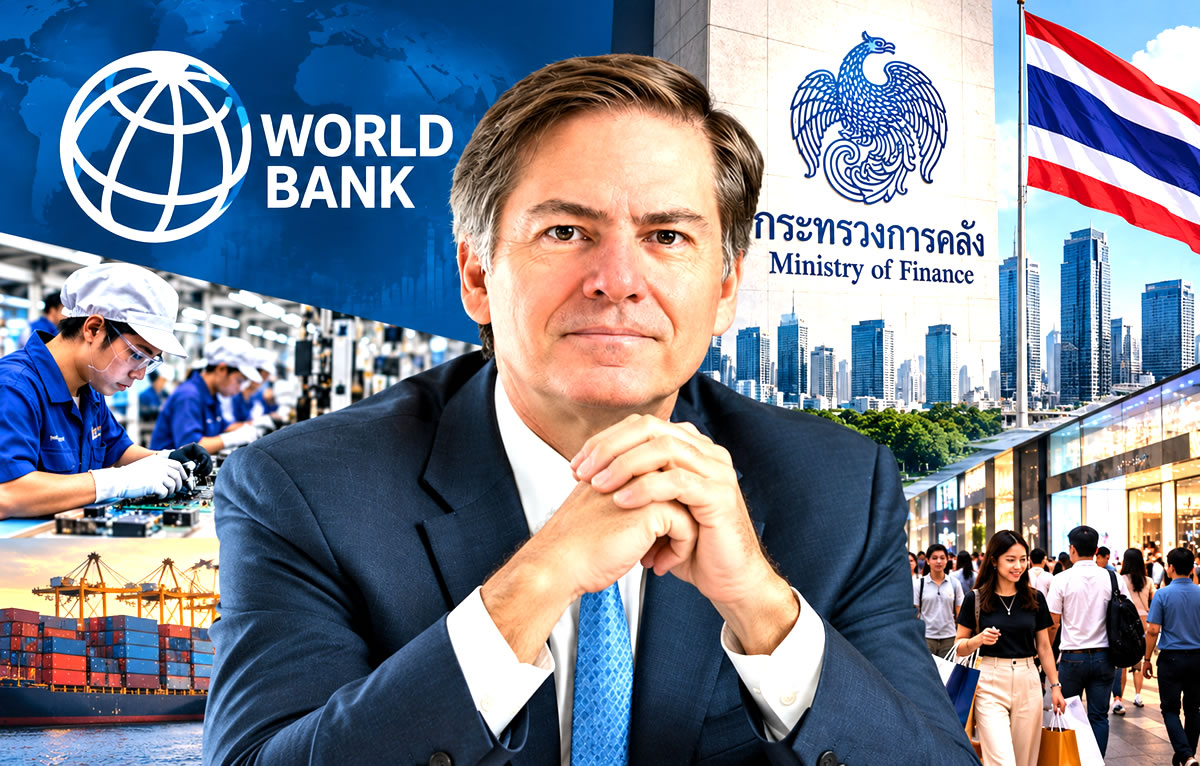
The World Bank has upgraded Thailand’s economic growth forecast to a meagre 2% for 2026. However, the improvement comes amid weakening public finances, disappointing tax collections and rapidly rising government expenditure.
Final figures for fiscal 2025 show a budget deficit approaching ฿900 billion, up more than 20%. Excise receipts missed their target by almost 12%, while government spending increased more than six times faster than revenue. Meanwhile, public debt reached 65.08% of GDP, moving closer to the statutory 70% ceiling. The kingdom faces growing fiscal pressures despite stronger exports linked to the global artificial intelligence boom.
The World Bank announced its revised forecast on Tuesday, October 6. It raised Thailand’s projected GDP growth from 1.3% to 2%, an increase of 0.7 percentage points.
Thailand’s upgraded 2% growth forecast still leaves the kingdom far behind its regional neighbours
The improvement reflects stronger demand for electronics and high-technology products used in artificial intelligence infrastructure. Nevertheless, the kingdom remains among the region’s slowest-growing major economies. The bank also upgraded its East Asia and Pacific growth forecast from 4.2% to 4.5%.
In contrast, Vietnam received a larger upward revision of 1.1 percentage points, lifting projected growth to 7.4%. Malaysia’s forecast increased to 5.1%, while China is expected to expand by 4.4%.
Consequently, Thailand’s revised projection remains less than half the regional average. Vietnam is expected to grow more than three times as quickly. The figures highlight the widening differences in economic performance across Southeast Asia.
The World Bank attributed much of the regional improvement to rising international demand for AI-related products. These include electronics, semiconductors and computer components required for data centres and advanced computing infrastructure.
Notably, AI-related goods accounted for more than 70% of export growth across Thailand, Malaysia, Vietnam and the Philippines. However, the bank found that trade growth outside the technology sector remained weak or negative across several economies.
World Bank warns AI export boom has yet to deliver wider economic gains and stronger domestic demand
World Bank Vice President for East Asia and Pacific Carlos Felipe Jaramillo highlighted the challenge of extending these gains. “The challenge now is to turn the region’s strength in producing AI-related goods into widespread AI adoption that boosts productivity and creates more and better jobs for millions of people.”
Despite stronger technology exports, Thailand continues to face weak domestic demand, sluggish productivity and limited investment. Household purchasing power remains constrained by high indebtedness, while the ageing population presents additional long-term economic difficulties.
Furthermore, the World Bank identified energy costs and climate-related disruptions as continuing risks. Its latest assessment therefore raises Thailand’s headline growth projection without indicating a comparable recovery across the wider domestic economy.
The upgraded forecast coincides with the release of final government accounts for fiscal 2025. These figures reveal a substantial deterioration in the kingdom’s budgetary position. Government revenue reached ฿2.824 trillion during the financial year ending September 30, 2025. This represented an annual increase of approximately 1%. However, expenditure climbed 5.1% to ฿3.723 trillion, substantially outpacing the growth in government income.
Thailand’s fiscal deficit surges 20.6% to ฿898.8 billion as spending outstrips government revenue
As a result, Thailand recorded a budgetary deficit of ฿898.8 billion, compared with ฿745.5 billion in fiscal 2024. The shortfall increased by approximately ฿153.3 billion, equivalent to 20.6%. Moreover, government spending rose by ฿180.7 billion, while revenue increased by only ฿27.4 billion.
Expenditure growth therefore exceeded revenue growth more than sixfold. The imbalance left a substantially larger gap between the money collected by the government and its spending commitments.
The borrowing figures reveal the scale of the shortfall. During fiscal 2025, the government borrowed ฿922.7 billion to finance its operations. Meanwhile, the cash deficit before borrowing, after non-budgetary transactions, reached ฿856.5 billion. These figures accompanied weak tax collection performance across the kingdom’s three principal revenue departments. Although overall receipts increased year-on-year, all three departments failed to meet their annual targets.
Together, the Revenue, Excise and Customs departments collected ฿2.992 trillion during fiscal 2025. This represented growth of 2.8% over the previous financial year. Nevertheless, collections missed official targets by ฿112.2 billion, equivalent to 3.6%. The shortfall was concentrated particularly heavily in excise taxation, where revenue proved substantially weaker than expected.
The Excise Department collected ฿537.5 billion, missing its annual target by ฿72.2 billion, or 11.8%. Remarkably, this accounted for almost two-thirds of the combined shortfall across the three departments.
Weak automobile sales and electric vehicle incentives drive major shortfalls in Thailand’s tax receipts
The Finance Ministry identified disappointing automobile tax receipts as a major contributing factor. Thailand’s vehicle industry has faced subdued domestic demand and changing consumer purchasing patterns. In addition, government incentives supporting electric vehicles have reduced certain excise collections.
The decline against target is significant because automobile taxation forms an important component of excise revenue. Government measures encouraging electric vehicle adoption have also changed the composition of tax receipts from the industry.
Meanwhile, weakness in conventional vehicle demand has affected collections from internal-combustion models. The resulting revenue shortfall contributed heavily to the government’s overall failure to meet its fiscal targets.
Separately, the Revenue Department collected ฿2.335 trillion, approximately 3% more than during fiscal 2024. However, its receipts remained ฿37 billion, or 1.6%, below target. Corporate income tax and VAT collected on imports were among the weaker categories. These figures emerged against a background of subdued domestic consumption and difficult conditions for many businesses.
The Customs Department also reported disappointing collections. Its revenue reached ฿119.1 billion, falling ฿3.1 billion, or 2.5%, below expectations. The Finance Ministry identified the stronger baht, trade liberalisation and declining imports of conventional vehicles as contributing factors.
Overall, net government revenue missed its budget target by ฿64.3 billion, equivalent to 2.2%. Additional income from other government agencies partly offset the shortfalls recorded by the principal tax departments.
Government revenue grows but fails to keep pace with spending as debt and ageing costs increase
Importantly, the figures do not show an outright collapse in total tax revenue. Government income increased during fiscal 2025, but its growth remained substantially below expenditure growth. The distinction is important. Tax collections failed to meet government expectations while spending commitments continued to expand. Consequently, the budget deficit widened sharply despite positive annual revenue growth.
The World Bank’s February 2026 assessment identified increased capital expenditure as one reason for the deterioration. Government investment spending had returned towards normal levels following delays during the previous budget cycle.
Therefore, part of the expenditure increase reflected the timing of public investment rather than entirely new spending commitments. Nevertheless, the kingdom faces additional financial pressures from healthcare, pensions, elderly support and infrastructure requirements.
Thailand’s demographic position adds another dimension to its fiscal difficulties. An ageing population is increasing demand for healthcare and social protection. At the same time, a shrinking working-age population presents challenges for future income-tax collection.
The government must also continue servicing existing public debt while financing current expenditure and investment commitments. These pressures coincide with relatively weak economic growth and a narrow personal income-tax base.
By September 30, 2025, Thailand’s public debt had reached ฿12.226 trillion. This represented 65.08% of GDP, compared with the statutory debt ceiling of 70%. Furthermore, the Organisation for Economic Co-operation and Development has identified significant limitations in Thailand’s taxation system. Its 2025 economic survey estimated that approximately 90% of the labour force did not pay personal income tax.
Thailand’s narrow income tax base and informal economy expose a structural revenue gap worth billions
Many of these workers nevertheless contribute through VAT, excise duties and other indirect taxes. However, the figures demonstrate the limited reach of personal income taxation across the workforce.
Thailand also has a substantial informal economy, with many businesses operating outside conventional income-tax arrangements. Consequently, government revenue depends heavily on a relatively narrow group of income-tax payers and broader consumption-based taxation.
The World Bank has estimated that Thailand faces a structural tax gap equivalent to approximately 5.6% of GDP. This measures the difference between existing collections and revenue capacity suggested by comparable economies.
Furthermore, the bank estimates that comprehensive tax reforms could eventually raise additional revenue equivalent to 3.5 percentage points of GDP. Using an illustrative GDP of ฿18.8 trillion, this would represent approximately ฿658 billion annually.
However, that figure represents potential additional revenue following full implementation, rather than an official government forecast. The International Monetary Fund has separately examined changes to Thailand’s taxation system. These include increasing VAT from its current 7% rate towards the statutory 10% rate. According to IMF estimates, a phased increase could eventually generate additional annual revenue equivalent to approximately 1.8% of GDP.
Thailand examines income tax and corporate tax reforms as fiscal framework targets stronger collections
In parallel, reforms to personal income-tax allowances could potentially raise another 0.5% of GDP. International institutions have also examined reviewing corporate tax privileges, strengthening property taxation and improving digital tax compliance.
Thailand’s medium-term fiscal framework for 2026–2030 already includes plans to broaden the tax base and improve collection efficiency. The framework also provides for reviewing existing tax incentives and strengthening revenue mobilisation.
As part of these changes, Thailand has adopted the OECD/G20 global minimum tax framework for qualifying multinational enterprises. The 15% minimum tax arrangements began applying from the 2025 tax year. Meanwhile, the government’s fiscal objectives include containing deficits and maintaining public debt below 70% of GDP. These commitments form part of its medium-term financial planning as expenditure requirements continue to increase.
The latest figures place Deputy Prime Minister and Finance Minister Ekniti Nitithanpraphas at the centre of Thailand’s fiscal position. The kingdom recorded a budgetary deficit approaching ฿900 billion during fiscal 2025. Furthermore, tax receipts missed targets across all three principal collection departments. Public debt also moved closer to the statutory ceiling, while government expenditure increased far faster than revenue.
IMF chief warns of global debt pressures and uneven AI boom as Thailand faces widening fiscal deficit
The fiscal deterioration comes as the International Monetary Fund issues fresh warnings about global economic conditions. Speaking in Singapore on Wednesday, October 7, IMF managing director Kristalina Georgieva highlighted rising public debt and persistently high energy prices.
She also warned about financial risks surrounding the international artificial intelligence investment boom. Her remarks preceded the IMF and World Bank Annual Meetings scheduled for Bangkok the following week.
Georgieva described two powerful forces affecting the global economy. One was the negative energy supply shock caused by conflicts in the Middle East. The other was the positive demand shock generated by rapidly expanding investment in artificial intelligence. “The combined impact of these two forces is highly uneven across the world,” she said. She also warned that the AI boom was bypassing many countries.
Meanwhile, higher energy prices are increasing inflation, interest rates and government borrowing costs. Georgieva warned that these pressures were affecting economies already carrying substantial public debt. The IMF estimates that global public debt has reached its highest level since the Second World War. Furthermore, it projects that worldwide debt will exceed 100% of GDP before 2030.
The IMF chief identified advanced economies, particularly the United States, as carrying especially heavy debt burdens. She warned that governments could no longer depend on higher economic growth alone to resolve fiscal difficulties.
Georgieva calls for fiscal consolidation and warns that disappointing AI returns could trigger a shock
Instead, she called for credible medium-term fiscal consolidation plans, including upfront measures where necessary. Her comments came as governments worldwide face rising borrowing costs and additional expenditure pressures.
On another front, Georgieva identified risks surrounding the scale of global investment in artificial intelligence. Technology companies are committing substantial resources to computing infrastructure, data centres and advanced systems.
However, she warned that disappointing investment returns could trigger a far-reaching financial shock. Rising financial concentration among major AI companies has increased the importance of productivity and earnings gains.
Nevertheless, the IMF also identified considerable potential economic benefits from artificial intelligence. Its research suggests successful AI adoption could add approximately half a percentage point to annual global growth. These findings accompany the World Bank’s latest assessment of technology-driven export expansion across East Asia. However, the two institutions have also identified risks arising from the concentration of investment and economic activity.
For Thailand, the international developments coincide with substantial domestic financial pressures. The World Bank’s revised forecast relies heavily on stronger demand for AI-related exports. Meanwhile, the kingdom continues to face weak consumption, sluggish productivity and a rapidly ageing population. Its fiscal accounts reveal a widening deficit, disappointing revenue collection and substantial borrowing requirements.
Thailand trails Vietnam and Malaysia despite GDP upgrade as Finance Minister Ekniti faces fiscal strain
The contrast with neighbouring economies remains particularly striking. Vietnam is projected to grow by 7.4%, while Malaysia is expected to expand by 5.1%. China’s forecast stands at 4.4%, compared with Thailand’s revised 2%. Consequently, the kingdom remains well behind its principal regional competitors despite the upward adjustment.
For Finance Minister Ekniti, the final fiscal 2025 figures present an immediate financial challenge. Government expenditure exceeded revenue by almost ฿900 billion, while tax collections fell short of official targets.
Vietnam’s economic growth races ahead of Thailand’s putting it on track to overtake its net GDP by 2029
Thai industrial base hammered by flooding crisis. Over 4k firms report a need for financial assistance
In addition, public debt reached 65.08% of GDP, leaving limited headroom beneath the statutory ceiling. The government’s medium-term framework identifies broader taxation and stronger collection as important components of fiscal planning.
Thailand therefore enters the final quarter of 2026 with two sharply contrasting economic developments. The World Bank has raised its growth forecast as technology exports benefit from the global AI investment boom.
However, government spending continues to outpace revenue, while the tax base remains narrow. The latest fiscal accounts show a substantially larger deficit and mounting borrowing requirements. Meanwhile, even the upgraded GDP projection leaves Thailand growing at just 2%, far below the regional average.
Join the Thai News forum, follow Thai Examiner on Facebook here
Follow Thai Examiner on Google here
Receive all our stories as they come out on Telegram here
Follow Thai Examiner here
Further reading:
Thailand’s once mighty tourism industry is failing but now faces further damage from overvalued baht
Rate cut anticipated as outgoing Bank of Thailand governor attends last Monetary Policy Committee
Last minute tweaks in Bangkok as deal is finalised with U.S. However, Thailand may not match Vietnam