All 200 Senate seats could be at stake as former Constitutional Court judge Charun Pakdithanakul outlines a route to challenge the entire 2024 selection after divided EC votes blocked further DSI evidence and left only 77 persons facing legal action.
Thailand’s 200-member Senate faces a potentially seismic constitutional challenge after former Constitutional Court judge Charun Pakdithanakul outlined a route to overturn the entire 2024 selection. His intervention follows razor-thin EC votes blocking additional DSI financial, telephone and photographic evidence before the probe narrowed from 229 people to 77. Only 26 serving senators now face proceedings, while no political officeholders were referred. However, Charun says Supreme Court hearings could expose wider evidence for an Ombudsman referral to the Constitutional Court. If the selection were ruled unconstitutional, he argues all 200 Senate seats could fall.
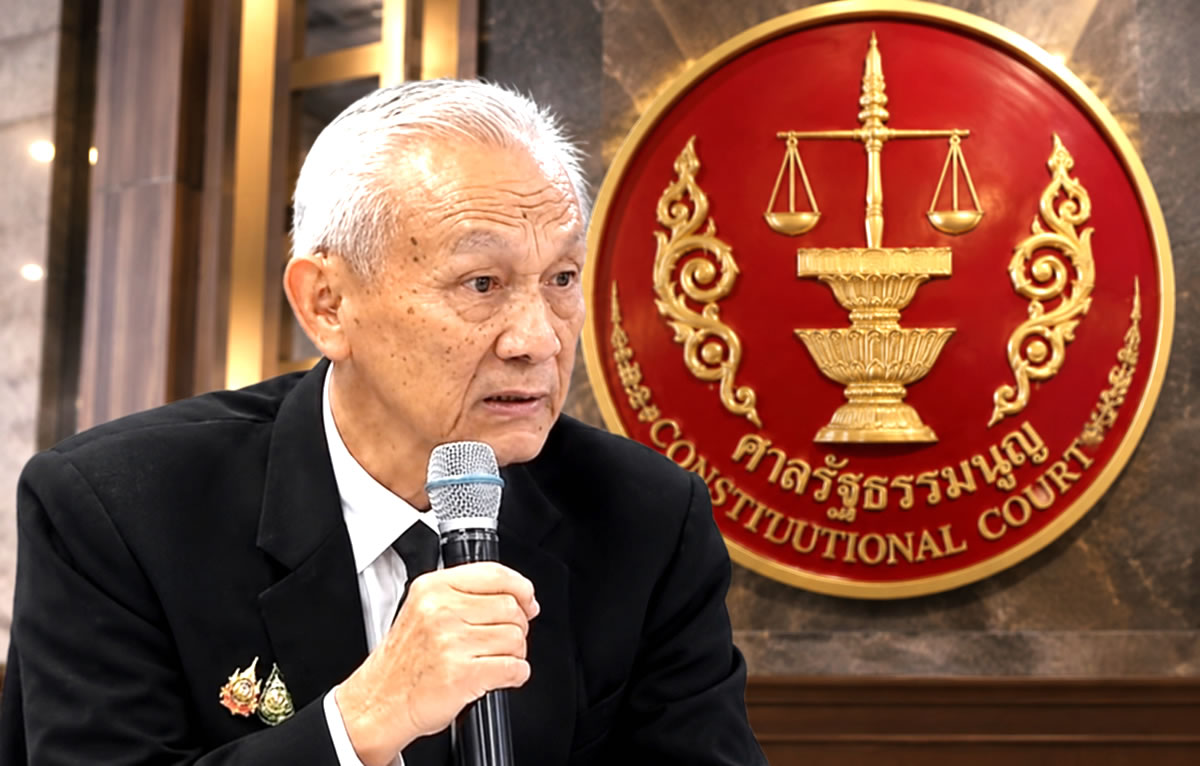
Former Constitutional Court judge Charun Pakdithanakul has outlined a route capable of challenging Thailand’s entire 2024 Senate selection. His proposal goes far beyond existing Election Commission action against 77 people.
Instead, it could place the constitutional validity of the full selection before the Constitutional Court. Ultimately, his legal analysis could put all 200 Senate seats at stake.
Professor Emeritus Charun outlined the route at a September 30 seminar on the Senate collusion case. Crucially, he argued that pursuing individuals alone cannot dismantle the system created by the 2024 selection. Even successful cases could simply remove senators and promote reserve candidates. The existing Senate structure would survive.
Charun proposes two-stage legal route that could place all 200 Senate seats before the Constitutional Court
The former Constitutional Court judge instead proposed a two-stage legal strategy. First, the Supreme Court could develop evidence through cases involving the existing 77 respondents. Subsequently, affected parties could take that evidence to the Ombudsman. The Ombudsman could then refer a wider constitutional question to the Constitutional Court.
At that point, the issue would no longer concern only individual wrongdoing. Rather, the court could examine whether the entire selection complied with constitutional requirements. Professor Emeritus Charun cited Sections 107, 215 and 224 of the Constitution. He particularly stressed honesty, fairness and the constitutional duties of independent organisations.
If constitutional violations were established, he also pointed to Section 5. Under his analysis, the selection could potentially become unenforceable. That could result in all 200 senators losing office. A completely new Senate selection could then follow.
However, no such case is presently before the Constitutional Court. The Ombudsman has not made the referral described by Professor Emeritus Charun. Accordingly, his proposal remains a potential legal route rather than an existing proceeding. The Constitutional Court has made no ruling supporting that eventual outcome.
EC narrowed original 229-person Senate investigation to 77 after two sharply divided commission votes
Still, his intervention sharply widens the legal questions surrounding the 2024 Senate selection. The existing proceedings concern named respondents. By contrast, Professor Emeritus Charun wants the selection process itself placed under constitutional examination.
The distinction is important because the original investigation was considerably larger. The inquiry initially covered 229 people. They comprised 138 senators and 91 political figures and other individuals. Yet the Election Commission ultimately proceeded against only 77 people.
Of those, 26 are serving senators. Another 36 are eligible candidates, while 15 are other individuals. Notably, no MPs or political officeholders were among the final 77 respondents. That outcome followed sharply divided votes inside the Election Commission.
One crucial vote concerned additional evidence from the Department of Special Investigation. Commissioners voted 4-3 against obtaining further DSI material involving eight accused people. That material reportedly included financial, telephone and photographic evidence.
Separately, commissioners voted 5-2 against proceedings involving 21 political figures. Election Commissioner Sitthichot Intrawises was in the minority during both decisions. His subsequent account exposed deep divisions over how far the investigation should extend.
Supreme Court could revisit rejected financial evidence and witnesses who later withdrew their statements
Against that background, Professor Emeritus Charun focused heavily on the rejected financial evidence. He questioned why the EC refused to obtain the additional financial trail. “If they don’t accept the evidence regarding the financial trail, it’s over,” he said.
In response, he proposed using the Supreme Court proceedings to obtain and test more evidence. The court could call financial transaction records rejected during the EC investigation. It could also examine telephone records and communications through applications. Photographic evidence could become part of the wider evidential picture.
In parallel, the court could revisit witnesses who withdrew earlier statements. Professor Emeritus Charun supported summoning those witnesses again. He also proposed lie-detector examinations before they testified. He described such testing as scientific evidence available for use during proceedings.
He nevertheless acknowledged uncertainty over its evidential weight. Even without lie-detector testing, however, earlier witness statements would remain available. Investigators could retain those statements in the case file. Prosecutors could then present them before the court.
Afterwards, judges could compare original statements with later retractions. They could then determine which testimony deserved greater weight. Thus, withdrawn statements would not necessarily disappear from the proceedings.
Charun says individual cases could remove senators while reserve candidates preserve the existing system
The broader objective is to establish facts extending beyond the existing 77 respondents. The Supreme Court could not disqualify people whom the EC had not brought before it. However, findings inside its eventual judgment could have wider significance. Those findings could later support an Ombudsman petition.
As part of this strategy, Professor Emeritus Charun wants the evidence used to establish whether collusion was systemic. He said any arrangement might not have originated from one central source. Instead, evidence could identify large, medium and smaller systems. Some arrangements could also have benefited family members.
That approach differs fundamentally from simply pursuing individual defendants. Professor Emeritus Charun illustrated the problem with a hypothetical outcome involving all 77 respondents. Suppose the Supreme Court ultimately ruled against every one of them. Serving senators among them could then lose office.
Their eligibility could also be revoked. Yet reserve candidates could move into the resulting vacancies. Consequently, the Senate created through the 2024 selection could continue operating. The underlying selection structure would therefore remain intact.
Time also weighs heavily in his proposal. Individual investigations could consume much of the Senate’s remaining five-year term. Professor Emeritus Charun estimated such proceedings might require three years. With faster handling, he said they could possibly finish within one year.
Lengthy criminal cases could outlast Senate term as Charun attacks weaknesses in self-selection system
Criminal proceedings would potentially run considerably longer. He estimated those cases could require at least five years. By then, another Senate selection could already have taken place. Hence, he argued that another legal route was needed before the current Senate completed its term.
On another front, Professor Emeritus Charun attacked weaknesses in the design of the current selection system. The Constitution created a complex self-selection process for senators. Candidates progressed through several voting stages before the final 200 were selected.
He said the current Election Commission had never previously handled such a system. In his assessment, the process required greater rigour and stricter supervision. He also argued that the underlying system needed changing.
Professor Emeritus Charun described the danger in stark terms. “Those who aren’t good at colluding get less, while those who are good at colluding get more,” he said.
Changing the system itself would require a constitutional amendment. Yet he was pessimistic about achieving that quickly. Amendments affecting independent organisations face several procedural restrictions. As a result, he suggested substantial constitutional changes might not happen within five years.
Ombudsman route in barcode case offers procedural model for wider constitutional challenge to Senate poll
That timetable prompted his alternative approach. Rather than waiting for constitutional amendments, he proposed using existing judicial mechanisms. Specifically, he identified the Ombudsman as the gateway to the Constitutional Court.
There is already a recent procedural example. Professor Emeritus Charun cited the ballot barcode and QR-code case. Earlier individual petitions concerning Senate-related disputes had encountered jurisdictional obstacles. The barcode dispute, however, reached the Constitutional Court through the Ombudsman.
In that case, the Ombudsman received petitions and evidence from 22 affected people. The Constitutional Court subsequently voted 6-3 to accept the matter. It delivered its ruling on September 28.
Professor Emeritus Charun agreed with the court’s conclusion on ballot secrecy. He said barcodes and QR codes did not themselves compromise secret voting. “No country has ever overturned a parliamentary election because of the use of any symbol, such as a QR code or barcode.”
More importantly for the Senate case, he focused on how the dispute reached the court. The Ombudsman provided the route after receiving petitions and supporting evidence. He suggested Senate complainants could eventually attempt something comparable.
Previous Senate petitions failed but Supreme Court findings could build a stronger case for the Ombudsman
There are obstacles. Professor Emeritus Charun referred to Section 213 of the Constitution. He also cited Sections 46-48 of the Constitutional Court Procedure Act. Those provisions restrict direct petitions where other legal remedies remain available.
Indeed, previous petitions concerning the Senate selection have already been dismissed. Professor Emeritus Charun therefore acknowledged uncertainty over whether the Ombudsman would accept another case. That is why the Supreme Court proceedings become central to his strategy.
Rather than returning immediately with substantially similar evidence, he wants a stronger factual record developed first. The Supreme Court could examine material never fully tested during the EC investigation. Its judgment could then contain findings extending beyond those directly facing proceedings.
Among the existing material are suspected voting lists and other documents linked to the selection. Documents were also reportedly discovered discarded inside restrooms. Moreover, the wider investigation has involved financial trails, telephone information and political connections across several provinces.
Sitthichot disclosures highlight rejected evidence as Charun seeks broader Supreme Court factual record
Mr Sitthichot’s disclosures add another layer to that evidential dispute. His account detailed the EC’s 4-3 rejection of additional DSI material. It also exposed the subsequent 5-2 vote concerning 21 political figures. In both instances, a majority chose the narrower course.
Professor Emeritus Charun now wants the Supreme Court process used to test evidence left outside that narrower EC case. Financial transactions are particularly important to his proposed route. Telephone and application communications could also establish connections among participants.
If that evidence linked more than 77 people, the Supreme Court would still face jurisdictional limits. It could rule only on respondents properly brought before it. Even so, its factual findings could subsequently become evidence elsewhere.
At the next stage, affected people could submit those findings to the Ombudsman. The petition could argue that the evidence demonstrated problems across the selection process. The Ombudsman would then decide whether a constitutional referral was justified.
If referred, the Constitutional Court would confront a substantially different question from the Supreme Court. It would not simply decide whether particular senators committed violations. Instead, it could examine whether the selection process itself complied with the Constitution.
Constitutional Court could examine full selection while Supreme Court remains limited to named respondents
Professor Emeritus Charun was explicit about the division between the courts. “Neither the Supreme Court, the Administrative Court, nor the Criminal Court has the power to overturn the Senate election system,” he said.
For that reason, he identified the Constitutional Court as the decisive forum for the wider issue. He argued it alone could examine whether the selection system conflicted with constitutional requirements. That examination would focus particularly on honesty and fairness.
Professor Emeritus Charun also distinguished the dispute from questions surrounding secret ballots. Senate candidates operated within a constitutionally designed self-selection system. They could introduce themselves and consult each other. That process differs significantly from elections for Members of Parliament.
Accordingly, he argued that ballot secrecy should not dominate the Senate investigation. Instead, the central issues should be honesty and fairness. Those standards, in his analysis, should determine whether the selection complied with constitutional requirements.
He was also sharply critical of the Election Commission’s methodology. Based on information he had received, he described its approach as at least gross negligence. He connected that criticism directly with integrity standards applying to independent organisations.
Charun says honesty and fairness, not ballot secrecy, should dominate scrutiny of Senate selection process
Under Sections 215 and 224, he stressed the importance of independence, impartiality and honesty. Independent bodies must be “not under anyone’s command, or influenced by anyone’s orders, or presuming to repay any favors.”
That argument feeds directly into his proposed constitutional challenge. The issue would not only concern conduct among Senate candidates. It could also encompass whether constitutional bodies properly discharged their responsibilities during the selection.
Should the Ombudsman eventually make a referral, Professor Emeritus Charun expects the Constitutional Court could move relatively quickly. Much of the evidence could already have been tested before the Supreme Court. Therefore, the constitutional case could arrive with a developed evidential record.
He estimated a ruling could be delivered within one year. Under a faster process, he suggested six months might be possible. “The country cannot delay in this matter,” he said.
Yet several legal steps must occur before that stage. The Supreme Court must first deal with proceedings arising from the EC’s 77 cases. Additional evidence would then need examination. Relevant findings would have to emerge from those proceedings.
Constitutional challenge could test independent bodies and potentially reach a ruling within one year
Next, affected parties would need to petition the Ombudsman. The Ombudsman would independently decide whether to proceed. Only then could the Constitutional Court consider accepting the constitutional question.
For now, therefore, the existing action against 77 people remains the live legal proceeding. Twenty-six serving senators are included in that group. The wider challenge outlined by Professor Emeritus Charun has not yet begun.
Even so, his proposal changes the scale of the legal argument surrounding the 2024 selection. The existing route can remove individual senators if courts rule against them. Reserve candidates could then take their places.
His proposed route targets something different. It seeks a judicial examination of whether the entire selection process can constitutionally stand. If it cannot, Professor Emeritus Charun pointed to Section 5 as potentially decisive.
Under his analysis, an unconstitutional selection could be declared unenforceable. That would go far beyond removing individual respondents. Instead, the consequences could extend to every one of the 200 Senate seats.
Ombudsman referral remains untested as existing case proceeds against 77 people including 26 senators
Finally, Professor Emeritus Charun argued that the dispute should remain within established legal procedures. He opposed attempts to resolve it through street demonstrations. “Don’t incite the masses to take to the streets because it won’t help anything. It actually harms the democratic system. Mobs aren’t democracy. Therefore, I apologise again, but I disagree with inciting the masses into mobs.”
The immediate legal battle nevertheless remains before the Supreme Court. Its handling of the 77 respondents could now assume significance beyond those individual cases. In particular, additional evidence could determine whether a much wider constitutional challenge later becomes possible.
Serving Election Commissioner again voicing his concerns about the probe into the 2024 Senate poll
Legal heavyweights plan seminar to review Election Commission’s move to let top politicians off the hook
The key dividing line is therefore clear. The present proceedings concern individuals selected or involved in the 2024 process. Professor Emeritus Charun’s proposed second route would put the process itself before the Constitutional Court.
If that route ever reaches adjudication, the question would extend far beyond 26 serving senators. It could place the constitutional validity of the entire 200-member Senate selection before Thailand’s highest constitutional tribunal.
Join the Thai News forum, follow Thai Examiner on Facebook here
Follow Thai Examiner on Google here
Receive all our stories as they come out on Telegram here
Follow Thai Examiner here
Further reading:
Serving Election Commissioner again voicing his concerns about the probe into the 2024 Senate poll
Election Commission exposed based on Monday’s sweeping decisions and judgments warns opposition
Election Commission creates more questions than answers as it refers 77 people to the Supreme Court
Ex Pheu Thai minister warns Commission members that soon they could be judged as crunch vote looms