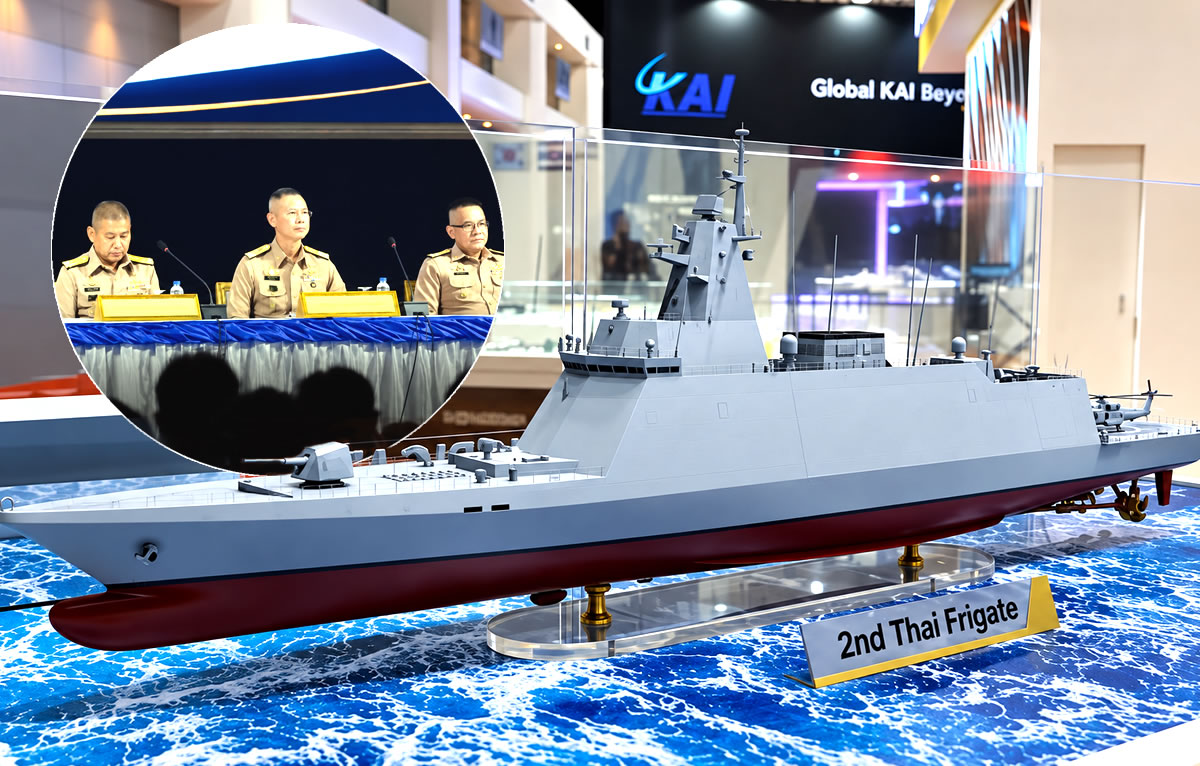
Thailand turns to South Korea for a ฿16.73 billion missile-packed frigate as the Navy plans eight warships by 2037, shifts up to 30% of construction into Thai yards and grabs technology for its drive to build advanced fighting ships at home in years ahead.
Thailand has picked South Korea’s Hanwha Ocean for a ฿16.73 billion, 4,000-tonne frigate as the Royal Thai Navy launches a far bigger drive to rebuild its fleet and eventually construct front-line warships at home. The heavily armed vessel will bring advanced missile, anti-submarine and air-defence capabilities, while at least 20% of its structural work must be carried out in Thailand. That share rises to 30% if a second ship follows. Crucially, the deal also brings technology transfers, naval designs and combat-system expertise as Thailand targets eight high-performance frigates by 2037. It deepens defence ties with South Korea while giving Thai shipyards their biggest opportunity yet to move from patrol vessels towards sophisticated modern frigates.
Thailand is moving to strengthen its naval firepower while pushing more warship construction into Thai yards. The Royal Thai Navy has selected South Korea’s Hanwha Ocean to build its next high-performance frigate.
The ฿16.73 billion deal covers a modern 4,000-tonne warship, combat systems, training and logistical support. Crucially, however, the contract reaches far beyond buying another foreign-built frigate.
Thailand wants technology, design expertise and direct construction experience from the programme. At least 20% of the first ship’s structural work must take place domestically. For a second vessel, that minimum rises to 30%. The Navy ultimately requires four additional high-performance frigates under its long-term force plan. Therefore, later ships could provide further opportunities to expand Thai participation.
Hanwha wins ฿16.73 billion frigate deal after Navy defends requirements and the procurement process
Navy commander-in-chief Admiral Pairoj Fueangchan announced Hanwha’s selection on Friday, September 18. The announcement came during an 11 am press conference at the Royal Thai Navy auditorium in Bangkok. Rear Admiral Parat Rattanachaiphan, the Navy spokesman, also outlined the procurement and its wider objectives.
The programme carried a ฿17 billion budget ceiling. Hanwha’s successful offer came ฿270 million below that limit. Yet the price includes considerably more than construction of the ship itself. The package covers onboard systems, equipment, spare parts, tools and technical documentation. It also includes testing, acceptance, training, logistical support, warranties, transport and insurance.
Operationally, the frigate must cover several major combat roles. It will conduct surface warfare, anti-submarine warfare and air defence. In addition, it must strike land targets and counter unmanned aerial threats. Modern command, control and networked operations form another requirement. The Navy says these capabilities reflect operational missions and anticipated threats.
The Navy also insists the requirements were not constructed around any particular company or warship design. Initially, 11 shipyards and organisations from several countries were invited under the terms of reference. However, the competition subsequently generated complaints from unsuccessful participants. Four competitors reportedly challenged Hanwha’s selection.
Hanwha frigate brings heavy missile armament as final weapons and sensor package remains unsettled
In response, the Navy has defended the procurement process. It says Hanwha remained the only bidder with a fully compliant proposal and supporting documentation. The South Korean company therefore emerged as the successful bidder after the evaluation process.
The selected ship is expected to displace approximately 4,000 tonnes. Hanwha’s proposal has generally been identified with its OCEAN-40F design. Displayed configurations point to a heavily armed, multi-role surface combatant built around modern air, surface and anti-submarine warfare capabilities.
Notably, Hanwha has displayed a 16-cell vertical-launch system aboard its proposed frigate. The configuration has been associated with MBDA VL MICA NG surface-to-air missiles. Exocet MM40 Block 3c missiles have also appeared in the proposed weapons package. Those weapons provide anti-ship capability and can also strike targets ashore.
Separately, a 76mm main gun has appeared in displayed configurations. Two 30mm guns would provide additional close-range firepower. SIMBAD RC short-range air-defence launchers have also been displayed. Meanwhile, proposed sensors have included the TRS-4D radar, alongside electronic warfare and fire-control equipment.
However, the complete contractual weapons and sensor package has not been publicly detailed. Equipment previously displayed with Hanwha’s proposal should therefore not automatically be treated as the final configuration. The precise combat package will become clearer as the programme advances.
South Korean frigate deal deepens naval ties as Thailand plans eight high-performance ships by 2037
The contract also deepens an established Thai-South Korean naval relationship. Hanwha Ocean already has an important connection with the Royal Thai Navy. Its predecessor, Daewoo Shipbuilding & Marine Engineering, built HTMS Bhumibol Adulyadej after winning the contract in 2013.
That frigate was delivered in 2018 and entered Royal Thai Navy service in 2019. It became one of Thailand’s most sophisticated surface combatants. Thus, Thailand is not placing its latest order with an unfamiliar builder. Training, maintenance and operational experience already connect the Navy with the Korean shipbuilding group.
This time, though, Bangkok wants considerably greater industrial participation. The Navy intends to use the frigate programme to strengthen Thailand’s domestic shipbuilding base. Its wider fleet requirement provides the framework for that effort.
The Navy ultimately wants eight high-performance frigates by 2037. Four would serve primarily in the Gulf of Thailand, while another four would cover the Andaman Sea. Currently, only four ships count towards that requirement. Consequently, Thailand needs another four frigates under its long-term force plan.
However, purchasing four sophisticated warships simultaneously would place a heavy burden on the defence budget. The Navy is therefore approaching the requirement through separate budget cycles. The Hanwha frigate represents the first vessel. A second ship has already been discussed for the 2028 fiscal year.
Thai construction rises from 20% to 30% as Hanwha offset package pushes work into domestic shipyards
Further purchases would still require government approval and future budgets. Nevertheless, the staggered programme creates an opportunity to increase Thai participation with each vessel. The first two stages already contain specific domestic construction requirements.
At least 20% of structural work on the first frigate must occur in Thailand. For a second ship, that requirement increases to at least 30%. Thai yards must therefore undertake substantial physical construction rather than simply receive training. That work should also expose Thai engineers and shipbuilders to construction methods used on a modern front-line combatant.
Beyond construction, Hanwha’s offset package adds another industrial layer. Its proposal contains offset activities with an actual value of ฿7,254,744,788.66. That represents 43.36% of the frigate project’s value. Importantly, the figure does not represent cash handed to the Thai government.
Instead, it measures qualifying investment and economic activity generated through the offset programme. A separate offset credit value exceeds ฿53.65 billion. Again, that figure is not a direct financial payment. It is calculated using multipliers assigned to qualifying offset activities.
Those activities include investment, research, development and technology transfers. Workforce development and joint production can also qualify. Likewise, use of Thai labour, materials, products and services forms part of the programme. The industrial package therefore extends well beyond structural work on the first frigate.
Hanwha transfers patrol and unmanned vessel designs as Thailand targets advanced naval integration
Hanwha will also provide Thailand with an offshore patrol vessel design. The transfer is intended to strengthen domestic ship design and construction knowledge. Furthermore, Thailand will receive a design for an unmanned surface vessel. Both could broaden the Navy’s domestic construction options beyond the frigate programme.
On another front, the package covers technical knowledge involving a tactical data link. Development rights connected with a combat management system are also included. Those transfers move beyond physical shipbuilding into the more difficult field of naval systems engineering.
That distinction is central to Thailand’s longer-term objective. Building a modern frigate involves much more than constructing its steel hull. Weapons, sensors, communications and propulsion systems must operate together reliably. Radar must work alongside sonar, communications and electronic warfare equipment.
At the same time, missiles and guns require reliable links with sensors and fire-control systems. Navigation and tactical communications must also operate within the wider architecture. Above these systems sits the combat management system, which combines information for the ship’s crew.
Accordingly, systems integration represents one of the hardest parts of modern warship construction. Thailand wants experience in both physical construction and integration. Still, the Navy is not claiming immediate independence from overseas suppliers.
Thailand targets domestic frigate construction but key engines, weapons and sensors will stay imported
Complete domestic construction has instead been described as a long-term strategic objective. Moreover, building a frigate in Thailand would not mean every component was manufactured domestically. Even countries possessing much larger naval industries frequently use imported systems.
Thailand would likewise remain dependent on foreign suppliers for sophisticated equipment. Large marine diesel engines or gas turbines could remain imported. Missiles and advanced radar components would probably also come from overseas. Sonar and electronic warfare equipment present similar challenges.
Specialist communications equipment, weapons and fire-control systems could also remain foreign-supplied. Marine gearboxes and other complex machinery create further industrial hurdles. The Navy itself has acknowledged that machinery, weapons and sensors would still require imports.
Domestic construction therefore differs from complete domestic manufacture. Thailand could build, outfit and test a frigate while still installing major foreign systems. Imported engines, weapons and sensors could be integrated into a ship constructed inside Thailand.
Over time, Thai engineers could also take greater responsibility for design modifications and systems integration. That would represent a major advance from purchasing completed warships overseas. However, the Navy has not announced when it expects to reach that stage.
Thailand brings proven shipbuilding experience from Krabi and Prachuap Khiri Khan into frigate push
Thailand does enter the programme with substantial shipbuilding experience. It has previously constructed large military vessels using transferred foreign technology. HTMS Krabi provides the clearest example of that approach.
In 2009, Thailand signed a technology-transfer agreement with Britain’s BAE Systems for a 90-metre offshore patrol vessel design. The design was subsequently adapted to Royal Thai Navy requirements. HTMS Krabi was then constructed at the Mahidol Adulyadej Naval Dockyard in Thailand.
British engineers worked alongside Bangkok Dock and Thai personnel during the programme. Importantly, the arrangement transferred design, engineering and construction knowledge. Krabi’s keel was laid in August 2010, and the vessel was launched around 15 months later. It entered Royal Thai Navy service in 2013.
Krabi was considerably more substantial than a small coastal patrol craft. The 90-metre vessel carries naval weapons and an integrated combat system. Its armament includes a 76mm gun. The project therefore gave Thai workers experience constructing and outfitting a significant military vessel.
Thailand then repeated the process. HTMS Prachuap Khiri Khan was based on the Krabi design and was also constructed domestically. The Navy explicitly connected that programme with self-reliance and greater capability to build large naval vessels.
Thai naval yards and private shipbuilders provide a domestic base for larger warship construction
That experience provides a clear precedent for the Hanwha strategy. Thailand first obtained a foreign design and received technology transfers. Thai workers then constructed the vessel domestically. Afterwards, a second Thai-built ship extended that experience and retained skills inside the country.
Thailand has also designed and constructed smaller naval craft itself. The T.994 patrol craft is one example. The Royal Thai Navy’s dockyard built the vessel from a Naval Dockyard Department design. Construction used modular blocks before propulsion, electrical and other systems were installed.
Electronic, navigation and weapons systems were also fitted in Thailand. Consequently, the country already possesses experience extending from small indigenous craft to large foreign-designed patrol vessels.
Private industry adds another layer. Thai shipbuilder Marsun says it has delivered more than 422 vessels, including military craft. Its products include fast patrol craft and fast attack missile craft. Its yard can outfit and launch vessels weighing approximately 3,000 tonnes.
Moreover, Marsun has designed and constructed military vessels for the Royal Thai Navy. Those include a 58-metre patrol gunboat. Thailand therefore already possesses shipyards, naval architects, engineers and skilled construction workers.
Thailand faces tougher technology demands as Hanwha deal deepens wider defence links with South Korea
The challenge is moving those capabilities into a much higher technological category. A modern 4,000-tonne frigate represents that step. Its engineering demands greatly exceed those of an offshore patrol vessel.
For instance, weapons supplied by different manufacturers must communicate through common combat systems. Radar and communications equipment must also function without unacceptable electromagnetic interference. A front-line warship must additionally control acoustic and electronic signatures.
Software integration presents another demanding field. Weapons integration, trials, certification and combat-system testing add further complexity. For that reason, Hanwha’s technology transfers could prove as important as the physical shipbuilding work.
South Korea itself developed its naval industry through a long expansion of domestic capability. The country previously depended heavily on foreign naval technology and licensed production. Its shipbuilding industry subsequently expanded into increasingly sophisticated vessels.
Today, South Korea ranks among the world’s major commercial and naval shipbuilding countries. Hanwha Ocean constructs destroyers, frigates and submarines. It also maintains extensive commercial shipbuilding operations.
Against that background, the frigate strengthens broader Thai-South Korean industrial ties. Defence cooperation between the two countries already extends beyond ships. In 2024, Thai Defence Industry reached an agreement with Hanwha Aerospace involving the K200 infantry fighting vehicle.
Thai-South Korean defence ties widen as transferred naval technology could support future ship exports
The Thai operation is linked with Thailand’s Defence Technology Institute. Thai defence manufacturer Chaiseri was also involved in the project. Significantly, the stated ambitions included potential production for customers outside Thailand.
Economic relations have been developing in parallel. Bangkok and Seoul have worked towards a broader comprehensive economic partnership agreement. Both governments also describe their bilateral relationship as a strategic partnership. The frigate contract now adds a major naval-industrial component.
Transferred technology could also strengthen Thailand’s existing naval export industry. Thai companies already possess experience supplying smaller vessels. Exporting sophisticated frigates, however, would represent a much greater step.
Major foreign shipbuilders already compete aggressively for those contracts. South Korean, Chinese, Turkish, French and Spanish companies are established competitors. By contrast, smaller naval vessels could provide Thailand with a more immediate export opportunity.
Here, Hanwha’s offshore patrol vessel design could become particularly important. Thai yards could construct such ships using transferred engineering knowledge. Imported weapons and electronics could then be fitted according to customer requirements.
Such vessels could serve navies and coastguards requiring patrol ships rather than advanced front-line frigates. Future exports, however, would partly depend on intellectual property rights transferred under the Hanwha agreement.
Intellectual property rights will shape Thailand’s freedom to modify, build and export future warships
That issue matters because modern warships contain technology belonging to numerous manufacturers. Hanwha can transfer rights covering designs and technology it controls. It cannot automatically transfer unrestricted rights belonging to other companies.
Missile manufacturers retain their own intellectual property. Radar, sonar, propulsion and electronic warfare suppliers do the same. Consequently, detailed contractual arrangements will shape Thailand’s freedom to modify or eventually export derived designs.
Access to engineering data will be one important measure. Another will be Thailand’s ability to alter designs without continuing foreign engineering assistance. Rights to construct additional vessels will also matter.
Likewise, combat-system interfaces and development rights will influence future Thai integration work. Export rights could become important if Thailand later markets ships derived from transferred designs.
For now, the programme establishes several concrete industrial steps. Thailand gets a new 4,000-tonne high-performance frigate for ฿16.73 billion. At least 20% of its structural work must take place domestically.
If a second ship follows, that minimum rises to 30%. Alongside this, Hanwha’s offset package contains ฿7.25 billion of actual qualifying activity. Thailand also receives offshore patrol vessel and unmanned surface vessel designs.
Thailand seeks combat-system expertise as four-ship frigate plan opens path to greater domestic work
Technical transfers additionally extend into tactical data links and combat management systems. Taken together, the package combines an immediate naval purchase with a longer industrial programme.
Thailand has already demonstrated that it can construct large offshore patrol vessels domestically. It has also designed and built smaller naval craft. Nevertheless, a modern frigate represents a much harder technological undertaking.
The Navy has not announced when a largely domestically constructed frigate could become reality. It has spent about two years assessing Thai shipyards and companies. Its assessment found several areas where domestic capabilities still require improvement.
Even so, the planned four-ship requirement provides repeated opportunities to increase Thai involvement. Those vessels will be required as older warships retire. By 2037, the Navy wants eight high-performance frigates in service.
Eight-frigate target splits future fleet between Gulf and Andaman as Thai construction share increases
Four are intended for the Gulf of Thailand. Another four are planned for the Andaman Sea. The first Hanwha vessel now starts that replacement programme while shifting part of construction into Thailand.
The first ship remains a South Korean-led project. Yet one-fifth of its structural work must already be performed domestically. A second vessel would increase that Thai requirement again.
Shell from cannon fired from one naval frigate into another as they docked at Sattahip Naval base on Thursday
Move by Navy Chief puts Chinese sub back in the water as he seeks legal clarity on the contract
In parallel, Hanwha must deliver technology, designs and industrial cooperation alongside the frigate. Thailand previously used that route to build offshore patrol vessels at home. This time, however, the technological target is far higher.
The immediate purchase is a ฿16.73 billion South Korean frigate. Behind it stands a broader Royal Thai Navy objective. Thailand wants the industrial capability to build increasingly sophisticated major warships inside the kingdom.
Join the Thai News forum, follow Thai Examiner on Facebook here
Follow Thai Examiner on Google here
Receive all our stories as they come out on Telegram here
Follow Thai Examiner here
Further reading:
Move by Navy Chief puts Chinese sub back in the water as he seeks legal clarity on the contract
Thailand cancels Chinese sub, wants credit for a new frigate. Tense talks that could yet go legal
Chinese nuclear-powered sub disaster, 55 dead in the Yellow Sea, a wakeup call for Thailand
Navy may accept Chinese engine in new ฿13.5 billion sub if it gets an older one thrown in for free
Sub call due soon but closer ties between Chinese and Thai navies signalled by top-level visit
War with China is a rising spectre that must be confronted as US General predicts conflict by 2025
Heat turned up over the Sukhothai naval tragedy with 19 thought to have perished and 10 missing
Former Pheu Thai finance minister expresses unease about US regional moves to counter China’s rise