Scam empire exposed. Amnesty links five security firms and more than 20 Cambodian officers to compounds rife with rape, torture and forced fraud. Chief Agnès Callamard alleges probable state complicity as Phnom Penh boasts of 605 closures.
Amnesty International chief Agnès Callamard has accused the Cambodian state of probable complicity in a vast criminal scam industry built on slavery, rape and torture. Speaking in Bangkok on Thursday, she unveiled an explosive investigation identifying 86 compounds, five security companies and links to more than 20 military and police personnel. Meanwhile, Phnom Penh claims to have closed 605 locations and referred 4,147 suspects for prosecution. Yet Amnesty says powerful security operators remain untouched. Survivors describe brutal beatings, electric shocks, sexual violence and forced online fraud. The findings expose connections reaching Cambodia’s security establishment and raise the prospect of international prosecutions and arrest warrants.
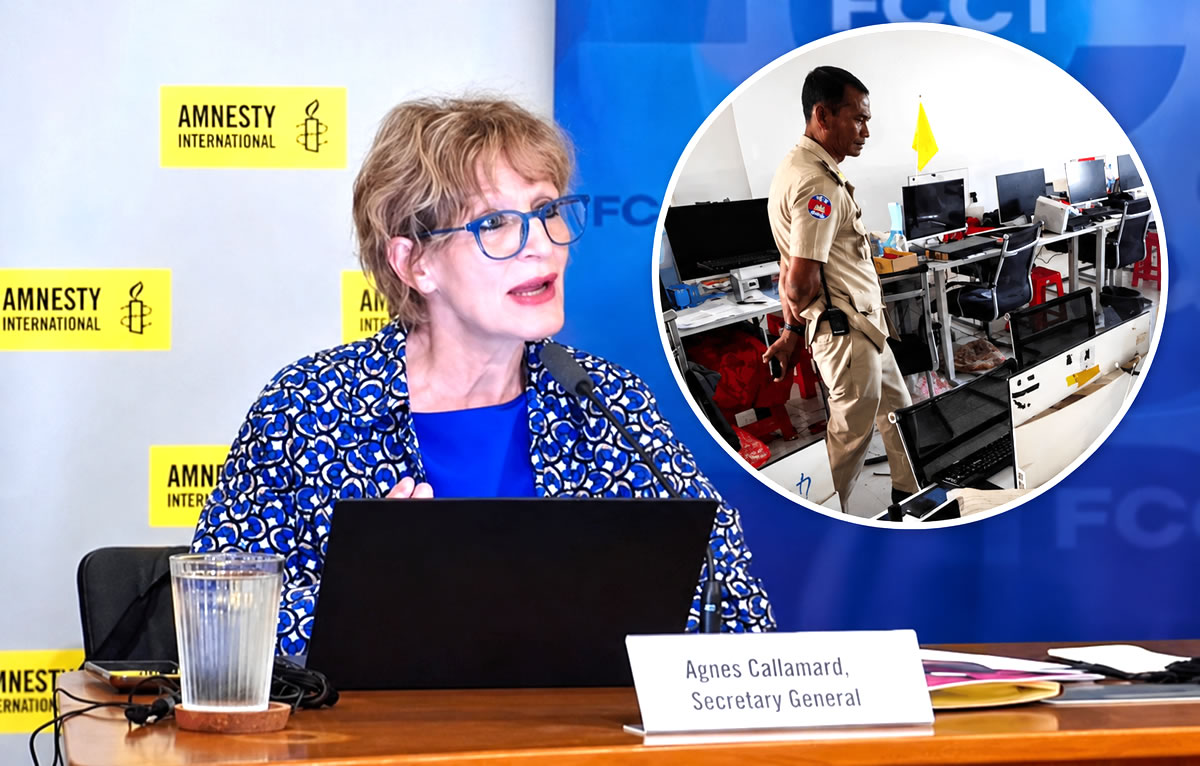
Amnesty International Secretary-General Agnès Callamard has accused the Cambodian state of probable complicity in its vast scam centre industry. Speaking in Bangkok on Thursday, October 29, she challenged Phnom Penh’s claims of a successful crackdown.
Her accusations followed an investigation linking private security companies, military officers and senior police personnel to criminal compounds. Researchers identified 86 compounds and five security companies connected to facilities involving trafficking, torture, rape and slavery.
Meanwhile, Cambodian authorities claim to have closed 605 locations and referred 4,147 suspects for prosecution. However, Amnesty says the businesses and security networks behind the industry have escaped meaningful investigation. The findings also expose the treatment of thousands of foreign workers, including victims forced into online fraud.
Amnesty chief accuses Cambodian state of probable complicity as security firms escape prosecution
Callamard delivered her accusations at the Foreign Correspondents Club of Thailand (FCCT) on Thursday afternoon. She had travelled from London to launch a 160-page investigation into Cambodia’s criminal scam compounds.
Her findings challenged months of government announcements concerning raids, arrests, compound closures and mass deportations. Notably, she described the Cambodian state as either “acquiescent” or “probably complicit” in the industry. “The footprint of the Cambodian state is everywhere,” she told journalists.
The accusations followed an investigation identifying links between private security companies and serving Cambodian military and police officers. Researchers also uncovered business relationships involving politically influential figures and property developments containing suspected criminal operations.
“Cambodia has failed to protect the victims. The security companies have not been touched,” Callamard said. She described the government’s response as “clearly, woefully insufficient”. Her criticism centred on the companies and individuals connected to the compounds rather than the number of police raids.
Cambodia claims major crackdown but Amnesty links five security firms and officers to scam compounds
Cambodian authorities maintain that their campaign has dismantled hundreds of suspected criminal locations. They also report thousands of suspects referred for prosecution and extensive deportation operations.
However, Amnesty’s latest findings identify five private security companies linked to facilities where investigators documented serious abuses. Separately, the investigation identified more than 20 Cambodian military and police personnel connected to compounds. These included serving officers, senior police figures and individuals linked to commercial property developments.
Amnesty did not establish that the Cambodian government had formally authorised the criminal operations. Instead, investigators documented connections between state personnel, private businesses and locations used for trafficking and forced labour.
The findings appeared in Thursday’s report, Official Business: Security Companies and Authorities at Scamming Compounds in Cambodia. The investigation covered January 2023 to September 2026 and examined 86 scam compounds across Cambodia. Researchers interviewed 151 survivors and reviewed records involving more than 400 additional victims.
Investigators trace guards across 82 compounds and identify a military officer linked to security firm
Investigators visited 82 of the 86 identified compounds and found security guards at every location. In parallel, Amnesty analysed footage from more than 200 TikTok accounts belonging to security guards.
Researchers connected videos from those accounts to 23 compounds. The footage provided additional evidence of security arrangements inside the facilities. According to Amnesty, guards controlled access, restricted movement and prevented trafficked workers from escaping. They also enforced instructions imposed by the criminal organisations operating inside.
Callamard said the industry could not function on such a scale without these security arrangements. “These are enormous [compounds]. You can’t hide from everyone to see,” she told the Bangkok press conference.
The report identified Leap Somnang as one of the principal companies providing security at suspected scam compounds. Amnesty linked the business to at least 15 locations across eight Cambodian provinces. Furthermore, investigators identified Colonel Ban Sophat, an officer in the Royal Cambodian Armed Forces, in connection with the company.
Five security companies face scrutiny over scam compounds and links to senior Cambodian officers
Ban Sophat had publicly appeared as chairman of Leap Somnang. However, he denied owning or managing the business. He maintained that his involvement had been limited to an advisory role.
The company’s presence across eight provinces placed it among the most extensively documented security operators in Amnesty’s investigation. Its operations also illustrated the connections researchers examined between private security businesses and serving military personnel.
Another company, Security Response, was linked to five scam compounds. Investigators identified connections involving Panda Bank and the Huione network. Meanwhile, ZD Security, previously known as BIC Security, was connected to two compounds in Botum Sakor.
Dara Security was linked to another two compounds in Sihanoukville. Best Security was identified in connection with a compound in Bavet, where Amnesty documented trafficking, forced labour and child labour. The report examined these companies alongside the businesses and officials associated with their operations.
The Bavet findings included a connection involving Deputy Police Chief Lay Channy. His telephone number appeared in advertising associated with Best Security. In addition, Lay Channy had participated in a crackdown in Bavet, where the company guarded a compound.
Best Security denied that the police officer controlled the business. The investigation also identified Brigadier General Tek Bunthoeun in connection with another property development. Researchers found he held a direct, potentially controlling interest in a development containing a scam compound.
Amnesty traces influential business links as Cambodia claims thousands of arrests and deportations
Other business connections involved a former bank chief executive and a property developer. Investigators also identified a relationship involving the son of a former Cambodian deputy prime minister. However, Amnesty did not establish that these individuals were personally responsible for abuses inside the compounds.
Instead, the report called for investigations into company ownership, management arrangements and connections involving state personnel. Its evidence included corporate relationships, property interests, security arrangements and material obtained from social media accounts.
The findings emerged against a series of Cambodian government announcements claiming substantial progress against scam centres. In February 2026, senior minister Chhay Sinarith reported that authorities had closed approximately 190 suspected locations.
Chhay Sinarith chairs Cambodia’s Commission for Combating Online Scams. He told Reuters that the crackdown had resulted in the arrest of 173 senior criminal figures. Additionally, Cambodian authorities reported deporting 11,000 workers during the enforcement campaign.
By August, the government was reporting much larger figures covering July 2025 to July 2026. According to those figures, authorities had targeted 751 suspected scam locations and closed 605. The government also reported referring 4,147 suspects for prosecution. On another front, 49 casino licences had been revoked or suspended.
Cambodia reports police discipline and mass closures but Amnesty finds major gaps in enforcement
These figures represented official Cambodian government claims rather than independently verified totals. Nevertheless, Phnom Penh presented the operations as evidence of its campaign against organised international cybercrime.
The Cambodian government maintains that the country must not become a safe haven for international cybercriminals. It has also acknowledged disciplinary proceedings involving police officers connected to scam compounds.
In correspondence dated October 15, Cambodian authorities told Amnesty that 77 police officers had been disciplined. Despite these measures, Amnesty questioned whether enforcement had reached the companies and individuals responsible for protecting the operations. Its investigation distinguished between shutting down compounds and prosecuting those responsible for running them.
That distinction had already emerged in an earlier Amnesty investigation published on June 8. Researchers examined government interventions at 86 identified scam compounds. They found evidence of state intervention at only 24 locations.
Seven additional compounds showed evidence of mass releases or escapes. Consequently, more than 70% of the identified compounds had shown no evidence of state intervention at that stage. The findings contrasted with the Cambodian government’s announcements concerning its campaign.
Survivors describe failed police interventions and trafficking victims denied recognition in Cambodia
Survivors described being moved between locations before police operations. Others reported officers entering or visiting compounds without securing the release of captive workers. One Kenyan survivor described police collecting a woman’s body from a compound.
According to the account, other captive workers remained imprisoned inside the facility. Separately, Amnesty interviewed survivors who reported suffering further abuse after police had already intervened at their compounds. The testimony formed part of its examination of enforcement practices.
The June investigation also examined how Cambodian authorities treated people removed from criminal facilities. None of the 73 survivors interviewed for that investigation had been formally recognised as trafficking victims.
Amnesty said their experiences met the relevant international criteria for such recognition. Callamard returned to this issue during Thursday’s Bangkok press conference. “We are demanding that the Cambodian government treat the victims as victims and not criminals,” she said.
Many foreign nationals had entered Cambodia after responding to fraudulent employment advertisements. The promised positions frequently involved technology, customer service or financial businesses. Instead, recruits arriving at the compounds discovered that they were not free to leave.
Captive workers face beatings, electric shocks and rape inside Cambodia’s guarded scam compounds
They were confined inside guarded facilities and ordered to participate in online fraud. Their captors imposed financial targets and monitored their performance. Workers who failed to generate the required income faced punishment.
The investigation documented beatings, electric shocks, confinement and threats with firearms. Some workers were assaulted after refusing instructions or attempting to escape.
Moreover, investigators recorded serious sexual violence against women held inside the compounds. At a facility identified as Park 8, a Cameroonian woman named Maia described being restrained and raped by managers. According to her testimony, security guards were stationed outside during the abuse.
Another survivor, a Ugandan man identified as Gabe, described being chained and beaten. He also reported being subjected to electric shocks. Callamard told journalists that some captive workers had been bought and sold between compounds.
In one case, a woman was raped three times after failing to generate the income demanded by her captors. The accounts formed part of Amnesty’s evidence concerning trafficking, forced labour, torture, rape and slavery.
Security firms controlled captive workers as Amnesty questions whether Cambodia dismantled the networks
The report identified security companies as important participants in maintaining the system of confinement. Guards prevented workers from leaving and helped enforce instructions issued by criminal organisations.
Crucially, Amnesty linked these arrangements to businesses with connections involving Cambodian state personnel. Its investigation therefore examined the companies responsible for guarding compounds alongside the criminal activities occurring inside them. The findings also documented the role of security personnel in maintaining control over trafficked workers.
The October report acknowledged changes following the Cambodian government’s enforcement campaign. Amnesty assessed that large-scale scam compound operations currently appeared to be dormant.
That finding marked a change from conditions documented during earlier investigations. Even so, the organisation maintained that underlying business and security networks had not faced adequate investigation. Its latest report concentrated on accountability for abuses already documented and the individuals connected to the compounds.
Callamard said the security companies identified by Amnesty had not been prosecuted. She called for investigations into their activities and the roles played by individuals associated with them.
Foreign trafficking victims face deportation as Amnesty demands scrutiny of scam centre financiers
The report also examined the international dimensions of the criminal industry. Foreign workers were recruited through fraudulent employment arrangements and transported into guarded facilities. Once inside, many were forced to participate in online financial fraud targeting victims elsewhere. Some were subsequently transferred or sold between compounds.
Others escaped, were released or were removed during police operations. Meanwhile, Cambodia’s enforcement campaign resulted in the deportation of thousands of workers. Amnesty’s earlier findings showed that trafficking victims were not always formally recognised as such.
The organisation raised concerns about treating coerced workers as criminal suspects. Its October investigation also examined those responsible for financing, managing and protecting the compounds. The report identified company owners, directors, managers and financiers as potential subjects for further investigation.
Amnesty’s recommendations extended beyond Cambodia to foreign governments and international law enforcement authorities. The organisation urged prompt, impartial and independent investigations into companies, corporate leadership and state officials.
It also questioned the use of raids, arrests and deportations as the principal measures of enforcement progress. Instead, the report focused on identifying those responsible for criminal operations and documented abuses. Its recommendations included scrutiny of companies providing security at the compounds.
Amnesty urges international prosecutions and arrest warrants over crimes in Cambodian scam compounds
The report proposed reviewing law enforcement, military, financial and security cooperation involving Cambodian institutions. Such reviews would concern institutions or individuals credibly implicated in enabling or protecting scam compounds.
Beyond Cambodia, Amnesty called for consideration of prosecutions in foreign jurisdictions. These could involve universal jurisdiction or other extraterritorial powers where national legislation permits their use. The organisation also recommended arrest warrants where investigators obtain sufficient admissible evidence.
Such proceedings would concern individuals, companies or groups suspected of responsibility for crimes under international law. The report additionally called for compensation and protection for victims. Its recommendations included people deported after being removed from the compounds.
The proposals placed international legal mechanisms alongside domestic Cambodian investigations. They also addressed the responsibilities of company leadership and state personnel connected to the industry.
Callamard’s appearance in Bangkok provided a regional platform for the investigation’s publication. She personally presented the findings and answered questions concerning the Cambodian government’s conduct.
Amnesty explained that its regional office was based in Bangkok. The organisation also said it could not organise the report’s launch in Phnom Penh. Importantly, it stressed that the decision to hold the event in Thailand was unrelated to the Thai-Cambodian conflict.
Report launch puts Cambodian state connections and cross-border criminal operations in focus
The press conference took place amid continuing regional concern about organised criminal networks operating across borders. Cambodia’s scam centre industry has involved foreign recruitment, trafficking and financial fraud targeting international victims.
Amnesty’s investigation concentrated on the companies and security structures supporting those operations inside Cambodia. Its findings identified specific businesses and connections involving serving military and police officers. The report also examined the treatment of foreign workers subjected to coercion and abuse.
For its part, the Cambodian government continues to point to hundreds of compound closures and thousands of suspects referred for prosecution. Those figures remain central to Phnom Penh’s account of its campaign against the industry.
However, Amnesty’s latest report examined whether the businesses and individuals behind the compounds had faced criminal investigation. It identified five private security companies connected to facilities where serious abuses had been documented. The investigation also uncovered links involving serving officers, senior police personnel and politically connected commercial interests.
Survivor evidence and company records fuel Amnesty’s accusation of probable Cambodian state complicity
The evidence included survivor testimony, corporate relationships, property interests and social media material. In particular, investigators documented the role of security guards in maintaining confinement and enforcing criminal operations. Callamard’s accusations therefore extended beyond criticism of Cambodia’s enforcement record.
She publicly raised the possibility of state complicity while presenting evidence of connections between officials and the industry. Amnesty did not establish that the Cambodian government had formally authorised the criminal operations.
Instead, its findings identified relationships involving state personnel and private businesses requiring further investigation. The Cambodian authorities have reported closing 605 locations and referring 4,147 suspects for prosecution.
They have also reported disciplinary action against 77 police officers. At the same time, Amnesty acknowledges that large-scale compound operations currently appear dormant following the crackdown. Nevertheless, its October investigation identified five security companies and numerous connections involving Cambodian state personnel.
Amnesty says connected security firms remain unprosecuted despite Cambodia’s extensive crackdown claims
Callamard said those companies had escaped prosecution despite their documented links to scam compounds. “The footprint of the Cambodian state is everywhere,” she told journalists. Her remarks placed the Cambodian authorities’ connections with private security businesses at the centre of the investigation.
The report also set out possible international legal action, including prosecutions and arrest warrants where sufficient evidence exists. These proposals concern individuals and companies suspected of responsibility for crimes under international law.
Former minister in Anutin’s first government appears on Congress list for sanctions over scam industry
Ben Smith affair & allegations of links to Cambodian scam centres continues to rage in parliament and police agencies
The latest findings stand alongside Cambodia’s official record of raids, arrests, deportations and compound closures. Amnesty identified businesses, security arrangements and state connections involving facilities where trafficking, torture, rape and slavery occurred. Its Secretary-General publicly accused the Cambodian state of being either acquiescent or probably complicit.
Meanwhile, Phnom Penh’s own figures document an extensive enforcement campaign against the industry. The central unresolved issue identified by Amnesty is whether the companies and individuals responsible for the compounds will face prosecution.
Join the Thai News forum, follow Thai Examiner on Facebook here
Follow Thai Examiner on Google here
Receive all our stories as they come out on Telegram here
Follow Thai Examiner here
Further reading:
New Zealand man who was stabbed by father-in-law forgives the older man and helps post bail for him
Road rage caused a marijuana dealer to fatally stab a Burmese painter in Bangkok on Sunday night
Marijuana use is linked to a tragic murder-suicide case in Nakhon Si Thammarat on Monday morning