Boom for big business, pain for Thai families! The Bank of Thailand raises its growth forecast to 2.4% as AI exports soar. Yet SME loans shrink, debt crushes spending and oil threatens tourism. Rates stay at 1% despite a widening divide.
Thailand is a tale of two economies, the Bank of Thailand confirmed on Wednesday. Technology exports are surging, yet households and smaller businesses remain under severe pressure. Despite raising its 2026 GDP forecast to 2.4%, the central bank held interest rates at 1%. September exports jumped 24%, but SME lending continues to contract and household debt is crippling consumption. Meanwhile, rising oil prices threaten tourism and inflation, with foreign arrivals expected to fall. The Monetary Policy Committee warned that growth remains below potential, despite the artificial intelligence boom. Worse, economic expansion is forecast to slow to 2.1% in 2027.
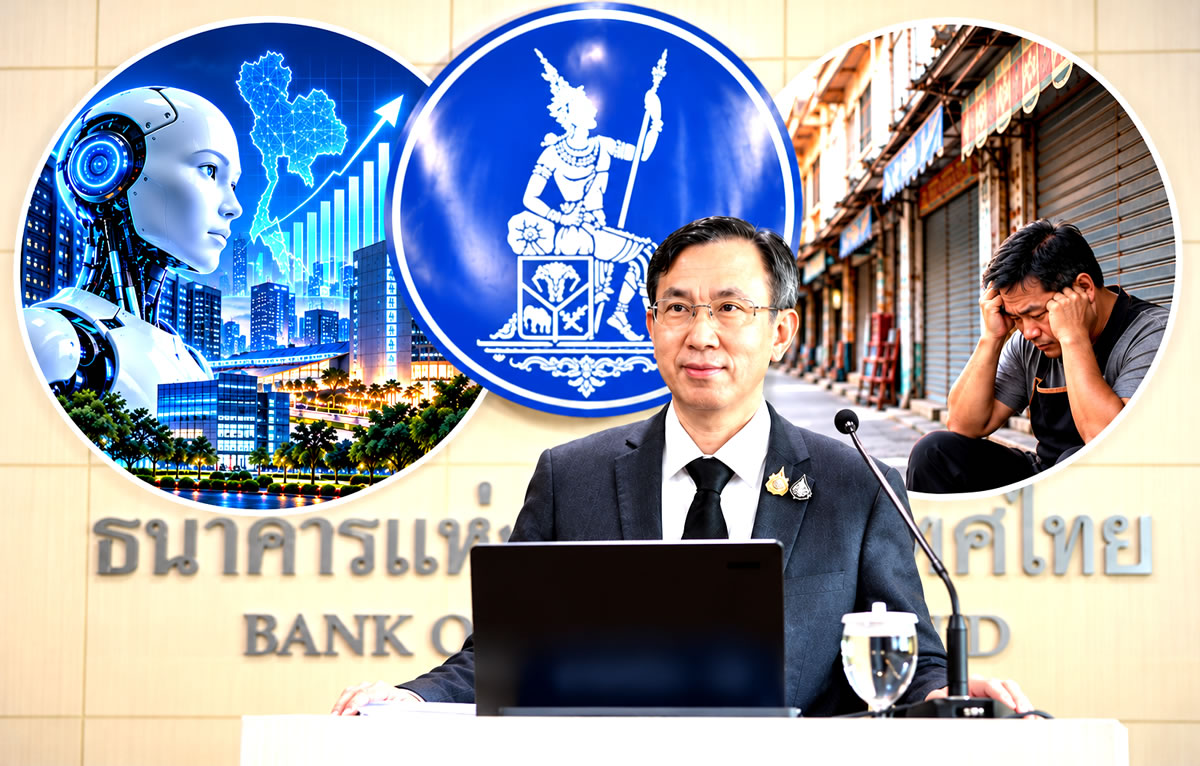
Thailand’s economy is splitting into two sharply different worlds. Technology exports are surging, large corporations are expanding, and investment is rising. Yet households remain burdened by debt, smaller businesses face shrinking credit, and consumer spending remains weak.
Tourism faces another downturn as higher oil prices threaten foreign arrivals. On Wednesday, the Bank of Thailand confirmed this widening divide. Despite raising its growth forecasts, the central bank warned that the wider economy remains weak. Its Monetary Policy Committee unanimously held interest rates at 1%, with economic growth still below potential.
The decision followed Wednesday’s Monetary Policy Committee (MPC) meeting in Bangkok. All six members attending voted to maintain the benchmark rate, while one committee member was absent.
Bank of Thailand holds rates as stronger exports lift forecasts but leave domestic businesses struggling
It was the fourth consecutive meeting without an interest rate change. More significantly, the committee’s latest assessment exposed contrasting conditions across Thailand’s economy. Stronger exports are lifting national output, but domestic businesses and consumers remain under pressure.
MPC Secretary Don Nakornthap announced the decision on 28 October. He confirmed higher economic growth forecasts for both 2026 and 2027. The upgrades reflect stronger merchandise exports and investment linked to the global artificial intelligence boom.
However, the improved projections conceal substantial weakness across the domestic economy. Smaller businesses continue to lose access to credit, while households face high debt and fragile employment conditions.
The Bank of Thailand now expects gross domestic product (GDP) to expand by 2.4% in 2026. Previously, it forecast growth of 2.3%. Its projection for 2027 has also increased, from 1.8% to 2.1%. Nevertheless, the latest figures still point to subdued expansion. Thailand’s economy grew by 2.4% in 2025, and the central bank expects the same rate this year. Growth is then forecast to slow in 2027.
Artificial intelligence exports boost manufacturing while household debt keeps domestic demand weak
The main improvement comes from Thailand’s internationally connected manufacturing industries. Electronics producers are benefiting from rising demand for technology products and artificial intelligence-related equipment.
In parallel, private investment associated with these industries has exceeded earlier expectations. Companies involved in the technology cycle are expanding activity, while related industrial and service businesses are benefiting. The MPC identified these developments as principal reasons for upgrading its forecasts.
The benefits, however, remain concentrated among particular companies and workers. Large sections of Thailand’s economy are not experiencing the same expansion.
Indeed, the central bank confirmed that overall growth remains below the country’s economic potential. Private consumption is constrained by household debt, weak purchasing power and fragile employment. Smaller businesses face restricted credit, intense competition and structural obstacles.
The findings establish a striking contrast. Internationally connected manufacturers are benefiting from expanding global markets and stronger investment.
By comparison, businesses dependent on Thai consumers continue to face weak demand and financial pressure. The divergence extends across manufacturing, lending, employment and household spending. It was central to Wednesday’s decision to maintain accommodative monetary policy despite the stronger GDP forecasts.
Low interest rates fail to revive SME lending as large corporations secure most new bank credit growth
The benchmark interest rate remains at 1%, its lowest level since September 2022. Since October 2024, the Bank of Thailand has reduced borrowing costs by a combined 1.5 percentage points.
Nevertheless, these reductions have not produced a broad recovery in lending. Overall credit has expanded, but the improvement is concentrated among large corporations. Smaller businesses continue to face declining loan availability.
Large companies are borrowing to finance working capital, strengthen liquidity and meet higher operating expenses. Some lending also reflects investment in expanding industries. Separately, credit to small and medium-sized enterprises continues to contract across almost every economic sector.
Banks remain cautious about extending loans to borrowers considered financially vulnerable. Consequently, the improvement in overall lending figures conceals serious weakness among smaller companies.
The contrast is particularly significant because SMEs depend heavily on bank financing. Restricted credit limits their ability to fund operations, purchase equipment and manage rising costs.
Large corporations, meanwhile, are obtaining additional financing for investment and everyday business requirements. The Bank of Thailand’s assessment confirms that access to credit remains sharply divided despite historically low interest rates.
Banks restrict lending to vulnerable firms as household debt and fragile employment weigh on spending
The MPC reported that overall loan quality remained stable. Even so, it warned that the repayment capacity of SMEs and vulnerable households requires continued monitoring. Financial institutions remain reluctant to increase exposure to higher-risk borrowers.
These restrictions persist despite substantial monetary easing over the past two years. The central bank therefore stressed the importance of targeted financial measures alongside its accommodative interest rate policy.
Household finances present another difficult picture. High debt levels continue to restrict spending and borrowing capacity. At the same time, fragile employment conditions are placing additional pressure on incomes.
The MPC identified lower-income households as particularly vulnerable. Their purchasing power remains weak, while rising living costs reduce the money available for other expenditure.
The weakness is affecting private consumption, a major component of domestic economic activity. Consequently, stronger industrial production has not produced an equivalent increase in household spending.
Workers connected to expanding technology industries are benefiting from international demand. Outside those sectors, however, employment conditions remain fragile. The central bank identified this uneven distribution of economic gains as a continuing constraint on growth.
Rising living costs squeeze Thai households even as technology exports and industrial investment surge
Rising living costs are adding to the pressure. Lower-income households face weak purchasing power while essential expenses increase. Furthermore, high existing debt limits their ability to absorb additional costs.
The MPC’s assessment links these conditions directly to subdued private consumption. Stronger export earnings have therefore not translated into a comparable recovery across Thailand’s domestic market.
The revised GDP forecasts reinforce this distinction. Although the central bank expects stronger exports, overall growth remains below potential. The 2026 projection of 2.4% matches last year’s expansion. For 2027, the forecast falls to 2.1%. Notably, this slowdown is expected despite continued support from technology-related exports and investment.
Thailand’s international trade figures illustrate the strength of the export sector. Merchandise exports surged by 24% in September compared with the corresponding month last year. Imports increased even faster, jumping 50.4%. The rise reflected stronger demand for fuel and capital goods, including purchases associated with business investment.
These figures highlight the importance of international trade to Thailand’s current economic outlook. Electronics manufacturers are benefiting from stronger demand for components and technology products. In addition, investment linked to artificial intelligence is supporting related industries. The MPC cited this expansion as a major reason for its improved GDP projections.
Strong export figures mask structural weaknesses as tourism faces higher costs and fewer foreign visitors
The stronger trade figures do not, however, reflect conditions across the entire economy. The benefits remain concentrated among businesses directly involved in expanding industrial and service sectors.
Companies dependent on domestic consumers continue to face weaker conditions. Moreover, smaller firms face difficulties adapting to changing markets and intense competition.
The central bank specifically identified structural problems as another constraint on growth. These difficulties are contributing to weak domestic demand and limiting economic expansion.
Meanwhile, high household debt continues to restrict consumption. The combination leaves Thailand’s export industries performing better than large sections of its domestic economy.
Tourism presents a separate and increasingly difficult outlook. The Bank of Thailand expects foreign tourist arrivals to decline as higher international oil prices increase travel costs. The warning affects hotels, airlines, restaurants, retailers and transport operators. Numerous smaller businesses also depend on spending by overseas visitors.
Higher aviation fuel prices increase airline operating expenses. As a result, ticket prices could rise, placing additional pressure on international travel demand. The MPC expects higher travel costs to reduce foreign arrivals. This would weaken activity among tourism-dependent businesses already facing rising operating expenses.
Higher oil prices threaten winter tourism and fuel inflation despite stronger technology-led exports
The warning comes ahead of Thailand’s important winter tourism season. On another front, stronger technology exports are lifting the central bank’s growth forecasts.
The contrasting outlooks reinforce the divide identified by policymakers. International technology demand is supporting manufacturing, while tourism faces higher costs and weaker visitor numbers.
The tourism outlook also reflects developments beyond Thailand’s domestic economy. International oil prices remain sensitive to uncertainty surrounding the Middle East conflict. Higher fuel costs affect airlines and other transport businesses. In turn, more expensive travel can reduce demand from foreign visitors. The MPC identified these pressures as part of its latest economic assessment.
Energy prices are also creating wider inflation risks. The central bank expects consumer prices to increase temporarily during the remainder of 2026 and early 2027. Rising oil prices are a principal factor. Additionally, El Niño weather conditions could increase agricultural production costs and food prices.
The Bank of Thailand forecasts headline inflation averaging 2.1% in 2026. It then expects the rate to decline to 1.3% in 2027. Core inflation is projected at 1.2% this year and 1.3% next year. These figures reflect temporary supply-side pressures alongside continuing weakness in domestic demand.
Middle East oil risks and El Niño raise inflation concerns while weak demand limits underlying prices
September’s annual headline inflation reached 2.82%. This placed it close to the upper end of the central bank’s 1–3% target range. Core inflation stood at 1.50%. Nonetheless, policymakers expect underlying price pressures to remain relatively contained over the medium term.
The Middle East conflict remains an important source of uncertainty. Rising oil prices are increasing production and transport costs across several industries. In addition, El Niño could affect agricultural output and food prices. Both developments threaten to increase expenses for businesses and households already facing difficult economic conditions.
The MPC also identified limitations on government energy price support measures. Such restrictions could leave consumers and businesses more exposed to international price increases. Beyond that, policymakers are monitoring whether companies pass higher costs on to customers. The concern is whether temporary increases spread into underlying inflation.
The committee warned that inflation could exceed current estimates. Continued uncertainty surrounding the Middle East conflict remains a major risk. Restrictions on energy subsidies could also increase price pressures. Equally important, businesses passing higher costs to consumers could affect core inflation and medium-term expectations.
Despite these risks, the central bank expects inflation to ease during 2027. Temporary supply-side pressures are projected to diminish. At the same time, weak domestic demand is expected to restrain underlying price increases. The forecast decline to 1.3% reflects these conditions.
Weak consumer demand keeps inflation subdued as markets weigh the possibility of higher rates in 2027
The inflation outlook provides another indication of Thailand’s weak domestic economy. Technology-related exports and investment are expected to support growth. Yet subdued consumer demand is projected to keep medium-term inflation relatively low. The central bank also cited structural economic problems as a constraint on expansion.
These competing pressures shaped Wednesday’s interest rate decision. Weak household spending and restricted SME lending favour continued accommodative policy. Conversely, higher energy costs and inflation risks require close monitoring. The MPC therefore maintained the existing rate rather than introducing another reduction.
Financial markets had widely anticipated the decision. All 26 economists surveyed by Reuters expected the central bank to leave its benchmark rate unchanged. Most also expect interest rates to remain at 1% through the end of 2027. The committee’s next scheduled meeting is on 23 December.
Some international financial institutions, however, see a possibility of tighter monetary policy next year. Bloomberg reported changing expectations among JPMorgan Chase, OCBC and Bank of America. These institutions have identified a growing possibility of interest rate increases during 2027. Their assessments reflect uncertainty surrounding inflation and future economic conditions.
Bank of Thailand warns of prolonged low-rate risks as US policy expectations weaken the Thai baht
The Bank of Thailand also warned about potential financial stability risks associated with prolonged low interest rates. Nevertheless, policymakers consider the existing rate appropriate under current conditions.
The MPC believes accommodative monetary policy is supporting economic activity. Targeted financial measures remain important for vulnerable borrowers and businesses.
Currency developments formed another part of Wednesday’s assessment. The Thai baht has weakened against the US dollar following changes in expectations surrounding American monetary policy. Markets increasingly anticipate a more restrictive US interest rate environment. Consequently, the dollar has strengthened against the baht.
Rising international oil prices have added further pressure. The Middle East conflict remains an important factor behind uncertainty in energy markets. Thailand’s exposure to international fuel costs continues to affect its economic outlook. These developments are influencing financial conditions alongside changes in American interest rate expectations.
Thai government bond yields have increased slightly, broadly following movements in international financial markets. Private-sector borrowing costs, however, have remained relatively stable. The MPC reported that loan interest rates remain consistent with the unchanged policy rate. Bank loans continue to represent the principal financing channel for many Thai businesses.
Large corporations secure loans while smaller firms struggle and the baht faces continued pressure
Access to this financing remains sharply uneven. Large corporations are borrowing for working capital, liquidity and investment. Smaller enterprises, by contrast, continue to face contracting credit across almost every sector. Financial institutions remain cautious about lending to borrowers considered vulnerable.
The baht showed little immediate reaction to Wednesday’s announcement. Financial markets had already anticipated the interest rate decision. Its broader depreciation nevertheless remains part of the central bank’s assessment. US monetary policy expectations and international oil prices continue to influence Thailand’s financial conditions.
Taken together, the MPC’s findings expose substantial differences beneath the headline economic figures. Overall lending is increasing, but smaller businesses are obtaining less credit. GDP forecasts have improved, yet household purchasing power remains weak. Stronger exports are supporting national output without producing an equivalent domestic spending recovery.
The technology sector is benefiting from international investment and demand. Tourism, meanwhile, faces the prospect of declining foreign arrivals. Large corporations are expanding borrowing and investment. Smaller businesses continue to face restricted financing, intense competition and difficult trading conditions.
Household debt and shrinking SME credit expose the gap between export growth and domestic weakness
Households are experiencing another set of pressures. High debt, fragile employment conditions and rising living costs continue to constrain consumption. As a consequence, the benefits of stronger industrial activity remain concentrated among selected companies and workers. The wider domestic economy is not experiencing the same expansion.
The central bank’s latest figures make the division clear. Technology-related exports are lifting growth forecasts, while household debt suppresses spending. Large corporations are obtaining more credit, while SME lending contracts. Foreign tourism is expected to weaken despite stronger merchandise exports.
The revised forecasts also indicate continued economic weakness beyond 2026. Thailand’s GDP is expected to expand by 2.4% this year before slowing to 2.1% in 2027. Meanwhile, headline inflation is forecast to decline from 2.1% to 1.3%. The central bank expects weak domestic demand to remain an important factor.
The MPC’s assessment therefore distinguishes stronger international trade from the condition of Thailand’s domestic economy. Export-oriented manufacturers are benefiting from global demand. Smaller businesses and households remain constrained by debt, restricted financing and weak purchasing power. Tourism adds another area of vulnerability as international travel costs increase.
December policy meeting approaches with inflation risks rising and domestic demand still under pressure
The next monetary policy meeting will take place on 23 December. Policymakers will review economic growth, inflation and financial conditions. They will also monitor the repayment capacity of SMEs and vulnerable households. These borrowers remain exposed to weak domestic demand and restricted credit.
Inflation will remain another priority. The MPC is watching whether higher energy and food costs spread into underlying consumer prices. Separately, developments in the Middle East could affect oil prices and tourism. US monetary policy expectations will remain important for the baht and financial markets.
For now, the benchmark interest rate remains at 1%. The committee unanimously concluded that the existing policy remains appropriate. The decision follows substantial monetary easing since October 2024. Even after those reductions, however, the central bank’s assessment confirms that domestic economic weaknesses persist.
Thailand’s economy is expected to grow by 2.4% this year. The improved forecast reflects stronger technology exports and related investment. Yet the central bank expects growth to slow to 2.1% in 2027. The figures do not indicate a broad improvement across the domestic economy.
Central bank confirms Thailand’s divided economy as export industries thrive but households struggle
Wednesday’s findings establish two sharply different economic pictures. Large companies and export industries are benefiting from stronger international demand. In contrast, smaller businesses, indebted households and tourism operators face continuing financial and commercial pressures. The divide extends across manufacturing, lending, employment and consumer spending.
The Monetary Policy Committee’s decision reflects those contrasting conditions. Stronger exports have improved the national growth outlook, but domestic demand remains weak. SME credit continues to contract, while household debt restricts consumption. Rising oil prices are also threatening tourism and increasing inflation risks.
Thailand’s GDP may get a bump up from the 3rd quarter after recent economic agency talks with PM Anutin
Prime Minister Anutin talks of an economy driven by ‘quality growth’ at the Bangkok IMF World Bank forum
Thailand enters the final months of 2026 with technology-related exports supporting national output. Nevertheless, the Bank of Thailand expects overall economic growth to remain below potential.
Its latest assessment confirms a tale of two economies. One is expanding through international technology demand and corporate investment. The other remains constrained by debt, restricted credit, fragile employment and weak consumer spending.
Join the Thai News forum, follow Thai Examiner on Facebook here
Follow Thai Examiner on Google here
Receive all our stories as they come out on Telegram here
Follow Thai Examiner here
Further reading:
Thailand’s once mighty tourism industry is failing but now faces further damage from overvalued baht