Anutin predicts an economic leap after Bangkok hosts the IMF–World Bank summit for 191 nations. US Fed chief Kevin Warsh applauded Thailand’s organisation, OECD chief Mathias Cormann expressed confidence in membership, while Scott Bessent demanded reform.
Prime Minister Anutin Charnvirakul hailed Bangkok’s IMF–World Bank summit as a triumph on Friday, predicting a major economic boost after welcoming representatives from 191 countries. He met US Federal Reserve Chairman Kevin Warsh, while OECD Secretary-General Mathias Cormann expressed confidence that Thailand would eventually secure membership. However, US Treasury Secretary Scott Bessent demanded fundamental reforms of both financial institutions, including an end to World Bank lending to China and changes to energy financing. Meanwhile, IMF chief Kristalina Georgieva warned of mounting global economic risks. Against this backdrop, Anutin celebrated Thailand’s growing international standing, new investment opportunities and prospects for stronger growth.
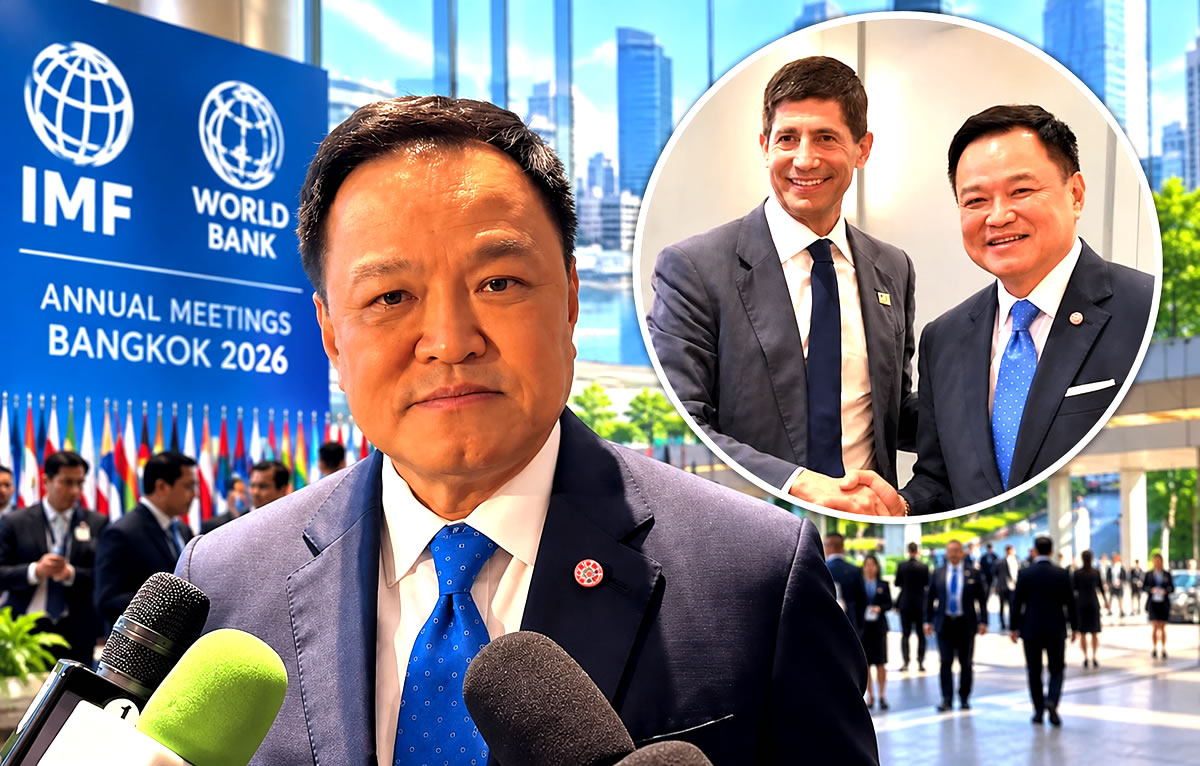
Prime Minister Anutin Charnvirakul declared Thailand’s hosting of the IMF–World Bank Annual Meetings a resounding success on Friday. He predicted an exponential increase in economic opportunities following the gathering of representatives from 191 countries.
Earlier, Anutin met US Federal Reserve Chairman Kevin Warsh, who praised Thailand’s organisation and hospitality. However, Washington delivered a sharply different message during the same week. US Treasury Secretary Scott Bessent launched a broad attack on both financial institutions, demanding fundamental reforms.
His targets included lending to China, restrictions on fossil fuel financing, executive spending and expanding institutional mandates. Meanwhile, Anutin insisted the summit had delivered economic benefits extending far beyond its immediate cost. He cited investment opportunities, international agreements and Thailand’s ambition to join the OECD.
Anutin hails Bangkok summit as 191 nations gather and Thailand claims a boost to investor confidence
Speaking at 5.15 pm on Friday, October 16, Anutin appeared delighted with Thailand’s performance. He addressed reporters at Bangkok’s Queen Sirikit National Convention Centre, which hosted the principal summit proceedings.
The meetings began on October 12, with approximately 17,000 participants expected throughout the week. Senior financial officials, central bankers and government representatives attended from across the world.
Anutin said Thailand had demonstrated its ability to organise one of the world’s most important economic gatherings. Moreover, he insisted the event had strengthened international confidence in the kingdom.
He praised Thailand’s infrastructure, logistics, economic stability and capacity to accommodate major international conferences. According to the prime minister, these capabilities had impressed visiting delegates and enhanced the country’s investment credentials.
Prime minister says delegates praised Thailand as investment pledges and job figures remain unclear
The prime minister claimed representatives from all 191 participating countries were satisfied with Thailand’s arrangements. He said there had been no significant shortcomings during the proceedings.
Furthermore, Anutin argued that Thailand had demonstrated its readiness despite growing geopolitical uncertainty. He highlighted the country’s legal procedures, institutional capabilities and economic potential. These factors, he maintained, had strengthened international confidence in Thailand as a destination for business and investment.
Consequently, Anutin said the government must convert that recognition into jobs, higher incomes and commercial opportunities. He identified business matching activities, memoranda of understanding and investment partnerships as important achievements.
In addition, he referred to international agreements concluded during the week. However, the government did not provide a comprehensive financial breakdown of these arrangements. No overall investment value, employment forecast or implementation timetable accompanied his remarks.
Thailand promotes conference success as Kevin Warsh praises its organisation during Friday meeting
Nevertheless, Anutin described the gathering as a major achievement for Thailand’s international conference industry. He said the country no longer needed to advertise its capabilities to overseas event organisers.
The IMF and World Bank had effectively demonstrated those capabilities by holding their annual meetings in Bangkok. Beyond tourism and conference services, he identified wider opportunities involving investment, trade and international economic cooperation.
The prime minister argued that Thailand had gained direct access to senior international decision-makers. He expected those relationships to generate commercial benefits after the delegates departed.
In particular, he wanted international recognition converted into investment and economic activity. Yet the government had not identified how many agreements would become binding investment commitments. The financial returns remained unquantified despite Anutin’s enthusiastic assessment.
Earlier on Friday, the prime minister held a significant meeting with US Federal Reserve Chairman Kevin Warsh. The encounter took place at approximately 12.35 pm in VIP Room 1B at the convention centre.
Government spokesman Ekkapob Pianpises subsequently released details of their discussions. According to Ekkapob, Warsh congratulated Thailand on successfully organising the IMF–World Bank Annual Meetings. He also praised the country’s logistical capabilities and ability to accommodate delegates from numerous nations.
Warsh and Anutin discuss US trade talks, political stability and Thailand’s international standing
Warsh expressed admiration for the hospitality and helpfulness of the Thai people. Additionally, he recognised Thailand’s experience in managing major international events.
The meeting covered Thailand’s international position and economic relationship with the United States. Anutin expressed satisfaction with continuing discussions between Bangkok and Washington. He also referred to previous meetings with the US president concerning economic and trade relations.
Notably, the prime minister discussed ongoing trade negotiations between Thailand and the United States. He indicated that those negotiations were progressing. However, the government’s account did not identify a new trade agreement resulting from Friday’s meeting. Nor did it announce a specific American investment commitment. No monetary-policy agreement or financial arrangement was disclosed following the encounter.
Political stability formed another important part of the discussions. According to Ekkapob, both sides addressed the importance of continuity in government policy. The spokesman linked political stability with confidence among businesses and other economic sectors.
He also emphasised the challenges created by rapidly changing international economic and trade conditions. In this environment, policy continuity was presented as important for Thailand’s ability to respond effectively.
Anutin highlights Federal Reserve meeting and OECD chief’s support for Thailand’s membership bid
The meeting gave Anutin direct access to one of the world’s most influential monetary policymakers. Subsequently, the prime minister highlighted the encounter while discussing Thailand’s international achievements with reporters.
He also referred to discussions with OECD Secretary-General Mathias Cormann. Thailand is seeking membership of the Organisation for Economic Co-operation and Development, a major objective of the government’s international economic policy.
Anutin said Cormann had expressed confidence in Thailand’s prospects of securing OECD membership. Indeed, he encouraged reporters to examine the secretary-general’s Facebook page. According to the prime minister, Cormann had publicly expressed confidence that Thailand would eventually join the organisation. Those comments, Anutin said, provided considerable encouragement for officials preparing the country’s accession documents.
Furthermore, the prime minister described the endorsement as a significant development for Thailand’s international standing. He argued that OECD membership would strengthen the country’s credibility and economic prospects.
However, Cormann’s reported comments did not constitute formal approval of Thailand’s application. The accession process remains incomplete. Even so, Anutin regarded the international encouragement as another important result of the week’s diplomatic activity.
Foreign leaders approached Thailand for talks as Anutin celebrates the country’s growing visibility
The prime minister also discussed meetings involving representatives from more than ten countries. When reporters referred to Thailand meeting those foreign representatives, Anutin corrected their interpretation. He insisted that international leaders had approached Thailand, rather than the other way around. Moreover, he said there was no rigid diplomatic requirement governing which leaders should meet first.
Anutin explained that he had instructed the Ministry of Foreign Affairs to arrange meetings with senior international officials. He was willing to meet central bank governors and economic policymakers, rather than restricting discussions to fellow prime ministers.
According to Anutin, these encounters provided opportunities to exchange views on international developments. The discussions had continued since October 12, including meetings with a Russian deputy prime minister and several foreign ministers.
Separately, Anutin highlighted his contacts with Warsh and Cormann as particularly important. He presented the exchanges as evidence of Thailand’s continuing international relevance. The prime minister also stressed the value of keeping Thailand prominent in global discussions.
He argued that repeated international references to the country could generate additional commercial opportunities. Greater visibility, he maintained, would strengthen Thailand’s prospects for future economic development.
Anutin defends summit spending and compares potential gains with benefits from domestic spending schemes
However, his most ambitious remarks came when reporters questioned the financial value of hosting the gathering. Anutin rejected the suggestion that success should be measured solely by comparing expenditure against immediate revenue.
Instead, he insisted the event had been worthwhile because of its wider economic benefits. He pointed to international agreements, business matching activities and relationships established throughout the week.
The prime minister argued that these developments would support future investment and commercial expansion. To illustrate his argument, he compared their potential impact with previous government programmes supporting domestic spending.
He cited Half-Price Plus and other measures that had benefited participating businesses. According to Anutin, those programmes increased sales during their implementation. He maintained that commercial benefits continued after the programmes ended.
Similarly, Anutin expected the international gathering to generate economic gains beyond its immediate duration. He also revealed that Finance Minister Ekniti Nitithanprapas had initially expressed concerns about hosting the meetings.
Those discussions occurred during Anutin’s first government, when it operated with a parliamentary minority. At that stage, uncertainty surrounded the government’s ability to complete preparations and secure the necessary cooperation.
Anutin credits national cooperation for summit success and predicts an exponential economic leap forward
Ekniti had identified Thailand’s responsibility for hosting the meetings as a major challenge. Nevertheless, Anutin said the event demonstrated the ability of different sectors to cooperate on national matters. He praised civil servants, private businesses, government officials and members of the public. Their combined efforts, he said, had ensured the successful organisation of the gathering.
By Friday evening, Anutin said the principal meetings and debates had concluded successfully. Some follow-up activities were scheduled for Saturday, October 17. Furthermore, he predicted that international delegates would retain positive impressions of Thailand.
He argued that business agreements concluded during the gathering would continue to associate Thailand with international economic activity. The prime minister also highlighted references to Thailand in agreements signed during the week.
When a reporter suggested the event represented an improvement in Thailand’s credibility, Anutin went considerably further.
He described its potential benefits as an exponential leap forward. The prediction was striking for an economy facing subdued growth and substantial structural pressures. However, Anutin provided no figures quantifying the additional expansion he expected. The government also identified no timetable for converting the reported opportunities into investment and employment.
Bessent challenges IMF and World Bank mandates while demanding new energy financing and spending rules
Meanwhile, Washington had already delivered a far more confrontational message concerning the international institutions gathered in Bangkok. US Treasury Secretary Scott Bessent issued written statements on Wednesday, October 14, addressing the future direction of both organisations. The submissions were directed towards their principal policy committees. Their contents attracted international attention on Thursday, October 15, while delegates continued their meetings in Thailand.
Bessent demanded extensive reforms of the IMF and World Bank. In particular, he challenged their lending priorities, energy policies, institutional spending and approach towards China. The US Treasury secretary argued that both organisations should return to their original economic responsibilities.
He wanted the IMF to concentrate on monetary stability, economic surveillance and balance-of-payments problems. For the World Bank, Washington demanded greater emphasis on economic growth, development and poverty reduction.
Bessent criticised activities Washington considers distractions from those central responsibilities. His intervention challenged the priorities adopted by both institutions.
Crucially, the American demands carried considerable weight because the United States is their largest shareholder. Washington therefore exercises substantial influence over their financing, governance and strategic direction. The submissions placed that influence behind demands for significant institutional changes.
The Treasury secretary did not attend the Bangkok meetings. US officials had previously attributed his absence to domestic commitments. Instead, Deputy Treasury Secretary Francis Brooke and Under Secretary for International Affairs Erin Browne led the American Treasury delegation.
Nevertheless, Bessent’s written statements placed Washington’s demands directly before the international financial institutions. They introduced a confrontational American position during one of the most important weeks in their annual calendar.
One major target was the World Bank’s approach to financing oil and gas production. Bessent called for the removal of restrictions on upstream exploration and production. He argued that development financing should reflect energy affordability, reliability and economic needs. Accordingly, Washington wants greater financial support for oil and gas projects. The proposals also included expanded financing for nuclear energy.
These demands challenged restrictions associated with the World Bank’s climate and environmental priorities. On another front, Bessent called for greater support for critical minerals.
His proposals included financing for mineral production and deep-sea mining. Washington considers access to critical minerals important for industrial development and technological competitiveness. The Treasury secretary therefore wants international development financing directed towards those strategic resources.
Bessent targets World Bank lending to China and urges tougher IMF scrutiny of Chinese trade policies
China was another central target of the American intervention. Bessent challenged the continuation of World Bank lending to the country. He questioned why China should receive development financing given its economic size and financial resources.
Moreover, Washington wants the IMF to challenge Chinese economic policies more aggressively. The United States argues that China’s non-market practices contribute to international trade imbalances.
Bessent’s proposals therefore extended beyond the World Bank’s lending operations. They also sought a stronger IMF response to economic distortions associated with Chinese policies. The demands carried particular relevance for Thailand. China is a major trading partner and source of investment for the Thai economy. At the same time, Thai manufacturers face increasing competition from Chinese production and exports.
Changes to international financing policies could affect commercial conditions across the region. However, Bessent’s submissions did not establish any immediate change to China’s access to World Bank lending. Such changes would require decisions through the institution’s governance procedures. The American position remained a demand for reform rather than an agreed institutional policy.
US Treasury demands lower institutional costs as IMF and World Bank chiefs warn of economic risks
The US Treasury secretary also targeted spending within the IMF and World Bank. He demanded tighter administrative controls and greater efficiency. Specifically, his proposals included restraint on executive board salaries and budgets.
Washington wants the institutions to reduce operating costs and concentrate resources on their principal economic functions. Bessent also questioned the expansion of their activities beyond those original responsibilities.
His criticism placed additional pressure on the management and governing bodies of both organisations. However, the submissions represented American policy demands rather than reforms already approved by member governments. The institutions continued their Bangkok proceedings against this background of disagreement. In parallel, their senior executives presented broader assessments of the global economy and international development.
IMF Managing Director Kristalina Georgieva and World Bank President Ajay Banga addressed Friday’s plenary session. Their remarks focused on global economic conditions, development financing and international financial stability.
Georgieva warned that the world economy remained vulnerable despite showing resilience. The IMF forecast global economic expansion of approximately 3.1% in 2026. However, substantial public debt, geopolitical tensions and energy pressures continued to threaten stability.
IMF warns over artificial intelligence while World Bank seeks fivefold increase in minerals financing
The IMF chief also identified uncertainty surrounding artificial intelligence as an important economic issue. Investment in the technology is influencing expectations for future productivity and growth.
Nevertheless, its effects on employment and economic activity remain significant concerns for policymakers. Artificial intelligence has become an increasingly important factor in international economic discussions. Its development also featured among the changing global conditions acknowledged by Anutin during the Bangkok gathering.
Banga concentrated on development financing, poverty reduction and employment. He emphasised the importance of supporting economic opportunities in developing countries. Furthermore, the World Bank president announced plans to increase financing for critical minerals fivefold within five years.
That objective partly overlapped with Washington’s demands for greater investment in strategically important resources. However, Banga’s broader development priorities extended beyond those emphasised by Bessent.
Washington’s reform demands collide with Thailand’s weak growth, debt burden and investment ambitions
The American intervention exposed competing priorities within the international financial system. Washington wants tighter institutional mandates and changes to financing policies. Meanwhile, the IMF and World Bank leadership continue to address broader economic and development challenges.
The disagreement emerged during a gathering intended to strengthen international economic cooperation. It also demonstrated the influence Washington intends to exercise over the future direction of both institutions.
For Thailand, the meetings came amid persistent domestic economic difficulties. The country faces weak economic growth, substantial household debt and increasing fiscal pressures.
Moreover, Thai manufacturers face growing competition from regional economies, including Vietnam. Demographic changes are placing additional pressure on the country’s longer-term economic prospects. Thailand must also attract investment capable of increasing productivity and supporting employment.
Against this background, Anutin promoted the Bangkok gathering as an opportunity to strengthen international confidence. He argued that Thailand had demonstrated its economic capabilities and readiness to accommodate major investors.
Furthermore, the prime minister linked international recognition with the government’s wider economic ambitions. These included attracting higher-value investment and strengthening Thailand’s international economic relationships.
Anutin cites US and OECD talks but offers no investment totals as Washington presses financial reforms
His meeting with Warsh provided an opportunity to discuss Thai–US trade relations and political stability. Meanwhile, his contact with Cormann reinforced the government’s focus on OECD membership.
The prime minister also highlighted agreements and business matching activities associated with the summit. However, the available government statements did not quantify the total investment secured. They also provided no comprehensive employment forecasts or implementation schedules.
Consequently, the economic returns described by Anutin remain prospective rather than confirmed financial gains. The gathering nevertheless provided Thailand with extensive international exposure and direct access to senior economic policymakers.
It also demonstrated the country’s ability to organise a major international event involving representatives from 191 countries. The government expects the relationships established during the week to support future commercial activity.
Meanwhile, Washington’s intervention placed the future policies of the IMF and World Bank under renewed pressure. Bessent demanded changes to lending, energy financing, institutional spending and scrutiny of Chinese economic practices.
Those proposals remain subject to decisions by the institutions and their member governments. Nevertheless, they placed substantial American financial and political influence behind calls for major reform.
Anutin ends summit celebrating economic promise while investment returns and job creation remain unclear
By Friday evening, Anutin had declared the Bangkok gathering an overwhelming success. He praised the organisers, celebrated the international attention and predicted substantial economic benefits.
The prime minister also presented the meetings as an important step towards stronger international credibility and OECD membership. However, the financial value of the investment opportunities and agreements promoted during the week had not been established.
US Bangkok broadside to the IMF and the World Bank delivered by Scott Bessent who snubbed the meeting
Friday protests by anti IMF World Bank activists continue after overnight camp event in central Bangkok
With follow-up activities continuing on Saturday, Thailand’s government must now pursue the commercial opportunities promoted during the meetings. Anutin has predicted an exponential leap forward for the economy.
At the same time, Washington is demanding major changes to the institutions that brought international economic leaders to Bangkok. The additional investment, jobs and national income expected from the gathering remain unquantified.
Join the Thai News forum, follow Thai Examiner on Facebook here
Follow Thai Examiner on Google here
Receive all our stories as they come out on Telegram here
Follow Thai Examiner here
Further reading:
Thailand’s once mighty tourism industry is failing but now faces further damage from overvalued baht