Thailand’s long-delayed tourist tax is back with a higher ฿450 price tag. Air travellers face the levy first from late 2026 or early 2027, but airline resistance persists as officials study online payments and airport kiosks for collection.
Thailand is reviving its long-delayed foreign tourist levy with a higher ฿450 charge and a fresh push for implementation. Air passengers face collection from late 2026 or early 2027, despite renewed airline resistance over collecting the fee. The levy will include automatic tourist insurance and finance a new tourism development fund. Land and sea arrivals will follow about a year later. Meanwhile, Bangkok is planning a wider tourism overhaul, including new accommodation rules, targeted tourism zones and five million ฿1,000 domestic travel coupons.
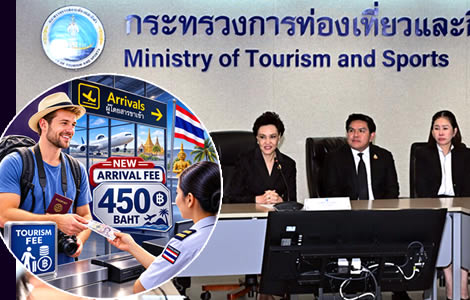
Thailand is pressing ahead with its long-delayed foreign tourist levy, raising the proposed charge to ฿450 per visitor. Collection is targeted for late 2026 or early 2027, with foreign passengers arriving by air facing the fee first. Land and sea arrivals would follow about one year later.
Deputy Prime Minister and Commerce Minister Suphajee Suthumpun chaired Friday’s National Tourism Policy Committee meeting. The meeting at the Ministry of Tourism and Sports set out the latest framework for the charge. Notably, officials also outlined a broader shift in Thailand’s tourism strategy.
Tourism and Sports Minister Surasak Panjaroenvorakul confirmed the levy had increased from the previously proposed ฿300. Ultimately, the ฿450 charge is intended to cover foreign visitors entering Thailand by air, land and sea. However, practical problems mean the rollout will begin at airports.
Airlines resist collection plan as officials study airport kiosks and online payment for tourist levy
Several payment methods remain under study. These include collection with airline tickets, an online application and kiosks at airports. Crucially, requiring airlines to collect the money has again drawn adverse industry feedback. Carriers previously rejected the proposal as too burdensome and intrusive into their operations.
In response, officials are examining methods that could reduce direct airline involvement. Online payment offers one option, while airport kiosks provide another. The final mechanism remains undecided and will be examined during consultations with relevant stakeholders.
The draft principles and National Tourism Policy Committee announcement will now enter public consultation. Mr Surasak said that process should take about 30 days. Afterwards, the proposal will return for further consideration before the final details go to the Cabinet.
Once approved, the measure would take effect 180 days after publication in the Royal Gazette. As a result, the implementation timetable has shifted from earlier expectations. Collection had previously been expected by the end of 2026 but could now move into early 2027.
Long-delayed tourist levy starts at airports before expanding to land and sea entry points
The delay adds another stage to a proposal that has spent over a decade in the pipeline. Successive versions have faced difficulties over implementation, particularly how the money should be collected. Thailand’s numerous entry routes have added complexity to the scheme.
For air arrivals, the government can develop payment systems around major international airports. By contrast, land crossings present greater congestion concerns. Sea arrivals also require separate collection arrangements and supporting systems.
Accordingly, the government plans a phased introduction rather than launching the levy across every entry route simultaneously. Airports will provide the first phase. Land and sea collection should follow approximately one year after air collection begins.
During that interval, officials will prepare systems for border checkpoints and sea routes. In particular, they want to avoid adding congestion at busy land crossings. The government will also examine how the fee should apply to travellers making repeated border entries.
Under one model, tourists could pay once and make multiple land or sea entries during the same trip. Subsequent entries would have to occur within the insurance coverage period. Thus, travellers could avoid paying another ฿450 every time they crossed the border during that period.
Tourist levy rises to ฿450 with automatic insurance cover and dedicated fund for tourism development
The increase from ฿300 to ฿450 follows changes to assumptions behind earlier studies. Mr Surasak cited the energy crisis and wars affecting the global tourism industry. Officials have therefore revised elements of the scheme before sending it through the approval process.
Central to the new charge is automatic insurance protection for foreign visitors. Payment would provide insurance coverage for a specified period while tourists are in Thailand. Claims would remain subject to specified limits under the eventual insurance arrangements.
As part of this, the government wants to reduce public spending on medical expenses incurred by foreign tourists. Revenue would also help establish a dedicated tourism development fund. The fund would provide another financing source outside Thailand’s regular annual budget.
Mr Surasak said tourism must compete for government funding with numerous ministries. Consequently, he said the amount available for tourism had been falling each year. The proposed fund is intended to provide direct financing for tourism development and supporting infrastructure.
“The government has a clear and committed policy to successfully collect these fees in order to establish a tourism development fund,” Mr Surasak said.
“This is considered off-budget funding that will directly help drive the tourism industry,” he added.
Tourism funding squeeze drives levy plan as government shifts its policy towards a visitor economy
He said the national budget was limited and had to fund numerous ministries. Tourism allocations were therefore declining, while the industry continued to require infrastructure investment and development financing.
Mr Surasak also warned about the consequences of failing to establish another financing mechanism. Without infrastructure support, he said Thai tourism could reach saturation or decline. He also said Thailand could become less able to compete with other countries over the longer term.
Separately, the minister addressed concerns about how money collected through the levy would be handled. The government plans to involve the private sector in the process. Mr Surasak said that participation was intended to ensure maximum transparency.
Friday’s meeting extended well beyond the foreign visitor charge. Ms Suphajee also outlined plans to shift Thailand from traditional tourism towards a “Visitor Economy”. The policy focuses on managing the entire tourist experience rather than concentrating mainly on arrival numbers.
Under that approach, management would begin before visitors reach Thailand and continue until their departure. Convenience and safety would form important parts of the experience. At the same time, officials want visitors to leave with positive impressions and return to Thailand.
New accommodation standards and sustainable tourism areas form part of broader visitor economy plan
More broadly, the government wants to increase economic value from tourism rather than simply increase tourist numbers. It also wants higher standards across the industry. Income should be distributed among tourism businesses and communities under the proposed framework.
In parallel, accommodation standards are being reviewed as part of the wider strategy. The government wants more informal accommodation providers brought into the formal system. Standards covering homestays and newer types of tourist accommodation would also be updated.
Under proposed criteria, community accommodation could have no more than eight rooms. Such businesses could accommodate a maximum of 30 guests. Furthermore, the revised framework would cover additional tourism formats, including camping, recreational vehicles and water activities.
On another front, officials plan to accelerate work in four designated sustainable tourism areas. These include Koh Chang, Chiang Rai, the Songkhla Lake Basin and Khum Bang Krachao. Cultural assets will also form part of the development programme.
World Heritage sites and Thai Travel Plus scheme feature in wider push to increase tourism value
World Heritage locations identified during the discussions include Sukhothai, Si Satchanalai and Kamphaeng Phet. Officials want to use their cultural capital to create greater tourism value. Meanwhile, the government plans coordinated development rather than relying on isolated state projects.
Private-sector involvement will also form a larger part of that strategy. The Joint Public-Private Sector Committee will help coordinate government and business participation. Ms Suphajee said the government wanted stronger international competitiveness without relying solely on public funding.
Beyond international tourism, Friday’s discussions also covered measures aimed at Thailand’s domestic travel market. Mr Surasak provided an update on the proposed “Thai Travel Plus” programme. Funding arrangements remain under discussion with the Ministry of Finance.
Two financing routes are being considered. Remaining loan funds could be used, allowing the programme to start more quickly. Alternatively, the government could finance the scheme through the 2027 budget.
The second option would delay implementation until after October 1, 2026. Even so, the government wants the programme launched immediately on October 1. Officials want continuity after the existing “Thai Helps Thai Plus” programme expires.
Thai Travel Plus targets five million entitlements as ฿450 foreign tourist levy moves towards launch
Mr Surasak said the government would try to complete the project within October. Before then, further system discussions with the Ministry of Finance are required. Other important elements of the scheme remain unchanged.
Specifically, Thai Travel Plus would offer five million entitlements. Each would include a ฿1,000 digital coupon for spending at participating businesses. Restaurants and other service businesses would be among the outlets where the coupons could be used.
For foreign visitors, however, the more immediate change is the proposed ฿450 entry charge. Public consultation must still be completed before the proposal advances to the Cabinet. Publication in the Royal Gazette would then trigger the 180-day implementation period.
6th Minister of Tourism and Sports in 3 years promises a tourist levy, a policy first proposed in 2015
Tourist levy hits further turbulence with fears it could harm airline’s effort to boost flight numbers
In the meantime, officials must settle the central collection question that has repeatedly delayed the levy. Airline ticket collection remains under consideration despite industry objections. Airport kiosks and online payments provide alternative routes if airlines are not given that role.
Initially, whatever system is selected will be tested on foreign visitors arriving by air. Officials will then have approximately another year to prepare land and sea collection. Multiple-entry arrangements for those routes will also require further study.
Over a decade after the foreign tourist charge first entered consideration, the government is again moving towards implementation. This time, the proposed levy is higher, insurance is central and airports are firmly positioned as the starting point.
Join the Thai News forum, follow Thai Examiner on Facebook here
Receive all our stories as they come out on Telegram here
Follow Thai Examiner here
Further reading:
60-day visa regime to be ended confirms Minister responding to rising industry security concerns
Tourism boss warns Thailand it is facing a Chinese blacklist if another security controversy erupts
Visa waiver scheme questioned with another China Crisis for foreign tourism driven by security fears
Tourism cryptocurrency sandbox payment plan is bound to face stiff opposition from the central bank
Thaksin calls for crypto-based bonds. Notes success and beauty of Isan women who marry foreigners
Future Bank of Thailand Chairman Pick warns that the Thai economy faces ‘disaster’ without rate cuts