Thailand moves to rein in cannabis as Cabinet backs medical-only sales and thousands of shops face expiring licences, while UK gangs recruit air travellers and four couriers are jailed over a £13.8m shipment of 460kg of Thai cannabis in 22 suitcases.
Thailand is moving to rein in its sprawling cannabis industry as the Cabinet backs sweeping new controls four years after decriminalisation. Thousands of shops now face licence expiry, medical-only sales and tougher inspections, while officials battle forged prescriptions used to bypass existing restrictions. At the same time, organised crime gangs are increasingly exploiting airline passengers to carry Thai cannabis into Britain. UK arrests rose again in 2025 and surged further during the first half of 2026. The scale was laid bare on Monday when four couriers were sentenced over a £13.8 million operation involving 460 kilogrammes of Thai cannabis packed into 22 suitcases in 2024. Against that backdrop, Tuesday’s Cabinet decision puts Thailand’s cannabis experiment at another decisive turning point, with tighter controls planned from farms and exports to prescriptions and the thousands of dispensaries still operating nationwide.

Thailand’s Cabinet approved sweeping cannabis legislation on Tuesday, tightening controls over an industry transformed by decriminalisation four years ago. The proposed law reaches from cannabis farms through processing, distribution and final retail sales.
Crucially, it reinforces the government’s position that cannabis should be supplied for medical purposes, not recreational consumption. Yet thousands of cannabis shops remain open nationwide under older licences.
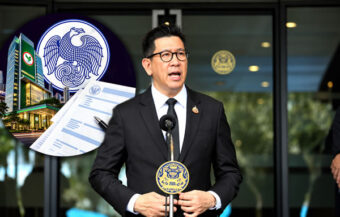
The Cabinet approved the draft Cannabis Control Act on September 22. It will now go before the House of Representatives for consideration. Therefore, the legislation is not yet law and must pass through Parliament. Public Health Minister Phatthana Phromphat announced the decision at Government House shortly before noon.
Tighter farm controls would trace cannabis from cultivation through processing, extraction and sale
At its core, the bill imposes tighter controls beginning at the cultivation stage. Small, medium and large cannabis farms would require registration. Their locations and production details would enter the regulatory system. As a result, officials could trace cannabis from cultivation through processing, extraction and eventual sale.
Beyond cultivation, the government wants stronger quality controls governing cannabis entering the commercial market. Extraction methods would also come under clearer regulation. Meanwhile, penalties would become clearer and heavier than those available under the existing framework. The legislation would create a dedicated national system covering almost every stage of the industry.
The bill marks another major shift for a market transformed by Thailand’s 2022 cannabis decriminalisation. Cannabis was removed from the country’s narcotics list that year. Anutin Charnvirakul championed the policy while serving as Public Health Minister. Four years later, Mr Anutin is Prime Minister and Interior Minister. His government has now approved substantially tighter controls over the industry that subsequently developed.
However, the proposed legislation does not simply return cannabis to Thailand’s narcotics list. Instead, it creates a dedicated legal framework centred on medical and health-related use. Research would remain permitted under conditions established by law. Commercial cultivation, production and sales would require licences under the proposed system.
Import and export licences join age limits, location bans and tighter restrictions on cannabis advertising
Likewise, importing and exporting cannabis would come under licensing controls. Licences would generally remain valid for three years. Furthermore, the legislation would establish a national cannabis committee chaired by the Public Health Minister. That committee would sit at the centre of the new regulatory structure.
The bill also restricts who can legally buy cannabis. Sales would be prohibited to anyone under 20. Pregnant women would also be barred from purchasing cannabis. Similarly, breastfeeding women would fall under the restriction. These measures would operate alongside tighter controls over where cannabis can be sold.
For example, sales would be prohibited at educational establishments, temples and dormitories. Public parks would also be covered. In addition, cannabis sales would be prohibited at zoos and amusement parks. The legislation therefore extends restrictions beyond individual customers into designated public locations.
Advertising faces another crackdown. Marketing cannabis flowers and resin would be prohibited. Promotion of cannabis smoking equipment would also be restricted. Moreover, unlicensed production, importing, exporting or selling could trigger criminal penalties under the proposed framework.
Expiring licences put thousands of cannabis shops on a path towards mandatory medical conversion
For existing dispensaries, however, the most immediate threat comes from expiring licences. More than 10,000 outlets and cultivation operations remain registered nationwide. Many dispensaries continue trading under three-year licences issued before the latest restrictions. Those licences are now steadily running out.
Some expire during 2026, while thousands more remain valid through 2027. The final group continues into 2028. Earlier ministry figures put the number of active registered cannabis shops at around 12,000. Consequently, the expiry programme potentially affects almost the entire established retail sector.
Approximately 5,000 to 6,000 licences were expected to expire during 2026. Another 4,000 to 5,000 were expected to end during 2027. Finally, around 1,000 remaining licences were expected to continue into 2028. The transition therefore unfolds over several years rather than through an immediate nationwide closure.
More significantly, businesses cannot simply expect to renew their existing retail operations unchanged. Shops seeking new licences must comply with the medical-use framework. Mr Phatthana said cannabis businesses would have to convert into medical facilities to continue. They would also need qualified medical practitioners.
Medical prescriptions and qualified practitioners become central as more than 10,000 sites are tracked
Under that model, cannabis could only be supplied through medical prescriptions. On Tuesday, Mr Phatthana again stressed that cannabis was intended for medical use. Existing shops can continue under older licences until those permits expire. Afterwards, businesses seeking renewal must satisfy the new requirements.
In practice, the government expects that process to sharply reduce cannabis outlet numbers. Earlier estimates suggested shop numbers could eventually fall from tens of thousands into thousands. Existing operators therefore face substantial changes to their business models. Conventional roadside cannabis dispensaries cannot simply continue unchanged after their licences expire.
Instead, continuing businesses would have to operate as recognised medical facilities. An authorised practitioner would need to be present. Additionally, cannabis supplied to patients would require properly issued medical prescriptions. Mr Phatthana said prescriptions would require signatures from authorised practitioners.
In parallel, the government is expanding its ability to track cannabis shops and cultivation sites. A digital system now records registered cannabis businesses and growing operations. By Tuesday morning, more than 10,000 locations had entered the system. Mr Phatthana said this covered more than 95% of relevant operations.
National database and inspections target illegal cannabis businesses as prescription abuse grows
That database gives officials a clearer map of the legal cannabis market. They can check whether individual shops and cultivation sites are registered. Consumers can also use the system to identify registered businesses. Accordingly, businesses missing from the database can be treated as potentially operating illegally.
At the enforcement level, inspection teams are being prepared for checks across Thailand. Tourist destinations will receive particular attention. Major urban centres will also face intensified inspections. The Department of Thai Traditional and Alternative Medicine will later provide further details about the programme.
Mr Phatthana said the government had sufficient personnel to conduct those inspections. Consequently, checks are expected to increase as more older licences expire. Tourist centres are particularly significant because cannabis shops remain highly visible there. Bangkok also retains a large cannabis retail presence.
Yet another problem is already confronting the medical framework. Thailand’s existing prescription system has been circumvented. Under earlier restrictions, cannabis flower sales became tied to medical prescriptions. Buyers were supposed to obtain those prescriptions from authorised practitioners.
Forged prescriptions expose weaknesses as officials warn cannabis shops and medical facilities of action
Purchases were capped at 30 grammes, regarded as a 30-day supply. Furthermore, patient information had to be recorded. Medical diagnoses and prescription information also had to enter the system. Those requirements were intended to establish a documented medical basis for each purchase.
Subsequently, telemedicine was permitted, allowing consultations to take place remotely. However, by June 2026, the Public Health Ministry was openly acknowledging abuses. Officials had discovered forged medical certificates and falsified Phor Thor 33 prescription forms. Some cannabis was therefore being obtained without genuine medical examinations.
Notably, officials reported prescription forms carrying practitioners’ signatures before patient information was completed. Other details could then be inserted afterwards. That practice allowed supposedly medical documentation to be completed without the normal examination process. It also gave regulators another enforcement problem.
In response, the Department of Thai Traditional and Alternative Medicine issued warnings over the practice. Officials said some prescriptions were effectively being supplied for recreational cannabis consumption. The department threatened legal proceedings against participating businesses and healthcare facilities. Individuals involved could also face criminal action.
Medical professionals face discipline as digital prescription checks tighten ahead of licence renewals
Medical professionals faced additional consequences. Doctors and other practitioners could also face professional disciplinary proceedings. Thus, enforcement began extending beyond cannabis shops into the medical system supporting sales. The discoveries exposed weaknesses inside the medical-only retail framework already being imposed.
The recreational cannabis trade did not simply disappear after medical restrictions arrived. Instead, officials discovered forged and improperly issued prescriptions being used to circumvent controls. The government has since moved towards stronger digital verification. Prescription codes can now be checked against medical practitioners and registered healthcare facilities.
Through those checks, duplicate prescription codes can be detected. Invalid prescriptions can also be flagged. Equally, mismatches involving practitioners or healthcare facilities can trigger scrutiny. These controls become increasingly important as thousands of existing shops approach their licence renewal deadlines.
Against this background, cannabis outlets remain highly visible across Thailand’s main tourism centres. The new legislation seeks to change the legal basis supporting that retail industry. Rather than maintaining a broad dispensary market, the government wants cannabis moved firmly into medical channels. Existing businesses therefore face rolling deadlines as their three-year licences expire.
Final cannabis licences expire through 2028 as a separate £13.8 million British prosecution advances
The process has already begun in 2026. It will continue throughout 2027. Ultimately, the remaining older licences are expected to expire during 2028. Shops then face either meeting medical requirements or ending operations under their existing model.
Separately, a major British prosecution has highlighted the international movement of cannabis from Thailand. The case concerns a huge shipment carried into Britain by airline passengers. Its latest development came one day before the Thai Cabinet approved the new legislation. However, there is no evidence the British prosecution prompted Tuesday’s decision.
The two developments emerged through entirely separate legal processes. Nevertheless, the British case involved an extraordinary quantity of cannabis leaving Thailand. On September 21, Britain’s National Crime Agency announced prison sentences for four couriers. The intercepted shipment carried an estimated British street value of £13.8 million.
Border Force officers stopped the operation at Birmingham Airport in August 2024. Investigators established that the couriers had travelled from Thailand. However, they did not fly directly into Birmingham. Instead, they travelled through Charles de Gaulle Airport in Paris before continuing to Britain.
British officers seize 460 kilogrammes of cannabis in 22 suitcases tracked through a single Apple account
Altogether, the operation involved 22 suitcases containing 460 kilogrammes of cannabis. That equals more than 1,000lb of the drug. The cannabis had been vacuum-packed before being placed inside the luggage. It was then concealed beneath thin layers of clothing.
Each courier carried two suitcases. Each case contained roughly 20 kilogrammes of cannabis. Indeed, the luggage was so heavy that excess baggage charges became necessary. Those charges were paid at Bangkok Airport before the group left Thailand.
Beyond the sheer weight, investigators found evidence of a coordinated tracking system. Eight suitcases contained Apple AirTags. Crucially, every device was linked to the same Apple ID account. Investigators could therefore connect several supposedly separate pieces of luggage to one digital account.
Investigators also recovered instructions sent to individual couriers. One courier was told a man would be waiting after arrival. The courier was ordered not to leave the airport until that man departed. Even collecting the suitcases immediately was considered unnecessary.
Instead, the courier was told to leave the luggage circulating if necessary. The bags could remain on the baggage carousel while the courier waited. The message even suggested going to the toilet rather than immediately collecting the cases.
Border Force operation at Birmingham Airport brings prison terms for four cannabis couriers from Thailand
By then, British Border Force officers were linking suspicious seizures involving passengers using connecting flights into Birmingham. Officers responded by fully staffing the airport’s nothing-to-declare customs channel. The intervention stopped the cannabis before the shipment left the airport.
Following the seizure, 11 people were charged over the importation operation. The charges covered carrying, removing, depositing, harbouring, keeping, concealing and dealing with Class B drugs. Prosecutors said those acts were intended to evade Britain’s prohibition on importing cannabis.
Four men have now received prison sentences at Birmingham Crown Court. Bradley Lloyd, 27, from Wythenshawe, Greater Manchester, received the longest term. He was jailed for four years. Lewis Ross, 35, from Bolton, Lancashire, received two years and eight months.
Nathan Vitorino, 26, from Welwyn Garden City, also received two years and eight months. Carsten Kyei, 21, from Newham, East London, received two years and six months. Kyei and Vitorino were convicted following a three-week trial.
During that trial, Ross and Lloyd changed their pleas to guilty. However, the prosecution is not finished. Seven more defendants remain awaiting sentence at Birmingham Crown Court. Three were convicted during another trial, while four had already pleaded guilty.
Seven more defendants await sentencing as Britain records a sharp rise in cannabis smuggling by air
Paige Crisp, 24, of Malvern, Worcestershire, was convicted of the same charge. Tasia Nelson, 22, of Newquay, Cornwall, was also convicted. Jaden Ramen, 23, of Merton, London, was convicted alongside them. Their convictions were returned at Birmingham Crown Court in August.
On another front, four defendants had already admitted their involvement. Claire McCullough, 36, from Wythenshawe, pleaded guilty. Ryan Boachie, 32, from Edmonton, London, also admitted the offence. Gideon Oluwasetemi Olumoyegun, 26, from Dagenham, entered a guilty plea.
Jamal Clarke, 22, from Mile End, also pleaded guilty. All seven remaining defendants are due for sentencing on October 22. Thus, the £13.8 million importation prosecution remains active more than two years after the Birmingham Airport seizure.
More broadly, the Birmingham operation forms part of a sharp increase in cannabis carried into Britain by airline passengers. According to the NCA, 801 cannabis smugglers were caught arriving by air during 2024. That represented a 464% increase from 2023.
The increase did not stop there. During 2025, British officers caught 976 air passengers carrying cannabis. Another 600 air-passenger couriers were arrested during the first six months of 2026. Those figures have driven a wider British campaign targeting cannabis smuggling by air.
British campaign targets cannabis smuggling from Thailand as officials warn young travellers of prison
As part of this, the NCA launched a social-media campaign specifically addressing cannabis smuggling from Thailand. The campaign is aimed particularly at younger travellers. It is being promoted through TikTok, Instagram, Snapchat and YouTube.
NCA senior investigating officer Paul Boniface addressed the Birmingham sentences after Monday’s court hearing. “These sentences show that drug couriers can end up paying a high price for smuggling cannabis to the UK,” he said. “It is simply not worth the effort, something that social media influencers promoting this lifestyle frequently overlook.”
Mr Boniface also credited cooperation between the NCA and Border Force. “With the help of Border Force, we were able to intercept these drugs,” he said. He said the operation deprived the criminal network behind the importation of considerable profits.
For his part, Adam Chatfield, head of Border Force Midlands Command, addressed the convictions. “These convictions should be a stark warning to anyone considering bringing cannabis into the UK,” he said. “The young people involved now have a serious crime on their records, damaging their job prospects and life chances.”
The British prosecution and Thailand’s Cabinet decision remain separate developments. Even so, both concern a cannabis industry transformed since Thailand changed its domestic policy during 2022. Britain is confronting increasing cannabis imports carried by airline passengers. Thailand, meanwhile, is tightening control over cultivation and its sprawling domestic retail trade.
Thailand and Britain tighten controls as 460-kilogramme Birmingham shipment exposes trafficking
In the Birmingham operation alone, 460 kilogrammes left Thailand inside 22 suitcases. The shipment travelled through France before reaching Britain. British investigators valued the cannabis at £13.8 million. Eight cases also carried tracking devices linked to one Apple account.
Back in Thailand, the proposed controls begin at cannabis farms. They continue through production and extraction. Importing and exporting would also require licences. Finally, the framework reaches thousands of retail businesses operating nationwide.
For those shops, the regulatory clock is already running. Older three-year licences are progressively expiring. Businesses seeking to continue must enter the medical system. That requires becoming recognised medical facilities and providing qualified practitioners.
At the same time, cannabis would have to be supplied under medical prescriptions. Yet regulators are already confronting abuses involving those documents. Officials have discovered forged medical certificates and improperly completed prescription forms. Some carried practitioners’ signatures before patient details were entered.
Accordingly, the government is tightening digital checks while increasing physical inspections. Tourist centres and major cities will receive particular attention. More than 10,000 shops and cultivation sites are already recorded in the government system. Officials say that represents more than 95% of relevant operations.
Cabinet bill heads to Parliament as cannabis shops face medical conversion and tighter enforcement
The Cabinet-approved bill now seeks to place that wider structure under dedicated national legislation. However, Parliament must still consider the measure. Until that process is completed, the Cannabis Control Act remains a draft. The existing licence-expiry process, by contrast, is already under way.
For thousands of cannabis businesses, those expiry dates now carry greater significance. Renewal will require far more than another conventional retail licence. Continuing operators must meet medical-facility requirements. They will also need qualified practitioners and properly issued prescriptions.
In tandem, officials are building systems to identify forged documentation and unregistered shops. The transition will continue through 2028 as the remaining older licences expire. Four years after decriminalisation, Thailand’s cannabis market is therefore entering another regulatory phase.
Cannabis remains outside the narcotics framework. Nevertheless, commercial controls are tightening sharply. The government’s stated model is medical use, licensed businesses and traceable production. Tuesday’s Cabinet decision seeks to place those principles inside a dedicated national law.
At retail level, existing businesses face inspections, licence expirations and tighter prescription controls. At cultivation level, farms face registration and traceability requirements. Across the supply chain, licences would govern production, imports, exports and sales.
Britain pursues cannabis couriers from Thailand as shops at home face a regulatory deadline through 2028
In Britain, meanwhile, investigators continue targeting cannabis carried from Thailand into the United Kingdom. The Birmingham case shows the scale reached by one operation. Twenty-two suitcases left Thailand carrying 460 kilogrammes of cannabis worth an estimated £13.8 million.
Not only were the cases packed with cannabis, but their weight triggered excess baggage charges in Bangkok. Eight AirTags were hidden among the luggage. The shipment then travelled through Paris before reaching Birmingham. Border Force officers intercepted the drugs before they left the airport.
New cannabis control law expected to be brought to cabinet. It will control and outlaw recreational use
Qatari tourist to be deported after unprovoked attacks in Hua Hin after third visit to a cannabis shop
Four couriers are now serving prison sentences. Another seven defendants will return to Birmingham Crown Court on October 22. In Thailand, thousands of cannabis businesses face a different timetable running through 2028.
By then, the final existing shop licences are expected to expire. Businesses wanting to remain open must meet the medical framework. The Cabinet has now approved legislation designed to place that framework firmly into national law.
Join the Thai News forum, follow Thai Examiner on Facebook here
Follow Thai Examiner on Google here
Receive all our stories as they come out on Telegram here
Follow Thai Examiner here
Further reading:
Polish couple deported for nudity on Koh Phangan. Polish man hospitalised for mental health tests
Thaksin does not rule out joining talks in US as Thai team finalises plans. They fly out on Thursday