Thai Airways flight TG925 makes an emergency landing in India after a reported engine fault, stranding passengers. A waterless lavatory, cracked cockpit window and massive data breach deepen the crisis as ousted chief Chai Eamsiri seeks his old role.
Thai Airways faces another crisis after a Munich–Bangkok flight made an emergency landing in India following a reported engine problem. Passengers were stranded in New Delhi as replacement parts were dispatched from Thailand. The incident follows a lavatory malfunction on the same route, a cracked cockpit window in Shanghai and a data breach affecting over 60,000 passenger records. Meanwhile, September’s baggage catastrophe stranded 25,000 bags, disrupted more than 200 flights and cost Chief Executive Officer Chai Eamsiri his position. Remarkably, he remains shortlisted for reappointment as the airline struggles under interim management.
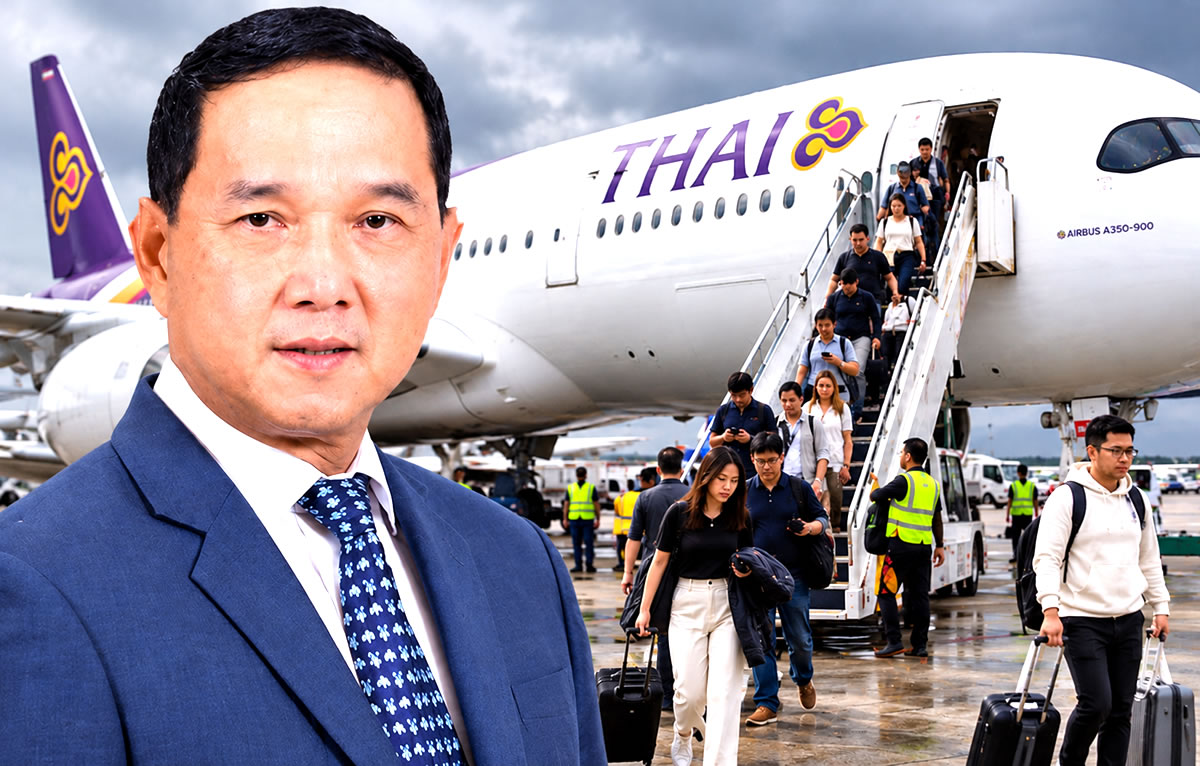
A Thai Airways Airbus A350-900 made an emergency landing in New Delhi after developing a reported engine problem on Saturday night. Flight TG925 was diverted from its Munich–Bangkok route, leaving passengers stranded in India while replacement aircraft parts were dispatched from Thailand.
Passengers reportedly remained aboard for nearly two hours after landing before being transferred to hotels. The emergency follows another technical malfunction reported on the same route days earlier.
Meanwhile, Thailand’s national carrier faces a major cybersecurity breach and continuing fallout from September’s catastrophic baggage failures. Its permanent chief executive position also remains vacant following the removal of Chai Eamsiri on October 2.
Thai Airways flight TG925 diverts to New Delhi after reported engine fault on Munich–Bangkok service
The aircraft departed Munich Airport on Saturday, November 14, at 13.35 local time. It was scheduled to reach Bangkok’s Suvarnabhumi Airport at 06.10 on Sunday. However, a technical problem developed during the journey, forcing the crew to divert to Indira Gandhi International Airport.
Initial reports identified an engine-related fault requiring replacement components from Thailand. The precise mechanical defect remained undisclosed by Sunday evening. Furthermore, Thai Airways had not confirmed when repairs would be completed or when the aircraft could resume commercial operations.
Independent flight-tracking records confirmed the diversion and identified the aircraft as an Airbus A350-900 registered HS-THT. According to FlightStats, TG925 departed Munich’s Terminal 2, Gate H32, at 13.35 on Saturday.
The aircraft became airborne at 13.50. Subsequently, it landed in New Delhi at approximately 23.52 local time that night. This corresponded to 01.22 on Sunday in Thailand. The aircraft reached the terminal at approximately 01.31 Bangkok time. However, flight-tracking records established the aircraft’s movements rather than the reported engine defect.
Passengers stranded in India as Thai Airways awaits parts and offers no confirmed departure time
According to a report published at 16.44 on Sunday, passengers remained aboard for almost two hours after landing. They were eventually allowed to disembark before being transferred to accommodation arranged by Thai Airways.
Meanwhile, passengers awaited further information about their onward journey to Bangkok. The airline had not announced a revised departure time when the report appeared. Moreover, the number of affected passengers remained undisclosed. There was no confirmation whether they would continue aboard the repaired aircraft or transfer to another service.
No injuries were reported, and there was no indication of an accident during landing. Nevertheless, the emergency interrupted a major European service and forced an unscheduled stop in India. By Sunday evening, the aircraft’s repair timetable remained unknown.
The airline had also not disclosed the precise engine defect or expected return to service. Separately, there was no information about possible disruption to subsequent flights assigned to HS-THT. The carrier had yet to provide a detailed technical explanation of the emergency.
The latest incident comes amid growing operational problems at Thai Airways. Notably, another technical malfunction was reported aboard the Munich–Bangkok route just days earlier.
Munich–Bangkok lavatory water failure precedes engine emergency, but aircraft link remains unconfirmed
On November 9–10, reports emerged of a lavatory water failure during a Thai Airways service from Munich. A passenger photograph circulated by aviation website LoyaltyLobby showed a drinking-water bottle beside an aircraft lavatory sink.
The bottle was reportedly provided because running water was unavailable. Consequently, passengers had to use bottled water to wash their hands during the long-haul journey.
The photograph subsequently attracted criticism over hygiene standards aboard the aircraft. However, the original complaint did not identify the flight number, aircraft registration or precise travel date. There is therefore no evidence establishing that Sunday’s diverted aircraft was involved in the earlier lavatory malfunction.
Nor was it confirmed whether the water failure affected every lavatory or only one sink. Thai Airways had not publicly explained the malfunction when the complaint was reported. Nevertheless, the incidents concerned the same important European route within days.
The two problems involved different aircraft systems. The earlier complaint concerned the lavatory water supply, while Sunday’s emergency involved a reported engine fault. Importantly, no technical connection has been established between them. Even so, both incidents interrupted the airline’s normal passenger services. The latest emergency also followed another aircraft problem involving a different international route.
Shanghai cockpit window incident adds to setbacks as Thai Airways reveals major passenger data breach
On November 4, a Thai Airways Boeing 787-9 returned to Shanghai after a cracked cockpit window was discovered. That incident involved a different aircraft type and a separate technical problem.
However, it added another interruption to the carrier’s international operations. The Shanghai incident, lavatory complaint and New Delhi diversion occurred within less than two weeks. In parallel, the airline disclosed a substantial cybersecurity breach involving passenger information held by an external technology provider.
On November 9, Thai Airways confirmed a cybersecurity incident involving Amadeus IT Group, its passenger service technology provider. According to the airline, unauthorised access to booking information occurred between August 10, 2023, and September 23, 2026.
The exposure therefore extended across more than three years. The airline identified 60,529 potentially affected passenger records. In addition, another 376 records involved further sensitive personal information. The compromised data potentially included passenger names, booking references, travel dates and flight routes.
Passport details potentially exposed as Amadeus resets passwords and Thai Airways contacts regulators
The smaller group of records may also have contained passport numbers and contact details. However, Thai Airways maintained that passengers’ credit card information had not been compromised. The airline also stated that its own computer systems and operational services remained unaffected.
Following discovery of the breach, Amadeus revoked compromised login credentials and reset affected passwords. The company also strengthened its security monitoring arrangements. Meanwhile, Thai Airways notified relevant regulators and began examining the affected passenger records.
As part of its response, the airline planned to contact affected customers individually after completing its assessment. Importantly, Thai Airways said it had found no evidence that the compromised information had been publicly released.
The breach concerned passenger information rather than aircraft operating systems. Consequently, there was no evidence connecting the cybersecurity incident with Sunday’s emergency landing or earlier aircraft malfunctions. Nevertheless, the disclosure created another significant problem for the airline’s management during an already difficult period.
Suvarnabhumi baggage catastrophe strands 25,000 bags and disrupts more than 200 flights in September
The latest setbacks follow September’s baggage catastrophe at Suvarnabhumi Airport, which triggered the removal of Chief Executive Officer Chai Eamsiri. Heavy rainfall and flooding disrupted airport operations in late September.
Subsequently, serious weaknesses emerged in baggage handling, staffing, ground services and emergency arrangements. The disruption spread beyond Bangkok as passengers arrived at international destinations without their luggage. Meanwhile, thousands of bags accumulated at Suvarnabhumi Airport as the backlog overwhelmed normal handling arrangements.
Subsequent figures indicated that approximately 25,000 bags became stranded during the breakdown. Furthermore, more than 200 flights were cancelled amid the wider disruption. Passengers faced delays, missing luggage and uncertainty over baggage deliveries across the international network.
The failures also exposed serious problems involving ground-handling capacity and operational coordination. Separately, cargo operations faced difficulties as the airline struggled with the wider consequences of the disruption.
Thai Airways orders baggage compensation and inquiry before removing chief executive Chai Eamsiri
Thai Airways Chairman Lavaron Sangsnit subsequently ordered emergency measures to clear the baggage backlog. These included arranging deliveries through other airlines and introducing automatic compensation for affected passengers.
In response, an investigation led by Police General Thatchai Pitaneelaboot examined the operational collapse. Investigators reviewed staffing levels, equipment availability, ground-handling procedures and the response to the disruption. The inquiry formed part of a wider examination of management performance following the airport crisis.
The baggage catastrophe coincided with broader problems involving cargo operations and management arrangements. Consequently, the Thai Airways board moved against Chief Executive Officer Chai Eamsiri.
On October 2, Chai was removed from his executive responsibilities following the severe operational disruption. The decision came amid growing concerns over management failures and the airline’s handling of passenger services. However, his removal did not immediately terminate his employment contract. His existing agreement runs until January 31, 2027.
Procurement investigations continue as acting chief takes charge and six candidates seek top airline job
The board also ordered separate internal investigations into operational management and procurement arrangements. One concerned ground-handling and cargo outsourcing contracts. Another examined reported procurement of approximately ฿800 million worth of in-flight wine from a single supplier.
However, these investigations did not establish wrongdoing by Chai. Their findings had not been disclosed in the supplied material. Nevertheless, they formed part of the wider management review following September’s operational breakdown.
Following Chai’s removal, the board appointed director Samrit Samniang as acting chief executive. Samrit previously held a senior finance position at PTT Exploration and Production. He subsequently assumed responsibility for the airline while the board began selecting a permanent replacement.
However, the leadership transition remained unfinished when Sunday’s emergency occurred in New Delhi. The airline therefore faced another international flight disruption while operating under interim executive management.
Thai Airways has shortlisted six candidates for the permanent chief executive position. Notably, Chai Eamsiri remains among them despite his removal from executive duties. On October 23, Chairman Lavaron Sangsnit confirmed that an overseas human resources consultancy had been appointed.
Its task was to assess the remaining candidates before a final recommendation reached the board. Initially, nine applicants entered the recruitment process. However, two external candidates failed qualification screening, while another applicant withdrew.
Six Thai Airways insiders compete for chief executive role with board decision expected by December
The remaining six candidates were interviewed on October 18. All are current or former Thai Airways executives. The shortlist includes Chai Eamsiri and Chawan Rattanawaraha, the airline’s Chief, Operations. Another candidate is Cherdphan Chotikhun, Chief, Technical.
Meanwhile, Varangkana Luerojvong, Chief of the Aviation Business Unit, is also competing for the position. The remaining candidates are Nond Kalinta and Korakot Chatasingha, both former chief commercial officers.
Consequently, the final selection is confined to executives with direct experience of the national carrier. No external candidate remains in contention following the qualification screening and withdrawal. The overseas consultancy was instructed to assess candidates’ capabilities beyond their interviews and presentations.
Subsequently, a seven-member selection committee will examine the findings before submitting its recommendation to the board. Chairman Lavaron expects the selection process to be completed by December. The successful applicant is scheduled to assume office on January 1, 2027.
However, no permanent appointment had been announced by Sunday evening, November 15. The airline therefore remains under interim management while several investigations and operational problems continue.
Interim management faces baggage, cyber and aircraft problems as passengers remain stranded in India
The recruitment timetable means Thai Airways could operate under acting leadership for another six weeks. During that period, management must address outstanding baggage, cybersecurity and aircraft incidents. The September baggage catastrophe remains a significant operational matter, despite recovery measures and compensation arrangements.
Separately, the passenger-data breach requires further examination of affected records and notification of customers. The airline must also address the consequences of compromised Amadeus credentials.
On another front, the Shanghai cockpit-window incident and Munich-route technical problems require individual explanations. No common mechanical defect has been established between these aircraft incidents. The problems concern different aircraft types, systems and operational circumstances.
Sunday’s emergency landing presents a more immediate operational challenge. The Airbus A350-900 involved was operating a scheduled service linking southern Germany with Thailand. Munich is an important European destination within the carrier’s international network.
However, the diversion interrupted a long-haul service scheduled to reach Bangkok early Sunday morning. Instead, passengers found themselves stranded in New Delhi. Furthermore, replacement aircraft components reportedly had to be transported from Thailand before repairs could proceed.
Thai Airways awaits aircraft repairs while expanding winter schedule to 998 weekly flights on 66 routes
Thai Airways had not confirmed whether the aircraft could be repaired locally or whether another aircraft would be deployed. The precise engine defect also remained unidentified in the available reports. Consequently, the expected repair duration and the aircraft’s return to service remained uncertain.
The airline had not disclosed whether subsequent flights would be affected. Meanwhile, passengers were awaiting arrangements to complete their interrupted journey to Bangkok. The number of people affected remained undisclosed, while no revised departure time had been confirmed.
Thai Airways is continuing to expand its international network despite the recent disruption. Its winter programme includes approximately 998 weekly flights across 66 routes. The expansion includes additional international services, with Munich among its important European destinations.
At the same time, the airline is seeking to strengthen Bangkok’s position as an Asian aviation hub. However, recent incidents have affected several separate areas of its operations. These include baggage processing, cargo handling, passenger information security and aircraft technical services.
Separate technical and security failures strike airline as permanent chief executive selection continues
The September catastrophe involved airport operations and baggage delivery. By contrast, the November cybersecurity disclosure concerned passenger information held through an external technology provider.
The Munich lavatory complaint involved onboard water availability, while the Shanghai incident concerned a cracked cockpit window. Sunday’s diversion followed a reported engine problem. These incidents involve different systems and circumstances.
Importantly, no evidence establishes that they resulted from a common technical failure. Nor does an emergency diversion independently establish inadequate maintenance.
Aircraft crews may divert when technical conditions require them to discontinue a planned journey. In Sunday’s case, the aircraft landed in New Delhi without reported injuries. Nevertheless, the diversion interrupted the service and left passengers awaiting onward travel arrangements.
The incident also occurred during a difficult leadership transition. Thai Airways has operated without a permanent chief executive since Chai’s removal on October 2. Meanwhile, the board’s recruitment process remains unfinished, with the successful candidate not expected to take office until January.
Chai Eamsiri remains shortlisted as Thai Airways seeks answers on diverted flight and stranded passengers
Chai’s continued presence on the shortlist remains a significant feature of the selection process. His employment contract runs until January 31, 2027, despite his removal from executive duties. The independent consultancy and seven-member committee will assess all six candidates. Subsequently, the board must approve the final appointment.
No decision had been disclosed by Sunday evening. Consequently, Samrit Samniang remained responsible for the airline’s executive management while the board prepared to appoint its next chief executive.
The immediate priority remains the interrupted TG925 service. Thai Airways must complete the necessary technical arrangements and organise passengers’ onward travel to Bangkok.
FlightStats has confirmed the aircraft’s registration, departure details and diversion to New Delhi. However, the exact engine defect remains based on initial reports rather than a detailed airline explanation. Furthermore, the number of stranded passengers remains undisclosed. The airline had also not confirmed a revised departure time or whether another aircraft would complete the journey.
The emergency follows a difficult week involving the Munich lavatory complaint and disclosure of the passenger-data breach. It also comes after the Shanghai cockpit-window incident earlier in November.
September baggage crisis and November engine emergency leave Thai Airways facing another leadership test
Together, these developments extend a succession of operational problems dating from September’s baggage catastrophe. That breakdown preceded the removal of Chief Executive Officer Chai Eamsiri and the appointment of interim management. Meanwhile, Thai Airways is preparing to select its next permanent chief executive from six candidates.
The board expects to make its decision by December, ahead of a planned January 1 appointment. However, Sunday’s emergency has created another immediate operational problem for the acting management team.
Thai Airways left reeling after major data breach over three years and reports of a lavatory without water
Thai Airways now says baggage failure was five times worse than admitted. Board orders compensation
Passengers aboard flight TG925 remained in India following their aircraft’s reported engine fault. Replacement components were reportedly being sent from Thailand, while the airline arranged accommodation and onward travel.
By Sunday evening, the repair timetable, passenger numbers and revised departure arrangements remained undisclosed. The latest incident therefore leaves Thai Airways confronting another international flight disruption while its permanent leadership remains undecided.
Its next chief executive is expected to take office on January 1, following months of baggage failures, management investigations, cybersecurity problems and interrupted international flights.
Join the Thai News forum, follow Thai Examiner on Facebook here
Follow Thai Examiner on Google here
Receive all our stories as they come out on Telegram here
Follow Thai Examiner here
Further reading:
Thai Airways now says baggage failure was five times worse than admitted. Board orders compensation
Government takes a stronger hand as Thai Airways crisis at Suvarnabhumi Airport worsened Wednesday