Thailand’s Prime Minister Anutin Charnvirakul dismisses emergency fears while his own disaster agency urges 72-hour survival supplies. Britain and the EU warn of disruption as the Pentagon reportedly plans 90-day self-sufficiency for US bases across the world.
Prime Minister and Minister of Interior Anutin Charnvirakul on Thursday dismissed emergency fears, despite his own ministry urging Thais to prepare 72-hour survival kits. He insisted food shortages were impossible, even as his disaster agency warned of war, cyberattacks and infrastructure failures. Meanwhile, Britain and the European Union have issued similar preparedness guidance. The Pentagon is reportedly preparing US military bases to operate independently for 90 days. With Russia confronting NATO and the US-Iran conflict threatening energy supplies, governments are preparing for serious disruption. Yet Thailand’s Prime Minister is urging calm while his own officials encourage households to prepare for emergencies and unforseen disruptions.
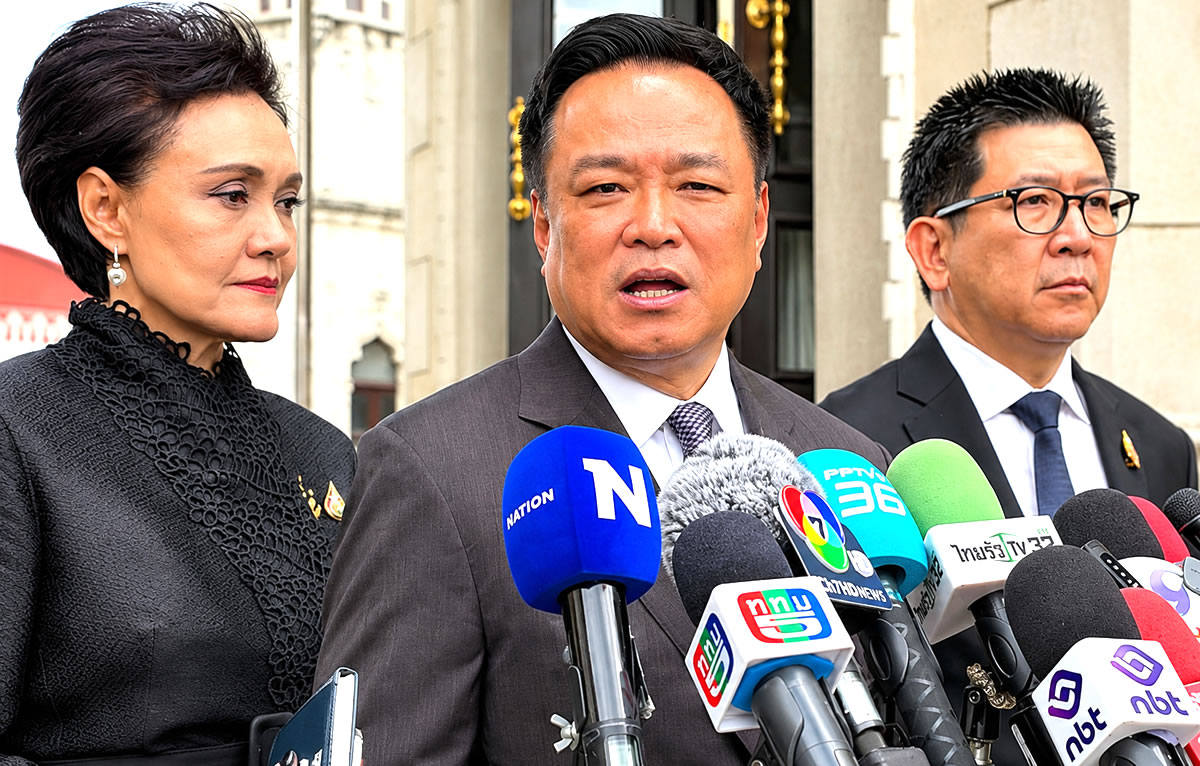
Prime Minister and Minister of Interior Anutin Charnvirakul on Thursday urged Thais not to panic or stockpile food. His intervention followed a 72-hour emergency preparedness warning from a department under his own ministry.
Meanwhile, Britain and the European Union have issued similar civilian preparedness guidance amid mounting international security tensions. The Pentagon is reportedly planning for American military installations to operate independently for 90 days. However, Thailand’s Prime Minister insisted the country would never face food shortages, citing its vast agricultural resources.
Speaking at Government House at 11.45 am on November 5, Prime Minister Anutin Charnvirakul dismissed fears over food security. He urged the population to continue normal activities despite growing concern about international developments. His comments followed emergency advice issued on November 2 by the Department of Disaster Prevention and Mitigation (DDPM). The agency operates under the Interior Ministry, which he also heads.
Anutin dismisses food shortage fears and urges Thais to live normally despite official emergency advice
“We must live our lives normally,” Prime Minister Anutin Charnvirakul declared when questioned about the advice. He warned against allowing events overseas to dictate public behaviour. “Don’t be swayed by things that might happen in other countries that are not the breadbasket countries,” he said.
The Prime Minister cited Thailand’s production of rice, cassava, sugar, vegetables, fruit and processed agricultural goods. Furthermore, he maintained that the country possessed a complete domestic food supply chain. He insisted the government would maintain adequate supplies and that Thailand would never experience food shortages.
Indeed, he suggested international instability could strengthen demand for Thai agricultural exports. Countries dependent on imported food might encounter difficulties, potentially creating opportunities for domestic producers. Separately, he addressed the threat of cyberattacks, saying manufacturers must protect their industrial supply chains.
Disaster chief urges 72-hour survival bags but says Thailand faces no warning of approaching war
On November 2, Department of Disaster Prevention and Mitigation Director-General Nirat Pongsitthaworn recommended that households prepare emergency survival bags.
These should contain sufficient provisions to sustain individuals and families independently for at least 72 hours. Recommended items included drinking water, ready-to-eat food, medicines, clothing, cash and communications equipment. Important personal documents should also be protected and kept accessible.
The department identified international conflict, cyberwarfare, sabotage, natural disasters, fires and civil disturbances among the emergencies requiring preparation. Such incidents could interrupt electricity, water, transport or telecommunications. Consequently, households might need to rely on their own resources until emergency assistance becomes available.
On November 4, Director-General Nirat Pongsitthaworn clarified that the advice was not a warning of approaching war. Instead, he explained that rescue services could face overwhelming demand during the first three days of a major emergency. Some communities might remain isolated, particularly where roads or communications networks had failed.
Notably, the director-general acknowledged that renewed European preparedness warnings had prompted questions about Thailand’s arrangements. His department had therefore repeated longstanding recommendations rather than identified a new domestic threat.
Security council denies Middle East stockpiling alert as Britain prepares households for disruption
Thailand’s National Security Council had already intervened in the public debate. On October 30, it denied issuing an emergency stockpiling alert linked to the Middle East conflict. The supposed warning concerned a 72-hour emergency arising from international hostilities. However, the denial addressed that specific claim, not the disaster department’s general household guidance.
There is an important distinction between panic buying and maintaining limited emergency provisions. Excessive purchasing can place sudden pressure on supermarket stocks and distribution networks. By contrast, preparing a three-day survival kit reduces dependence on outside assistance during a temporary emergency.
Britain launched its Be Ready campaign on October 22, encouraging households to prepare for serious disruption. The guidance recommended approximately nine litres of drinking water per person and three days of food. British Security Minister Dan Jarvis encouraged households able to follow the recommendations to make appropriate preparations.
Unlike conventional disaster campaigns, the initiative explicitly addressed hostile foreign activity and attacks on essential infrastructure. It identified climate-related disasters, technological dependence and hostile-state threats as major areas of concern. These risks could interrupt electricity, water supplies, telecommunications and other services essential to daily life.
British campaign highlights infrastructure failures as EU unveils fresh civilian emergency guidance
A prolonged electricity failure could disable water pumping stations, refrigeration and electronic payment systems. Similarly, communications outages could interfere with emergency coordination and public information. Supermarkets might struggle to operate, while transport networks could face disruption. Such failures could prevent households from obtaining supplies despite adequate stocks elsewhere.
The British government did not announce that an attack was imminent. Nevertheless, its campaign placed household preparedness within a wider national security framework. The objective was to strengthen civilian resilience during the initial stages of a serious emergency.
On November 3, the European Commission presented fresh preparedness guidance during the European Civil Protection Forum in Brussels. European Commissioner for Equality, Preparedness and Crisis Management Hadja Lahbib introduced the initiative. Its recommendations covered emergency supplies, public education, communications and assistance for vulnerable people.
As part of the programme, the Commission proposed an annual European Preparedness Day, beginning in October 2027. The guidance follows the European Union’s Preparedness Union Strategy, introduced in March 2025. Although non-binding, the latest recommendations seek common preparedness standards across the bloc’s 27 member states.
EU strategy targets cyberattacks, sabotage and threats to infrastructure amid tensions with NATO
The strategy identifies geopolitical conflict, cyberattacks, disinformation, climate disasters and threats to critical infrastructure. In addition, it calls for stronger emergency stockpiles, closer civilian-military cooperation and improved coordination with NATO. The programme extends beyond individual households to the continued functioning of governments and essential services.
Russia’s continuing confrontation with Ukraine and NATO provides a central security backdrop. European governments face concerns about military escalation, sabotage and attacks on energy infrastructure. Cyber operations could also disrupt civilian services without conventional military attacks taking place on national territory.
Accordingly, European preparedness planning increasingly combines national security, infrastructure protection and emergency management. The strategy recognises that civilian services can become targets or casualties during international conflict. Maintaining public communications and essential supplies is therefore part of the bloc’s broader security arrangements.
Pentagon plans 90-day military resilience as Sweden, Finland and Japan maintain emergency guidance
Across the Atlantic, the Pentagon is reportedly examining how American military installations could withstand prolonged disruption. According to an October 26 report by Fortune, the initiative is known as FORTRESS. It would enable essential military operations to continue for up to 90 days without normal external support.
The reported programme focuses on electricity failures and interruptions to logistical supply chains. Military installations depend on reliable power, fuel, communications and transport. Disruption to these systems could compromise operational capabilities and interfere with essential activities.
Unlike the British and European campaigns, the American initiative concerns military self-sufficiency rather than civilian household preparedness. Fortune also reported that the American and British initiatives were not known to be coordinated.
Elsewhere, several countries have maintained extensive civilian preparedness arrangements for years. Sweden’s guidance covers armed conflict, electricity failures and interruptions to essential supplies. Finland likewise recommends household self-sufficiency as part of longstanding national resilience planning. Japan maintains emergency arrangements reflecting its exposure to earthquakes and other natural disasters.
These established programmes demonstrate that emergency planning does not necessarily indicate an approaching catastrophe. Nevertheless, the latest British and European initiatives explicitly recognise hostile-state activity alongside conventional disaster risks.
Three-day survival guidance sets out water, medicine and equipment for households facing disruption
The 72-hour recommendation reflects established emergency management practice. During a major disaster, rescue organisations may be unable to reach every affected household immediately. Roads can become impassable, hospitals overwhelmed and communications unreliable. The three-day period is therefore a planning benchmark, not a guarantee that assistance will arrive within that time.
Thailand’s disaster prevention department recommends approximately three litres of drinking water per person daily. Consequently, an individual would require nine litres for three days. A four-person household would need approximately 36 litres. These quantities represent basic emergency provisions rather than prolonged stockpiling.
Additional supplies include essential medicines, torches, batteries and charged power banks. A battery-powered radio can provide official information when other communications systems fail. Households should also retain some cash and waterproof copies of important documents. Clothing, hygiene products and supplies for children or elderly relatives may be necessary.
For Thailand, the practical applications extend to familiar domestic emergencies. Floods, storms, landslides and earthquakes can isolate communities and interrupt transport. Severe flooding may leave households without reliable access to shops or public services for several days. Under those conditions, basic provisions can provide temporary independence while rescue operations continue.
Thailand’s food production cannot prevent distribution failures amid energy and shipping disruptions
Thailand’s extensive agricultural production provides advantages over countries heavily dependent on imported food. However, domestic production does not guarantee uninterrupted distribution during a major infrastructure failure. Agricultural products must reach distribution centres, wholesale markets, retailers and consumers.
Transport operations depend on fuel, functioning roads and communications networks. Refrigerated storage also requires reliable electricity. Furthermore, electronic payment systems support commercial transactions throughout the supply chain. A serious cyberattack could interfere with several of these functions simultaneously.
Thailand remains dependent on imported energy and international shipping. The continuing US-Iran conflict has increased concerns about Middle Eastern oil supplies and maritime trade. Disruption to energy imports could raise transport costs and interfere with industrial operations.
On another front, interruptions to shipping could complicate the movement of imported components and other commercial goods. Such developments would not necessarily cause nationwide food shortages. Yet they could affect distribution and economic activity even while domestic agricultural production remained strong.
The distinction exposes a limitation in the Prime Minister’s food security argument. A country can possess substantial agricultural resources while experiencing temporary difficulties delivering products to consumers. Emergency preparedness addresses those operational vulnerabilities rather than simply the quantity of food available nationally.
Global emergency preparations coincide with rising tensions but no shared intelligence alert is found
The international announcements have attracted attention because of their timing and the wider security environment. Russia’s confrontation with NATO continues, while the US-Iran conflict threatens energy markets and international shipping. Western governments are also strengthening protection against cyberattacks and sabotage affecting civilian infrastructure.
However, the available information does not establish that the announcements resulted from a shared intelligence warning. The European Union’s guidance developed from a strategy introduced in March 2025. Several other countries maintained emergency preparedness arrangements long before the current tensions.
In parallel, the programmes address different responsibilities. Britain is encouraging civilian households to maintain limited emergency supplies. The European Union is strengthening coordination between governments, emergency services and military organisations. The Pentagon’s reported initiative concerns the operational independence of American military installations.
Anutin’s reassurances leave questions over how Thailand should balance preparedness and food hoarding
For Thailand, the central issue is the government’s response to emergency advice issued under its own authority. Prime Minister and Minister of Interior Anutin Charnvirakul has sought to prevent public alarm over possible food shortages. His disaster prevention agency has recommended practical preparations for temporary disruption to essential services.
Neither the Thai advice nor the international initiatives establish that a major catastrophe is imminent. However, the developments reflect increasing concern about emergencies extending beyond conventional natural disasters. Thailand’s agricultural strength offers protection against food scarcity, but cannot guarantee uninterrupted access to essential services.
Bangkok preps for renewed war between Iran and the United States in coming weeks. Key meeting this week
PM’s remarks on shooting burglars at home prompt hostile reaction. Police clarify self defence is legal
The Prime Minister’s reassurances therefore leave an important question unresolved. His department has identified circumstances in which households could temporarily lose access to supplies despite adequate national production. The government’s challenge is to distinguish sensible emergency preparation from unnecessary hoarding without undermining its own disaster prevention advice.