Microsoft says Thai workers are using advanced AI at more than double the global average, creating new forms of work once thought impossible. The company now urges businesses to overhaul workflows before they fall behind.
Thailand’s workforce is embracing advanced artificial intelligence at one of the fastest rates in the world, with Microsoft revealing that nearly one in three employees now use AI at an advanced level—more than double the global average—while almost nine in ten already rely on it to develop ideas. However, the technology giant warns that many organisations risk falling behind unless executives rapidly redesign workplaces, support AI experimentation and overhaul traditional business processes, as AI evolves from a simple productivity tool into a partner capable of creating entirely new forms of work and reshaping Thailand’s digital economy.
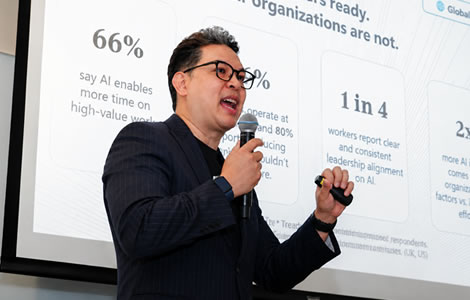
Thai workers are adopting advanced artificial intelligence at more than twice the global average, according to Microsoft’s Work Trend Index 2026.
The report paints a picture of a workforce rapidly embracing AI beyond simple automation. Instead, employees are increasingly relying on the technology to generate ideas, analyse information and support business decisions.
Thanawat Suthamphan, Managing Director of Microsoft Thailand and Emerging Markets, presented the findings. He said Thai workers are highly receptive to experimenting with AI across the workplace.
Thai workers embrace advanced AI at more than twice the global rate as innovation moves beyond automation
The report found that 89% of employees already use AI-generated results as the foundation for developing their own ideas. Meanwhile, 32% now qualify as advanced AI users. That is more than double the global average.
Notably, more than 86% of those advanced users said AI enables them to create entirely new types of work that were previously impossible.
“Thai workers are ready and receptive to experimenting with AI. The key challenge for Thai organisations today is not just to encourage employees to use AI to increase daily work efficiency, but to use AI as an opportunity to review and redesign entire work processes. Executives must play a crucial role in identifying which processes need modification, and then bring technology, experts, and employees together to create new work models that integrate the capabilities of people and AI. Promoting analytical thinking and skills among personnel is also essential to elevate AI from basic tasks to effectively controlling and evaluating more complex work outcomes.”
His comments reflect a shift identified throughout the report. AI is no longer viewed simply as another workplace tool. Rather, Microsoft says it is becoming an active partner in how employees perform their jobs.
Consequently, organisations face pressure to rethink workflows instead of merely improving existing routines. The report argues that redesigning work around AI will deliver greater benefits than simply adding AI to established processes.
Thai firms outpace global peers on AI strategy, but leadership support still trails workforce enthusiasm
The findings also suggest Thai businesses have made visible progress in setting strategic direction. Some 51% of Thai employees said management has established a clear AI vision. By comparison, the global average stands at just 26%. Regionally, Thailand also outperformed several neighbouring countries. Vietnam recorded 48%, while Indonesia reached 42%.
Even so, executive backing remains less developed than employee enthusiasm. Only about one-third of Thai executives are prepared to support staff experimenting with new AI applications before immediate business results emerge.
As a result, Microsoft says many organisations remain caught in what it calls the “Transformation Paradox”. Employees are advancing quickly, yet leadership structures have not fully adapted to match that pace.
Separately, Microsoft’s global Copilot data illustrates how workplace AI is evolving. More than 49% of users now rely on AI for analysis, reasoning and decision support. Those functions extend well beyond basic information searches.
Instead, they place AI directly inside everyday business processes. Most commonly, employees use AI to solve problems and collaborate on high-priority decisions. That category accounts for 28% of reported usage worldwide.
Microsoft’s three-level strategy urges firms to embed AI into everyday work and long-term transformation
In response to those trends, Microsoft’s report outlines a three-level strategy for organisations seeking to become what it describes as Frontier Firms.
The recommendations span employees, management and organisational leadership. Together, they are intended to help companies move beyond isolated AI projects towards permanent operational transformation.
At employee level, Microsoft recommends accelerating critical thinking and quality control skills. It also encourages organisations to build confidence among staff to experiment with new approaches.
In parallel, employees should be encouraged to reshape everyday work practices instead of simply completing existing tasks faster. Microsoft believes that this process supports bottom-up innovation throughout an organisation.
At management level, the report recommends integrating AI transformation into normal work responsibilities. Rather than treating AI as a separate initiative, leaders should embed experimentation into everyday operations.
Managers should also allocate sufficient time and resources for employees to strengthen their capabilities. According to Microsoft, that approach allows staff to develop their potential while creating sustainable organisational change.
Businesses urged to adapt workflows for AI while maintaining security, transparency and governance
On another front, the report urges organisations to learn continuously from internal AI adoption. Companies should closely monitor usage patterns alongside changes affecting personnel, workloads and operating systems.
Those observations should then guide workflow redesign. Businesses are also encouraged to build continuous learning systems while maintaining security, transparency and good governance throughout the transition.
Microsoft invited executives from leading Thai companies to discuss practical AI implementation during the report’s presentation. Dr Teerawat Asavapokee, Senior Executive Vice President of Kasikornbank Public Company Limited, outlined KBank’s dual-track AI strategy.
“KBank’s AI strategy operates on two reinforcing approaches: firstly, distributing AI power to all employees through AI self-service tools to enable smarter work, and secondly, expanding enterprise-level AI capabilities to encompass internal knowledge management, intelligent recommendations, and operational intelligence, thereby enhancing the experience for both employees and customers on a broad scale.”
Leading Thai companies outline practical AI strategies as Microsoft promotes frontier firm change
His remarks highlight the bank’s emphasis on combining workforce access with enterprise-wide AI infrastructure. The strategy also extends AI beyond productivity gains into knowledge management and operational intelligence.
Likewise, Akkarin Phurisit, Chief People Officer of Central Pattana Public Company Limited, described AI as reshaping workforce roles rather than replacing them.
“The future of work is about people and AI growing together. At Central Pattana, our people are shifting from ‘doers’ to ‘thinkers and decision-makers,’ with AI enhancing their capabilities.
Democrat Party Deputy Leader reveals flaws in the TH-AI Passport plan and calls on Minister to abort it
Self taught Thai hacker learned the trade to access police data systems and wipe his own arrest warrants
However, decisions regarding people must always be made by people, because this transition begins with people and ends with people – we will move towards this future together.”
Finally, Microsoft said transforming Thai organisations into Frontier Firms requires coordinated action across every level of a business. The company said organisations must combine human capability with reliable and secure AI systems.
They must also convert practical experience into what it describes as “Owned Intelligence”. Microsoft said it remains committed to supporting Thai organisations throughout that transition while contributing to the long-term growth of Thailand’s digital economy.
Join the Thai News forum, follow Thai Examiner on Facebook here
Receive all our stories as they come out on Telegram here
Follow Thai Examiner here
Further reading:
Ministry fails to halt ฿25.4 billion payment order to Hong Kong based firm linked to 1990 contract
Microsoft accepts charges of corrupt payments in Thailand as it makes a deal with US investigators
Provincial agency boss arrested in Mukdahan after trying to extort ฿2 million from a businessman
Parliamentary vote on constitutional reform is questioned, court says referendum may be needed
Bangkok MP on Phuket mission to investigate controversial local condo project before the courts
Drinks giant Thai Beverage to resume expansion with Singapore IPO for Asean regional beer operation