Government anger closes in on Thai Airways as 8,000 bags remain stranded at Suvarnabhumi. Phiphat takes charge, Air Force reinforcements move in and flights remain cut after Surasak tells unwilling THAI executives to resign over the deepening crisis.
Government anger at Thai Airways boiled over Wednesday as the baggage crisis grew far beyond the airline’s first figures. Deputy Prime Minister and Minister of Transport Phiphat Ratchakitprakarn took charge after accumulated stranded luggage hit about 10,000 bags. Around 8,000 remained outstanding as military reinforcements and equipment flooded into Suvarnabhumi Airport. His intervention followed a blistering attack by Minister of Tourism and Sports Surasak Phancharoenworakul. He accused THAI management of serious failures and told unwilling executives to resign. Meanwhile, flights remained cancelled, schedules were slashed and cargo operations came under pressure. Suvarnabhumi never closed, yet Thailand’s flag carrier remained badly disrupted days after flooding triggered the crisis of overflowing baggage.
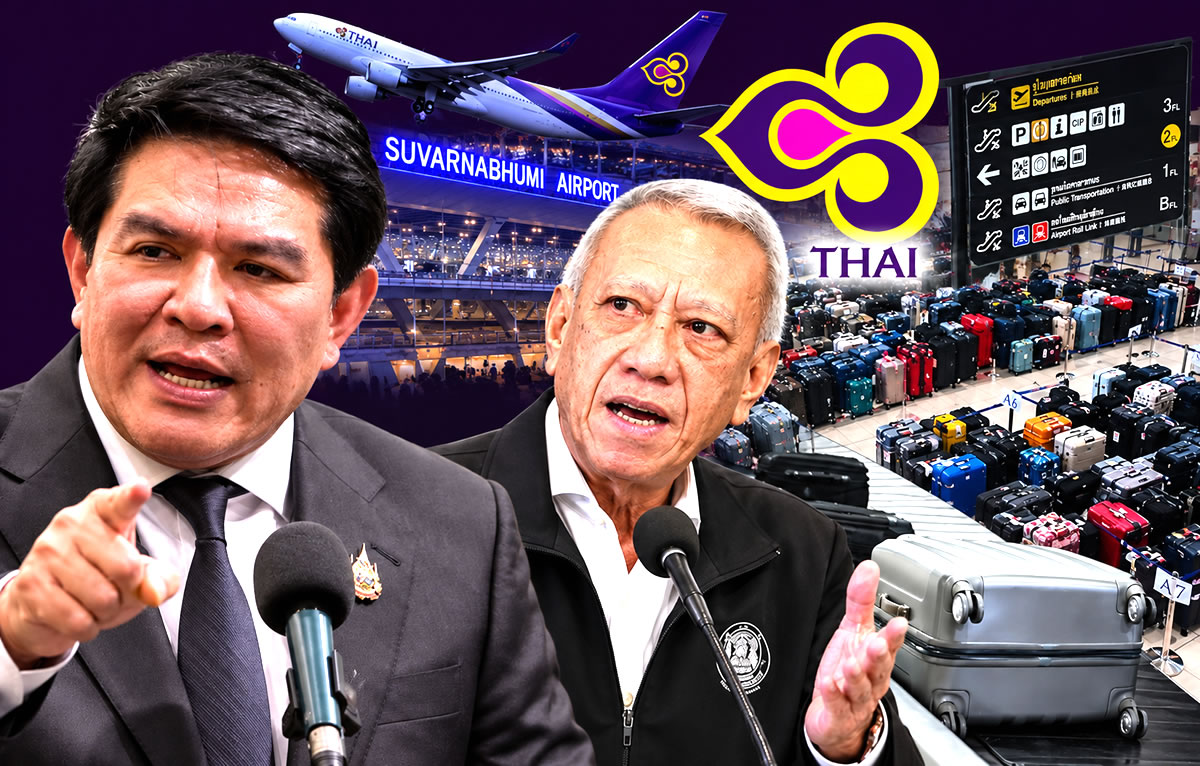
Deputy Prime Minister and Minister of Transport Phiphat Ratchakitprakarn stepped directly into the emergency at Suvarnabhumi Airport. Crucially, new government figures showed the problem was substantially larger than Thai Airways had previously disclosed.
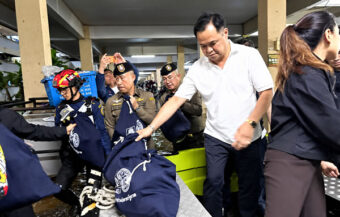
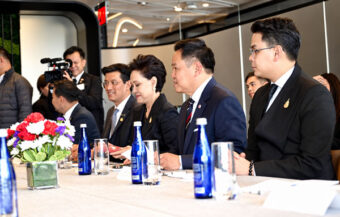
Mr Phiphat summoned Thai Airways International (THAI), Airports of Thailand (AOT) and the Civil Aviation Authority of Thailand (CAAT). Other agencies involved in the emergency also attended. In response, the government mobilised additional military personnel and equipment to tackle the huge baggage backlog. Mr Phiphat also intervened to keep Thai Airways’ cargo operation running.
His intervention followed a blistering attack Tuesday by Minister of Tourism and Sports Surasak Phancharoenworakul. Mr Surasak accused THAI management of mishandling the crisis after flooding prevented hundreds of employees from reaching work. However, his criticism extended far beyond the original manpower shortage. He directly questioned decisions taken by management after the disruption began.
Surasak attacks THAI over staff deployment and poor coordination as military personnel arrive to help
In particular, Mr Surasak attacked THAI for continuing to deploy scarce employees to service other airlines. He said the airline appeared concerned about contractual penalties from those customers. As a result, according to Mr Surasak, Thai Airways’ own flights suffered some of the worst disruption.
The accusation struck directly at management’s handling of limited manpower during an emergency. Heavy rainfall had already prevented large numbers of ground workers reaching Suvarnabhumi. Yet Mr Surasak said remaining employees were still assigned to other airline contracts. He described the decision as highly reprehensible.
Separately, the minister attacked THAI’s coordination with military personnel sent to help. The Ministry of Defence had arranged hundreds of soldiers and vehicles for the recovery operation. Mr Surasak said those personnel arrived without adequate information, food or accommodation. Eventually, some returned to their military units for meals before travelling back to Suvarnabhumi.
“The soldiers who went to help didn’t even have food to eat or accommodation,” Mr Surasak said. “They had to go back to their unit to eat and then come back, which is very reprehensible.”
Surasak tells unwilling THAI executives to resign as baggage crisis grows far beyond initial figures
He said government agencies wanted to help the airline. Instead, he accused THAI of failing to provide sufficient information or coordinate the response effectively.
“Everyone wanted to help, but Thai Airways seemed to be not providing any information or trying to solve the problem,” he said. He added that the crisis affected Thailand’s image, tourism and Thai Airways’ reputation.
Notably, Mr Surasak then turned directly on senior executives. He questioned the position of managers approaching the end of their terms. He said executives unwilling to tackle the crisis should make way for people prepared to do so.
“If you think your term is ending and you’re not going to do anything, I think that’s unacceptable,” he said. “Resigning would be better, or if you don’t want to do anything, you should reconsider your position quickly.” He said others willing to do the work could then step in.
Within 24 hours, the scale of the operational problem became clearer. Mr Phiphat disclosed Wednesday that around 10,000 bags accumulated during the September 26-28 disruption. Between September 29 and 30, officials sorted and returned only about 1,800 bags.
Consequently, approximately 8,000 bags remained stranded as the government intensified its intervention. The cumulative total was far above the 5,600 delayed bags previously disclosed by Thai Airways. The 10,000 figure covered baggage accumulated during the worst period. It did not mean all 10,000 bags remained stranded simultaneously.
Phiphat deploys 100 more Air Force personnel and equipment as 8,000 stranded bags await processing
Still, about 8,000 bags remained outstanding Wednesday. That left the government confronting a huge clearance operation several days after the initial breakdown. It also placed THAI’s earlier 72-hour recovery effort under renewed pressure.
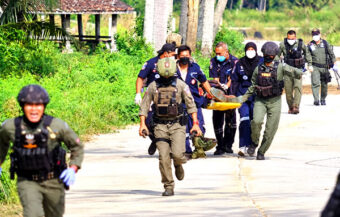
In parallel, the government sharply increased outside assistance at Suvarnabhumi. Another 100 Royal Thai Air Force personnel were dispatched Wednesday. Wing 6 also supplied 12 cargo-handling machines and their drivers. Military support had already been provided since September 26.
Mr Phiphat then imposed a tight recovery timetable. He wants the accumulated baggage cleared by October 1. Officials will have until October 2 to resolve any remaining cases. Normally, however, a maximum of around 2,000 bags can be processed daily.
That created a formidable workload. Roughly 8,000 bags remained outstanding Wednesday, while new flights continued arriving and departing. Staff therefore had to clear old luggage without allowing another backlog to develop.
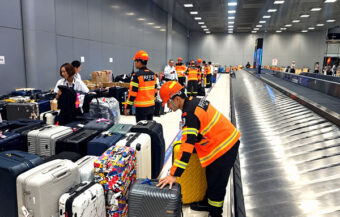
As part of this, military personnel were assigned much of the physical work. They can lift, move and transport baggage through the airport. Thai Airways employees, however, must check tags and perform specialist sorting. Those jobs require trained personnel and accuracy.
Military reinforcements tackle old baggage as THAI works to prevent another airport luggage backlog
The military therefore cannot simply replace missing THAI baggage staff. Instead, the reinforcements increase the manpower available for moving thousands of stranded bags. Airline employees must then identify, sort and dispatch them correctly.
There was one important improvement. Since September 29, baggage from new flights has largely been processed on a daily basis. Accordingly, the historical backlog was no longer increasing at its previous rate. Thousands of older bags nevertheless remained trapped inside the system.
Transit passengers presented another urgent problem. Some had already continued their journeys without their luggage. Thai Airways must therefore identify affected passengers individually. The airline must then coordinate delivery using available contact details.
Earlier, Mr Surasak had challenged the practicality of delayed baggage delivery. He said foreign visitors could not necessarily wait several days for their belongings. Some could leave Thailand before their luggage reached their hotels. He therefore questioned whether later delivery represented an effective answer.
The minister had first-hand experience of the disruption. He inspected Suvarnabhumi after returning from the Asian Games. He also failed to receive his own luggage immediately.
Surasak describes five-hour baggage waits as flooded roads leave THAI desperately short of ground staff
“The other day I had the opportunity to observe the situation at the airport,” he said. “The problem was specific to Thai Airways.” He said arriving passengers waited five or six hours for their luggage. Some waited even longer.
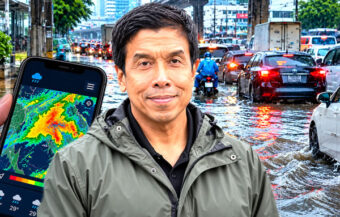
Mr Surasak accepted that severe rain triggered the original staffing problem. Flooded roads prevented many baggage handlers from reaching Suvarnabhumi. Consequently, luggage began accumulating rapidly while flights continued operating.
“The main reason was the rainy season, which prevented baggage handlers from coming to work,” he said. “This led to a buildup of luggage, creating a major problem.”
From there, the disruption spread beyond the baggage belts. Aircraft could not be unloaded efficiently. Some aircraft therefore could not proceed normally to their next scheduled services. At the same time, baggage for departing passengers could not be loaded efficiently.
Suvarnabhumi Airport itself never closed. Flights continued despite serious flooding around the airport. Instead, flooded roads prevented large numbers of airline employees from reaching work. THAI consequently suffered a severe manpower shortage while the airport remained operational.
Thai Airways normally had about 500 ground workers available. During the worst disruption, roughly 200-300 could not report for work. The airline therefore lost a large share of its ground-handling workforce almost immediately.
THAI cuts capacity after losing hundreds of ground workers as baggage and flight delays spread rapidly
The impact spread rapidly. Almost every Thai Airways flight suffered delays during the worst two days. Meanwhile, the carrier cut its Bangkok capacity by around 30-40% while attempting to stabilise operations.
Chief Executive Officer Chai Eamsiri subsequently apologised. He also acknowledged that Thai Airways initially underestimated the severity of the disruption. The airline launched a 72-hour recovery operation as baggage continued accumulating.
By Wednesday, however, government figures illustrated the size of the task still facing THAI. The cumulative baggage problem had reached approximately 10,000 bags. Only around 1,800 had subsequently been sorted and returned.
More importantly, Mr Surasak’s criticism was not confined to THAI’s initial assessment. He questioned how executives deployed employees after the staffing shortage became clear. His most serious criticism concerned ground-handling work performed for other airlines.
According to Mr Surasak, THAI continued assigning limited workers to those contracts. He said the airline appeared intent on avoiding contractual penalties. In turn, he said THAI’s own passengers suffered particularly severe disruption.
His criticism also focused heavily on military assistance. Hundreds of soldiers and vehicles had been made available. Nevertheless, he said THAI failed to provide basic coordination for personnel arriving to help.
Surasak turns fire on THAI management over airline contracts and poor coordination with military teams
Mr Surasak also challenged management’s urgency. “I’ve experienced this firsthand; I felt more anxious than those in charge,” he said. “This isn’t just about one person; it’s about the reputation of the country.”
On another front, he demanded action from the Ministry of Finance. Thai Airways is no longer a state enterprise following its restructuring. The Finance Ministry, however, remains its largest shareholder.
Mr Surasak therefore urged the ministry to exercise its shareholder position. He wanted a Thai Airways board meeting convened over the disruption. The board should consider the impact and management’s response, he said.
By Wednesday, another part of THAI’s operation was also under pressure. Its cargo business faced serious manpower and storage constraints. Reports emerged that cargo operations could be suspended.
Mr Phiphat subsequently intervened. Following Wednesday’s meeting, he confirmed THAI would continue receiving and dispatching cargo at Suvarnabhumi. Both inbound and outbound operations would remain open.
Surasak seeks Finance Ministry action as Phiphat intervenes to keep THAI cargo operations running
Some procedures could nevertheless take longer while operators managed available space. AOT therefore began clearing additional areas for freight stranded aboard transport trucks. Temporary rainproof tents were also erected to protect goods awaiting onward movement.
At the same time, the Royal Thai Air Force reinforced the cargo operation. Wing 6 supplied 12 cargo-handling machines and drivers. Government resources were consequently supporting both passenger baggage and freight operations.
Mr Phiphat said agencies would add personnel and equipment wherever shortages remained. The Transport Ministry also ordered Thai Airways to report continuously on recovery progress. Officials would then assess baggage clearance and wider operational performance.
CAAT applied pressure from another direction. The regulator demanded urgent corrective measures from THAI as the disruption continued. These included better operational management and flight adjustments or consolidation where required. CAAT also sought a dedicated operation for passenger complaints.
Taken together, the measures represented a broad government intervention into the recovery. The Transport Ministry was coordinating the response. AOT was creating extra cargo capacity. CAAT was demanding operational changes.
Government widens airport intervention as Air Force, AOT and CAAT reinforce THAI recovery operations
Alongside them, the Army and Royal Thai Air Force were supplying manpower. The Air Force was also providing cargo equipment. Thai Airways employees remained responsible for specialist baggage identification and sorting.
Yet the immediate numbers remained severe. About 10,000 bags accumulated during the September 26-28 disruption. Only approximately 1,800 were sorted and returned during September 29-30. Around 8,000 therefore remained outstanding on Wednesday.
Current passengers also required normal baggage services. THAI was consequently running two major baggage operations simultaneously. Staff had to prevent fresh accumulation while clearing thousands of older bags.
Beyond baggage, the airline still faced a heavily disrupted flight schedule. THAI normally operates around 115 flights daily. It was not expected to return immediately to that level.
Plans called for approximately 100 flights on Thursday, October 1. The figure was expected to rise to around 105 on October 2. Full operations of roughly 115 daily flights were expected within seven days.
Thus, clearing the baggage backlog would not itself restore normal operations. Flight cancellations were already extending into Thursday. Four major European departures were among the services cancelled.
THAI faces reduced schedules and European cancellations as thousands of bags remain stranded
TG930 from Bangkok to Paris was cancelled. TG934 from Bangkok to Brussels was also removed. TG940 to Milan and TG960 to Stockholm were cancelled as well.
Those flights formed part of 37 additional cancellations covering September 29 through October 1. Thursday was therefore set to remain another disrupted day for Thai Airways at Suvarnabhumi.
Even so, officials reported progress in one crucial area. New-flight baggage had been handled daily since September 29. That reduced the danger of another rapidly expanding pile of luggage.
It did not, however, solve the historical backlog. Nor did it restore the airline’s full schedule. Passengers who had already travelled overseas also remained separated from their belongings.
Those cases require individual tracing and delivery. The recovery therefore involves several different operations running simultaneously.
First, THAI must clear thousands of accumulated bags. Second, it must keep baggage moving for current flights. Third, it must restore its reduced flight schedule. Finally, cargo must continue moving despite ongoing manpower and storage pressures.
THAI battles baggage, flight and cargo disruption simultaneously as recovery operation enters new phase
Against that backdrop, Mr Surasak’s attack on management remained unresolved Wednesday. THAI management had apologised for the disruption. Mr Chai had also acknowledged that the airline underestimated its severity.
There was, however, no announcement that senior executives intended to resign. Nor was there a substantive public response to Mr Surasak’s accusation over staff allocation.
Specifically, the minister accused THAI of deploying scarce employees to service other airlines. He said avoiding contractual penalties contributed to worse disruption for the flag carrier’s passengers.
His complaints concerning military coordination also remained unanswered publicly. Mr Surasak said soldiers arrived ready to help but lacked adequate support from Thai Airways.
Mr Phiphat adopted a different emphasis Wednesday. He said the immediate priority was resolving the crisis rather than assigning blame. He also pointed to the exceptional scale of Thai Airways’ operation.
The carrier handles a large volume of flights and passengers at Suvarnabhumi. Losing hundreds of ground workers therefore produced an immediate operational shock. Nonetheless, Mr Phiphat acknowledged damage to Thai Airways and Thailand’s international image.
Surasak’s attack remains unanswered as Phiphat shifts focus towards an urgent operational recovery
His response concentrated on manpower, equipment, baggage clearance and cargo capacity. Mr Surasak, by contrast, concentrated heavily on management decisions and responsibility.
Both ministers were nevertheless confronting worsening figures. The cumulative baggage accumulation reached approximately 10,000. About 8,000 bags remained outstanding Wednesday.
In addition, military involvement was expanding rather than winding down. Cargo required government intervention to remain operating. Flight cancellations extended into Thursday. THAI’s normal daily schedule also remained reduced.
The disruption had therefore moved far beyond the original weekend staffing shortage. Heavy rain triggered the crisis by preventing workers from reaching Suvarnabhumi. Its consequences then spread across several parts of the airline’s operation.
Arriving baggage was affected. Departing luggage was delayed. Connecting passengers travelled without bags. Aircraft rotations were disrupted. Cargo operations then came under pressure.
Subsequently, military personnel became increasingly involved in the recovery. The government imposed deadlines and demanded continuing progress reports. It also supplied additional machinery and opened temporary freight space.
Phiphat leads expanding government response as THAI disruption spreads from baggage to flights and cargo
Mr Phiphat now wants the main baggage backlog eliminated by October 1. Any residual cases should be completed by October 2. The target requires a rapid acceleration from normal baggage-processing capacity.
Ordinarily, only around 2,000 bags can be processed daily. Yet approximately 8,000 remained outstanding Wednesday. Military manpower has therefore become central to the accelerated clearance effort.
At the same time, THAI employees must continue specialist identification and sorting. Current flights must keep operating. Cargo must keep moving. Overseas passengers must receive missing bags.
The airline must also restore its reduced schedule. That means recovery cannot be measured solely by the number of old bags remaining.
Tuesday and Wednesday consequently produced two distinct stages in the government’s response. First came Mr Surasak’s public attack on management. Then came Mr Phiphat’s direct operational intervention as the larger baggage figures emerged.
Surasak’s attack and Phiphat’s intervention mark two stages in government response to THAI crisis
Mr Surasak questioned THAI’s decisions, coordination and urgency. He also suggested unwilling executives should resign. Furthermore, he called on the Finance Ministry to bring the matter before THAI’s board.
The following day, Mr Phiphat brought THAI, AOT, CAAT and other agencies together. Another 100 Air Force personnel were deployed. Wing 6 supplied 12 cargo-handling machines and drivers.
AOT also cleared extra cargo space and erected rainproof tents. THAI was ordered to provide continuing progress reports. At the same time, cargo operations were kept open rather than suspended.
Despite those measures, Wednesday’s figures showed the recovery remained incomplete. Around 8,000 bags were still outstanding. The flight schedule remained below normal.
Thursday will therefore provide another major test for Thai Airways. Four European departures are already cancelled. The airline must simultaneously clear old baggage and process luggage from current flights.
It must also keep cargo moving while restoring its wider network. Meanwhile, military personnel and equipment remain embedded in the recovery effort.
THAI enters another critical day with 8,000 bags outstanding and military still supporting recovery
The airport itself never closed during the flooding. Yet Thailand’s flag carrier remained seriously disrupted several days after the original manpower shortage.
The original 5,600 delayed-bag figure has now been overtaken by the government’s cumulative total of approximately 10,000. Moreover, thousands of bags remained unresolved Wednesday.
Mr Surasak’s attack had already put THAI management under intense government pressure. Within a day, Mr Phiphat was personally coordinating the wider recovery.
Thai Airways admits it got it wrong as Suvarnabhumi Airport public areas are swamped by a baggage flood
Thai Airways CEO apologises for ongoing flooding crisis issues with defective carts and delayed flights
The government now wants the baggage mountain cleared by October 1-2. Thai Airways must achieve that while operating flights, handling new luggage and maintaining cargo services.
For now, military reinforcements remain at Suvarnabhumi. The flight schedule remains reduced. Thousands of bags still require processing.
And the management row triggered by Mr Surasak’s extraordinary Tuesday intervention remains unresolved.
Join the Thai News forum, follow Thai Examiner on Facebook here
Follow Thai Examiner on Google here
Receive all our stories as they come out on Telegram here
Follow Thai Examiner here
Further reading:
Bangkok airports open and flights running but there are delays and baggage issues at Suvarnabhumi
Engineers work through night after Sunday’s fire on Bangkok’s Blue Line saw more damage than thought
Arrested man linked with Chatuchak building collapse now tells police he is a Chinese state employee