Floodwaters threaten a wider economic shock as the Bank of Thailand warns indebted households and small firms are already stretched. Losses could reach ฿33.8 billion as hotels lose bookings, factories halt and tourism takes a hit.
Thailand’s flood crisis is punching into the wider economy as the Bank of Thailand warns of mounting pressure on indebted households and small businesses. Bangkok hotels are already losing bookings during China’s Golden Week, while supply-chain disruption has halted four Toyota plants. Economists put nationwide losses as high as ฿33.8 billion. Yet major hotels, airports and central Bangkok remain open, prompting industry fears that dramatic flood images could drive tourists elsewhere. With household finances already weakened by successive shocks, the flooding is rapidly becoming an economic crisis far beyond the streets underwater.

Thailand’s flood crisis is hitting an economy where vulnerable households and small businesses already face severe financial pressure. The Bank of Thailand now warns that the damage could persist after floodwaters recede. Its concern centres on borrowers already weakened by repeated economic shocks.
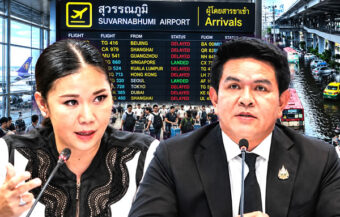
Assistant Governor for Corporate Relations and BOT spokesperson Chayawadee Chai-Anant highlighted the mounting pressure on stretched borrowers. She said successive shocks had weakened balance sheets before the latest flooding arrived.
“Small businesses and vulnerable groups could face a heavier debt burden,” Ms Chayawadee warned. “Successive economic shocks are weakening their balance sheets. That is quite worrying.”
Flood disruption spreads across key sectors as billions in economic losses begin mounting across Bangkok
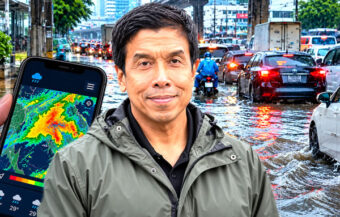
Already, the flooding is disrupting economic activity far beyond Bangkok’s submerged roads. Services, transport, retail, wholesale, construction and goods distribution have been affected. Hotel bookings are also being cancelled or postponed as travellers reconsider visits.
In parallel, economists are calculating losses running into billions of baht. The final economic cost remains unclear because flooding continues across Bangkok and other provinces. Still, the effects are increasingly visible across major sectors.
Services have taken a direct hit alongside transport and goods distribution. Retailers and wholesalers have also suffered disruption, while construction activity has been affected. Initially, manufacturing escaped much of the wider impact.
More recently, supply-chain disruption temporarily stopped operations at four Toyota plants. That development pushed the economic impact beyond businesses and communities directly exposed to floodwater.
Separately, the central bank is watching household purchasing power closely. It is also monitoring tourism confidence as Thailand approaches the final months of 2026. Both issues could extend the economic impact beyond the immediate emergency.
Bangkok hotel cancellations rise as Golden Week visitors reconsider trips amid widespread flood images
That concern is now reflected in Bangkok’s hotel industry. Thai Hotels Association President Thienprasit Chaiyapatranun confirmed cancellations and postponed reservations. The THA has started surveying members to establish how many travellers have changed their plans.
For now, complete survey results have not been released. However, THA expects Bangkok hotel occupancy to decline during September and October. It forecasts a year-on-year fall of less than 10%.
Notably, the flooding has struck during an important period for international tourism. China’s National Day Golden Week began on October 1. The disruption therefore coincides with a major outbound travel period for Chinese visitors.
At the same time, THA is concerned about images reaching potential visitors overseas. Pictures of flooded Bangkok roads can influence perceptions about conditions across the entire capital. The actual physical impact is more concentrated.
Most major Bangkok hotels have not suffered direct flooding. Central business districts and important tourism areas also remain largely operational. Thon Buri and Phra Nakhon have continued functioning despite serious flooding elsewhere.
Eastern Bangkok bears worst flooding as hotels face cancellations and tourists consider other destinations
Instead, some of the worst inundation has been concentrated across eastern Bangkok. Affected districts include Bang Kapi and areas around Ramkhamhaeng. Srinakarin and On Nut have also experienced serious disruption.
On another front, parts of neighbouring Samut Prakan have been hit. However, comparatively fewer hotels are concentrated across the worst affected areas. That limits direct damage to Bangkok’s principal hotel districts.
Even so, the tourism impact can spread beyond areas physically underwater. Accessibility and overseas perceptions have become important concerns for the hotel industry. Travellers can also alter reservations shortly before arriving.
Mr Thienprasit said bookings can be changed or cancelled just two or three days beforehand. As a result, hotels remain exposed to last-minute cancellations while flooding continues. Prolonged disruption could also send travellers towards competing destinations.
Meanwhile, the Association of Thai Travel Agents expects Bangkok tourism to feel the impact for around 10 days. It has also warned that some international visitors could switch to other countries.
Golden Week raises tourism stakes as airports stay open and Bangkok keeps major transport routes running
Against that backdrop, the Golden Week period increases the immediate stakes. Chinese travellers considering Bangkok can still alter their itineraries. Hotels therefore face uncertainty even when their properties remain dry and accessible.
Yet THA has stressed that current conditions differ substantially from the catastrophic 2011 floods. Mr Thienprasit estimates that current flooding affects around 30–40% of Bangkok. Large parts of the capital remain operational.
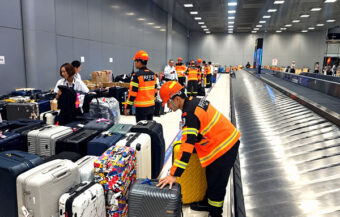
Crucially, both major Bangkok airports remain open. Suvarnabhumi Airport continues operating despite the wider disruption. Don Mueang Airport is also operating.
Elsewhere, several important transport arteries remain usable. Vibhavadi Rangsit Road continues providing access, while Bangkok’s motorway network remains operational. Expressways towards central areas are also functioning.
Consequently, large sections of Bangkok remain accessible despite severe flooding in other districts. THA believes conditions could also improve relatively quickly if heavy rainfall subsides.
Unlike some provincial floods, Bangkok inundation generally does not leave large deposits of heavy mud. Affected areas can therefore recover faster after water levels fall. THA believes flooded locations could drain within seven days under favourable conditions.
Hotel industry seeks clearer flood messaging as economic losses climb towards ฿17 billion nationwide
In response, the hotel industry wants clearer information reaching international markets. THA has called for accurate communication from the Bangkok Metropolitan Administration. It also wants the Tourism Authority of Thailand involved.
Specifically, travellers need accurate information about flooded districts and accessible areas. They also need information about usable roads and functioning tourism zones. THA wants to prevent localised flooding from being interpreted as citywide paralysis.
Beyond tourism, however, the financial losses are already mounting. Kasikorn Research Centre initially estimates damage between ฿7 billion and ฿17 billion. That represents approximately 0.03–0.11% of gross domestic product.
Importantly, those calculations assume disruption lasting only three to seven days. Continued flooding could therefore drive losses considerably higher. The scale depends partly on whether disruption spreads further through the economy.
For example, additional manufacturing stoppages would increase the cost. Problems affecting logistics would add further losses. Disruption to important supply chains could also broaden the damage.
Economist puts nationwide flood losses at up to ฿33.8 billion as household finances come under strain
Other estimates are already substantially higher. Rangsit University economist Aat Pisanwanich estimates nationwide losses between ฿16.9 billion and ฿33.8 billion. His central scenario places Bangkok’s losses at approximately ฿10.6 billion.
By comparison, his calculations suggest a 0.36–0.73% impact on third-quarter GDP. However, those figures cover a different measurement period from annual GDP estimates. They therefore cannot be compared directly.
More broadly, the headline figures do not capture every financial consequence. Many households entered the flooding with already stretched finances. Thailand’s economic growth was also expected at only around 2–2.5%.
For workers dependent on daily income, disruption can immediately reduce earnings. Flooded roads can prevent employees from reaching workplaces. Closed businesses can also eliminate income from the first day.
Nevertheless, household loan repayments continue. Rent and other fixed expenses also remain payable. The financial squeeze can therefore begin before homes or businesses suffer direct physical damage.
Small businesses and indebted households face mounting pressure from successive economic shocks
Small companies face similar pressures. Sales can disappear while wages, loans and operating costs remain. Even short disruptions can consequently weaken businesses already operating with limited financial buffers.
Likewise, Standard Chartered economist Tim Leelahaphan has highlighted risks facing vulnerable households. He warned that headline flood-loss estimates could conceal heavier financial consequences for these groups.
Bangkok and surrounding provinces account for roughly half of Thailand’s economic output. Meanwhile, high household debt limits the ability of many families to absorb sudden income losses.
This is the core of Ms Chayawadee’s warning. The BOT is looking beyond damaged homes, roads and businesses. It is examining borrowers already weakened before the latest crisis.
Successive economic shocks have eroded household and small-business balance sheets. The latest flooding has now added another disruption. For heavily indebted borrowers, lost income can compound existing financial pressure.
BOT urges banks to assist flood-hit borrowers as public debt and reconstruction costs add fiscal pressure
As part of its response, the BOT is encouraging financial institutions to assist affected borrowers. Measures can include temporary principal and interest payment holidays. Banks can also reduce monthly instalments.
Additionally, lenders can provide extra liquidity to small and medium-sized businesses. Such measures are aimed at borrowers directly affected by the flooding and associated economic disruption.
On the fiscal side, the floods could create further demands on government finances. Public debt is already approaching the government’s ceiling of 70% of GDP. Flood relief and reconstruction require additional expenditure.
Infrastructure damaged by flooding also requires repairs. Repeated flood events can therefore create recurring fiscal costs. Thailand simultaneously faces longer-term welfare and healthcare expenditure from an ageing population.
For the immediate economy, much now depends on the duration of the flooding. A shorter disruption would contain some direct losses. Businesses could reopen, while transport networks could return to normal.
Flooding threatens tourism, supply chains and incomes despite Bangkok hotels and airports staying open
Similarly, tourism confidence could recover relatively quickly once conditions improve. However, each additional day increases pressure on businesses unable to operate. Workers affected by closures also lose more income.
Furthermore, extended flooding raises the risk of deeper logistics problems. Manufacturing could face further supply-chain disruption. Retail and wholesale businesses could also experience longer interruptions.
For Bangkok’s hotel industry, the coming days are particularly important. Most major hotels remain open and the airports are operating. Central tourism districts also remain largely accessible.
Despite that, tourists do not need to encounter floodwater before cancelling. Reservations can be changed thousands of kilometres away after travellers see images of inundated roads.
Thus, economic damage can spread far beyond districts actually covered by floodwater. Golden Week has intensified that risk at a crucial moment for Chinese travel.
THA measures booking cancellations as BOT tracks wider losses spreading across commerce and manufacturing
The THA is now trying to determine how widely cancellations and postponements have spread. Its preliminary occupancy forecast already points towards a year-on-year decline.
In contrast, the BOT is examining the broader consequences across the economy. Transport disruption is affecting commerce, while retailers and wholesalers are losing activity. Construction has also been interrupted.
Supply-chain problems have reached manufacturing plants. Hotels are losing reservations, while affected workers can lose income. Small businesses are also losing revenue while fixed costs continue.
Business leaders pile pressure on Thai Airways over vital air cargo artery for the kingdom’s exports to the world
Government takes a stronger hand as Thai Airways crisis at Suvarnabhumi Airport worsened Wednesday
Taken together, economists are already putting immediate losses into billions of baht. Yet the final cost cannot be established while flooding continues. Prolonged disruption could push losses higher and widen the number of affected sectors.
For Ms Chayawadee, however, one immediate financial risk is already evident. Vulnerable households and small businesses entered the floods after successive economic shocks. Their balance sheets had already weakened.
Join the Thai News forum, follow Thai Examiner on Facebook here
Follow Thai Examiner on Google here
Receive all our stories as they come out on Telegram here
Follow Thai Examiner here
Further reading:
Government takes a stronger hand as Thai Airways crisis at Suvarnabhumi Airport worsened Wednesday
Bangkok airports open and flights running but there are delays and baggage issues at Suvarnabhumi
Engineers work through night after Sunday’s fire on Bangkok’s Blue Line saw more damage than thought
Arrested man linked with Chatuchak building collapse now tells police he is a Chinese state employee