Election Commission commissioners face possible Section 157 action after sending only 77 Senate cases towards court, warn opposition figures. No political party officeholder was referred to as People’s Party’s Nattapong Ruangpanyawut launches a five-front challenge and demands the evidence reaches judges or appropriate authorities.
Thailand’s Election Commission has ignited a new legal and political battle after effectively judging the 2024 Senate collusion case itself. Rather than send the wider suspected organised conspiracy to court, commissioners assessed individual cases and referred only 77 people. Just 26 are serving senators, while every political officeholder escaped referral. The EC also effectively rejected the wider case that an organised operation lay behind the disputed Senate selection. Its chairman offered explanations for the exclusions on Monday, but those have only sharpened scrutiny of the majority decision. Now commissioners face warnings of Section 157 complaints, NACC scrutiny and possible court action, while the People’s Party prepares a five-front legal and parliamentary offensive.
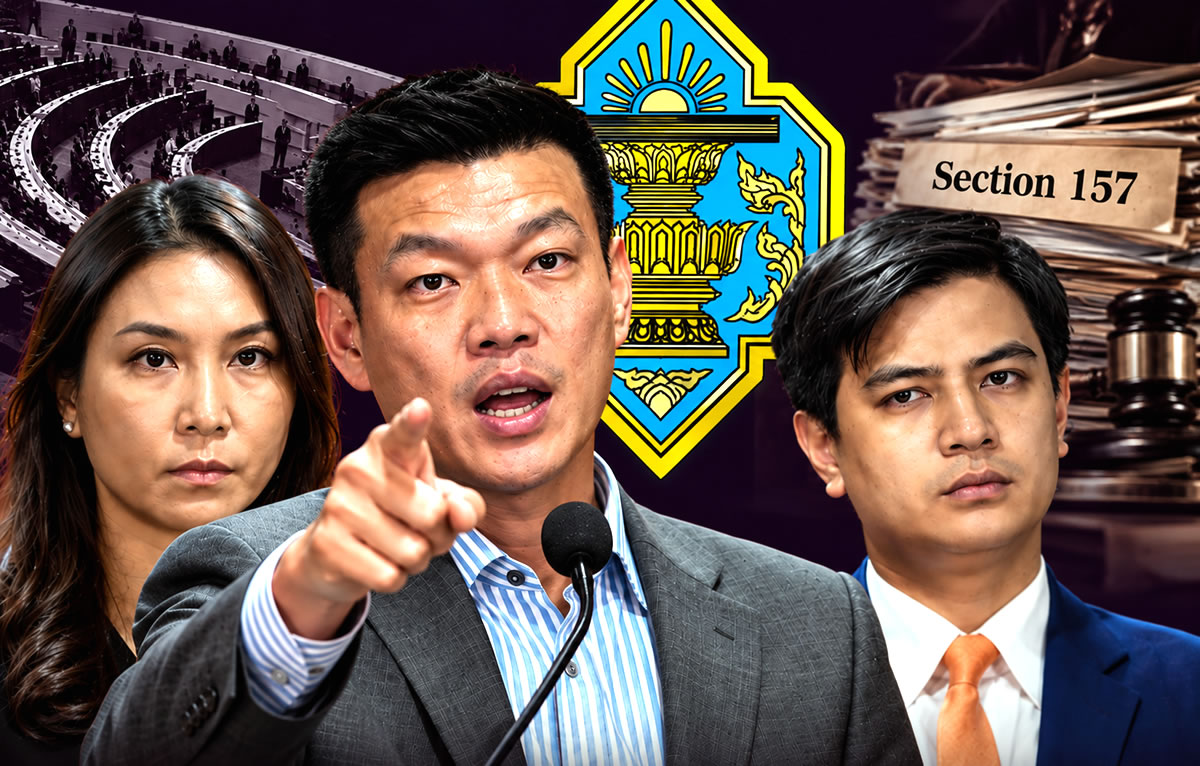
Thailand’s Election Commission faces a widening legal backlash after Monday’s ruling on the disputed 2024 Senate selection. Opposition figures and lawmakers warn commissioners could themselves face criminal proceedings under Section 157 of the Criminal Code. The warning follows the EC’s decision to proceed against only 77 people from the sprawling investigation. Notably, that number includes just 26 serving senators.
No political officeholders were included among those facing proceedings. They included ministers, MPs and Bhumjaithai Party executives investigated over the affair. Moreover, the decision was reached by a majority rather than unanimously. That immediately shifted attention towards how the seven commissioners exercised their discretion.
People’s Party leader Nattapong Ruangpanyawut launched a five-pronged response within hours. He appeared with party MPs at 5.45 pm on Monday following the EC decision.
People’s Party attacks partial Senate referrals as Nattapong points to evidence of coordinated process
Mr Nattapong described the affair as one of the biggest corruption sagas in Thai political history. He said it stemmed from efforts by a political group seeking control over state institutions.
According to Mr Nattapong, that effort involved processes which violated the law and lacked accountability to voters. Yet the EC proceeded against only a fraction of those investigated. Its 26th investigative committee had examined a much wider group over suspected involvement in the Senate selection. Nevertheless, only 26 serving senators are among the 77 people now facing court proceedings.
No ministers, MPs or Bhumjaithai Party executives were included. That distinction became the central target of the People’s Party’s challenge. Mr Nattapong said the resolution prevented most accused people from having their cases tested before the Supreme Court. In particular, he pointed towards the extensive evidence collected during the investigation.
That material included voting slips, orders and ballot statistics. Investigators also examined financial trails, audio recordings and evidence concerning meetings at voting centres. Phone records formed another part of the evidence. Taken together, Mr Nattapong said those elements indicated a coordinated process rather than isolated events.
For that reason, he rejected separating individual incidents when deciding who should face proceedings. He said the Senate selection operation had to be examined as one connected process. In his view, alleged wrongdoing could not properly be divided into unrelated cases. He also contrasted Monday’s ruling with previous EC standards.
People’s Party says wider evidence raises Section 157 threat as Witthaya separately warns commissioners
Previously, Mr Nattapong said the EC had proceeded using only several LINE messages concerning matched voting. By comparison, he said the present investigation contained a considerably wider body of evidence. As a result, the People’s Party believes Monday’s exercise of discretion breached legal principles and previous EC standards.
Mr Nattapong said the conduct could constitute abuse of power or omission of official duties. He also raised possible breaches under the Organic Act on the Election Commission. Accordingly, his party intends to pursue and support legal action against the commissioners. Section 157 of the Criminal Code stands at the centre of that threat.
The provision concerns wrongful exercise or omission of official duties by public officials. Crucially, the People’s Party is not alone in raising it. Ruam Thai Sang Chart Party deputy leader Witthaya Kaewphradai issued a separate warning on Monday evening. He said selective proceedings could expose commissioners themselves to complaints under Section 157.
Mr Witthaya stressed that Monday’s resolution binds the commissioners who supported it. His warning focused particularly on evidence already contained in the investigation files. If that evidence covers everyone involved, he said all relevant cases should enter the judicial process. Courts could then determine the facts and liability concerning each person.
Witthaya demands EC explain partial action as Section 157 complaints could reach the Supreme Court
Instead, the EC chose partial action. Consequently, Mr Witthaya said questions now surrounded the criteria used to distinguish between those investigated. Some people face proceedings, while others covered by the investigation do not. The EC must therefore explain the evidence and standards behind that distinction, he said.
“The only way out for the Election Commission, including those involved in both subcommittees, is if all the evidence is sufficient, then all of it should be submitted to the process,” Mr Witthaya said.
“If they only order partial action, the matter may not be resolved, because the resolution issued today will bind everyone who participated in the vote,” he added.
Mr Witthaya then outlined the potential legal consequences. Aggrieved parties could ask the National Anti-Corruption Commission to investigate the EC’s conduct under Section 157. Should the NACC find wrongdoing, proceedings could reach the Supreme Court’s Criminal Division for Holders of Political Positions.
Significantly, acceptance of such a case could have immediate consequences for a commissioner. Mr Witthaya said an accused commissioner could be required to cease performing official duties. The court could, however, order otherwise. Another route could involve a complaint to the Ombudsman.
Constitutional Court route raises stakes as Witthaya demands EC standards and warns of double standards
From there, he said, the issue could potentially reach the Constitutional Court. Thus, the consequences could extend beyond the original Senate investigation. The EC has direct responsibility for organising and supervising elections. Any proceedings affecting commissioners could therefore hit its work during a critical political period.
Mr Witthaya said political parties must consider that wider impact. Even so, his central challenge concerned the standards behind Monday’s decision. He demanded a clear explanation of why certain people faced proceedings while others escaped them.
“This isn’t just about whether or not to prosecute someone, but the Election Commission must answer what evidence and standards were applied to each individual,” Mr Witthaya said.
“Because if they choose to proceed only with certain cases, those who have been harmed have the right to file complaints or pursue further legal action.”
“Ultimately, the Election Commission itself is the one that must answer questions about the exercise of discretion,” he added.
On another front, Mr Witthaya raised cheating in local government examinations. That matter does not fall within the EC’s primary responsibilities. However, he said connections had been noted between that network and the Senate election case. He therefore called for clear and transparent standards in handling cases.
Nattapong questions EC ties to Senate as People’s Party opens five-front legal and political challenge
Without such standards, he warned, the EC could face accusations of discrimination or double standards. That issue could become important if people excluded from Monday’s action challenge the decision. Their complaints would inevitably focus on why different standards were applied within the same investigation.
In parallel, Mr Nattapong raised a politically sensitive feature of the EC itself. Four of the seven commissioners were approved by the current Senate. He said that situation could affect perceptions surrounding the majority’s exercise of discretion. He then raised the possibility of a political quid pro quo.
Mr Nattapong said the majority decision could be perceived as rewarding those connected with the disputed Senate process. His claim formed part of a broader attack on Monday’s outcome. The People’s Party says most accused people were denied judicial examination because the EC refused to refer them.
Beyond that, Mr Nattapong linked the controversy with the structure of independent organisations under the 2017 Constitution. He said those bodies were supposed to operate independently from political interference. Instead, he argued, they were also insulated from sufficient public accountability.
The People’s Party has now announced five routes for further action. The first involves legal proceedings against the Election Commission itself. Those proceedings could concern malfeasance or omission of official duties under the Criminal Code. They could also concern breaches of duties imposed by the EC organic law.
People’s Party targets excluded evidence and Parliament as Nattapong raises no-confidence confrontation
As part of this, the party will support other legal proceedings against commissioners where appropriate. Its lawyers will examine the available channels and determine who qualifies as a directly injured party. Mr Nattapong said further details would be released by the legal team shortly.
The second route concerns evidence involving people excluded from Monday’s referrals. The party wants that evidence considered by a court despite the EC’s decision. Its lawyers will therefore examine alternative legal avenues capable of bringing those cases into judicial proceedings.
Separately, the third route runs directly through Parliament. The People’s Party intends to investigate political officeholders connected with the Senate affair. Mr Nattapong specifically raised no-confidence motions as one available parliamentary mechanism. The party also intends to campaign publicly for political accountability.
That parliamentary strategy could produce another confrontation. Mr Nattapong said the party had received behind-the-scenes information concerning possible restrictions on no-confidence motions. In particular, he referred to possible use of the parliamentary Speaker’s powers during the present government’s term.
In response, Mr Nattapong insisted Parliament must be allowed to exercise its normal scrutiny functions. He said no-confidence debates had historically examined the qualifications of individual ministers. Past conduct and transparency questions could also be scrutinised, he said.
People’s Party seeks Senate and EC reforms alongside elected assembly while immediate legal battle grows
The opposition leader therefore urged the government to allow parliamentary checks and balances to proceed straightforwardly. He called on the public to watch how the parliamentary mechanism develops. The question, he said, is whether the government is prepared to face opposition questioning.
The fourth route involves constitutional and legal reform. Mr Nattapong said the People’s Party would seek limits on what it considers illegitimate Senate powers. It also wants independent organisations restructured to become more efficient, transparent and democratically legitimate.
Under those proposals, citizens would receive greater powers to scrutinise officeholders within independent organisations. They would also gain greater ability to initiate removal proceedings. Monday’s EC ruling has therefore become part of the party’s broader constitutional campaign.
The fifth route involves drafting an entirely new constitution. That effort would follow the February 8, 2026 referendum result. The People’s Party wants Constitutional Drafting Assembly members elected directly by voters. Those members would then receive authority to draft the new charter.
At the same time, the party opposes giving the Senate special powers over that process. Mr Nattapong said such powers should not obstruct the will expressed by voters. However, the immediate battle remains firmly centred on the EC’s Senate ruling.
Nattapong challenges politicians’ exclusion as witness dispute and wider legal action sharpen EC pressure
Questions intensified after the commission explained why political figures were excluded. Mr Nattapong was asked specifically about politicians associated with the “blue” political camp. He was also questioned about claims that relevant financial trails had not been traced.
In reply, he again rejected examining the Senate investigation as disconnected individual cases. He said the process under investigation was systematic. Accordingly, he argued that evidence must be considered across the entire operation rather than separated person by person.
A separate dispute surrounds witness number 16/26. The EC chairman said that the witness had given inconsistent testimony. Mr Nattapong said he personally believed political pressure might have affected the testimony. He then attacked the broader implication of the EC’s majority ruling.
In effect, he said, the EC had concluded that the huge Senate fraud scheme involved no politicians. The People’s Party rejects that conclusion. It will therefore challenge the outcome through legal proceedings and parliamentary scrutiny.
The confrontation could now spread far beyond the 77 people facing proceedings. Evidence involving people excluded from the referrals could become the subject of separate legal action. Meanwhile, ministers and other political officeholders could face questioning through Parliament.
Section 157 threat puts EC discretion under scrutiny as legal and parliamentary challenges gather pace
More immediately, the commissioners behind Monday’s ruling could themselves face complaints. Mr Witthaya identified Section 157 as a possible route. He also identified the NACC, Ombudsman, Supreme Court and Constitutional Court as institutions potentially drawn into the dispute.
The legal threat places the EC’s exercise of discretion under direct scrutiny. Commissioners may eventually have to explain why 77 people were selected for proceedings. Equally, they could be required to justify why others within the investigation were excluded.
Mr Witthaya warned specifically against different standards being applied within the same affair. He said the EC must show precisely what evidence was considered for each person. Otherwise, people claiming damage could challenge the commissioners through other legal channels.
The stakes extend beyond the Senate case because the EC supervises Thailand’s elections. Proceedings affecting its commissioners could therefore coincide with a critical electoral period. Mr Witthaya warned that parties must consider those consequences when pursuing the dispute.
At the same time, the People’s Party is preparing a wider offensive. Its lawyers are examining standing, injured parties and possible criminal proceedings. Its MPs are preparing parliamentary scrutiny against political officeholders excluded from Monday’s action.
Section 157 warnings intensify as People’s Party links EC dispute with wider constitutional reform drive
The party is also tying the case to its push for constitutional change. Yet the immediate threat to the Election Commission is more direct. Its majority decision could itself become evidence in complaints concerning the commissioners’ performance of duty.
Section 157 now sits at the centre of warnings from politicians in different parties. Mr Nattapong has raised abuse of power and omission of duty. Mr Witthaya, meanwhile, has stressed that commissioners are bound by the votes they cast.
Both arguments focus on the EC’s selective treatment of people inside one investigation. Twenty-six serving senators are heading towards court proceedings. Political officeholders investigated over the wider affair are not.
That dividing line is now likely to drive the next stage of the dispute. Mr Witthaya wants the EC to explain its evidence and standards for each individual. Mr Nattapong wants excluded evidence placed before courts through other legal routes.
Monday’s resolution therefore settled only one part of the 2024 Senate controversy. It sent 77 people towards proceedings, including 26 serving senators. At the same time, it opened a fresh dispute over everyone left outside the case.
EC faces legal risk over excluded cases as commissioners prepare to defend both referrals and omissions
For the Election Commission, that exclusion now carries its own legal risk. Aggrieved parties could seek NACC scrutiny under Section 157. Other challenges could proceed through the Ombudsman, while parliamentary scrutiny advances on a separate track.
The EC could consequently find itself defending two decisions at once. First, commissioners must defend the evidence supporting the 77 referrals. More critically, they may have to defend their decision not to proceed against others.
Mr Witthaya’s warning puts that distinction at the heart of any future complaint. The commissioners who supported Monday’s resolution are bound by their votes, he said. The People’s Party is simultaneously preparing its own legal challenge.
Election Commission creates more questions than answers as it refers 77 people to the Supreme Court
Ex Pheu Thai minister warns Commission members that soon they could be judged as crunch vote looms
The 2024 Senate case has therefore entered a new phase. The first legal front concerns the 77 people selected for proceedings. The second now concerns the Election Commission and how that list was drawn.
That second front carries potentially serious consequences for the seven-member commission. Section 157 complaints could trigger NACC scrutiny and eventually court proceedings. Meanwhile, parliamentary action could target political officeholders who escaped the EC referrals.
Monday’s ruling was intended to determine who should face proceedings over the Senate selection. Instead, it has produced a new legal question surrounding the decision-makers themselves. The next fight will centre on how the EC separated those prosecuted from those left outside the case.
Join the Thai News forum, follow Thai Examiner on Facebook here
Follow Thai Examiner on Google here
Receive all our stories as they come out on Telegram here
Follow Thai Examiner here
Further reading:
Election Commission creates more questions than answers as it refers 77 people to the Supreme Court
Ex Pheu Thai minister warns Commission members that soon they could be judged as crunch vote looms
Opposition and People’s Party leader attacks ‘blue regime’ on the 12th anniversary of the 2014 coup
Thammasat University legal scholar and 1992 protest leader warns another coup cannot be ruled out