Senate scandal heads for court as EC targets 77 people, including 26 serving senators, but extraordinarily withholds every name. Anutin, Newin and other accused political figures escape referral as a new political fight begins.
Thailand’s Election Commission has left more questions than answers over the explosive 2024 Senate scandal, nearly two years and three months after the election. It is sending 77 people towards the Supreme Court, including 26 serving senators, yet has extraordinarily named none of them. Meanwhile, every political figure accused of helping candidates escaped referral, including Prime Minister Anutin Charnvirakul and influential Bhumjaithai figure Newin Chidchob. Now the controversy is turning towards the EC itself, with the People’s Party weighing legal action and a fresh offensive in Parliament.
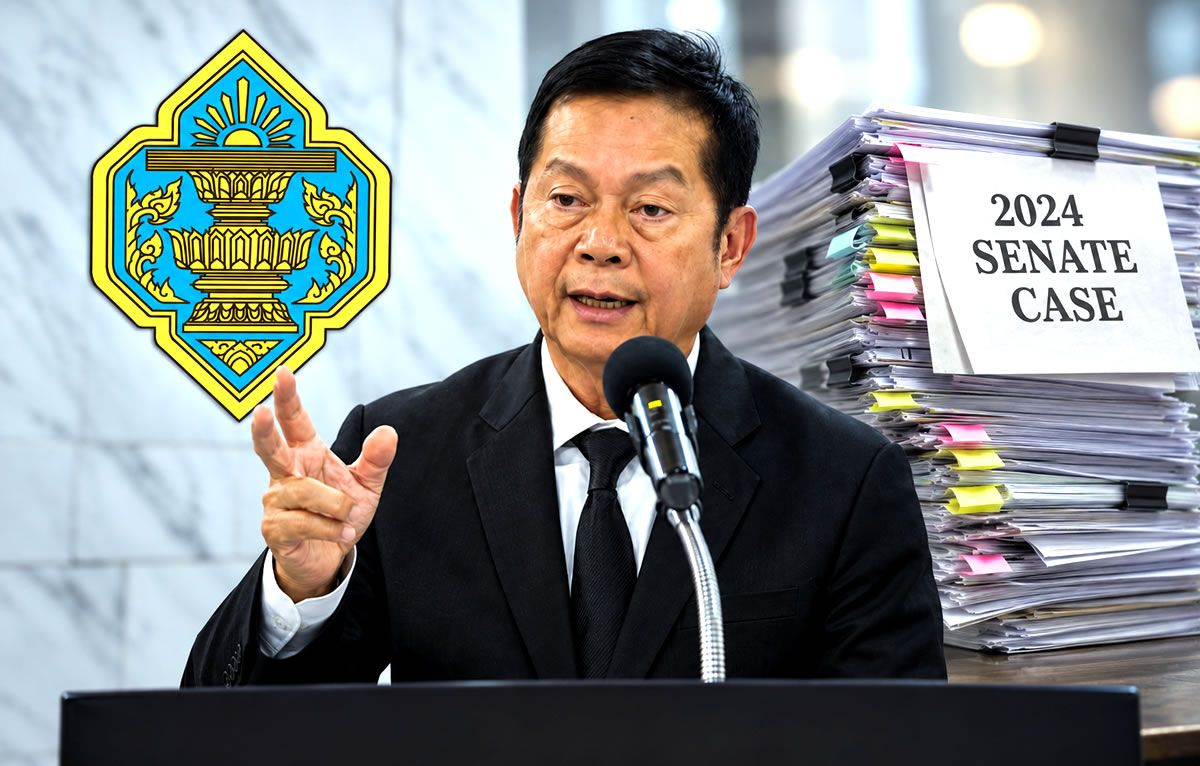
Thailand’s Election Commission has pushed the 2024 Senate selection scandal towards the Supreme Court. However, every political figure accused of assisting candidates has escaped referral. Monday’s ruling sends 77 people towards court, including 26 serving senators. Yet no Bhumjaithai executive, minister, MP or political office-holder is among them.
Prime Minister Anutin Charnvirakul escaped referral under the crucial political-assistance allegation. Influential Bhumjaithai figure Newin Chidchob also avoided the court process. Meanwhile, the EC found sufficient grounds for proceedings against dozens of Senate-selection participants. The ruling has therefore split the case sharply between participants and their accused political backers.
The decision immediately triggered another political battle. People’s Party leader Nattapong Ruangpanyawut accused the EC of breaking an interconnected case into separate pieces. In response, his party is considering legal proceedings against Election Commissioners themselves. It also intends to pursue political office-holders through Parliament.
EC sends 77 towards court but withholds names as blue Senate links remain under close scrutiny today
The formal investigation was considerably larger than the widely reported group of 229 people. Altogether, proceedings involved 67 complainants and 427 respondents. The investigation file ran to 75,722 pages. Nevertheless, the 229 remained the politically sensitive core of the case.
Committee 26 had previously recommended proceedings against all 229. They included 138 serving senators and numerous politicians, former candidates and other figures. Additionally, reporting identified people within the wider group as belonging to a Bhumjaithai-linked political network.
On Monday afternoon, the seven Election Commissioners reached their final decision. The EC ordered Supreme Court petitions against 77 people. Criminal proceedings will also follow against members of the group.
The 77 comprise 26 serving senators, 36 other eligible Senate-selection participants and 15 other people. Notably, the EC did not publicly identify them. Instead, it announced only the number and categories involved.
That omission has become one of Monday’s most significant developments. Thailand now knows 26 serving senators face Supreme Court proceedings. However, it does not officially know which senators they are.
Some senators investigated in the wider case have previously been associated with the so-called blue Senate bloc. The term commonly describes senators regarded as aligned with Bhumjaithai’s wider political power base. Senators themselves are not formal party representatives.
Withheld names block scrutiny of 26 senators as political figures escape referral from the EC today
Even so, the names matter. Without them, the 26 cannot be mapped against senators previously linked publicly with the blue bloc. Likewise, their provinces, occupational groups and voting histories cannot yet be compared.
Their reported political connections also remain impossible to test against the final EC list. By contrast, the political figures escaping referral are already identifiable. That difference has added another element to the controversy.
The most important EC decisions involved allegations one and two. Allegation one accused political figures of helping candidates become senators. It was brought under Section 76(1) of the Senate selection law.
That allegation covered 21 people. However, the EC decided not to send any of them to the Supreme Court. The group included political figures associated with Bhumjaithai. Anutin and Newin were among those escaping referral.
Allegation two concerned Senate candidates accused of knowingly accepting political assistance. That accusation covered 140 people. They included 137 serving senators, one reserve candidate and two other eligible participants.
Again, the EC declined to refer anybody under that allegation. Consequently, both accusations providing the direct political bridge into the case have failed at EC level. One concerned providing assistance. The other concerned receiving it.
EC rejects political-assistance link but keeps wider Senate selection case alive against 77 in court
The commission therefore rejected the legal connection between the accused politicians and the candidates. However, it did not clear the 2024 Senate selection itself. Instead, substantial proceedings survive against 77 people under other allegations.
That distinction now defines Monday’s ruling. The political-assistance case has stopped inside the Election Commission. The cases involving numerous Senate participants are moving towards court.
EC chairman Narong Klanwarin later gave a detailed explanation for the majority’s decision. At the centre of his account was witness 16/26. Former Election Commissioner Somchai Srisutthiyakorn subsequently identified that witness as Ekkarat Changlao.
Ekkarat was previously a Bhumjaithai MP for Khon Kaen. He won the election under the party banner in 2023. Later, his relationship with the party collapsed following a major criminal case.
On April 17, 2025, the Khon Kaen Provincial Court sentenced him over the Teachers’ Savings Cooperative case. He was also ordered to repay approximately ฿405 million. Bhumjaithai expelled him the following day.
Afterwards, Ekkarat provided evidence to investigative Committee 26. His testimony was highly significant because it directly connected senior Bhumjaithai figures with the suspected Senate operation. Subsequently, however, he withdrew that evidence.
Ekkarat’s testimony placed senior Bhumjaithai figures inside alleged planning before later withdrawal
His original testimony described four separate events. The first concerned preparations before the national Senate selection. According to Ekkarat, Bhumjaithai figures studied election rules and relevant laws.
He said a group led by Paradorn Prisnanantakul worked on those preparations. Furthermore, he claimed they devised a programme to calculate Senate voting arrangements. He said the information came from fellow MPs and Bhumjaithai executives.
The second claimed event occurred between June 16 and June 26, 2024. That was immediately before the national Senate selection. According to Ekkarat, a meeting took place at Bhumjaithai headquarters in Bangkok.
He said Paradorn and Chaichanok Chidchob were among the main speakers. Other party executives and MPs were also said to have attended. Crucially, Ekkarat claimed Newin and Anutin chaired the meeting.
The witness said he attended personally. If accepted, that testimony would have placed leading Bhumjaithai figures inside the preparations described by investigators. The respondents denied wrongdoing.
The third event allegedly occurred on June 24, 2024. That was two days before the national selection. According to the testimony, Ekkarat travelled with others to Ayutthaya.
Ayutthaya voting preparations and Pullman meeting become central to disputed witness account evidence
The location was Rajamangala University of Technology Suvarnabhumi’s Hantra campus. There, he said participants prepared voting material for the Senate selection. Suksomruay Wantaniyakul and student assistants were also said to have participated.
Then came the fourth claimed event. It occurred after the national Senate vote. Ekkarat said allied senators were taken to Bangkok’s Pullman Hotel.
There, according to his original account, they received policy directions from Newin. The alleged meeting became one of the most politically sensitive elements of the investigation. Again, the respondents rejected wrongdoing.
Narong said the EC majority ultimately considered Ekkarat an unreliable witness. One major problem involved timing. The national Senate selection occurred on June 26, 2024.
Later, the EC announced successful senators and reserve candidates on July 10. Yet Ekkarat did not provide his crucial statement until May 28, 2025. Almost one year had passed since the events he described.
Narong therefore questioned why Ekkarat had not reported the activity earlier. In addition, the chairman highlighted his previous relationship with Bhumjaithai. At the time of the claimed events, Ekkarat remained associated with the party.
Later, Bhumjaithai expelled him following his conviction. He subsequently sought to join the Kla Tham Party. At that point, political disagreements existed between Kla Tham and Bhumjaithai.
EC questions Ekkarat’s credibility as delayed evidence and missing corroboration weaken political case
Then, on May 28, Ekkarat gave evidence acknowledging his own involvement. As part of this, he asked to become a witness instead of a respondent. The EC majority consequently treated his account with particular caution.
Narong also pointed to weaknesses in supporting evidence. Investigators found no photographs confirming the claimed meeting at Bhumjaithai headquarters. Similarly, no documentary evidence established the claimed voting-calculation programme.
Nor was there physical evidence proving Paradorn’s role in creating such a system. Importantly, investigators found no abnormal financial transactions supporting the political-assistance accusation.
Narong said Ekkarat could not establish who received money. He also could not explain how any claimed payments were made. Accordingly, the EC majority found insufficient corroboration for the political allegations.
Two other witnesses also became important. They were identified as witnesses 21/26 and 22/26. Both were serving senators and were treated as supporting witnesses.
However, both testified after witness 16/26 had already given his statement. They said they attended preparations for voting material on June 24. In parallel, they connected those preparations with arrangements described by Ekkarat.
Supporting senators give conflicting accounts before all three witnesses later withdraw their evidence
The EC nevertheless found inconsistencies between their accounts. Witness 22/26 said he belonged to a group associated with witness 16/26. He described that group as having a quota of two senators.
Those two were himself and witness 21/26. Yet Ekkarat did not identify witness 22/26 as part of his team. Instead, his original account referred to witness 21/26.
Witness 21/26 came from Khon Kaen, the same province as Ekkarat. Those differences became significant during the EC’s assessment. Moreover, witness 22/26 did not directly implicate the political respondents in organising the scheme.
Instead, he said they might have benefited because a candidate list existed. He did not know who had prepared that list. The supporting witnesses also attributed submission of names to Ekkarat.
Eventually, all three witnesses withdrew statements concerning political respondents and the financial arrangements. Narong cited those reversals as another credibility problem. He also referred to Ekkarat’s conviction and political disqualification.
Narong described the EC majority’s concerns bluntly.
“There are inconsistencies in the witness statements. Witness 22/26, for example, never mentioned that the respondent group was involved in the scheme, but testified that they likely benefited because a list was made, though they didn’t know who made it. Furthermore, they claimed that witness 16/26 was the one who submitted the names. As you can see, there’s a complete lack of inconsistency in the witness statements. All three witnesses have retracted their testimonies, denying all allegations regarding the accused’s conduct and the money trail.”
Somchai challenges witness retractions and points to phone links involving Bhumjaithai respondents
He then questioned Ekkarat’s reliability more directly.
“This witness, or the other three, was unreliable from the start. I think he gave his testimony long after the incident. And witness code 16/26 was sentenced to 11 years in prison for embezzlement and disqualified from politics due to an ethics case. We need to consider his credibility. There are inconsistencies, and the investigation into the financial transactions of all those accused found no irregularities. Phone calls may have been made, but that’s not confirmation of what they discussed,” Mr. Narong said.
Former EC commissioner Somchai has challenged the significance attached to the later retractions. His argument focuses on the reliability of a witness giving contradictory accounts.
If the original evidence was unreliable, Somchai argues, the later withdrawal does not automatically become reliable. That point does not establish Ekkarat’s original account as true. Rather, it challenges treating the retraction as proof the earlier claims were false.
Separately, Somchai highlighted evidence outside Ekkarat’s testimony. He examined records from Subcommittee 36 and focused on telephone connections involving political respondents.
According to Somchai, respondent No. 191 was a Bhumjaithai executive. Records showed telephone contact between that respondent and a successful Senate candidate, he said.
On another front, Somchai described telephone links involving respondent No. 197. That respondent was also identified as a Bhumjaithai executive. Somchai said calls passed through connections involving successful Senate candidates.
Phone records reach Newin as Somchai questions case handling and Narong rejects proof of wrongdoing
He said those connections ultimately reached respondent No. 228. Respondent No. 228 was Newin.
Somchai nevertheless identified weaknesses in the material itself. He said potentially important call information lacked sufficient dates and times. Consequently, he questioned where those evidential weaknesses had developed.
One possibility concerned Committee 26’s original investigation. Another involved how evidence was subsequently presented to Subcommittee 36. Somchai also questioned the time spent assessing the political respondents.
According to him, meetings examining 22 political respondents totalled about five-and-a-half hours. That represented roughly 15 minutes for each respondent.
Narong took a different view of the telephone evidence. He said phone contact did not prove the substance of conversations. Calls might have occurred without establishing unlawful activity.
The EC treated the Pullman Hotel allegations similarly. Witnesses referred to Newin and Anutin being present. However, Narong said the file did not establish unlawful conduct by either man.
Accordingly, allegation one was dismissed. That decision then affected allegation two. Without proven political assistance, the EC could not establish candidates knowingly received such assistance.
EC clears 140 on political assistance but sends 26 serving senators towards Supreme Court proceedings
Therefore, all 140 respondents escaped referral under allegation two. Still, proceedings against Senate participants did not end there.
Under allegation three, investigators considered 175 respondents. That allegation concerned breaches of rules governing how candidates introduced themselves during the selection.
The EC decided to send 36 people to the Supreme Court. Significantly, 26 are serving senators. One other person was an eligible participant, while nine were classified as others.
The remaining allegations concern substantially different conduct. Allegations four through seven include providing money or benefits to influence voting.
They also include providing hospitality as an inducement. Separately, they concern receiving benefits connected with becoming a candidate. Another accusation covers benefits offered or received for votes.
For those allegations, the EC identified the wider group of 77 people. Again, the same 26 serving senators are included. Another 36 were eligible Senate-selection participants.
The remaining 15 were other individuals. Thus, the EC rejected the alleged political-assistance structure while preserving substantial accusations about the selection itself.
The legal distinction is important. Evidence directly implicating political figures failed before the EC majority. Yet evidence involving scores of selection participants met the threshold for proceedings.
Twenty-six senators remain in office as withheld identities deepen scrutiny of the EC’s final ruling
For now, the 26 senators remain in office. The EC must first prepare its formal decisions and petitions. That process can take up to 60 days.
After that, the cases will move to the Supreme Court’s Election Cases Division. A crucial consequence follows if the court formally accepts petitions against sitting senators.
At that point, affected senators must stop performing their duties. Their suspension would continue until the court delivers judgment.
If ultimately found responsible, their membership would end from the suspension date. Reserve candidates could then fill vacancies under the applicable rules.
Consequently, Monday’s ruling has not removed 26 senators from the chamber. Nevertheless, their votes could disappear once the Supreme Court accepts their cases.
That could become important during future Senate business. The chamber exercises significant constitutional powers, including appointments and scrutiny involving independent bodies.
Meanwhile, the decision to withhold names has opened another dispute. Before Monday, People’s Party MP Parit Wacharasindhu had already raised concerns about possible secrecy.
He questioned reports that the EC could disclose numbers while withholding identities. Former commissioner Somchai also demanded greater transparency before the decision.
Secret identities prevent public mapping of court-bound senators against the wider blue Senate bloc
He called for names, voting figures and individual commissioners’ positions to be disclosed. Instead, Monday’s announcement provided categories without identities.
As a result, the public knows exactly how many sitting senators face proceedings. Yet their precise position within existing Senate blocs cannot be established officially.
This matters because much of the original 229-person group had already been politically mapped. It included 138 serving senators.
Additionally, it contained 21 ministers, MPs and Bhumjaithai executives. Another 20 were described in reporting as belonging to the Bhumjaithai-linked network.
The remaining group included reserve candidates and other participants. Now, 26 investigated serving senators are heading towards court.
Yet their identities remain outside the EC announcement. That prevents immediate comparison with the so-called blue bloc.
It also prevents confirmation of whether the 26 are central figures or more peripheral participants. For that reason, claims they are merely scapegoats cannot currently be established.
People’s Party attacks EC split decision after political figures escape while 77 still face court
The Supreme Court has not examined their cases. Nor has the EC published enough information to establish their exact political positioning.
Even so, the structure of Monday’s ruling is unmistakable. The EC found grounds to proceed against Senate participants. It simultaneously rejected every political-assistance case against the accused political figures.
That divide is driving the People’s Party’s response. At about 5.45pm, Nattapong delivered the opposition’s first major attack.
He accused the EC majority of cutting the case into separate pieces. According to Nattapong, the evidence should instead be assessed as a connected operation.
The People’s Party cited candidate lists, voting statistics and financial trails. It also pointed to audio material, meetings and telephone records.
Its complaint centres on how the EC treated those pieces separately. The commission found sufficient grounds for proceedings against 77 people.
Yet none of the political figures accused of helping candidates is among them.
Nattapong weighs Section 157 action as opposition turns its attack directly onto Election Commissioners
In response, Nattapong said his party would examine proceedings against Election Commissioners themselves. Those proceedings could invoke Section 157 of the Criminal Code.
Section 157 concerns wrongful performance or omission of official duties. The party also intends to explore routes for placing cleared-person evidence before a court.
Monday’s ruling has therefore created a second possible legal battle. The first concerns the 77 respondents. The other could concern Election Commissioners.
Nattapong also raised the appointment history of the current EC. Four of the seven commissioners entered office following approval by the current Senate.
The People’s Party says that creates questions surrounding the decision. However, the party has not established wrongdoing by any commissioner.
The EC rejects claims of improper political influence. Narong said commissioners weighed evidence independently. They considered witness testimony, communications, financial material and investigative records.
Furthermore, he said public pressure did not determine their decision. The confrontation has therefore expanded beyond the original Senate defendants.
Parliament becomes next front as no-confidence threat keeps Anutin and Bhumjaithai under pressure
Parliament now represents another arena. The People’s Party says it will use parliamentary mechanisms against political office-holders connected with the controversy.
Nattapong specifically identified a no-confidence motion as one possible route. Consequently, Anutin’s escape from EC referral does not end the issue politically.
The Prime Minister has repeatedly rejected Bhumjaithai involvement. Before the 2024 selection, he said he ordered party members not to interfere.
For its part, the government has distanced itself from the EC proceedings. Government spokesman Ekkapop Pienpises said the government had no role in the investigation.
Before Monday’s ruling, Ekkapop described the matter as an independent legal process. He said the government remained focused on economic issues.
Monday’s outcome now gives Bhumjaithai a powerful legal response. The EC examined the political-assistance accusations and declined to send them to court.
Nevertheless, the opposition is attacking how the commission separated those allegations from proceedings against the 77.
iLaw evidence threat and court petitions open fresh fronts as identities of 26 senators stay hidden
Outside Parliament, another pressure point remains. Before Monday, iLaw said it could publish evidence concerning people whom the EC cleared.
That pledge has gained significance after the ruling. Most of the politically sensitive 229-person group will not reach court through Monday’s decision.
At the same time, the identities of those who will reach court remain undisclosed.
Several processes will now move forward. First, the Election Commission must prepare its formal petitions against the 77.
Next, the Supreme Court must decide whether to accept those cases. Separately, the People’s Party is examining action against commissioners.
In parallel, the Senate controversy is moving towards parliamentary scrutiny. Meanwhile, iLaw has left open the prospect of releasing evidence outside the EC process.
The next major legal milestone will come when petitions reach the Supreme Court. At that point, 26 serving senators could immediately lose their ability to vote.
However, one significant question remains unresolved before then. The EC has not told the public who those 26 senators are.
Withheld names leave Thailand unable to identify which 26 senators are heading towards the Supreme Court
That decision leaves the composition of the court-bound group unknown. It also blocks a complete assessment of their position inside the Senate.
For now, the EC has confirmed serious proceedings involving 77 people. Twenty-six are current senators. Yet every political figure accused of providing direct assistance has escaped referral.
The political-assistance evidence has therefore stopped at the Election Commission. The proceedings against the 77 have not.
Gauntlet thrown down to the Election Commission before it votes on explosive Senate collusion scandal cases
Ex Pheu Thai minister warns Commission members that soon they could be judged as crunch vote looms
At the same time, the People’s Party has opened a new fight over the EC’s conduct. Parliament could provide the next political front.
Most immediately, however, the unanswered names carry their own significance. Thailand knows 26 senators are moving towards the Supreme Court.
It still does not know which 26.
Join the Thai News forum, follow Thai Examiner on Facebook here
Follow Thai Examiner on Google here
Receive all our stories as they come out on Telegram here
Follow Thai Examiner here
Further reading:
Ex Pheu Thai minister warns Commission members that soon they could be judged as crunch vote looms
Opposition and People’s Party leader attacks ‘blue regime’ on the 12th anniversary of the 2014 coup
Thammasat University legal scholar and 1992 protest leader warns another coup cannot be ruled out