Cannabis sweets horror. Two parents suffer violent convulsions and lose consciousness as their toddler falls ill. Police raid a Bangkok shop, arrest a 26-year-old woman and seize 90 jelly products. FDA tests could trigger further criminal charges.
Bangkok police raided a cannabis shop and arrested a 26-year-old woman after a family of three was hospitalised following a cannabis jelly sweets ordeal in Chanthaburi. Both parents suffered violent convulsions, lost consciousness and reportedly needed ventilators. Their two-year-old son also required emergency treatment. Officers seized 90 cannabis jelly products worth ฿50,000, all lacking Thai-language labels and FDA registration numbers. The arrested employee admitted selling the sweets for ฿80 each to Thais and foreign tourists for a year. Meanwhile, police are pursuing the shop’s owners and suppliers. Laboratory tests will establish THC levels, with further criminal charges possible as health authorities order tougher cannabis shop inspections.
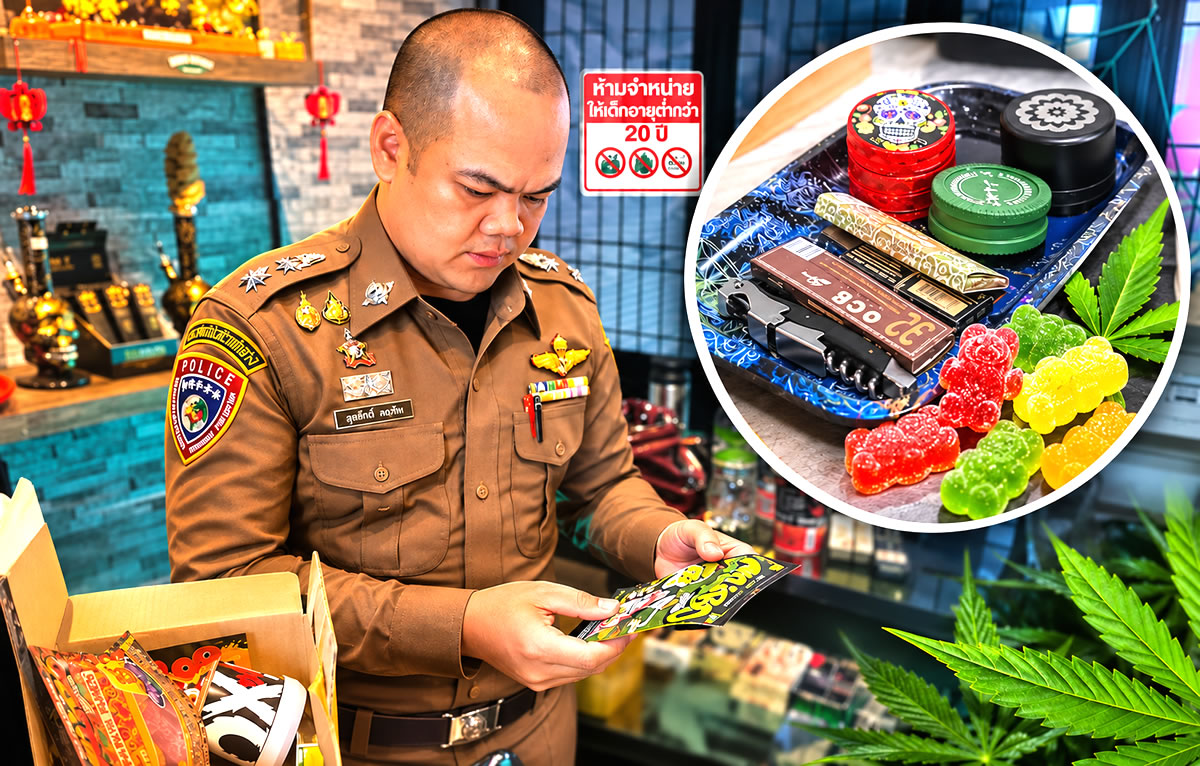
A family of three was rushed to hospital after eating cannabis jelly sweets, triggering a police raid on a Bangkok shop. Both parents suffered violent convulsions and lost consciousness. Their two-year-old son became lethargic and also needed emergency treatment.
In response, police launched an investigation into the sale of cannabis-infused confectionery. Officers traced a suspected supplier to Bangkok’s busy Banthat Thong district. A 26-year-old female employee was arrested, while 90 cannabis jelly products worth ฿50,000 were seized.
The sweets lacked Thai-language labels and Food and Drug Administration (FDA) registration numbers. Crucially, laboratory tests will determine whether their THC and CBD concentrations exceeded legal limits. Further criminal charges are under consideration.
Police investigate after Chanthaburi family suffers convulsions and child falls ill from cannabis sweets
The crackdown was announced on Sunday, November 1, following an investigation involving police and senior public health officials. Officers from the Consumer Protection Police Division joined forces with the FDA and cannabis regulators. Their inquiry followed the hospitalisation of a family in Khlung district, Chanthaburi province.
The parents had consumed cannabis-infused jelly sweets before suffering severe muscle spasms, convulsions and unconsciousness. Both reportedly required ventilator support. Their two-year-old child also became seriously unwell.
Subsequently, investigators identified a suspected distributor operating from commercial premises in Bangkok. A court-authorised search uncovered cannabis sweets without the required food registration details.
The medical emergency began after the father, mother and child consumed sweets containing cannabis. According to investigators, the adults developed severe symptoms, including muscle stiffness and repeated convulsions.
Both lost consciousness and required urgent medical intervention. Their condition was reportedly serious enough to require ventilators. Meanwhile, their two-year-old son became lethargic, although investigators believe he may have consumed a smaller quantity. All three were transported to hospital for treatment.
However, authorities have not disclosed their latest medical condition or confirmed their discharge. The precise amount of cannabis consumed by each family member also remains unknown. No medical test results establishing their individual doses have been released.
Social media reports lead police to Bangkok cannabis supplier as senior officers organise shop raid
Reports of the incident spread across social media, attracting the attention of consumer protection authorities. Consequently, police and FDA investigators began examining the distribution of cannabis-infused sweets.
Their inquiries led to Bangkok’s Banthat Thong district, a commercial area frequented by Thai shoppers and foreign tourists. Investigators discovered that cannabis jelly products were reportedly being advertised through social media.
Notably, the packaging resembled ordinary confectionery, including brightly coloured sweets commonly purchased for children. Police suspected the products were being sold without proper food registration. Nevertheless, authorities have not confirmed that the confiscated sweets came from the same batch consumed by the Chanthaburi family.
The operation was directed by Police Lieutenant General Natthasak Chaowanasai, Commissioner of the Central Investigation Bureau. He ordered senior consumer protection officers to coordinate the raid with public health officials.
Police Major General Krisadaporn Panprong, Commander of the Consumer Protection Police Division, was assigned to the investigation. Police Colonel Pattanapong Sripinphra, the division’s deputy commander, also joined the operation. In addition, Police Colonel Veerapong Klaithong, Superintendent of Sub-Division 4, participated. Police Lieutenant Colonel Surasri Kongthap, an inspector attached to Sub-Division 4, led the search team. The operation combined criminal investigators, food safety regulators and officials responsible for enforcing cannabis legislation.
FDA officials join court-authorised raid on second-floor cannabis shop in Bangkok’s Pathum Wan district
Senior FDA officials also took part in the investigation. They included Secretary-General Suphatra Boonserm and Deputy Secretary-General Dr Pichet Phuedkhunthod. Pharmacist Morakot Charoonwatthana, a specialist in product safety and efficacy, joined the operation.
Separately, Dr Pongsathorn Phokphermdee represented the Department of Thai Traditional and Alternative Medicine as director-general. His department supervises compliance with legislation governing controlled cannabis products and retail outlets.
As part of the operation, investigators examined suspected licensing offences alongside food safety violations. Officials also sought to establish whether the sweets contained excessive concentrations of cannabis compounds. Laboratory analysis will determine those concentrations.
Police obtained a search warrant from Pathum Wan District Court for a commercial building in Bangkok. The premises were identified as 188/25 Soi Rong Mueang 5, Wang Mai subdistrict, Pathum Wan. Officers entered the building and inspected its commercial operations.
They discovered a cannabis shop operating on the second floor. Inside, investigators found cannabis flowers and other cannabis products alongside brightly packaged jelly sweets. However, the sweets carried no Thai-language labels or FDA food registration numbers. Police examined the stock and questioned the employee present.
The missing registration details became central to the suspected food labelling offences. Investigators also examined whether the business possessed the required authorisation to sell controlled cannabis products.
Cops seize ฿50,000 in cannabis sweets and arrest employee who sold them for ฿80 each
The search uncovered 90 units of cannabis-infused jelly sweets, collectively valued by authorities at approximately ฿50,000. Officers confiscated the products and transferred them to consumer protection investigators.
The stock will undergo examination to establish its ingredients and chemical concentrations. Furthermore, police are investigating whether the products complied with Thailand’s food regulations. The packaging displayed neither the required Thai-language information nor FDA registration numbers.
Those findings prompted suspected offences under legislation governing controlled herbs and food products. In parallel, investigators began examining the business’s ownership and supply arrangements. The source of the confiscated sweets has not been publicly identified.
Police arrested Saowaluk Namwongsa, a 26-year-old employee found at the premises during the search. According to investigators, she admitted working at the shop and selling cannabis-infused jelly sweets. She said the products cost ฿80 each. Her customers included Thai residents and foreign tourists visiting the area.
Significantly, Saowaluk told officers that she had been selling the sweets for approximately one year. Her account indicated that the business had operated for a substantial period before the raid. However, police have not disclosed how many products were sold during that time. Neither have they established the total revenue generated from the sales.
Investigators trace shop ownership and supply chain as employee faces cannabis and food law offences
Saowaluk’s statements gave investigators details of the shop’s commercial activities. The premises sold cannabis jelly sweets directly to customers, including visitors from overseas. The products were also reportedly advertised through social media channels.
On another front, police began tracing the individuals responsible for supplying the confiscated stock. Investigators intend to identify the shop’s owner and anyone else involved in distribution. However, authorities have not disclosed the owner’s identity or named the original manufacturer.
They have also not confirmed whether the sweets were manufactured in Thailand or imported. Further prosecutions remain possible as investigators examine the evidence.
The initial suspected offences involve selling controlled herbs without permission and producing or selling improperly labelled food. The first falls under the Protection and Promotion of Traditional Thai Medicine Wisdom Act of 1999. Selling controlled herbs without authorisation carries a maximum sentence of one year’s imprisonment.
Offenders can also face a ฿20,000 fine, or both penalties. Meanwhile, food labelling violations fall under the Food Act of 1979. The relevant offence carries a maximum fine of ฿30,000. Police have forwarded the case to Sub-Division 4 of the Consumer Protection Police Division. Investigators are pursuing evidence against the employee and others potentially responsible for the business.
Laboratory tests to establish THC levels as FDA details strict limits for cannabis-containing foods
The seized sweets will undergo laboratory analysis at the Department of Medical Sciences under the Ministry of Public Health. Scientists will measure their tetrahydrocannabinol and cannabidiol concentrations.
THC is the principal psychoactive compound in cannabis, while CBD is another cannabis-derived substance. The results will establish whether the products exceeded the applicable regulatory limits. If additional violations are identified, police intend to file further criminal charges.
However, the laboratory findings had not been released when authorities announced the operation on Sunday. Therefore, the precise THC and CBD concentrations remain unknown. Investigators have not confirmed whether the seized products breached the permitted chemical limits.
FDA Secretary-General Suphatra Boonserm addressed the case and the regulations governing cannabis-containing food products. She said children should not consume foods containing cannabis. Adults purchasing such products should select only those authorised by the FDA. Under the agency’s standards, approved products must contain no more than 1.6 milligrams of THC per container.
The limit applies to each bottle, box or sachet. Moreover, the FDA examines ingredient formulas before granting product approval. Manufacturers must provide appropriate information about ingredients, consumption and safety. The confiscated jelly sweets lacked the required Thai-language labels and registration numbers. Their chemical contents remain subject to laboratory examination.
FDA warns over missing labels and child-friendly packaging as officials step up food safety checks
The FDA also requires cannabis-containing foods to display consumption instructions and prominent safety warnings. According to Suphatra, approved labels must advise consumers not to exceed two servings daily. Products must also carry warnings against consumption by children, pregnant women and breastfeeding mothers.
Additionally, consumers experiencing adverse reactions must be instructed to discontinue consumption immediately. People allergic or sensitive to THC or CBD must receive appropriate warnings.
These requirements form part of Thailand’s food approval system. Yet investigators found that the seized sweets lacked the necessary Thai-language information. Their registration status is also under investigation. Laboratory results will determine whether further product standards were breached.
Suphatra specifically addressed cannabis sweets packaged to resemble ordinary confectionery. She warned about illegally produced or imported products lacking food registration numbers. The FDA advised consumers to examine packaging for Thai-language information and cannabis-related markings.
These may include cannabis leaf symbols or wording such as Cannabis, CA and THC. Likewise, the agency identified missing registration numbers as a warning sign. It said improperly regulated cannabis sweets could present serious health risks. Provincial public health offices and the FDA are expected to strengthen surveillance of cannabis-containing foods. The Chanthaburi family’s hospitalisation provided the immediate background to the warning.
Health ministry orders closer scrutiny of cannabis shops in tourist areas and tighter licence checks
Dr Pongsathorn Phokphermdee said the Ministry of Public Health had ordered tighter supervision of cannabis retail outlets. His Department of Thai Traditional and Alternative Medicine monitors compliance with cannabis control legislation. Accordingly, officials will increase inspections of businesses operating in major tourist destinations.
These areas attract large numbers of foreign visitors and contain numerous cannabis outlets. The department intends to examine licensing, product quality and compliance with applicable restrictions. Inspections will also cover measures preventing children and young people from accessing cannabis products.
Pongsathorn said businesses must comply with the relevant laws and standards. His department will continue cooperating with other enforcement agencies.
The involvement of several public health agencies reflects the separate regulations governing cannabis businesses and food products. The FDA supervises food registration, labelling and product safety. By comparison, the Department of Thai Traditional and Alternative Medicine oversees compliance with cannabis control requirements.
Police investigate suspected criminal offences and pursue prosecutions. As a result, the Bangkok operation involves several distinct lines of inquiry. Investigators must establish whether the shop possessed the necessary authorisation.
They must also determine whether the sweets complied with food regulations. Separately, laboratory tests will establish their THC and CBD concentrations. Authorities have not announced when those results will become available.
Police chief warns of cannabis sweets reaching children and vows further action against illegal sales
Central Investigation Bureau Commissioner Natthasak Chaowanasai also addressed the use of cannabis in confectionery and other foods. He said cannabis was increasingly being mixed into jelly sweets, biscuits, candies and similar products.
According to Natthasak, some products were intended to produce euphoria and intoxication rather than serve medical purposes. He highlighted their attractive appearance and resemblance to ordinary confectionery.
In particular, he warned that such products could reach children and young people unaware of their contents. The commissioner specifically mentioned residential communities and areas surrounding educational institutions. Police intend to continue operations against businesses breaching cannabis regulations.
Natthasak said investigators would pursue offenders under the relevant laws. He also encouraged the public to report suspected illegal cannabis sales to consumer protection police. Reports can be submitted through the Consumer Protection Police Division hotline on 1135. Alternatively, information can be provided through the division’s Consumer Warning Facebook page.
The commissioner linked continued enforcement to concerns about improperly regulated cannabis sweets. However, police have not announced additional arrests connected with the Bangkok premises. Investigators are still seeking the shop’s owner and other individuals involved. Further action will depend on the evidence collected and laboratory findings.
Online cannabis sweets advertising comes under scrutiny as police examine a year of shop sales
The investigation has also identified social media advertising as a channel used to promote cannabis-infused sweets. Police said the products were advertised online before investigators located the suspected supplier.
Furthermore, their packaging resembled ordinary jelly confectionery. The sweets were therefore presented in a form similar to conventional products. However, authorities have not disclosed the advertising accounts or specific platforms involved. Neither have they confirmed whether other online sellers are under investigation.
Police are examining the confiscated stock and the shop’s distribution arrangements. Establishing the original supplier remains important to identifying those responsible for the products.
The shop’s reported year-long operation is another significant detail. According to Saowaluk, she had been selling cannabis sweets at the premises for approximately 12 months. Customers included Thai residents and foreign tourists.
The products were sold for ฿80 each. However, police have not disclosed sales records, turnover figures or the number of sweets distributed. The confiscated stock was valued at ฿50,000. That valuation does not establish the business’s total revenue. Investigators have also not disclosed whether the shop sold the same products throughout the year. Those matters remain unresolved as police examine the business and its suppliers.
Chanthaburi family’s condition remains undisclosed as police pursue shop owners and lab findings
The Chanthaburi family’s medical emergency remains central to the case. Both parents reportedly suffered severe convulsions and unconsciousness after consuming cannabis-infused sweets. Their two-year-old son also required hospital treatment after becoming lethargic.
However, medical findings establishing the precise cannabis dose consumed by each family member have not been released. Authorities have not confirmed whether the family’s sweets matched the confiscated Bangkok products.
Furthermore, investigators have not established publicly whether the products came from the same manufacturer or production batch. The family’s latest medical condition remains undisclosed. Nevertheless, reports of their hospitalisation triggered the investigation that led to the Bangkok shop.
The operation established suspected violations involving product labelling and cannabis retail authorisation. Police discovered 90 cannabis jelly products without Thai-language labels or FDA registration numbers.
The employee also acknowledged selling the sweets for approximately one year. Investigators are examining her statements alongside evidence recovered during the search. The case has been forwarded for prosecution under the relevant legislation. However, police have not completed inquiries into the business’s ownership and supply arrangements.
Further charges hinge on laboratory results after Bangkok raid uncovers unregistered cannabis sweets
Laboratory analysis could establish further offences involving THC or CBD concentrations. Consequently, the investigation remains active beyond the initial arrest and seizure.
By Sunday, November 1, police had arrested Saowaluk Namwongsa and confiscated cannabis jelly products valued at ฿50,000. The operation followed the hospitalisation of a family of three in Chanthaburi. Investigators had also identified suspected licensing and food labelling offences at the Bangkok premises.
Thai woman flees punter’s Pattaya apartment after adverse reaction to taking weed and cannabis jelly
Collapsed foreign tourist in Phuket raises questions about Thailand’s flourishing cannabis edibles sector
The seized stock was being prepared for laboratory examination by the Department of Medical Sciences. Meanwhile, police were seeking the shop’s owner and other individuals connected with distribution. Further charges will depend on chemical analysis and additional evidence.
The FDA and Department of Thai Traditional and Alternative Medicine have pledged continued inspections. The case remains open, with laboratory results, product origins and wider business arrangements still unresolved.
Join the Thai News forum, follow Thai Examiner on Facebook here
Receive all our stories as they come out on Telegram here
Follow Thai Examiner here
Further reading:
Thai woman flees punter’s Pattaya apartment after adverse reaction to taking weed and cannabis jelly
Confidence and trust in Thailand damaged by Chinese VIP tourist services advertised online
Viral Chinese video says VIP arrival with a police escort can be bought when holidaying in Thailand
Royal Thai Police Sergeant Major arrested on Ko Samui, charged with the rape of female detainee
Top Thai and US drug suppression officials warn of the use of cryptocurrencies in the drug trade
Drug police put retraction behind them to smash billion baht Myanmar drug operation in Bangkok raid