Beijing-linked boss Zhang Chuanling gets three years for using Thai nominees. His company worked on the Bangkok tower collapse that killed over 90. The court orders the firm closed and jails three Thai shareholders, but Zhang secures bail pending appeal.
A Chinese construction boss who claimed to act on Beijing’s orders was jailed for three years in Bangkok on Wednesday, November 18. Zhang Chuanling was convicted of illegally controlling a Thai construction company through nominee shareholders. His Chinese state-linked firm helped build the ฿2.136 billion State Audit Office tower, which collapsed in March 2025, killing over 90 people. Meanwhile, three Thai accomplices received prison sentences, including two approaching five years. The Criminal Court ordered China Railway No. 10 (Thailand) to shut down and imposed heavy fines. However, Zhang and two Thai directors walked free on bail pending appeal. Crucially, the verdict exposes years of illegal foreign control behind a major government contract. Separate criminal proceedings over the deadly collapse continue, alongside a corruption investigation involving 70 public officials.
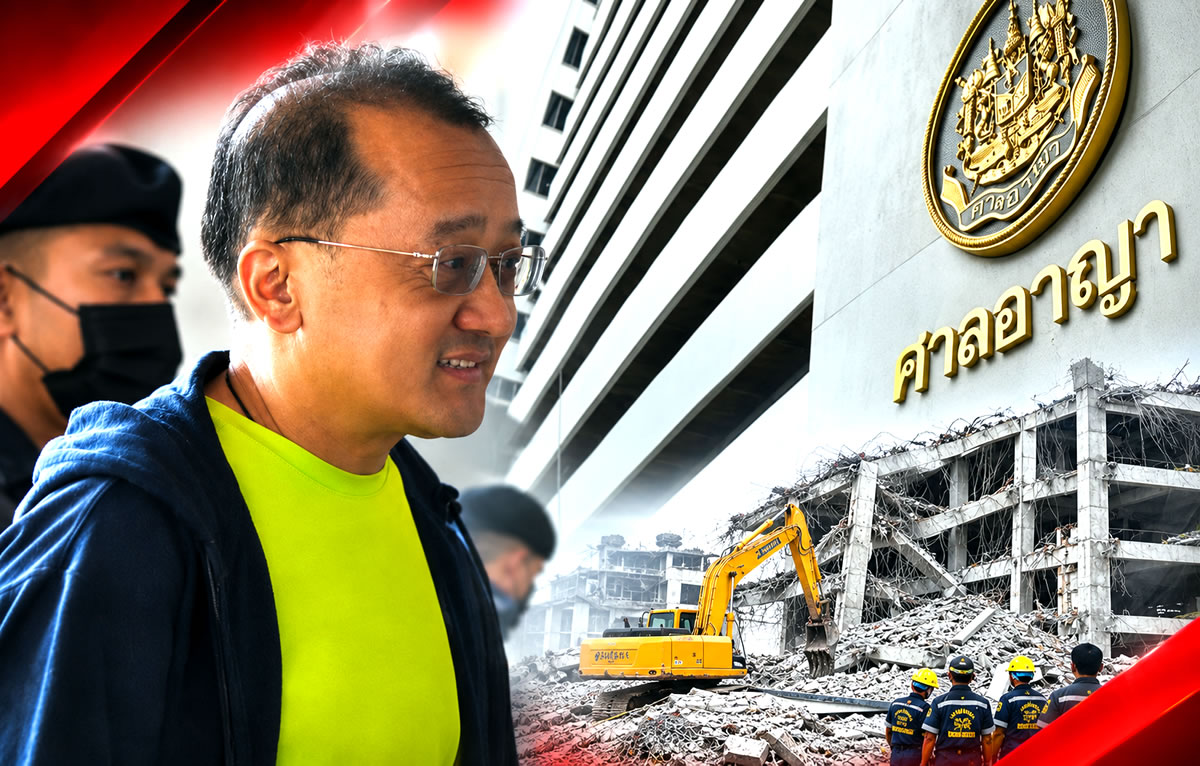
A Chinese construction executive who claimed to represent Beijing was sentenced to three years in prison on Wednesday, November 18. Bangkok’s Criminal Court convicted Zhang Chuanling of illegally operating a construction company through Thai nominee shareholders.
His company helped build the State Audit Office headquarters, which collapsed during the March 2025 earthquake. The disaster killed more than 90 people. Meanwhile, three Thai shareholders received prison sentences, including two terms approaching five years.
The Chinese state-linked company was fined ฿1 million and ordered to cease operations. However, Zhang and two Thai directors secured bail pending appeal.
Court finds Chinese railway contractor used Thai nominees as Zhang claimed direct orders from Beijing
The verdict followed a major Department of Special Investigation (DSI) inquiry into China Railway No. 10 (Thailand) Ltd. The company was a contractor on the doomed government headquarters in Bangkok’s Chatuchak district.
Crucially, judges found that its apparent Thai majority ownership concealed foreign control. The arrangement breached Thailand’s Foreign Business Act of 1999. It also allowed the Chinese-controlled business to operate without the required authorisation.
The ruling was delivered at approximately 10 am in courtroom 904 of the Criminal Court on Ratchadaphisek Road. Prosecutors from Special Cases Division 5 brought the proceedings under criminal case number Or Ang 1558/2568.
Five defendants faced prosecution, including the company, its Chinese director and three Thai shareholders. The charges concerned unauthorised foreign construction operations and arrangements designed to circumvent ownership restrictions.
Significantly, Zhang had previously claimed that he was an official representative of the Chinese state. Following his arrest on April 19, 2025, he told investigators that Beijing had sent him to oversee infrastructure investments. Furthermore, he described his responsibilities as part of government-backed construction cooperation between China and Thailand. He also claimed to operate under instructions from Beijing.
Zhang’s Chinese state role claims face scrutiny as judges establish his control over Thai contracts
Zhang presented himself as an authorised executive of the Chinese state-owned China Railway Group. His Thai company was connected to China Railway No. 10 Engineering Group, part of China’s state-owned construction industry.
During questioning, he also distinguished himself from another Chinese businessman, Bin Ling Wu. Zhang insisted that Wu did not represent the Chinese government, unlike himself.
Those statements emerged following Zhang’s arrest in April 2025. However, Wednesday’s judgment centred on his direct management of the Thai construction company.
The court established that he had controlled its operations since becoming an executive director in October 2018. Notably, he possessed sole authority to execute important corporate documents, including construction contracts and financial statements.
The Chinese executive also signed the joint-venture agreement with Italian-Thai Development. That partnership secured the government contract for the State Audit Office headquarters.
Consequently, Zhang’s signatures became important evidence establishing his authority over the business. The judges found that he exercised effective control despite the company’s apparent Thai majority ownership.
Chinese director jailed for three years as Thai nominees receive longer sentences and secure bail
The Criminal Court sentenced Zhang to three years in prison and fined him ฿1 million. Separately, China Railway No. 10 (Thailand) Ltd. received a ฿1 million fine.
Judges also ordered the company to cease operating in Thailand. The penalties followed findings that its ownership structure had repeatedly circumvented restrictions governing foreign participation in construction.
Meanwhile, two Thai directors received longer prison sentences. Sophon Meechai and Manat Sri-Anan were each jailed for four years, nine months and 18 days. Both were also fined ฿1.6 million. The court found that they had helped conceal foreign ownership while serving as directors and shareholders.
Their participation allowed the business to maintain an apparent Thai majority. In addition, a third shareholder, Prajuab Sirikhet, received two years, four months and 24 days in prison. He was fined ฿800,000. The judges ordered all three Thai defendants to stop assisting the Chinese company and cease holding shares on its behalf.
Despite the substantial sentences, three defendants secured release shortly after Wednesday’s judgment. Zhang, Sophon and Manat applied for bail pending appeal. The Criminal Court granted their applications, allowing all three to leave custody. Consequently, the Chinese executive and two Thai directors remain free while challenging their convictions.
Thai shareholder remains jailed over separate paternity fraud as Bangkok tower disaster comes into focus
However, Prajuab remained behind bars because of an unrelated criminal conviction. He was already serving three years imposed by the Central Criminal Court for Corruption and Misconduct Cases.
That prosecution concerned false registration of paternity. As a result, he did not apply for bail following Wednesday’s verdict. The judges ordered his new sentence to run consecutively to the existing prison term.
The nominee investigation emerged from the catastrophic collapse of the State Audit Office headquarters on March 28, 2025. The unfinished 33-storey tower stood in Bangkok’s Chatuchak district and was approaching completion.
That afternoon, a magnitude 7.7 earthquake struck neighbouring Burma, sending powerful tremors across Thailand. Buildings throughout Bangkok shook as the earthquake reached the capital.
However, the State Audit Office tower suffered a complete structural collapse. Other high-rise buildings in Bangkok remained standing. The disaster killed more than 90 people, many of them construction workers. Rescue teams searched through enormous quantities of debris as investigators began examining the circumstances surrounding the catastrophe.
Investigators uncover 51% Thai nominee ownership behind ฿2.136 billion State Audit Office contract
The government construction project was valued at approximately ฿2.136 billion. Work was undertaken by ITD-CREC, a joint venture between Italian-Thai Development and China Railway No. 10 (Thailand). Italian-Thai Development held a 51% interest in the partnership. The Chinese company participated through arrangements signed by Zhang, its authorised director.
In the aftermath, investigators began examining the Chinese company’s own ownership structure. Corporate records showed that Thai nationals controlled 51% of China Railway No. 10 (Thailand).
Zhang held the remaining 49%, while the company’s registered capital stood at ฿100 million. On paper, therefore, the business appeared to satisfy Thai majority ownership requirements.
The three Thai shareholders held sharply different stakes. Sophon Meechai controlled approximately 40.7997%, while Prajuab Sirikhet held 10.2%. Manat Sri-Anan held a further 0.0003%.
Together, their registered holdings gave Thai nationals a nominal majority. Nevertheless, investigators found that their apparent investments did not correspond with their personal financial circumstances.
DSI traces suspect Thai shareholdings across firms and invokes restrictions on foreign construction
The DSI also discovered that the same Thai individuals appeared as majority shareholders in numerous other businesses involving foreign interests.
Consequently, investigators examined whether these represented genuine investments or arrangements concealing foreign control. Their inquiries focused on financial records, corporate documents, shareholder agreements and actual management authority.
On April 2, 2025, DSI Director-General Police Major Yutthana Praedam publicly outlined the investigation. He confirmed that three Thai shareholders collectively held 51% of the company. Subsequently, the agency pursued special case 32/2568, examining the financial arrangements behind the construction business.
Under Thailand’s Foreign Business Act of 1999, construction falls within a restricted category for foreign operators. The legislation identifies businesses where Thai nationals are considered insufficiently prepared to compete with foreign companies.
Foreign construction firms may operate where applicable permission or exemption requirements are satisfied. However, using Thai shareholders to disguise foreign ownership and evade those restrictions constitutes an offence.
Judges find years of illegal foreign control damaged Thai contractors and reject suspended sentences
The Criminal Court concluded that the three Thai shareholders were acting on behalf of foreign interests. Their registered ownership therefore concealed the company’s actual control.
Furthermore, judges found that Zhang exercised authority over important commercial decisions and corporate documents. The business had operated without the required authorisation despite its apparent Thai majority.
The court also found that the illegal arrangements extended over several years. They were not confined to a single transaction or government contract. Instead, the company had repeatedly circumvented Thai law while participating in state construction projects. Judges determined that these activities undermined fair competition and caused damage to legitimate Thai construction businesses.
Significantly, the court rejected arguments for suspended prison sentences. The defendants’ previous clean criminal records did not outweigh the prolonged nature of the offences.
Moreover, judges considered the participation of Thai nationals in facilitating unauthorised foreign business operations. Their conduct had enabled the company to avoid restrictions governing foreign competition.
Court rejects Zhang’s compensation plea as Thai defendants admit guilt and win reduced prison terms
Zhang’s financial assistance to victims of the State Audit Office disaster was also considered during sentencing. He had provided compensation to bereaved families and injured workers following the collapse. However, the judges found those payments insufficient compared with the losses suffered. Consequently, they refused to reduce his punishment on that basis.
The Thai defendants initially denied wrongdoing but subsequently changed their pleas during the evidence hearings. Their guilty pleas resulted in one-fifth reductions to their prison sentences and fines.
Nevertheless, the court considered the timing of those admissions. The defendants had changed their positions after damaging prosecution evidence emerged. Therefore, substantial custodial sentences were imposed despite the reductions.
Wednesday’s verdict establishes that the Chinese company’s Thai ownership arrangements breached the Foreign Business Act. It also establishes Zhang’s personal responsibility for controlling its operations.
However, the convictions concern illegal foreign business activities rather than criminal responsibility for the building’s collapse. That separate prosecution remains before the Criminal Court.
Structural inquiry exposes weak concrete and defective reinforcement as 23 face collapse prosecution
Following the March 2025 disaster, investigators examined structural components recovered from the wreckage. Particular attention focused on concrete strength, reinforcing steel and the building’s shear walls.
A State Audit Office update in December 2025 identified serious construction and design deficiencies. Concrete samples taken from structural shear walls failed to meet specified strength requirements.
In addition, investigators found that construction drawings and design details did not comply with applicable standards. Reinforcing steel anchorage at critical beam-to-wall connections was also shorter than required.
The investigation concluded that structural failure began on the building’s lower floors. Earthquake forces overwhelmed critical shear walls, triggering the collapse of the unfinished tower.
These findings became central to the wider criminal investigation into the disaster. However, they were separate from the evidence concerning illegal nominee shareholders. On August 7, 2025, prosecutors indicted 23 individuals and corporate entities over the collapse.
The defendants included executives and companies responsible for construction, engineering, design and supervision.
Former Italian-Thai chief among 23 defendants as corruption investigators examine 70 public officials
Among those prosecuted was Premchai Karnasuta, 72, the former president of Italian-Thai Development. His company was the Thai partner in the State Audit Office construction joint venture.
The wider prosecution concerns failures to comply with engineering and construction requirements. Charges also involve endangering lives and causing deaths. Additionally, some defendants face document-forgery offences.
As of Thursday, November 19, 2026, the main criminal case remains before the Criminal Court. Witness examinations are continuing, and no final judgment has established criminal responsibility for the deaths.
Meanwhile, investigators have pursued separate questions concerning government procurement, construction supervision and possible corruption surrounding the project.
The DSI examined possible bid-rigging and referred substantial evidence to the National Anti-Corruption Commission (NACC). In June 2025, investigators submitted 46 case files containing approximately 17,620 documents. The inquiry reportedly involved 76 individuals, including 70 public officials. Senior State Audit Office figures were among those scrutinised over the award and administration of the construction contract.
Procurement probe remains unresolved as Zhang’s claimed Beijing appointment draws fresh attention
However, no final NACC ruling resolving the wider procurement allegations had been confirmed by Thursday. Those investigations remain separate from Wednesday’s nominee-shareholder convictions. The proceedings therefore cover distinct questions involving corporate ownership, construction safety and government procurement.
The Chinese company’s involvement has attracted particular attention because of its connection to China’s state-owned construction industry.
China Railway No. 10 Engineering Group forms part of the country’s extensive railway construction sector. Zhang’s earlier statements added another dimension, particularly his claim that Beijing had appointed him to oversee government-backed infrastructure investments.
Furthermore, Zhang described his responsibilities as connected to cooperation between the Chinese and Thai governments. He maintained that he operated under instructions from Beijing.
Nevertheless, Wednesday’s judgment concerned his management of the Thai company and its unlawful ownership arrangements. His claims about his Chinese government appointment were separate from those judicial findings.
Deadly railway crane collapse adds pressure on Chinese contractors as ambassador demands legal compliance
Separately, Chinese-linked infrastructure projects have faced renewed scrutiny following another deadly construction disaster in January 2026. A construction crane collapsed onto a moving passenger train at a Thai-Chinese high-speed railway project.
At least 32 people were killed. Italian-Thai Development was also a contractor on that railway project, while a Chinese company handled design and construction supervision.
The railway disaster prompted further investigations into construction safety and the responsibilities of international contractors. Following the accident, Chinese Ambassador to Thailand Zhang Jianwei addressed the obligations of Chinese companies operating overseas.
He said Beijing expected them to comply with foreign laws and cooperate with Thai investigations. However, the railway accident and the State Audit Office collapse involve separate circumstances and legal proceedings.
On Thursday morning, the DSI issued an official statement confirming Wednesday’s Criminal Court judgment. Published at 8.53 am, the announcement detailed the convictions under special case 32/2568.
The agency confirmed the prison sentences, financial penalties and order requiring the Chinese company to cease operations. Furthermore, it distinguished the nominee prosecution from the continuing criminal proceedings concerning the building collapse.
Chinese contractor ordered to shut as three defendants remain on bail and fatal collapse trial continues
The ruling leaves China Railway No. 10 (Thailand) facing a court order to end its business activities. Its Chinese director has received three years in prison, while three Thai shareholders have also been convicted.
However, Zhang and two Thai directors remain free on bail pending appeal. Prajuab remains in custody under his separate conviction, with Wednesday’s additional sentence ordered to follow.
Arrested Chinese fraud citizenship ring has links to the infamous China Railway No. 10 (Thailand) Ltd
Elusive China Railway company kingpin arrested in Bangkok over March 28 Chatuchak building collapse
The Criminal Court has therefore established illegal foreign control of a company involved in one of Thailand’s deadliest construction disasters. Meanwhile, the criminal prosecution concerning the deaths continues, alongside separate investigations into government procurement and project supervision.
Wednesday’s verdict establishes the contractor’s unlawful ownership arrangements. The remaining proceedings concern responsibility for the structural collapse, the fatalities and any offences involving the government construction contract.
Join the Thai News forum, follow Thai Examiner on Facebook here
Follow Thai Examiner on Google here
Receive all our stories as they come out on Telegram here
Follow Thai Examiner here
Further reading:
Bitter end of the dream for Chinese woman who came to Thailand to start a new life over 30 years ago
Chinese invasion claim by Chuwit saying there are now 3 million new arrivals in tourist hotspots
Charges brought against Chinese mafia kingpin as Chuwit warns witnesses are put under pressure
DSI chief removed from his post as scandal over a raid on a former diplomatic residence grows
Chinese gangs approaching expectant Thai fathers in private hospitals seeking identity transfers