Beijing strikes eight agreements with Thailand days before Anutin’s Trump trade talks. Electric vehicles and security lead the agenda, but no giant investment deal or 500,000-tonne rice contract emerges. US trade conditions remain under wraps for now.
Chinese Premier Li Qiang’s three-day visit to Thailand has delivered eight agreements covering security, electric vehicles, agriculture and industrial cooperation. Yet major deals remain unsigned, including a proposed 500,000-tonne rice purchase, while railway financing remains unresolved. The visit comes at a critical moment for Prime Minister Anutin Charnvirakul, who is preparing to sign a trade communiqué with US President Donald Trump in Manila. Meanwhile, Washington’s concerns over Chinese goods entering American markets through Thailand place billions in existing industrial investment under scrutiny. Beijing has strengthened its strategic ties with Bangkok, but the terms of Thailand’s forthcoming US trade agreement remain undisclosed.
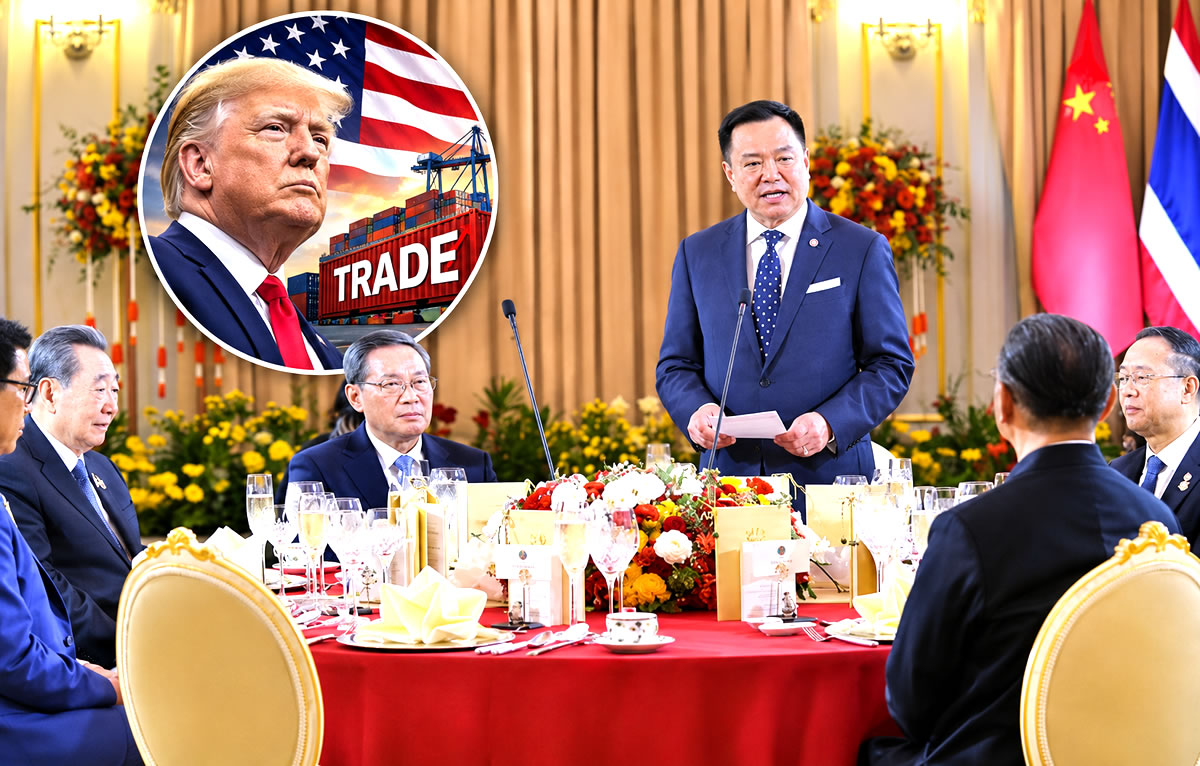
Chinese Premier Li Qiang arrived in Bangkok on Friday for a major diplomatic visit that puts Thailand’s relations with Beijing in the spotlight. The visit comes just days before Prime Minister Anutin Charnvirakul is expected to sign a trade communiqué with US President Donald Trump.
That announcement is scheduled for the ASEAN meetings in Manila next week. Against this backdrop, the Chinese premier has secured eight cooperation agreements covering security, manufacturing, agriculture and technical cooperation.
However, several major commercial commitments remain outstanding, including a proposed Chinese purchase of 500,000 tonnes of Thai rice.
Thailand balances Chinese investment and US trade talks as Li Qiang begins three-day Bangkok visit
The visit brings together two of Thailand’s most important economic relationships at a particularly sensitive moment. China remains a major source of investment, industrial technology and manufactured components.
Meanwhile, the United States is a crucial export market for Thai businesses. Washington is also negotiating trade arrangements that extend beyond tariffs into investment screening, supply chains and economic security. Consequently, the terms of Thailand’s forthcoming American agreement carry implications for industries supported by Chinese investment.
Li’s official visit runs from November 13 to 15, with the principal bilateral negotiations taking place on Friday. Prime Minister Anutin hosted the Chinese leader at Government House before the two governments exchanged eight cooperation documents.
Business discussions followed on Saturday, ahead of Li’s scheduled departure for the China–ASEAN Summit in Manila. Notably, the visit also precedes Anutin’s planned trip to Shenzhen on November 18 and 19. The diplomatic programme therefore places Thailand’s relations with both major powers under scrutiny within a single week.
Eight China agreements span industry and security but the Manila trade statement remains unfinished
The eight agreements cover electric vehicles, batteries, industrial supply chains, agricultural exports, food safety, vocational education and commercial standards. They also include arrangements concerning consular staffing and cooperation under China’s Global Security Initiative.
Significantly, the security memorandum extends the relationship beyond conventional trade and investment. However, the agreements largely establish frameworks for future cooperation rather than completed commercial transactions. No binding multibillion-dollar investment package was announced, despite the breadth of the diplomatic programme.
The proposed American trade statement provides an important backdrop to the visit. Thailand’s Cabinet approved the draft document on November 10, ahead of the November 15–17 ASEAN meetings.
Anutin and Trump are expected to announce substantial agreement on the principal elements of an Agreement on Reciprocal Trade. However, the communiqué will not constitute a final bilateral trade agreement. Its precise commitments remain unpublished, while further negotiations and legal procedures may still be required.
US trade demands raise questions over Chinese components and Thailand’s access to American markets
This is important because American trade policy increasingly involves conditions beyond tariff reductions. The Trump administration’s frameworks with several countries include provisions concerning investment screening, export controls and industrial supply chains.
Separately, Washington has raised concerns about Chinese products passing through Southeast Asian countries to avoid American tariffs. Reuters has previously reported such concerns involving Thailand and Vietnam. These issues place manufacturing arrangements and product-origin requirements at the centre of wider trade discussions.
For Thailand, the implications extend directly to industries receiving substantial Chinese investment. Chinese manufacturers have established a significant position in electric vehicles, batteries and related production.
At the same time, Thai exporters depend on access to American markets. Any additional American requirements concerning imported components could affect manufacturing and export documentation.
Nevertheless, the specific conditions proposed for Thailand remain undisclosed. No published evidence establishes that Bangkok has accepted restrictions affecting Chinese-backed companies.
China deepens electric vehicle cooperation as Anutin cites nearly 500 new investment applications
The automotive sector featured prominently in Li’s negotiations with Anutin. The relevant memorandum covers electric and intelligent vehicles, battery technology, recycling, technical standards and industrial supply chains.
It also provides for closer cooperation between Chinese manufacturers and Thai suppliers. In practical terms, the agreement reinforces an existing industrial relationship rather than announcing a new investment package. No additional investment total or comprehensive list of new manufacturing projects was disclosed.
On Saturday, Anutin addressed a bilateral business gathering and highlighted Chinese investment interest in Thailand. He said Chinese companies had submitted nearly 500 investment promotion applications during the first nine months of 2026.
The Prime Minister also stressed the importance of securing greater benefits for domestic manufacturers. Specifically, he wants Chinese investment to strengthen local component production and industrial supply chains. However, investment applications do not represent completed factories or guaranteed expenditure.
Chinese investment pledges face fresh scrutiny as US examines goods routed through Southeast Asia
This distinction runs through several of the agreements announced during Li’s visit. The documents establish channels for cooperation, but they do not guarantee that proposed investments will proceed.
Likewise, broader commitments to strengthen economic relations do not constitute binding financial contracts. The automotive memorandum nevertheless covers industries central to Thailand’s manufacturing sector. These include battery production, recycling and the development of electric vehicle supply chains.
The timing also brings American concerns about Chinese-origin goods into sharper focus. Washington has previously examined products entering its market through Southeast Asian countries.
Such arrangements can involve transshipment intended to avoid tariffs imposed on Chinese goods. Accordingly, rules governing product origin and imported components remain important in American trade negotiations. Thai manufacturers using Chinese components could face additional verification requirements under future agreements.
US economic-security provisions remain undisclosed as China expands strategic dialogue with Thailand
Beyond automotive production, American economic-security provisions could affect electronics, semiconductors, artificial intelligence and advanced manufacturing. The Council on Foreign Relations has identified these provisions as a feature of the Trump administration’s reciprocal trade frameworks.
They can include investment screening, export controls and cooperation over trade measures affecting third countries. However, the proposed Thailand–US communiqué has not been published in full. Its precise treatment of Chinese investment and manufacturing therefore remains unknown.
Security cooperation formed another major element of the Chinese premier’s visit. The memorandum linked to China’s Global Security Initiative provides a framework for closer strategic dialogue.
Chinese official statements also emphasised political trust and support for each country’s principal interests. Furthermore, Li called for stronger cooperation through existing foreign and defence ministers’ dialogue arrangements. He also sought closer coordination on Belt and Road projects and a new five-year economic cooperation plan.
China security memorandum leaves military obligations unclear as both sides discuss fraud and tourism
The security memorandum carries particular significance because it extends the agreements beyond commercial matters. However, its detailed operational obligations have not been disclosed.
There is no evidence that Thailand accepted a military alliance with China. Equally, the published documents do not establish restrictions on Thailand’s existing security cooperation with the United States. The agreement instead creates another formal channel for strategic engagement between Bangkok and Beijing.
Both governments also discussed telecommunications fraud, online gambling, cybercrime and the safety of Chinese tourists. These subjects have become increasingly important in Thailand’s relations with China. Cross-border criminal networks and online fraud have prompted stronger regional law enforcement cooperation.
In parallel, Chinese concerns about visitor safety have added another dimension to bilateral security discussions. However, the available announcements did not identify a comprehensive package of new joint enforcement operations.
Thai fruit exports gain new Chinese protocols but proposed 500,000-tonne rice purchase remains unsigned
Agricultural trade produced several of the visit’s most specific agreements. Thailand secured updated export protocols covering durian and salacca. The two governments also agreed to strengthen cooperation on food safety and agricultural inspection standards.
These arrangements provide a formal basis for improving market access for Thai agricultural exporters. Moreover, they address technical requirements governing imports and exports. Their commercial impact will depend on implementation and compliance with the agreed standards.
However, the much-discussed proposal for China to purchase 500,000 tonnes of Thai rice remains unresolved. The proposed transaction had featured prominently in discussions preceding Li’s arrival.
Yet no binding purchase contract emerged from Friday’s signing ceremony. The eight announced documents did not include a confirmed transaction covering that quantity. Nor were a commercial price, delivery schedule or final purchase arrangements disclosed.
Rice purchase remains unconfirmed as Thailand and China reaffirm high-speed railway plans for 2030
The absence of a confirmed rice contract distinguishes the agricultural protocols from the larger commercial proposals. Thailand obtained specific arrangements covering durian and salacca exports.
However, broader Chinese expressions of willingness to purchase Thai agricultural products do not constitute firm orders. Consequently, the proposed rice transaction remains separate from the completed agreements. The announcement leaves a substantial agricultural commitment outstanding despite the formal signing ceremony.
Infrastructure cooperation also occupied an important place in the negotiations. Anutin reaffirmed Thailand’s target to open the first phase of its high-speed railway by 2030. He also committed to preparing the second phase of the project.
The planned railway would connect Thailand through Laos to China. It remains an important component of Beijing’s regional connectivity programme. However, Friday’s discussions did not produce a newly disclosed financing package for the complete cross-border route.
Neither government announced a revised completion guarantee covering the entire railway. Accordingly, the project remains subject to its existing development and financing arrangements. Both sides nevertheless reaffirmed their commitment to closer cooperation on regional infrastructure.
Li presses Belt and Road cooperation as China offers water testing support and technical training
Li specifically raised coordination under China’s Belt and Road programme. He also sought progress on a new five-year economic cooperation plan. These discussions connect railway development with wider industrial and transport cooperation.
Environmental issues added another element to the visit. China offered technical assistance and monitoring equipment to address cross-border water pollution. Both governments also discussed establishing a joint water-testing laboratory in northern Thailand.
The proposed facility would support environmental monitoring and the collection of water-quality information. However, no comprehensive financing arrangement or construction timetable was disclosed. Implementation details therefore remain outstanding.
On another front, the agreements included cooperation on industrial standards and vocational education. These arrangements concern measurement systems, commercial standards and technical skills development.
They provide channels for cooperation between government agencies, educational institutions and industrial producers. Nevertheless, the announcements did not establish major new financial commitments. Their practical results will depend on subsequent implementation by the responsible authorities.
Anutin hosts Li Qiang at Government House as both leaders emphasise two millennia of shared ties
The diplomatic programme continued on Friday evening with an official dinner hosted by Anutin at Government House. The reception began at 6.45 pm in the Santi Maitri Building’s Outer Wing. Li attended as Premier of the People’s Republic of China.
During the dinner, Anutin emphasised the importance of maintaining stable relations amid international uncertainty. He said continued cooperation would benefit both countries and contribute to regional prosperity.
Li responded by highlighting the long history of relations between Thailand and China. He described their relationship as extending over 2,000 years. The Chinese premier also recalled the establishment of formal diplomatic relations in 1975.
Since then, he said, bilateral cooperation has continued without interruption. Furthermore, Li expressed confidence that relations would remain stable despite international uncertainty.
The Chinese premier referred to shared challenges, including natural disasters and economic difficulties. He stressed the importance of mutual assistance during periods of hardship. Li also described the two countries as close neighbours with longstanding ties.
His remarks reinforced Beijing’s official emphasis on political trust and continued strategic cooperation. Nevertheless, the commercial results remained more limited than the breadth of the diplomatic programme.
Eight signed documents leave investment and rice deals unresolved ahead of crucial Manila trade talks
Eight cooperation documents were signed, but no major new investment total was disclosed. The proposed rice purchase remains unconfirmed, while railway financing and security implementation details are outstanding.
Similarly, the automotive memorandum establishes cooperation without guaranteeing additional investment expenditure. The environmental laboratory proposal also lacks a disclosed construction timetable and comprehensive financing arrangement.
The diplomatic timetable now moves rapidly towards Manila. Li’s official visit to Thailand continues until November 15. The ASEAN meetings in the Philippines are scheduled for November 15–17. Anutin is expected to meet Trump during those meetings and announce progress towards the reciprocal trade agreement.
Meanwhile, Li is scheduled to attend the China–ASEAN Summit. Thailand’s Ministry of Foreign Affairs confirmed the wider diplomatic programme on November 11.
Anutin heads for Shenzhen after Manila as terms of proposed US trade agreement remain undisclosed
Anutin is then scheduled to attend meetings in Shenzhen on November 18 and 19. The programme provides another opportunity for high-level exchanges with Beijing after the American trade announcement.
As a result, the Thai Prime Minister will engage both major powers within days. The sequence places the Chinese cooperation agreements immediately before the expected American statement, although the negotiations remain separate.
The Manila communiqué represents the next significant development. According to the Thai government, it will confirm substantial agreement on the principal elements of reciprocal trade. However, it will not settle every outstanding issue or constitute the final bilateral agreement.
Further negotiations and legal procedures may still be required. Moreover, the precise American commitments concerning investment, supply chains and third-country trade remain unpublished.
There has been no verified disclosure that Li demanded Thailand reject, postpone or amend the American trade statement. Neither government has publicly established that the Bangkok agreements were negotiated in response to specific American conditions.
Nevertheless, the two diplomatic programmes address overlapping areas of economic and strategic importance. These include manufacturing, investment, infrastructure, trade standards and security cooperation.
Beijing and Bangkok reaffirm cooperation but American trade terms leave investment questions open
Beijing’s official statements concentrated on political trust, long-term economic planning and closer strategic dialogue. Meanwhile, Bangkok reaffirmed its interest in Chinese investment, agricultural exports and regional infrastructure.
The signed documents formalised cooperation across these sectors without establishing a comprehensive new investment package. The American negotiations present a separate set of unresolved commitments, including possible economic-security provisions affecting third-country trade.
The practical relationship between the Chinese agreements and the proposed American statement remains unsettled. No confirmed conflict between their provisions has been established.
Their implications will depend on the final wording of the American agreement and the implementation of China’s cooperation frameworks. For Thailand, the immediate results from Li’s visit are concentrated in agricultural protocols and industrial cooperation arrangements.
China security pact and unsigned rice deal expose limits of agreements before Manila trade statement
The security memorandum adds a wider strategic dimension, while the railway and proposed rice purchase remain unresolved. Likewise, the automotive agreement provides no guaranteed investment total.
The visit has therefore produced formal commitments without resolving several major commercial questions. No binding multibillion-dollar investment package was announced, and the proposed 500,000-tonne rice purchase remains unsigned.
Chinese PM flies in Friday for high level talk with Anutin before Thailand signs a US trade communiqué in Manila
Chinese warning to its nationals stays as Bangkok embassy reveals it receives up to ten panic calls a day
As of Saturday evening, November 14, Li’s official visit is continuing and the proposed American communiqué remains unsigned. Eight Chinese cooperation documents have been concluded, while Thailand’s final trade commitments to Washington remain outstanding.
The next development comes in Manila, where Anutin and Trump are expected to announce their trade understanding. Its provisions will establish whether new American conditions affect the Chinese investment and industrial cooperation reaffirmed in Bangkok.
Join the Thai News forum, follow Thai Examiner on Facebook here
Follow Thai Examiner on Google here
Receive all our stories as they come out on Telegram here
Follow Thai Examiner here
Further reading:
Three Chinese nationals rescued by police in Tak province near Burma. Police top brass want answers
Tourism chiefs furious as another Chinese abduction and a spat with the Embassy threaten bookings
Thailand losing appeal to Chinese tourists despite a gain in numbers from last year as Vietnam rises
Government to reopen Hua Hin to international flights as it pushes Thai Airways on more flights