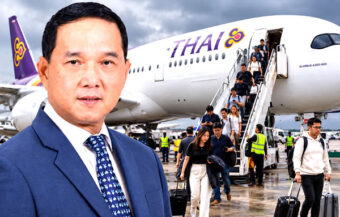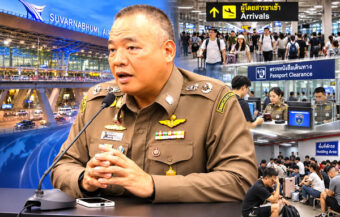
Thai Airways is back in the red with a ฿418m quarterly loss. Former boss Chai Eamsiri, who led its bankruptcy recovery, is out of the CEO race. A senior Finance Ministry official chairs the board as three contenders fight for the top job. New boss in place on January 1, 2027.
Thai Airways has plunged back into the red, posting a ฿418 million quarterly loss as its leadership crisis deepens. Meanwhile, the board has excluded former Chief Executive Officer Chai Eamsiri, who led its recovery from bankruptcy, from the final shortlist. Chai lost control following September’s baggage chaos at Suvarnabhumi Airport. Since then, aircraft incidents, cargo backlogs and a major passenger data breach have battered the airline. Operating profit has plunged 55.1%, while nine-month earnings have fallen sharply. Crucially, Finance Ministry Permanent Secretary Lavaron Sangsnit chairs the board choosing Chai’s successor, placing a senior civil servant at the centre of the decision. Three executives remain in contention, with a new chief expected on January 1, 2027.
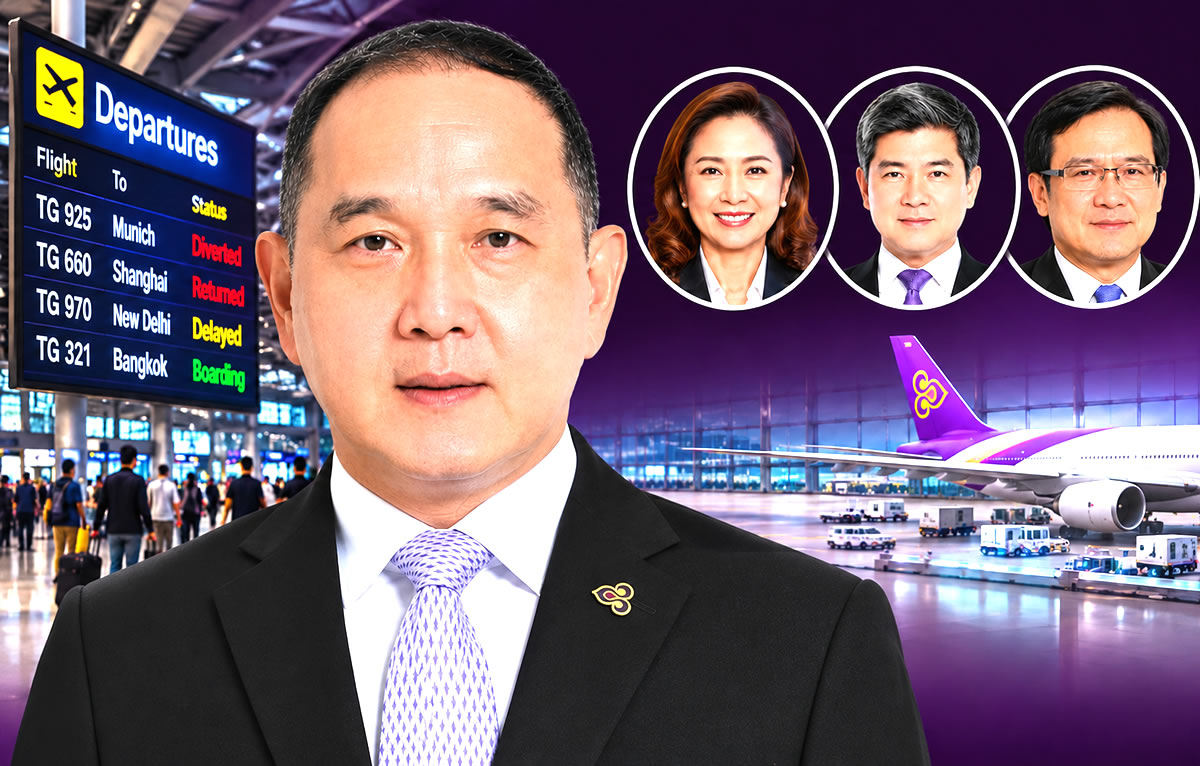
Thai Airways has returned to quarterly losses as its board prepares to replace the executive who led its recovery from bankruptcy. The national carrier reported a ฿418 million net loss for the third quarter of 2026.
Meanwhile, former Chief Executive Officer Chai Eamsiri has been excluded from the final shortlist to lead the airline. His removal follows September’s disastrous baggage crisis at Suvarnabhumi Airport and a succession of operational failures. The board expects to appoint a successor before December ends, with the new chief taking office on January 1, 2027.
The financial reversal comes less than four years after Chai took charge of the airline’s rehabilitation. He became Chief Executive Officer on February 1, 2023, overseeing a crucial stage of its recovery from bankruptcy proceedings.
Chai Eamsiri loses control as Thai Airways posts fresh losses and suffers repeated operational failures
However, his authority collapsed following widespread disruption at Bangkok’s principal international airport in late September. On October 2, the board suspended him and appointed director Samrit Samniang as acting Chief Executive Officer. Subsequently, Chai remained in the recruitment contest before being eliminated from the final selection.
The airline’s latest financial results have intensified the leadership crisis. Third-quarter revenue rose 12.9% to ฿50.13 billion, but operating expenses increased 29.1%. Consequently, operating profit plunged 55.1% to ฿3.84 billion before finance costs and one-time items.
The company then reported its ฿418 million net loss. The figures exposed a sharp deterioration in profitability despite higher revenue and the airline’s recent financial recovery.
At the same time, Thai Airways faces mounting problems across its operations. September’s baggage chaos disrupted flights and stranded thousands of passengers without their luggage. Since then, technical incidents have affected international services involving Shanghai, Munich and New Delhi.
Cargo handling backlogs have also prompted complaints from businesses and freight operators. Separately, a cybersecurity breach raised concerns over more than 60,000 passenger booking records.
Finance Ministry permanent secretary chairs board as three candidates compete for Thai Airways top job
The leadership contest has also brought renewed attention to government influence within the national carrier. Board chairman Lavaron Sangsnit is Permanent Secretary of Thailand’s Finance Ministry, one of the country’s most senior civil servants.
Consequently, the final appointment will be made by directors under the leadership of a senior government official. His position gives the selection process a significant government dimension as the airline confronts renewed financial and operational difficulties.
Three candidates have survived the recruitment process. They are Warangkana Luerojwong, Korakot Chatasingha and Cherdphan Chotikhun, all experienced aviation executives.
Their professional backgrounds cover ground operations, commercial management and aircraft engineering. Notably, the shortlist excludes Chai despite his earlier application and recent calls for his reinstatement. The board has not announced a preferred candidate or made a final appointment.
The recruitment exercise began in September, before the baggage crisis brought Chai’s leadership to an abrupt end. Six candidates subsequently underwent interviews and presented their management plans on October 18. Chai remained among them despite losing operational control earlier that month.
However, the nomination committee later reduced the field to three finalists, excluding the former chief executive.
Thai Airways turns to independent assessments after excluding turnaround chief from final shortlist
As part of the selection process, Thai Airways engaged an international human resources consultancy to assess the candidates. The assessments followed management presentations and interviews conducted during October.
According to local sources, the three finalists have completed the evaluation stage. The board is expected to announce its decision before December 31, allowing a handover ahead of January’s management changes.
The exclusion represents a dramatic reversal for Chai, whose tenure became associated with the airline’s financial turnaround. He took control during a prolonged restructuring following Thai Airways’ financial collapse.
Under his leadership, the carrier returned to profitability and continued rebuilding its international operations. Nevertheless, the September baggage crisis brought his management under intense scrutiny and ended his direct control of the company.
The disruption at Suvarnabhumi Airport involved severe baggage delays, flight problems and failures in ground handling. Flooding and staff shortages contributed to the breakdown during the final days of September.
Consequently, thousands of passengers encountered difficulties retrieving luggage as delayed bags accumulated across the airport system. Airline staff struggled to restore normal operations while flight schedules and passenger services suffered.
Board suspends Chai Eamsiri after September baggage crisis and opens investigation into management
In response, the board suspended Chai from his chief executive duties on October 2. Samrit Samniang, a director and executive committee member, assumed responsibility as acting chief executive.
The intervention removed Chai from operational command during a critical period for the airline. Meanwhile, the board initiated an investigation into senior management accountability following the disruption.
The suspension was a major decision involving an executive closely associated with Thai Airways’ rehabilitation. Chai had overseen the company’s return to financial stability after its bankruptcy proceedings.
However, the baggage crisis exposed serious operational weaknesses during his leadership. His removal came before the airline announced the latest quarterly loss, which covered his final full quarter in charge.
Separately, a reported procurement arrangement involving approximately 860,000 bottles of wine attracted scrutiny. The purchase was valued at more than ฿800 million and reportedly involved a single supplier.
The matter became another focus of attention surrounding the former chief executive. Nevertheless, the procurement concerns remain under investigation, with no completed findings establishing misconduct.
Former Thai Airways chief seeks another term but fails to reach final three despite reinstatement calls
Despite his suspension, Chai continued seeking another term. He had applied before losing operational control and participated in the October 18 recruitment interviews.
His inclusion among the six candidates demonstrated that the appointment process remained separate from the suspension. However, his subsequent exclusion from the final three ended his immediate prospects of returning through that process.
The decision followed recent calls for his reinstatement. Nevertheless, the nomination committee advanced three other executives to the final assessment stage. The board is therefore proceeding towards a new leadership appointment without the man who oversaw the airline’s recovery. No completed investigation has established Chai’s personal responsibility for every operational problem.
Meanwhile, the selection process is taking place under the chairmanship of Finance Ministry Permanent Secretary Lavaron Sangsnit.
His position combines senior responsibility within Thailand’s financial administration with leadership of the national carrier’s board. The arrangement places a senior civil servant at the centre of one of the airline’s most important management decisions.
Senior civil servant leads Thai Airways board as directors prepare to choose new chief executive
Thai Airways remains a listed company with a longstanding relationship with the Thai state. Its board chairman’s government position reflects that connection. Consequently, the selection of the next chief executive carries significance beyond the airline’s commercial operations. The appointment will be made by directors operating under Lavaron’s leadership.
Nevertheless, no confirmed evidence establishes that ministers have instructed directors to favour a particular candidate. The board retains formal responsibility for the appointment, supported by the international consultancy’s assessments.
However, the chairman’s senior civil service position gives the decision a clear government connection. The result will determine who takes charge during a period of renewed financial pressure.
That pressure became unmistakable on Tuesday, November 17, when Thai Airways released its third-quarter financial results. Revenue reached ฿50.13 billion, up 12.9% from the corresponding period in 2025. However, expenses increased substantially faster than income, rising 29.1%. The sharp increase severely reduced operating profitability.
Thai Airways posts quarterly loss as soaring fuel costs overwhelm revenue growth and squeeze profits
The airline reported operating profit of ฿3.84 billion before finance costs and one-time items. This represented a 55.1% decline year-on-year. More seriously, the company recorded a quarterly net loss of ฿418 million. The result marked a significant setback following its prolonged financial rehabilitation.
The principal pressure came from aviation fuel. Average fuel prices increased 59.8% year-on-year amid geopolitical tensions in the Middle East. The surge raised costs across the airline’s international operations, particularly its long-haul services. Furthermore, overall operating expenses increased at more than twice the rate of revenue growth.
The figures revealed a company generating more income but retaining considerably less operating profit. Despite the revenue increase, the cost surge overwhelmed much of the additional earnings. Consequently, the airline moved into a quarterly net loss after previously reporting stronger profitability.
The timing of the results is significant. Chai remained chief executive throughout July, August and September, the period covered by the quarterly accounts. However, the board had already suspended him before the results were released. The acting management appointed in October therefore inherited the financial position disclosed in November.
Fuel costs drive down earnings as Thai Airways reports sharp fall in nine-month profits and passengers
The financial report identified higher fuel costs as a major cause of weaker profitability. Accordingly, the loss cannot be attributed solely to September’s baggage crisis or subsequent management changes. Nevertheless, the deterioration adds a serious financial problem to the leadership transition.
The broader nine-month results provide further evidence of falling earnings. Thai Airways reported revenue of ฿149.78 billion for the first nine months of 2026, excluding one-time items. Operating profit reached ฿21.28 billion, while net profit stood at ฿11.23 billion. However, net profit had reached ฿26.39 billion during the corresponding period in 2025.
The decline amounted to approximately 57.5%, representing more than ฿15 billion in reduced profitability. Although the airline remained profitable over nine months, its earnings weakened dramatically. The third-quarter loss marked a further deterioration within that reporting period.
Passenger numbers also fell. Thai Airways carried 11.81 million passengers during the first nine months of 2026, down 3.1% year-on-year. Meanwhile, the company continued pursuing fleet expansion and international network development. As of September 30, the airline operated 91 aircraft.
Baggage crisis exposes operational weaknesses as Thai Airways faces falling profits and rising costs
The expanding operation requires dependable engineering, ground services, staffing and airport coordination. However, recent incidents have exposed serious difficulties across several departments. The September baggage crisis was followed by technical disruptions, cargo backlogs and cybersecurity concerns.
Despite the financial setback, Thai Airways retains substantial liquidity. Cash and other current financial assets totalled ฿135.49 billion at the reporting date. The company therefore remains far removed from the immediate financial distress that preceded its earlier collapse. Nevertheless, falling profits and rising expenses present a difficult financial background for the incoming chief executive.
The September baggage crisis remains central to the leadership upheaval. Severe flooding and staffing shortages disrupted operations at Suvarnabhumi Airport. Passengers encountered lengthy waits while delayed luggage accumulated within the baggage system. Flight schedules also suffered as the airline struggled to restore normal ground handling.
The breakdown affected international travellers and placed immediate pressure on airport services. Reports described thousands of delayed bags and serious difficulties coordinating baggage operations. Consequently, the crisis triggered the board intervention that ended Chai’s operational control.
Cockpit window crack, dry lavatory and India diversion add to Thai Airways flight disruption problems
Yet the airline’s difficulties continued after the management change. In early November, a Thai Airways aircraft returned to Shanghai after a crack was discovered in a cockpit window. The incident interrupted an international service and required technical attention. It also added to scrutiny of the airline’s aircraft reliability.
On another front, photographs circulated showing bottled water being used inside a lavatory aboard a Munich–Bangkok flight. The arrangement followed a reported failure of the running water supply. The incident attracted attention to passenger facilities and cabin maintenance. However, the precise technical cause has not been confirmed.
Then, on November 16, Thai Airways flight TG925 encountered another technical problem while travelling from Munich to Bangkok. The aircraft diverted to New Delhi, India, rather than continuing directly to Thailand. Passengers faced disruption while the airline arranged repairs and onward travel.
The diversion added another incident to an increasingly difficult November. However, the Shanghai cockpit window problem, lavatory failure and New Delhi diversion involved separate circumstances. No completed investigation has established a common technical cause.
Cargo backlogs and major passenger data breach deepen Thai Airways troubles after aircraft incidents
Nevertheless, the succession of incidents has increased scrutiny of the airline’s engineering and operational departments. International services depend on reliable aircraft, maintenance arrangements and ground support. Technical disruptions also place additional demands on crews, airport personnel and passenger handling.
In parallel, Thai Airways’ cargo business encountered difficulties. Freight forwarders, shipping companies and commercial operators complained about backlogs affecting international air freight. The disruption created problems for businesses relying on scheduled cargo movements. Thai Airways and relevant agencies have been working to address the delays.
The cargo complaints followed September’s serious baggage handling failures. Although commercial freight and passenger luggage involve different operations, both depend on airport coordination and ground services. Consequently, the problems placed further pressure on the airline’s aviation business divisions.
Another serious setback emerged in November when Thai Airways confirmed unauthorised access involving its passenger booking platform. Reports indicated that more than 60,000 booking records could have been exposed. The breach reportedly involved access extending over several years, raising concerns about the security of passenger information.
Passenger booking breach adds to mounting problems as Thai Airways investigates exposed travel records
The incident brought cybersecurity into the airline’s expanding list of operational problems. Passenger reservation systems contain information required for international travel and airline administration. Consequently, the investigation focused attention on data protection and the security of booking technology.
The precise extent of compromised passport information and other sensitive records remains unconfirmed. Nevertheless, the incident added another management responsibility during the leadership transition. The incoming chief executive will inherit the consequences alongside the airline’s financial and operational difficulties.
The series of failures has placed several important departments under scrutiny. Ground handling suffered major disruption in September, while technical incidents affected international flights during November. Separately, cargo operations encountered backlogs and passenger information security came under investigation.
However, the individual problems have not been formally linked to a single management failure. The baggage crisis involved flooding and staffing shortages, while aircraft incidents arose under separate circumstances. Nevertheless, the difficulties have unfolded during a period of management upheaval and falling profitability.
Three shortlisted executives bring contrasting operational and commercial experience to Thai Airways
Against this background, the board has shortlisted three executives with contrasting professional experience. Warangkana Luerojwong joined Thai Airways in 1997 and has worked across several operational departments. Her experience includes ground services, catering, cargo and ground equipment.
Her background covers important parts of the airline’s aviation services. Notably, ground handling and cargo operations have both experienced serious difficulties during recent months. However, the nomination committee has not publicly indicated whether her operational experience gives her an advantage.
Korakot Chatasingha brings a different management profile. As former Chief Commercial Officer, he has experience in sales, revenue management and commercial strategy. His expertise covers airline income generation and market development. These responsibilities have gained importance following the sharp decline in profitability.
The latest financial results show that higher revenue failed to prevent a quarterly net loss. Meanwhile, passenger numbers fell over the first nine months of 2026. Korakot’s commercial background therefore differs substantially from the operational experience offered by Warangkana.
Technical chief joins final shortlist as Thai Airways prepares January leadership change under new boss
Cherdphan Chotikhun, the third finalist, specialises in aircraft engineering and aviation safety standards. As Chief Technical Officer, his responsibilities cover the airline’s technical operations. His inclusion comes amid heightened attention to aircraft incidents and service reliability.
However, the recent technical problems have not been established as evidence of systemic maintenance deficiencies. The three finalists therefore represent different management backgrounds rather than competing conclusions about the airline’s difficulties.
The board must now choose between those candidates before the end of December. The successful executive is expected to take office on January 1, 2027. The timetable allows a transition before the existing management team’s terms expire later that month.
Meanwhile, Samrit Samniang continues overseeing the airline during the interim period. He assumed responsibility following Chai’s suspension and inherited the aftermath of the September baggage crisis. Subsequently, the airline encountered further technical incidents, cargo complaints and the passenger data breach.
The leadership transition has unfolded in two stages. First, the board removed Chai from operational control and appointed an acting chief executive. Subsequently, the nomination committee reduced the recruitment field and excluded him from the final shortlist. The December appointment is expected to complete the process.
Chai Eamsiri faces final exclusion as Finance Ministry official oversees Thai Airways succession decision
For Chai, the developments represent a dramatic reversal. He took charge in February 2023 during Thai Airways’ recovery from bankruptcy proceedings. His tenure became closely associated with the airline’s return to profitability and financial stability.
However, by October 2026, he had lost direct control following the September operational crisis. Weeks later, Thai Airways reported another quarterly loss. His exclusion from the shortlist then ended his immediate prospects of returning through the recruitment process.
The board’s decision will also place Lavaron Sangsnit under renewed attention. As Finance Ministry Permanent Secretary and chairman, he holds two significant positions linking government administration and airline management. Consequently, the appointment will carry importance beyond the company’s executive offices.
The selection process includes independent assessments conducted by an international consultancy. Nevertheless, the final choice rests with directors under Lavaron’s chairmanship. No confirmed evidence establishes political instructions favouring any candidate.
Thai Airways therefore approaches the end of 2026 with several major developments converging. Its former turnaround chief has been excluded from the leadership contest.
Its latest quarterly accounts have returned to losses, while nine-month profitability has fallen sharply. Meanwhile, technical incidents, cargo backlogs and cybersecurity concerns continue to burden management.
Thai Airways faces fresh quarterly losses and new leadership. Board expects December CEO appointment
The financial figures remain particularly striking. Revenue increased during the third quarter, yet operating profit collapsed by more than half. Fuel prices rose almost 60%, while overall expenses increased substantially faster than income. Consequently, the airline recorded a ฿418 million net loss despite generating more than ฿50 billion in quarterly revenue.
At the same time, passenger numbers declined over the first nine months. The company remained profitable over that period and retained substantial liquidity. Nevertheless, the latest results mark a serious setback following its financial rehabilitation.
Thai Airways flight from Munich makes an emergency landing in India. Series of incidents without a CEO
Thai Airways left reeling after major data breach over three years and reports of a lavatory without water
The next decisive move rests with the board chaired by Finance Ministry Permanent Secretary Lavaron Sangsnit. Directors are expected to approve a new chief executive before December ends. The successful candidate is scheduled to assume office on January 1, 2027.
By then, Thai Airways will have completed a major leadership change less than four years after Chai began overseeing its recovery. The national carrier will enter 2027 with a new boss, weaker earnings and unresolved operational difficulties. Its financial rehabilitation remains intact, but the latest quarterly loss marks a serious reversal. Meanwhile, the executive who led its turnaround has been left outside the final leadership contest.
Join the Thai News forum, follow Thai Examiner on Facebook here
Follow Thai Examiner on Google here
Receive all our stories as they come out on Telegram here
Follow Thai Examiner here
Further reading:
Thai Airways now says baggage failure was five times worse than admitted. Board orders compensation
Government takes a stronger hand as Thai Airways crisis at Suvarnabhumi Airport worsened Wednesday