Japan’s bold seven-nation 2046 World Cup plan could bring football’s biggest tournament to Thailand for the first time. Rajamangala is lined up as Bangkok’s key venue, but Japan has yet to make a formal approach and any deal must go to Cabinet first.
World Cup football could come to Thailand for the first time under a blockbuster Japanese plan to stage the 2046 tournament across seven Asian nations. Sports Minister Surasak Panjaroenworakul says Bangkok is ready to consider joining Japan, China, South Korea, Indonesia, Malaysia and Singapore. Rajamangala National Stadium could become Thailand’s 70,000-seat World Cup stage. However, Japan has yet to make a formal approach, while any deal must face Cabinet scrutiny. The audacious plan would span East and Southeast Asia, 12 years after Saudi Arabia hosts the 2034 tournament.
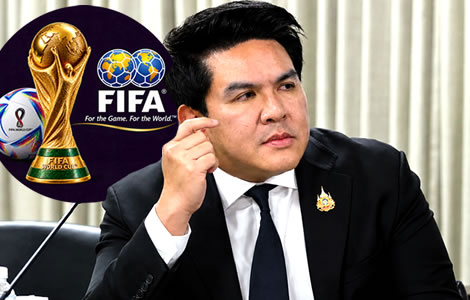
Thailand has opened the door to joining Japan’s ambitious seven-country bid for the 2046 FIFA World Cup. Minister of Tourism and Sports Surasak confirmed the government’s interest following reports about the emerging Japanese plan. However, the Japan Football Association has made no formal approach to Thailand.
Bangkok has received neither a proposal nor detailed hosting conditions. Nevertheless, Mr Surasak said Thailand would consider the project if Japan formally presents an offer. He described the prospect as a major opportunity to host one of the world’s largest sporting events.
“If Japan genuinely submits an offer to host the World Cup, the government would definitely consider it,” Mr Surasak said. A reporter asked whether Japanese football officials had already approached Thailand. In response, the minister confirmed that no proposal had been received.
Thailand awaits formal Japanese approach before Cabinet considers the ambitious 2046 World Cup bid
Any official approach would trigger discussions over Japan’s conditions. Subsequently, the matter would be brought before the Cabinet for consideration. Mr Surasak said proposals benefiting Thailand and contributing to sports development would be welcomed. For now, though, Bangkok is waiting for Japan to disclose its terms.
“If they are, I believe the government will be willing to support it,” Mr Surasak said. He described the tournament as an opportunity to stage a major sporting event. Crucially, his comments amount to interest rather than a commitment to participate.
Meanwhile, the Japan Football Association is developing plans for a vast multinational World Cup bid. The concept could spread the 2046 tournament across seven Asian countries. Japan would lead the proposed group, alongside South Korea and China.
In parallel, Thailand, Indonesia, Malaysia and Singapore would provide the four ASEAN members. The proposed bid would therefore stretch deep into East and Southeast Asia. It would be considerably broader than a simple Japan-ASEAN hosting arrangement.
Notably, Japan and South Korea already have direct experience of hosting the tournament. They jointly staged the 2002 FIFA World Cup. Thailand, by contrast, has never staged a men’s World Cup match.
Rajamangala lined up as Thailand’s key venue in proposed seven-country Asian World Cup hosting plan
As part of the emerging concept, Bangkok’s Rajamangala National Stadium could become Thailand’s principal venue. The stadium can accommodate about 70,000 spectators. That gives Thailand an existing large venue should the project eventually proceed.
Elsewhere, Malaysia possesses one of Southeast Asia’s largest stadiums. Bukit Jalil National Stadium can accommodate nearly 90,000 spectators. Indonesia also brings substantial existing stadium infrastructure to the proposed group.
Specifically, Indonesia offers Gelora Bung Karno Stadium and Jakarta International Stadium. Both can accommodate more than 80,000 spectators. Singapore’s National Stadium, meanwhile, has a capacity of approximately 55,000.
Existing stadium infrastructure reportedly helped shape the preliminary choice of potential partners. Significantly, Vietnam is absent from the proposed seven-country group. Reports suggest concerns over its existing stadium infrastructure influenced the preliminary selection.
Even so, the current line-up is not final. No formal FIFA bidding process for the 2046 tournament has begun. Nor have the seven countries agreed on a common bid.
Expanded 48-team World Cup drives huge infrastructure demands as Japan develops seven-country bid
Japan must first develop its proposal and establish which partners will participate. Thailand must then examine the conditions attached to any Japanese invitation. Only afterwards could Bangkok decide whether to formally join.
At the same time, the modern World Cup presents far greater demands than Japan and South Korea faced in 2002. FIFA expanded the competition from 32 teams to 48 for the 2026 tournament. The larger format significantly increases the infrastructure required from hosts.
For example, numerous large stadiums are needed to accommodate the expanded competition. Hosts also require training centres, hotels and extensive transport infrastructure. Major airport capacity is another central requirement for teams and international visitors.
Against that backdrop, Japan’s concept would spread matches across seven countries with substantial existing facilities. The proposed hosts would stretch from Japan and South Korea into Southeast Asia. China would provide another major East Asian component.
Separately, FIFA has already embraced multinational hosting for the 2030 World Cup. Spain, Portugal and Morocco will serve as its principal hosts. Yet the competition will actually extend across six countries and three continents.
World Cup heads from six-country 2030 tournament to Saudi Arabia in 2034 before possible Asian return
Uruguay, Argentina and Paraguay will each stage one celebratory match. Those fixtures will mark the World Cup’s centenary. Uruguay hosted the inaugural tournament in 1930.
Accordingly, the 2030 competition will return to South America exactly 100 years after that first tournament. FIFA formally confirmed the unusual six-country arrangement in December 2024.
Four years later, the World Cup will move entirely to Asia. Saudi Arabia will host the 2034 tournament. Unlike the 2030 competition, all matches will be staged within one country.
FIFA confirmed Saudi Arabia at the same Extraordinary FIFA Congress in December 2024. Thus, Japan’s proposal would potentially bring the World Cup back to Asia only 12 years later.
On another front, the 2046 selection remains years away. Reports suggest the formal host selection process could begin around 2031. Japan and its prospective partners therefore have considerable time to develop their plans.
Before then, the countries would need to determine the final membership of any bid. They would also need to settle stadium selections and infrastructure requirements. Individual hosting commitments would form another critical part of those discussions.
Thailand waits on Japan’s formal terms as Rajamangala emerges as potential venue for 2046 World Cup
For Thailand, Rajamangala National Stadium provides an immediate starting point. Its roughly 70,000 capacity compares with major venues elsewhere in the proposed group. Moreover, Bangkok would potentially stage World Cup football for the first time.
Still, no such arrangements have been agreed. The Japan Football Association has not submitted hosting conditions to the Thai government. Bangkok has neither approved a stadium programme nor committed itself to the proposed tournament.
Instead, the government’s position remains conditional on receiving an official Japanese approach. Mr Surasak said those conditions would then be examined. Following that review, the proposal would go before the Cabinet.
Argentinian football star Messi steals the World Cup show in Bangkok where the 2026 tournament is a hit
Monomax Sports secures rights to 2026 World Cup with a last minute 2.3 billion baht deal for 2030 tournament also
In practical terms, Japan is assembling an Asian World Cup concept while Thailand waits for details. The proposed map already includes seven countries and several stadiums holding more than 70,000 spectators. Yet the project remains preliminary and FIFA’s formal process has not started.
For Thailand, the next move therefore rests with Japan. Bangkok has signed nothing and received no formal offer. Nonetheless, Mr Surasak has made the government’s initial position clear.
If Japan formally asks Thailand to join the 2046 World Cup project, the government is prepared to consider the offer.
Join the Thai News forum, follow Thai Examiner on Facebook here
Receive all our stories as they come out on Telegram here
Follow Thai Examiner here
Further reading:
World Cup all set to be available on free-to-air TV in a vital boost to the foreign tourism industry
Flight connectivity dogs tourism recovery as Immigration Bureau warns travellers of delays
Travel to Thailand rebounding despite inflation and higher fares, now nearly 2 million a month
Thailand’s once mighty foreign tourism industry lastingly damaged with lower spends and numbers
Nightlife until 4 am as poll shows plans to move foreign tourism upmarket a ‘recipe for disaster’