Thailand faces the risk of a World Cup TV blackout as FIFA demands up to ฿1.7 billion for the 2026 rights. With Anutin ruling out public funds and sponsors reluctant, talks stall ahead of the June 11 kickoff, leaving free-to-air coverage in doubt.
Thailand’s bid for free-to-air coverage of the 2026 FIFA World Cup has reached a hard stalemate as talks with FIFA stall over a sharply inflated price of up to 1.7 billion baht. With Prime Minister Anutin Charnvirakul ruling out public funding and private sponsors showing little interest, a major financing gap remains just weeks before the June 11 kickoff in Mexico City. Rising rights costs, strict broadcast rules, weak commercial demand, and sharp international price comparisons have all converged, leaving Thailand’s access to the world’s biggest sporting event unresolved as negotiations continue without a breakthrough.
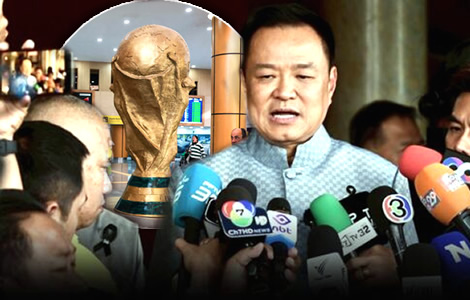
Thailand has not secured broadcast rights for the 2026 FIFA World Cup as negotiations with FIFA continue over a sharply increased price range. On Friday, while Prime Minister Anutin Charnvirakul visited France, concern grew over the stalled negotiations.
At the same time, attention focused on whether Thai audiences would receive free-to-air coverage of the tournament. The World Cup remains the largest sporting event in the world. It begins on June 11 in Mexico City. It ends on July 19. Hosts include Mexico, the United States, and Canada.
However, negotiations remain unresolved with FIFA. The reported asking price ranges from 1.3 billion to 1.7 billion baht. Moreover, the figure marks a sharp increase from previous cycles. In 2022, Thailand paid around 600 million baht for rights.
World Cup rights talks escalate as FIFA price rises to 1.7 billion baht range, putting pressure on deal
Some earlier reports placed that cycle at approximately 1.4 billion baht. As a result, the current negotiation range represents a significant escalation.
Meanwhile, ancillary costs further increase the financial burden. Consequently, estimates rise toward 1.7 billion baht in total obligations. Moreover, stakeholders have flagged additional fees as a key pressure point. Therefore, pricing remains a central obstacle in discussions. At the same time, negotiations between agencies and FIFA continue without a final agreement.
On May 12, the Cabinet approved a resolution supporting Thailand’s bid to secure the rights. However, the resolution did not allocate public funding. Instead, it instructed agencies to pursue commercial arrangements. The Public Relations Department was assigned the coordination responsibility. In addition, the NBTC was tasked with regulatory oversight.
However, progress has been limited since the Cabinet decision. Moreover, private sector participation has not materialised at expected levels. Sponsors and broadcasters have shown weak engagement. As a result, funding gaps remain unresolved. Therefore, negotiations have stalled at a financial impasse.
Cabinet backs FIFA World Cup rights talks but no public funding as private sponsors stay weak
On May 18, Prime Minister Anutin Charnvirakul made a key intervention. He ruled out the use of public funds for the World Cup broadcast rights. He stated clearly that the state budget would not be used. Instead, he said the government would act only as a coordinator. Furthermore, he emphasised continued efforts to facilitate a deal.
He also addressed speculation that Thailand might withdraw from negotiations. “We are coordinating to the best of our ability,” he said. “We are trying every possible avenue,” he added. He described the approach as “best effort.” However, he did not confirm any financial commitment. As a result, uncertainty over funding remained unchanged.
At Government House on the same day, Anutin reiterated his position. He confirmed again that no public funds would be used. He also stressed that the government’s role was facilitative rather than financial. Moreover, he said discussions were ongoing with relevant stakeholders. However, he gave no indication of a breakthrough.
Anutin rules out public funds for World Cup rights and insists that best effort coordination continues
Meanwhile, timing constraints have increased pressure on negotiations. The tournament begins on June 11. As a result, less than a month remains before kickoff. However, no final agreement has been reached. Therefore, Thailand’s broadcast status remains unresolved.
In addition, commercial conditions have weakened participation. Private broadcasters have shown limited interest in funding the rights. Similarly, sponsors have not committed financial backing. Moreover, economic conditions in Thailand have constrained investment appetite. As a result, commercial support remains insufficient to close the gap.
Furthermore, scheduling challenges reduce the value of the rights package. Matches are expected to air during early morning hours in Thailand. Kickoff times include 3:00 a.m., 5:00 a.m., and 9:00 a.m. Consequently, advertising revenue potential is limited. Moreover, audience reach is expected to decline significantly during these hours.
On regulatory grounds, Thailand enforces a strict “must-have” rule. Any rights holder must provide free-to-air broadcast access. This requirement limits monetisation opportunities. Moreover, it increases financial risk for any buyer. As a result, the structure of the deal remains commercially difficult.
NBTC weighs World Cup funding as Thailand questions economic return and regulatory broadcast risks
At the same time, the NBTC continues to review possible funding mechanisms. Acting Secretary General Trairat Viriyasirikul said the research and development fund could be considered. However, he stressed that any expenditure must be justified. He said the cost must align with public benefit.
“The fund exists to support public access to television broadcasts,” he said. “This includes major events like the World Cup,” he added. However, he also warned that the financial scale must be carefully assessed. Therefore, approval is not automatic.
He further questioned whether the investment would generate economic benefit. Thailand’s national team did not qualify for the tournament. Moreover, most matches will air overnight. As a result, he said the economic stimulus may be limited. “We must consider whether this expenditure is justified,” he said.
He also referenced past broadcast issues. During previous World Cup cycles, viewers experienced signal interruptions. FIFA enforces strict compliance with live broadcast rights. Consequently, signals can be cut if contractual rules are violated. This creates operational risk for broadcasters.
NBTC awaits updates on FIFA talks as board decision pending amid ongoing broadcast negotiations
Meanwhile, the NBTC is awaiting updates from ongoing negotiations. It is monitoring discussions between the Public Relations Department and FIFA. Furthermore, a board decision will follow once full information is received. Therefore, regulatory approval remains pending.
At the same time, Minister in the Prime Minister’s Office Supamas Isarabhakdi raised concerns about pricing. She said FIFA’s charges are excessive. She also confirmed that private firms are reluctant to participate. As a result, financial support has not materialised.
She stated that Thailand, with around 70 million people, faces disproportionately high costs. She compared this to countries with far larger populations. “The price is about 20 times higher than a country of 1.5 billion people,” she said. However, she did not identify the country directly.
Supamas criticises FIFA pricing as excessive amid sponsor reluctance and rising World Cup demands
She added that such pricing discourages both public and private investment. “Even private companies would be discouraged,” she said. Therefore, she indicated that current pricing is commercially unworkable.
She also declined to disclose final contract figures. FIFA has requested confidentiality in ongoing negotiations. However, earlier media reports suggested a base cost of about 1.3 billion baht. Additional fees may push the total higher.
Earlier reporting also indicated that 2022 broadcast rights cost approximately 1.4 billion baht. However, the current cycle appears more expensive. As a result, pressure on funding has increased significantly.
External comparisons have also entered discussions. Reports cited China’s broadcast rights at around $60 million, according to state media reports referenced by Reuters. This figure has been used in comparative discussions. However, no official adjustment has been confirmed.
External comparisons over China’s broadcast rights and tightening deadline as World Cup talks stall
Meanwhile, time constraints continue to tighten. The tournament begins on June 11. Therefore, less than one month remains for agreement. However, negotiations remain incomplete. As a result, broadcast access in Thailand remains uncertain.
At the policy level, the government’s position remains unchanged. The state will not use public funds. Instead, it continues to act simply as a coordinator. Moreover, agencies are still attempting to secure commercial participation. However, sponsor engagement remains weak.
Prime Minister promises the Thai public free access to the 2026 World Cup despite 1.3 billion baht price
Tourism Minister sets Thailand a herculean ambition of securing the World Cup finals from 2038 onwards
World Cup all set to be available on free-to-air TV in a vital boost to the foreign tourism industry
In addition, negotiations between Thailand’s Public Relations Department and FIFA continue. However, confidentiality limits disclosure of details. Therefore, progress is difficult to assess publicly. No breakthrough has been announced.
Overall, the situation remains unresolved and time-sensitive. Pricing remains the central obstacle. Moreover, commercial participation remains limited. Regulatory requirements further complicate funding structures. As a result, Thailand’s broadcast access for the 2026 FIFA World Cup remains undecided.
Join the Thai News forum, follow Thai Examiner on Facebook here
Receive all our stories as they come out on Telegram here
Follow Thai Examiner here
Further reading:
World Cup all set to be available on free-to-air TV in a vital boost to the foreign tourism industry
Flight connectivity dogs tourism recovery as Immigration Bureau warns travellers of delays
Travel to Thailand rebounding despite inflation and higher fares, now nearly 2 million a month
Thailand’s once mighty foreign tourism industry lastingly damaged with lower spends and numbers
Nightlife until 4 am as poll shows plans to move foreign tourism upmarket a ‘recipe for disaster’
Thai economy in an upswing with over 1 million foreign tourists in July powering higher GDP gains
Negative reaction and horror at Thailand’s plan to charge foreigners more than locals at hotels
Concern for the Thai baht and liquidity if Thailand does not move swiftly to raise interest rates
Prolonged Ukraine war to see Thai inflation at 6.3%, a stalled economy and a possible downgrade