Fierce protests greeted Myanmar junta chief Min Aung Hlaing’s Bangkok visit as Anutin pressed ahead with talks on trade, border security and polluted rivers despite international legal action and claims the military controls only part of Myanmar.
Thai Prime Minister Anutin Charnvirakul welcomed Myanmar military leader Min Aung Hlaing to Bangkok on Thursday for talks on trade, border security, investment and polluted northern rivers despite fierce opposition from civil society groups, democracy advocates and opposition politicians, who argue the visit legitimises an internationally isolated military administration that controls only part of Myanmar, while the junta chief also faces an arrest warrant issued by an Argentine court and a request by the Prosecutor of the International Criminal Court for an arrest warrant over alleged crimes against humanity. The visit raised fresh questions over whether Bangkok’s diplomatic strategy can resolve cross-border crime and toxic pollution originating largely in territory controlled by the Chinese-backed United Wa State Army, other ethnic armed organisations and breakaway administrations beyond the military government’s effective authority.
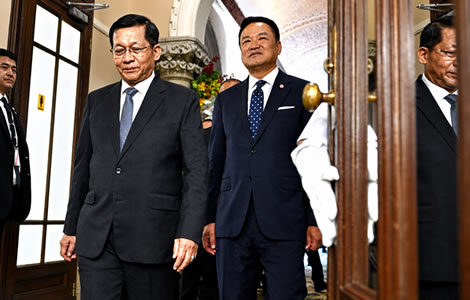
Prime Minister Anutin Charnvirakul formally welcomed Myanmar leader Min Aung Hlaing to Government House on Thursday despite mounting criticism from civil society groups, democracy advocates and opposition politicians.
The two-day visit immediately placed Thailand’s Myanmar policy under renewed scrutiny. While Bangkok defended direct engagement as a matter of national interest, critics argued the visit risks legitimising a military administration whose authority remains widely contested inside Myanmar.
At 10.20 am, Mr Anutin received Min Aung Hlaing on the lawn outside the Thai Khu Fah Building at Government House. The Myanmar leader is visiting Thailand as an official guest of the Thai government.
Official welcome at Government House launches talks on security, trade and wider bilateral cooperation
Both leaders attended a formal welcoming ceremony before reviewing an honour guard. They then moved upstairs for a restricted meeting. Afterwards, senior ministers and officials joined a plenary session in the Green Room to broaden bilateral discussions.
According to the Prime Minister’s Office, the talks centred on cross-border cooperation, energy security, trade facilitation and stability along the Thai-Myanmar frontier. The agenda reflected the breadth of issues linking the neighbouring countries.
Border commerce, migration, organised crime, environmental concerns and transport connectivity all featured prominently. In parallel, officials examined practical measures designed to strengthen long-term economic cooperation despite Myanmar’s continuing political turmoil.
Later in the day, both leaders jointly opened the Thailand-Myanmar Business Forum 2026 before overseeing fresh agreements on economic and environmental cooperation.
As part of this, officials advanced new mechanisms covering trade, investment, transport links and river pollution. Consequently, the visit extended well beyond protocol, combining diplomacy with negotiations on issues carrying direct consequences for Thailand.
Business forum and bilateral agreements expand visit beyond diplomacy into practical cooperation plans
However, the programme unfolded against the backdrop of Myanmar’s prolonged internal conflict. Since the February 2021 military coup, the country has faced sustained armed resistance, political instability and deepening international isolation.
Notably, the military administration no longer exercises effective control across large sections of the country. Instead, extensive territory is administered by ethnic armed organisations and other non-state forces.
That reality increasingly shapes Thailand’s policy calculations. Border instability directly affects Thailand’s security, economy and public safety. Illegal migration, organised crime and cross-border trade all depend upon conditions inside Myanmar.
Moreover, several emerging challenges originate in areas lying outside the military government’s effective authority. Those realities have complicated every major bilateral discussion between Bangkok and Naypyidaw.
Ahead of the visit, Mr Anutin defended Thailand’s approach while addressing the ASEAN Secretariat in Jakarta on August 4. He reaffirmed support for ASEAN’s Five-Point Consensus, which remains the bloc’s principal framework for addressing Myanmar’s crisis. At the same time, he repeated Thailand’s backing for what it calls “calibrated re-engagement.”
Anutin defends ASEAN engagement as Myanmar’s conflict reshapes Thailand’s strategic calculations
According to Mr Anutin, the policy preserves dialogue while recognising realities on the ground. He added that sustained engagement creates opportunities for practical cooperation and measurable progress.
“A peaceful and stable Myanmar is not only in Thailand’s interest as a neighbouring country, but is also vital to ASEAN unity and regional stability,” Mr Anutin said.
His remarks reflected Bangkok’s assessment that Myanmar’s crisis cannot be separated from Thailand’s national interests.
Thailand shares one of Southeast Asia’s longest land borders with Myanmar. Cross-border developments therefore influence security, trade, migration, investment and energy supplies. Separately, they affect criminal networks operating across both countries. The Thai government argues those realities require continued communication regardless of political disagreements.
Economic considerations also underpin Bangkok’s policy. Myanmar remains one of Thailand’s most important trading partners. Bilateral trade currently exceeds US$7.4 billion. Meanwhile, Thai investment spans energy, manufacturing, logistics, transport, telecommunications, tourism and real estate.
Those commercial links support employment, supply chains and border economies on both sides of the frontier. Accordingly, Thai officials continue pursuing economic engagement alongside diplomatic dialogue.
Trade, investment and border security remain central to Thailand’s continued engagement with Myanmar
Nevertheless, the government’s approach has become increasingly contentious. Critics argue official engagement strengthens a military administration that remains internationally isolated and politically disputed.
They also note that Myanmar’s recent election has not fundamentally altered conditions across much of the country. Instead, fighting continues while substantial territory remains beyond the military government’s effective reach.
On another front, northern Thailand’s growing environmental concerns have intensified political debate surrounding the visit. Toxic contamination affecting the Kok and Sai rivers has become one of Bangkok’s most pressing cross-border challenges.
The pollution has been linked to mining activities north of the Thai border. However, opposition politicians argue those mining areas are not primarily controlled by Myanmar’s military administration.
According to testimony presented before a parliamentary committee, the affected territory falls under the control of the United Wa State Army. The Wa administration operates with substantial autonomy from Myanmar’s central government.
It also maintains longstanding support from China. As a result, critics question whether bilateral discussions with Naypyidaw alone can resolve the pollution problem affecting northern Thailand.
Toxic river pollution and Wa-controlled territory complicate Thailand’s diplomacy with Myanmar leaders
Those concerns surfaced repeatedly before Min Aung Hlaing’s arrival. Opponents argued Thailand’s diplomatic strategy fails to reflect Myanmar’s fragmented territorial reality.
They contend that meaningful progress requires engagement with those exercising effective control over the affected areas. Even so, the Thai government proceeded with the visit, maintaining that sustained dialogue remains essential for protecting Thailand’s security, economy and broader national interests.
Opposition to the visit intensified as Min Aung Hlaing arrived in Bangkok. Civil society organisations, democracy advocates and opposition politicians questioned both the timing and the purpose of the official reception.
Their objections centred on Myanmar’s continuing conflict, the military government’s contested authority and Thailand’s decision to accord full diplomatic recognition during the visit.
Sixteen Thai civil society organisations issued a joint statement opposing Min Aung Hlaing’s official visit. The coalition was led by Solidarity Collective TH and the Spirit in Education Movement (SEM).
It urged the Thai government to abandon policies that, in its view, benefit Myanmar’s military administration. It also called on Bangkok to avoid actions that could legitimise its leadership before the conflict ends.
Civil society groups condemn visit and warn against legitimising Myanmar’s military administration
According to the coalition, Myanmar’s military administration has been marked by widespread violence, systematic human rights abuses and alleged war crimes.
Therefore, the organisations argued deeper engagement would prolong conflict rather than contribute to regional peace. They urged Thailand to review every area of cooperation benefiting Myanmar’s military authorities. In addition, they called for stronger protections for Myanmar migrant workers living in Thailand.
The coalition also pressed Bangkok to support independent humanitarian assistance reaching civilians directly. At the same time, it urged Thailand to reject the legitimacy of Myanmar’s military-led government.
Furthermore, the organisations opposed Myanmar’s reintegration into ASEAN until violence ends and democratic rule is restored. Their joint statement concluded by urging Thailand to stand with the people of Myanmar rather than, in its words, “those responsible for violence and war crimes.”
Separately, the Thai-Myanmar Foundation issued another strongly worded statement condemning the visit. The organisation argued Min Aung Hlaing was attempting to secure regional legitimacy after failing to obtain broad international recognition.
It maintained that recent elections had not fundamentally changed political realities inside Myanmar. Instead, it said effective authority across much of the country remains outside military control.
Foundation says Myanmar’s military no longer controls much of the country despite recent election
According to the foundation, extensive territory is now administered by ethnic armed organisations rather than Myanmar’s central military authorities. It argued this reality should shape Thailand’s diplomatic assessment.
The organisation also reminded Bangkok that Min Aung Hlaing seized power through the February 2021 military coup. That coup overthrew Myanmar’s elected civilian government and fundamentally altered the country’s political landscape.
Following the takeover, former State Counsellor Aung San Suu Kyi and numerous democratic leaders were imprisoned. Meanwhile, armed conflict steadily expanded across many regions.
The foundation accused Myanmar’s military of arbitrary arrests, torture, forced conscription and attacks on civilians. It also referred to continued air strikes against schools and hospitals even after this year’s devastating earthquake.
Citing United Nations figures, the foundation said more than 5,000 people have been killed since the military takeover. It also pointed to continuing international legal proceedings involving Myanmar’s military leader.
Specifically, it referred to an arrest warrant issued by an Argentine court under the principle of universal jurisdiction. In addition, it cited the International Criminal Court prosecutor’s request, submitted on November 27, 2024, seeking an arrest warrant against Min Aung Hlaing for alleged crimes against humanity.
Foundation cites killings and legal cases while opposing recognition of Myanmar’s military leadership
The foundation argued Myanmar’s military chief has turned the country into what it described as a failed state through violence against civilians. It also maintained that last year’s election does not erase responsibility for alleged atrocities committed under military rule.
Consequently, it warned Thailand’s recognition of Min Aung Hlaing as head of state risks helping the military administration retain power while undermining international law and the rule of law.
Its statement received support from several prominent organisations. These included the Thai-Myanmar Foundation, the Campaign for Democracy in Burma, the Union for Civil Liberty, the Campaign Committee for Democracy, the World Peace Working Group, the Foundation for Asia Development and other Thai civil society organisations.
Political criticism also emerged inside Parliament. People’s Party deputy leader Rangsiman Rome questioned whether the government had correctly assessed the practical realities surrounding Thailand’s most urgent cross-border challenges. He argued the visit risked conferring legitimacy on Myanmar’s military leadership without producing meaningful results for Thailand.
Rangsiman questions whether visit advances Thailand’s interests or solves pressing border challenges
Mr Rangsiman focused particularly on toxic contamination affecting the Kok River. He said evidence presented before a parliamentary committee showed the mining areas linked to the pollution are controlled by the United Wa State Army rather than Myanmar’s military government. Consequently, he questioned whether discussions with Naypyidaw alone could realistically resolve the issue.
“The real situation is known to everyone, but everyone is acting as if talking to the Myanmar military government will solve the problem,” he said.
According to Mr Rangsiman, Thailand should instead develop a strategy addressing the Wa armed group itself. He linked the organisation to several cross-border threats affecting Thailand.
These included scam operations, drug trafficking, human trafficking and, most recently, toxic pollution flowing into northern rivers. He argued those issues originate in territory lying largely beyond the military government’s effective authority.
The United Wa State Army controls a large autonomous area inside Myanmar but outside the effective reach of the central military administration. The Wa authorities also maintain longstanding support from China. That territorial reality has increasingly complicated Thailand’s diplomatic calculations. Although Bangkok conducts official relations with Myanmar’s recognised government, several pressing security challenges originate elsewhere.
Wa-controlled territory raises doubts over Myanmar government’s ability to resolve northern pollution
For critics, that distinction has become increasingly important. They argue effective control matters more than formal recognition when addressing practical cross-border problems. Consequently, they question whether agreements reached solely with Naypyidaw can produce meaningful results on issues arising in Wa-controlled territory.
Mr Rangsiman also challenged the government’s wider diplomatic strategy. He argued hosting Min Aung Hlaing risks undermining ASEAN’s own Five-Point Consensus. He noted that one of the framework’s central commitments calls for an immediate cessation of violence inside Myanmar. However, he said Myanmar’s military government has clearly demonstrated no intention of complying with that requirement.
“If the Myanmar military government cannot deliver anything for Thailand, then the question is what position Thailand should take,” Mr Rangsiman said.
“Thailand should always put national interests first, but I am not convinced that what the government is doing now truly serves the country’s interests or brings any tangible benefit.”
His comments reflected a broader political debate over Thailand’s Myanmar policy. The government argues continued dialogue remains essential because instability inside Myanmar directly affects Thailand’s economy, security and border provinces. Critics, however, contend engagement should be measured against practical outcomes rather than diplomatic protocol. They also argue any policy must reflect the fragmented territorial realities now defining much of Myanmar.
Economic diplomacy moves centre stage as Thailand and Myanmar launch major bilateral business forum
Despite the criticism, the official programme continued throughout Thursday. Attention shifted during the afternoon from politics to economic cooperation as Thailand and Myanmar sought to reinforce long-standing commercial ties. The agenda reflected Bangkok’s view that practical cooperation should continue despite the difficult political environment surrounding Myanmar.
At 2.30 pm, Prime Minister Anutin and Min Aung Hlaing jointly opened the Thailand-Myanmar Business Forum 2026 at the Queen Sirikit National Convention Centre.
More than 700 representatives from government agencies, business organisations and private companies from both countries attended. The forum was organised by the Thai-Myanmar Friendship Association together with the Federation of Myanmar Chambers of Commerce and Industry.
Deputy government spokeswoman Lalida Periswiwatana said the event focused on opening a new chapter in bilateral economic cooperation. It was held under the theme “New Chapter and Future of Enhancing the Thailand-Myanmar Business Partnership.” Business leaders, officials and investors attended to discuss trade, investment and future commercial opportunities. Accordingly, the forum became the economic centrepiece of Min Aung Hlaing’s visit.
Anutin targets stronger trade and investment while promoting long-term economic partnership
Addressing delegates, Mr Anutin said Thailand and Myanmar were ready to strengthen economic cooperation based on trust, confidence and mutual benefit.
He said governments have a duty to improve employment, incomes and living standards regardless of internal or external political circumstances. Moreover, he said both governments share responsibility for ensuring their economies continue moving forward steadily while creating opportunities for future generations.
The Prime Minister said private businesses have connected the economies of both countries for decades through investment, employment and trade. Myanmar, he said, remains one of Thailand’s most important economic partners. Bilateral trade now exceeds US$7.4 billion. Nevertheless, he said the relationship still offers substantial room for expansion.
Thai investment already extends across energy, manufacturing, transportation, logistics, telecommunications, real estate and tourism. Those sectors have become major pillars of bilateral economic cooperation. Consequently, Mr Anutin said Thailand’s private sector remains confident in Myanmar’s long-term economic potential despite current political uncertainties.
During bilateral discussions, both governments agreed to pursue several practical measures designed to strengthen economic cooperation. Regarding trade, they welcomed the reopening of the second Thai-Myanmar Friendship Bridge linking Mae Sot and Myawaddy.
Border trade, investment and transport links form core of expanded Thailand-Myanmar cooperation plans
They also committed to removing regulatory obstacles preventing the crossing from operating at full capacity. In parallel, officials agreed to examine opening additional border crossings where conditions permit.
Border trade formed another major priority. Thailand will host a meeting of the Joint Trade Commission involving commerce ministers from both countries.
The objective is to increase bilateral trade to US$12 billion. At the same time, both governments hope to revitalise border commerce and strengthen local economies along the frontier.
Investment also featured prominently during the discussions. Mr Anutin said Thai companies remain interested in expanding investment across sectors where both countries share long-term potential.
Those industries include energy, agriculture, agro-industry, infrastructure, tourism and future industries. In response, the Thai government pledged to simplify procedures, remove unnecessary regulations and improve the investment climate.
Energy cooperation remained another important focus. Both governments agreed to continue existing projects while accelerating procedures supporting shared energy security.
Separately, officials agreed to establish a joint working group promoting transport connectivity between the neighbouring countries. The initiative will also improve logistics infrastructure and harmonise regulations affecting cross-border transport.
New transport and energy initiatives aim to deepen long-term economic integration between neighbours
Mr Anutin said changing global supply chains are creating new opportunities for countries capable of connecting trade, investment and people efficiently. Therefore, he said closer cooperation would allow both countries to maximise their respective strengths.
He also emphasised the central role of the private sector in driving future growth. Meanwhile, both governments would continue supporting chambers of commerce and entrepreneurs seeking to expand commercial activity.
He concluded by describing the Thailand-Myanmar Business Forum as more than an opportunity to exchange ideas.
Instead, he said it marked the beginning of practical cooperation capable of producing measurable economic results. He also thanked the Thai-Myanmar Friendship Association and participating organisations for organising the event.
Alongside trade and investment, environmental issues featured prominently during the bilateral programme. Thailand and Myanmar signed Terms of Reference establishing a joint technical working group to address pollution affecting the Kok and Sai rivers.
The agreement represents Bangkok’s first formal bilateral mechanism specifically targeting contamination affecting communities along the northern border.
Thailand and Myanmar establish joint working group to tackle Kok and Sai river pollution
Deputy Prime Minister and Foreign Minister Sihasak Phuangketkaew announced the agreement following meetings with his Myanmar counterpart. He said the new working group would base its work on scientific evidence and technical cooperation between both governments. Furthermore, regular meetings will begin following the signing of the agreement.
Mr Sihasak also revealed plans for a joint visit to the affected areas. He said discussions had already taken place with Myanmar’s foreign minister regarding an inspection involving relevant agencies from both countries.
The proposed visit would allow officials to assess conditions directly while reviewing available scientific evidence. He said the inspection is expected to take place soon.
The agreement reflects growing concern over contamination affecting the Kok and Sai rivers. However, questions remain over how effectively the new mechanism can address pollution originating in territory lying largely beyond Myanmar’s military administration.
Opposition politicians maintain that many mining operations linked to the contamination are located in areas controlled by the United Wa State Army rather than Naypyidaw.
That issue remains central to Thailand’s wider policy debate. Bangkok continues conducting official diplomacy with Myanmar’s recognised government. Yet several pressing cross-border challenges originate in territory effectively controlled by other armed groups.
River pollution, flooding and haze cooperation highlight diplomatic limits amid divided Myanmar territory
Consequently, critics argue practical solutions may ultimately require engagement extending beyond formal state-to-state diplomacy.
Flood prevention also formed part of the bilateral discussions. Thailand and Myanmar examined proposals to dredge the Sai and Luak rivers to reduce flooding affecting border communities.
In addition, both governments agreed to strengthen cooperation on transboundary haze. That work will continue through existing bilateral mechanisms and the Thailand-Myanmar-Laos trilateral framework.
Taken together, the agreements demonstrated Thailand’s determination to maintain working relations with its neighbour despite continuing political controversy.
Bangkok protest anger over northern rivers poisoned by Chinese-backed firms near the Thai border erupts
Burma’s Min Aung Hlaing to meet Malaysia’s PM Anwar Ibrahim in Bangkok on Thursday in peace push
Trade, investment, environmental protection, transport and border management all featured prominently during the discussions. Those issues directly affect communities on both sides of the frontier and remain central to Bangkok’s long-term policy.
Nevertheless, Min Aung Hlaing’s visit exposed the difficult balance confronting the Thai government. Bangkok maintains that dialogue remains necessary to protect Thailand’s economic interests, border security and regional stability.
Critics, however, argue engagement should be judged by practical outcomes rather than diplomatic protocol, particularly when many of Thailand’s most pressing cross-border challenges originate outside the effective control of Myanmar’s military administration. That debate is likely to continue long after the official ceremonies and business meetings have concluded.
Join the Thai News forum, follow Thai Examiner on Facebook here
Receive all our stories as they come out on Telegram here
Follow Thai Examiner here
Further reading:
Burma’s Min Aung Hlaing to meet Malaysia’s PM Anwar Ibrahim in Bangkok on Thursday in peace push
China closes border crossings with Burma after bomb attack on its consulate in Mandalay last week
Arakan Army on the verge of seizing Burma’s western Rakhine State as junta power collapses there
Burma’s General Min Aung Hlaing suffers more setbacks as his regime moves towards collapse
Ex-Senator gives PM Srettha 50:50 odds on surviving this Wednesday. Not impressed with his defence
Political maelstrom may be unleashed in June with potential crises brewing and coming to a climax
PM survives Constitutional Court’s call in a close run thing raising real questions over his future
PM Srettha Thavisin could be temporarily toppled from power on Thursday by the Constitutional Court