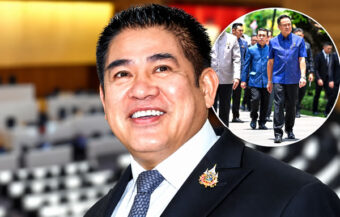
Anutin retreats from his warning against shooting burglars as police confirm lawful self-defence remains protected. New gun permits are frozen after the school massacre, while Thailand faces 10.3 million civilian firearms and deep provincial gun culture.
Prime Minister Anutin Charnvirakul has been forced to clarify his warning against shooting burglars as Thailand launches a sweeping gun crackdown after the Debsirin Nonthaburi massacre. Police insist lawful self-defence remains protected, even as new gun purchases are halted, politicians are told to leave firearms behind and the government confronts a country with more than 10 million civilian guns, including an estimated 4.1 million illegal or unregistered weapons.

Prime Minister Anutin Charnvirakul on Wednesday clarified his controversial warning about Thai householders shooting burglars inside their homes. His intervention followed a detailed legal explanation from the Royal Thai Police.
Crucially, police confirmed that Thailand’s Criminal Code protects lawful self-defence. Shooting an intruder is therefore not automatically illegal. However, entering somebody’s home does not give its owner an unrestricted right to kill.
Mr Anutin conceded that his remarks a day earlier had been too brief. Instead, he said his intention was to warn people about firearms and their consequences. The Prime Minister accepted that shooting a burglar could be lawful under certain circumstances.
Nevertheless, a fatal shooting would trigger a police investigation and could lead to lengthy court proceedings. Even somebody eventually cleared could face questioning, bail and repeated court appearances.
Gun crackdown follows school massacre as police move to clarify Thailand’s existing self-defence laws
The clarification came during a rapidly expanding government crackdown on firearms. That campaign followed the August 7 massacre at Debsirin Nonthaburi School.
Yet Mr Anutin’s initial remarks immediately raised questions about Thailand’s established right to self-defence. In response, police moved quickly to spell out the legal position. Significantly, the Criminal Code has not changed.
On Wednesday, reporters also challenged Mr Anutin over his personal attitude towards firearms. He said he personally stayed away from guns because they were dangerous. At that point, reporters noted that his own wife possesses a firearm. The exchange came as the government targeted gun ownership and carrying following another mass killing.
Separately, Pol Lt Gen Trairong Phiwphan addressed the legal controversy on August 12. He is Deputy Inspector General and spokesman for the Royal Thai Police. His intervention followed public questions about homeowners using firearms against intruders. In particular, debate centred on whether killing a burglar automatically exposes a homeowner to criminal liability.
Pol Lt Gen Trairong said no automatic conclusion could be reached. Rather, investigators must establish precisely what happened before and during the shooting. Any shooting death requires police investigation, verification of facts and collection of evidence. Consequently, officers must determine the sequence of events before reaching a legal opinion.
Police say home shootings depend on threat and force as Section 68 protects the right to self-defence
Police cannot simply declare a shooting lawful because the dead person was trespassing. Equally, they cannot automatically blame the homeowner because somebody died inside the property. Instead, investigators must examine the threat facing the person who fired. The timing, circumstances and level of force are all critical.
At the centre of that assessment is Section 68 of Thailand’s Criminal Code. It recognises the right to defend oneself or another person against imminent unlawful danger. However, the response must be proportionate to the circumstances. Where those requirements are satisfied, the person acting in self-defence is not guilty.
Accordingly, Thai law contains no blanket rule allowing homeowners to shoot every burglar. Conversely, it contains no rule making them automatically guilty after shooting an intruder. The facts existing when the weapon was fired become decisive.
For example, investigators may consider whether an intruder entered during the night. They may examine whether that person approached or threatened the homeowner. Likewise, refusing instructions to stop could become relevant. The intruder’s behaviour and movements could also influence the legal assessment.
Section 69 may reduce punishment where genuine self-defence exceeds proportionate force in a home
More importantly, investigators must establish whether the homeowner reasonably believed an imminent danger existed. That danger can concern life, physical safety or property. Once the immediate threat ends, however, the legal position can change. Continued violence or gunfire could then produce a different assessment.
Section 69 provides another important part of the legal framework. It covers cases where genuine grounds for self-defence existed, but the response exceeded proportionate force.
Under those circumstances, a court can impose punishment below the normal level. Furthermore, excitement, shock or fear can affect the eventual sentence. In qualifying circumstances, the court may impose no punishment.
Pol Lt Gen Trairong also rejected another assumption surrounding defensive shootings. A police investigation does not automatically mean the person defending themselves is guilty. Instead, officers have a duty to investigate whenever somebody dies. Their task is to establish what happened when the weapon was used.
As part of that process, investigators examine the crime scene, firearm and wounds. Forensic specialists may analyse physical evidence. Police can also inspect CCTV footage and interview witnesses. In addition, officers question those directly involved. Investigators then assemble an evidential account before reaching their opinion.
Police evidence moves from investigators to prosecutors and courts as Anutin explains his warning
The investigating officer subsequently submits that opinion through the established criminal justice process. Prosecutors then examine the evidence and determine how the case should proceed. Ultimately, if proceedings reach court, judges determine criminal liability. Neither the location nor the deceased person’s status decides the case alone.
Against that backdrop, Mr Anutin addressed reporters at Sanam Luang at 7.35 am on August 12. The Prime Minister and Interior Minister were questioned about his expanding firearms policy. He acknowledged that his earlier explanation had been abbreviated. However, he insisted his central argument concerned the consequences of using guns.
“The main point is that I was trying to make everyone see that firearms are useless to anyone,” Mr Anutin said. He argued that even justified firearm use must subsequently withstand legal scrutiny. “If they are used, whether in an emergency or justified manner, it must be proven in court,” he said.
In practice, Mr Anutin said neither he nor police could finally determine whether a shooting was justified. Instead, the evidence must move through the criminal justice system. A shooting could lead to investigation, charges and court proceedings. Moreover, the person involved could face bail requirements while the case continued.
Anutin says justified shootings can still bring charges, bail and lengthy proceedings through court
The Prime Minister acknowledged that somebody might ultimately establish that the shooting was justified self-defence. Even then, he said, substantial time could be spent dealing with the justice system. “I understand that what you did was self-defence, and it was justified,” he said. Yet court appearances, bail and other procedures could still follow.
Mr Anutin therefore characterised his earlier remarks as a warning rather than a change in law. “The law exists; it hasn’t changed,” he said. He again urged people to keep away from firearms. Whether anybody accepted his advice was their decision, he added.
Meanwhile, his government has begun tightening several parts of Thailand’s firearms system. Mr Anutin had already instructed Bhumjaithai Party MPs not to carry guns. On Wednesday, however, he stressed that the restriction extended beyond his party. According to the Prime Minister, permits allowing firearms to be carried had expired.
As a result, Mr Anutin said carrying firearms was no longer permitted. He also demanded that politicians set an example. Reporters then questioned him about several party figures possessing collections of guns. In reply, the Prime Minister distinguished between legal ownership and carrying firearms.
Government halts new gun permits as Anutin tells politicians to set an example on firearm controls
He said legally owned firearms were a personal matter where politicians had properly declared them. Such weapons appear in mandatory asset declarations for political officeholders. Nonetheless, Mr Anutin said MPs and other elected figures carried particular responsibilities. Candidates and public figures must comply with firearms laws, he argued.
On another front, the government has moved directly against new gun purchases. The Cabinet decided on August 11 to halt new P.3 firearm purchase permits. Reporters therefore asked whether nobody could purchase another gun under the measure. Mr Anutin confirmed that purchases had effectively stopped for now.
“Yes, until further notice,” the Prime Minister replied. “We have to regulate the situation.” He then pointed towards the huge number of firearms already circulating throughout Thailand. “There are tens of millions of guns in Thailand right now,” Mr Anutin said. “It’s unsustainable because we have a population of seventy million.”
In parallel, the government has moved against the welfare firearms programme. Officials have also been instructed to pursue amendments to firearms legislation within 60 days. The crackdown consequently reaches beyond restrictions on carrying weapons. It targets new purchases and established channels used to obtain firearms.
Thailand’s deep gun culture spans police, soldiers, provincial figures and rural household protection
The measures strike at a longstanding feature of Thai society. Thailand has traditionally recorded exceptionally high civilian gun ownership compared with neighbouring Southeast Asian countries. Firearms are regulated under Thai law. Even so, legal weapons have remained widely available across significant sections of society.
Police officers and soldiers have traditionally been prominent firearm owners. Local officials, businessmen and politically connected provincial figures have also commonly possessed guns. Beyond those groups, firearms have frequently been kept to protect homes, farms, livestock and businesses. That pattern has been particularly established across provincial and rural Thailand.
Notably, gun ownership also has a longstanding cultural dimension. Traditional concepts surrounding masculinity, personal status and authority have contributed to Thailand’s relationship with firearms. For some owners, a handgun represents protection and personal independence. Other factors, however, have also contributed heavily to the country’s huge firearms stockpile.
Criminal activity accounts for part of the illegal weapons market. Elsewhere, the insurgency in Thailand’s Deep South has contributed to the presence of firearms. Above all, millions of legal and illegal guns are already circulating. That existing stockpile presents a different challenge from stopping future purchases.
Survey put civilian gun stock at 10.342 million, including 4.1 million illegal or unregistered weapons
The most frequently cited comprehensive estimate comes from the Small Arms Survey. Its figures date from 2017 and therefore do not represent a current 2026 count. Still, they demonstrate the exceptional scale of civilian gun ownership in Thailand.
The survey estimated that Thai civilians possessed 10.342 million firearms. That represented approximately 15.1 civilian guns for every 100 people. Of those weapons, approximately 6.22 million were registered. Another 4.1 million were estimated to be illegal or unregistered.
Put another way, almost four in every ten civilian firearms were outside the registered system. Thailand consequently had the highest estimated civilian firearm ownership rate in Southeast Asia. Its civilian firearms stockpile was enormous by regional standards.
Importantly, the 10.342 million figure should not be presented as Thailand’s current gun count. It remains a 2017 estimate which continues to be widely cited. No equally comprehensive replacement has established the precise number presently circulating. Mr Anutin himself referred on Wednesday to “tens of millions” of guns.
Over the past decade, a succession of mass shootings has repeatedly returned firearms to Thailand’s political agenda. In February 2020, a Thai soldier carried out the Korat massacre. Dozens of people were killed during the rampage. It became one of the country’s deadliest mass shootings.
Mass shootings from Korat to Siam Paragon put gun access back under intense national scrutiny again
Two years later, another mass killing struck Nong Bua Lamphu. In October 2022, a former police officer attacked a nursery and killed children and adults. Once again, firearm access came under intense national scrutiny. Less than one year later, gunfire struck the centre of Bangkok.
In October 2023, a teenage gunman opened fire inside Siam Paragon shopping centre. The attack again raised questions surrounding access to firearms and ammunition. Most recently, the Debsirin Nonthaburi School massacre brought another teenage gunman into the national spotlight.
On August 7, 2026, the 14-year-old first killed his grandparents at their home. Afterwards, he travelled to Debsirin Nonthaburi School in Bang Kruai. He entered the school wearing his purple physical education uniform. The teenager was armed with his grandfather’s 9mm CZ pistol.
The attack then unfolded during the school morning. Six people were killed at the school before the teenager took his own life. In total, nine people died when his grandparents and the gunman are included. Another seven people were injured.
Debsirin massacre leaves nine dead as teenager uses grandfather’s 9mm CZ pistol in school attack
Police subsequently recovered two magazines and 34 unused rounds. Significantly, the teenager had obtained the weapon from within his family. The massacre therefore put household firearm access directly into the government’s response.
These attacks do not establish a continuous statistical increase in mass shootings throughout the entire decade. They do, however, represent repeated high-profile mass killings involving firearms. Each attack has returned gun access and regulation to national attention.
In response to the latest massacre, Mr Anutin moved within days. The government targeted new purchases, firearm carrying and the welfare gun programme. Yet controlling future sales addresses only part of Thailand’s firearms landscape. Millions of weapons are already in private hands.
According to the 2017 estimate, more than six million civilian firearms were legally registered. A further 4.1 million were believed to be illegal or unregistered. Thus, suspending P.3 permits cannot remove the huge stock already circulating.
Gun crackdown targets future purchases while millions of legal and illegal weapons remain in circulation
At present, the government has announced no general confiscation programme for legally owned firearms. Its immediate measures instead focus on future purchases and carrying weapons. The welfare firearms system is also being targeted. Legislative amendments are expected to follow within the government’s 60-day timetable.
Politically, broader restrictions would reach deeply into Thailand’s provincial communities. Mr Anutin’s Bhumjaithai Party draws substantial political strength from provincial Thailand. Many conservative and traditional voters live in areas where legal gun ownership has long been accepted.
For many owners, firearms have served as practical protection for homes, farms, businesses and livestock. As a consequence, restrictions affecting existing legal ownership could encounter resistance within Mr Anutin’s own political heartlands. Those same provincial constituencies form an important part of his party’s electoral strength.
For now, the government has not moved against firearms already legally held by ordinary owners. Rather, it has halted new P.3 permits until further notice. It has also targeted public carrying and the welfare gun programme. Politicians have simultaneously been instructed to set an example.
Broader gun restrictions could meet resistance across Anutin’s conservative provincial political base
At the same time, the police intervention established an important boundary around the government’s campaign. Thailand’s statutory right to lawful self-defence remains intact. Section 68 of the Criminal Code has not been altered.
Under that provision, a homeowner facing imminent unlawful danger can still defend themselves or another person. Such defence can include force proportionate to the threat. A fatal shooting, however, requires investigators to establish precisely what happened.
Neither the location of the shooting nor the victim’s status alone determines guilt. Similarly, the dead person’s status as a burglar does not automatically establish the shooter’s innocence. Police must instead examine the threat, timing and proportionality of the response.
Thereafter, prosecutors must consider the evidence assembled by investigators. Courts ultimately retain authority to determine criminal liability. Section 69 also provides discretion where genuine self-defence exceeds proportionate force because of excitement, shock or fear.
Mr Anutin’s clarification consequently narrowed the gap between his earlier remarks and the police explanation. He no longer suggested that shooting a burglar was automatically illegal. Rather, he stressed the legal process which could follow even a justified shooting.
For its part, the Royal Thai Police made an equally important distinction. Investigation after a shooting does not establish that the person defending themselves is guilty. It is the required process when somebody has been killed.
Police stress Section 68 remains intact as courts retain final authority over claims of self-defence
The dispute has emerged during one of Thailand’s sharpest recent moves against firearms. The country already has one of Southeast Asia’s largest civilian gun stocks. Millions of weapons are legally registered, while millions more are estimated to remain outside the system.
Furthermore, the latest crackdown follows a school massacre involving a firearm kept within a family home. Mr Anutin has stopped new purchase permits and tightened restrictions on carrying weapons. His government has also targeted welfare guns and ordered work on further legislative changes.
Illegal to shoot an intruder or burglar at home with a licenced gun says PM in new firearms crackdown
Online commentary glorifying guns in Thai schools. Minister says mass shooter used mainstream sites
Yet those measures are being introduced in a country with deep traditions of legal firearm ownership. Those traditions are particularly established across provincial Thailand. They also extend into constituencies forming a central part of Mr Anutin’s political base.
The immediate policy is nevertheless clear. New P.3 purchase permits have been stopped until further notice. Politicians have been told not to carry firearms. The welfare gun programme is being targeted, while wider legal changes are being prepared.
One central legal provision, though, remains unchanged. Thai citizens retain the statutory right to lawful self-defence. Under Section 68, proportionate force remains lawful when a person faces an imminent unlawful threat.
Join the Thai News forum, follow Thai Examiner on Facebook here
Receive all our stories as they come out on Telegram here
Follow Thai Examiner here
Further reading:
Political bigwig charged with murder in Nonthaburi after gunning down Provincial Authority President
Kamnan Nok finally handed down a Life in-prison sentence for 2023 murder of a senior police officer
Kamnan Nok death penalty case leads to a national crackdown on all illegal activity and corruption
Prisons boss confirms that the man being held in jail is the real Kamnan Nok to counter rumours
Kamnan murder case sees probe into possible corruption in Ministry of Interior contract bids
Local corruption linked to the police under the spotlight after officer’s murder in Nakhon Pathom
Corruption and border smuggling linked to the Muno blast in Narathiwat. Call for top-level probe