Twenty years after tanks toppled Thaksin, Phumtham warns Thailand still bears the scars. Two coups, dissolved parties, fallen prime ministers and rewritten charters later, over 30 million voters have now backed another constitutional reset.
Twenty years after tanks rolled into Bangkok and toppled Thaksin Shinawatra’s government, an ousted minister has issued a stark anniversary warning. Former Deputy Prime Minister Phumtham Wechayachai says Thailand lost time, trust and opportunities after the September 19, 2006 coup. Another coup, rewritten constitutions, dissolved parties, removed prime ministers and deadly street clashes followed. Yet Phumtham also rejects unchecked elected power, insisting governments must face scrutiny and removal under established rules. Now, more than 30 million Thais have backed another constitutional drafting process. Two decades after the military abolished the 1997 “People’s Constitution”, Thailand is again rewriting its political rules.
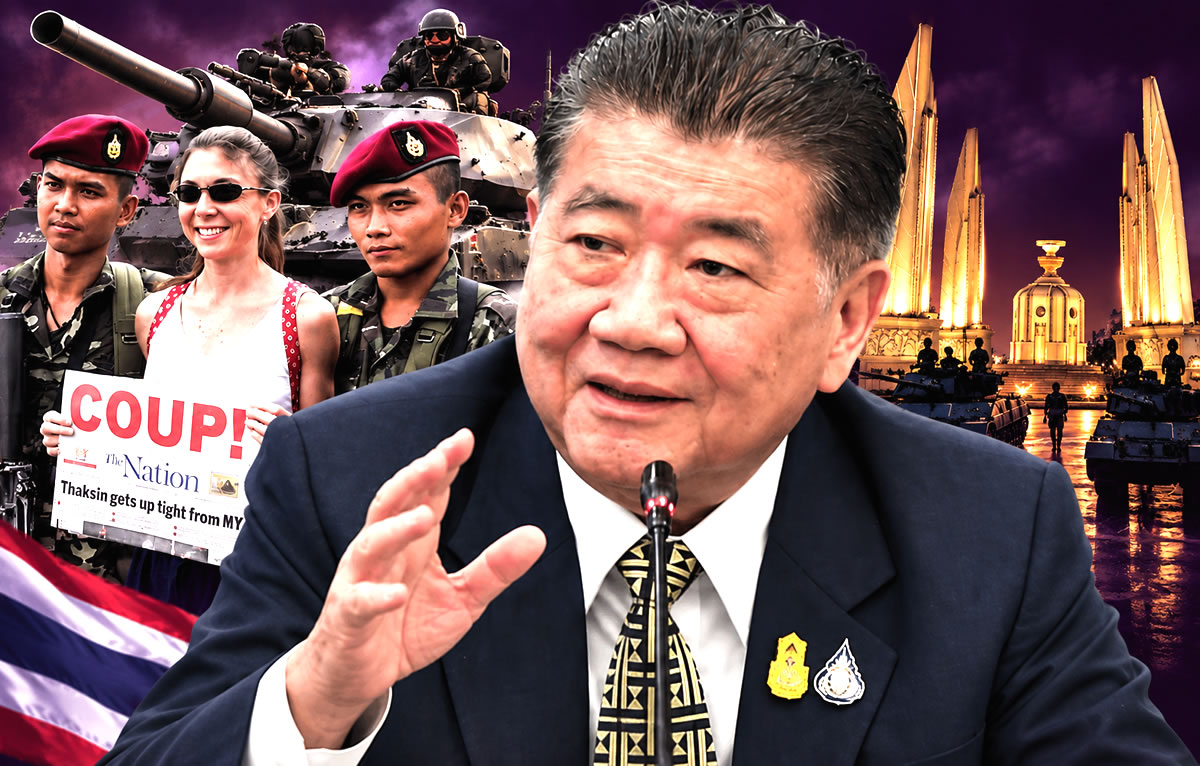
Former Deputy Prime Minister Phumtham Wechayachai marked Thailand’s 2006 military coup anniversary on Saturday with a warning about its consequences. Twenty years later, he said political conflict, constitutional change and lost opportunities continued to shape the country.
Mr Phumtham spoke from direct experience of the September 19, 2006 seizure of power. He was Deputy Minister of Transport when the military removed Prime Minister Thaksin Shinawatra. Mr Thaksin was attending the United Nations General Assembly in New York. Back in Bangkok, tanks appeared as military commanders took control.
Notably, Mr Phumtham’s ministerial career ended immediately. He later became one of 111 Thai Rak Thai executives banned from politics for five years. The party itself was dissolved in May 2007. Yet its political movement survived and returned to government after the next election.
Phumtham recalls 2006 coup and warns Thailand against using extra-constitutional power to end crises
On Saturday, Mr Phumtham returned to those events in a lengthy Facebook statement. It was entitled “20 years since September 19th, the coup against an elected government.” He said Thailand must learn from the episode and remember its consequences.
“Twenty years after September 19, 2006, a crucial question remains for the Thai people to remember,” Mr Phumtham said. “I was a minister in the government that was overthrown. On that day, Thailand went through conflict, lost opportunities, and repercussions that have lasted for two decades.”
At the centre of his statement was the use of extra-constitutional power. Mr Phumtham said its use against democratic mechanisms required renewed scrutiny by Thai society. In particular, he questioned whether military intervention could resolve political disputes rather than merely change governments.
“The most important lesson I learned from that day’s events is that the use of extra-constitutional power to undermine the mechanisms and continuity of democracy must be seriously questioned and scrutinised by Thai society once again,” Mr Phumtham stated.
His argument then turned to Thailand’s experience since the coup. A military takeover could change a government overnight, he said. However, it could also create larger problems and cost the country opportunities.
“Over the past twenty years, we have seen… many changes in government, constitutional amendments, and changes to the rules,” he said. “But the problems and conflicts have not disappeared.”
Phumtham backs checks on elected governments but says accountability must be democratic
Instead, Mr Phumtham said Thailand had lost time, continuity, trust and opportunities for its people. “This is a lesson I believe Thailand should not have to face again,” he added.
Crucially, Mr Phumtham did not argue that an electoral victory gave governments unrestricted political power. He specifically rejected the proposition that a parliamentary majority could exercise absolute authority.
Democracy must also recognise minority rights, he said. Equally, governments must operate under checks and balances which command public confidence. Governments making mistakes must face scrutiny, while corrupt politicians must face prosecution.
Separately, failed governments must be replaceable. Political parties breaking promises must also face accountability. Mr Phumtham insisted these processes should operate under democratic laws and established political rules.
In his account, democracy could never guarantee a government acceptable to everyone. Rather, political institutions must provide mechanisms for investigating wrongdoing and replacing governments. Voters must also retain the power to determine their political future.
“If the people make the wrong choice, they must have the right to choose again,” Mr Phumtham said. “If the government makes a mistake, it must be scrutinised and held accountable.”
Thaksin’s landslide mandate and rural support built unprecedented power before opposition intensified
Consequently, he argued that correcting political mistakes should not create even larger problems. His intervention also returned attention to the extraordinary political crisis which engulfed Thailand during 2006.
The military intervention did not emerge from a political vacuum. Mr Thaksin had entered the crisis after an overwhelming electoral victory only one year earlier. Thai Rak Thai dominated the February 2005 general election, winning 377 of the House’s 500 seats.
As a result, Mr Thaksin became the first elected Thai prime minister to complete a full four-year term. He then returned to office with an overwhelming parliamentary majority. Thai Rak Thai had become the country’s dominant electoral organisation.
Its strength rested heavily across northern and northeastern Thailand. Furthermore, millions of lower-income and rural voters formed an important part of its coalition. Universal healthcare and village funds were among the government’s signature programmes.
By then, Thai Rak Thai had established an electoral operation without precedent in contemporary Thai politics. Mr Thaksin had also become the country’s dominant political figure. At the same time, his concentration of political power generated fierce opposition.
Shin Corporation sale, tax controversy and Bangkok protests deepen the political crisis around Thaksin
Critics accused his government of conflicts of interest, cronyism and interference with independent institutions. They also accused it of applying pressure against critical media. In addition, opponents complained that too much political power had become concentrated around Mr Thaksin.
His human rights record faced separate criticism. Specifically, his government’s 2003 campaign against illegal drugs was associated with more than 2,000 deaths. Political opposition then intensified sharply during late 2005 and early 2006.
Against that backdrop came a business deal which transformed the confrontation. In January 2006, the Shinawatra family sold its controlling Shin Corporation interest to Singapore’s Temasek. The transaction was worth approximately $1.9 billion.
Significantly, the family incurred no capital gains tax on the share transaction. The deal immediately generated political controversy. Critics attacked its tax treatment and the transfer of a major telecommunications group to a foreign state-owned investor.
In response, opposition to Mr Thaksin accelerated. The transaction became a powerful rallying point for his opponents. Large demonstrations followed in Bangkok, led principally by the People’s Alliance for Democracy.
Boycotted election is annulled before tanks enter Bangkok and military commanders remove Thaksin
Under mounting pressure, Mr Thaksin dissolved parliament in February 2006. He then called a snap general election for April 2. The Democrat Party and other opposition parties boycotted the contest.
Thai Rak Thai subsequently dominated the election and received approximately 16.4 million votes. Nevertheless, the boycott produced severe problems in constituencies where government candidates lacked significant opposition. The political deadlock therefore intensified.
On May 8, the Constitutional Court annulled the election. Another general election was eventually scheduled for October 15. Before voters could return to the polls, however, the military intervened.
On September 19, Mr Thaksin was thousands of kilometres away in New York. He had travelled there for the United Nations General Assembly. Meanwhile, tanks and troops appeared at strategic locations across Bangkok.
Army commander General Sonthi Boonyaratglin and other senior officers seized power. The military imposed martial law and removed Mr Thaksin’s government. More significantly, the coup leaders abolished the 1997 Constitution.
Coup ends parliament and 1997 charter as military leaders cite division, corruption and political deadlock
Parliament and the Senate were abolished. Political parties faced restrictions on their normal operations. Public gatherings were also restricted, while troops were deployed at media organisations. Broadcasting controls followed.
For their part, the coup leaders offered several reasons for intervening. They cited national division and corruption. They also accused the government of interfering with independent institutions.
Moreover, military leaders argued that existing political mechanisms had failed to resolve the crisis. Mr Thaksin’s opponents had already accused his government of weakening constitutional checks. His supporters, however, argued that the coup destroyed the constitutional system itself.
Beyond Mr Thaksin’s removal, the coup terminated a major constitutional experiment. Thailand’s 1997 charter was widely called the “People’s Constitution”. It had emerged from earlier instability and demands for political reform.
Importantly, the charter sought to create stronger elected governments alongside powerful independent institutions. Thailand had previously endured unstable coalitions and frequent changes of prime minister. Accordingly, the new system encouraged stronger parties and more durable governments.
People’s Constitution strengthened elected governments before military intervention ended its framework
It succeeded on both counts. Mr Thaksin used the framework more effectively than any previous Thai politician. Thai Rak Thai became an extraordinarily powerful national organisation and secured a commanding parliamentary majority.
Conversely, critics argued that this strength weakened institutions intended to scrutinise elected power. The military responded by abolishing the constitutional framework altogether. September 19 therefore changed far more than the identity of Thailand’s prime minister.
Afterwards, retired General Surayud Chulanont became prime minister under post-coup arrangements. A new constitutional drafting process also began. The resulting 2007 Constitution went before voters the following August.
About 57% of participating voters approved the charter. Thailand then returned to a general election in December 2007. The result demonstrated the continuing electoral strength of the movement removed one year earlier.
By then, Thai Rak Thai no longer existed. The party had been dissolved in May 2007. Its 111 banned executives included Mr Phumtham.
Despite that, the political movement associated with Mr Thaksin survived. The People Power Party became its principal successor. In December 2007, it won the largest number of parliamentary seats.
Thaksin movement survives party dissolution and returns through People Power Party after the 2006 coup
Samak Sundaravej subsequently became prime minister. Thus, the coup had removed Mr Thaksin without eliminating the electoral coalition behind him. That reality dominated the next phase of Thai politics.
Within months, upheaval returned. The Constitutional Court removed Mr Samak from office in September 2008. Somchai Wongsawat succeeded him as prime minister.
His tenure was equally short. In December 2008, the Constitutional Court dissolved the People Power Party. Mr Somchai consequently lost office.
Thereafter, Democrat Party leader Abhisit Vejjajiva became prime minister. Street politics continued, however, as the Red Shirt movement mobilised against his government. Large demonstrations followed.
Eventually, confrontation in Bangkok during 2010 turned deadly. The crisis became another major episode in the struggle which followed September 2006. Thailand then returned to national elections in July 2011.
Once again, a party associated with Mr Thaksin won decisively. Pheu Thai captured 265 of the House’s 500 seats. Yingluck Shinawatra subsequently became Thailand’s first female prime minister.
Courts remove two prime ministers before Pheu Thai wins 2011 election and Yingluck Shinawatra takes office
Two years later, another political crisis developed. Large anti-government demonstrations again filled Bangkok during late 2013. The confrontation continued into the following year.
In May 2014, the Constitutional Court removed Ms Yingluck from office. Nine days later, the military intervened again. Army commander General Prayut Chan-o-cha seized power on May 22.
Consequently, Thailand had experienced two successful military coups within eight years. Both removed governments originating from the same broad electoral political movement. The second takeover then produced another extended period of military rule.
As part of that process, Thailand acquired another constitutional framework. The present 2017 Constitution emerged following the 2014 coup. Yet the country’s political landscape was already changing again.
At the 2019 general election, Future Forward emerged as a significant new political force. It attracted substantial support, particularly among younger voters. Its programme also moved beyond the older political confrontation surrounding Mr Thaksin.
Yingluck’s removal precedes 2014 coup before Future Forward emerged as a new political force in Thailand
The Constitutional Court dissolved Future Forward in February 2020. Even so, much of its political support subsequently transferred to Move Forward. That party then produced another major electoral shift in May 2023.
Move Forward won 151 House seats, more than any other party. Party leader Pita Limjaroenrat nevertheless failed to secure sufficient parliamentary support to become prime minister. Pheu Thai subsequently assembled a coalition government.
Another change followed in August 2024. The Constitutional Court dissolved Move Forward. Its political movement subsequently continued through the People’s Party.
By 2026, therefore, Thailand’s political landscape differed markedly from September 2006. The conflict was no longer centred exclusively on Mr Thaksin and his network. Constitutional disputes and party dissolutions nevertheless continued throughout the period.
On another front, Mr Phumtham used Saturday’s statement to revive another theme associated with the Thai Rak Thai era. He called it “a democracy that feeds the people”.
For Mr Phumtham, political institutions also had to produce tangible results in everyday life. “Democracy must answer fundamental questions: Do people have enough income to live on? Do farmers have a future?”
“Do ordinary people have access to healthcare? Do our children have education, jobs, and hope?”
Links democracy to living standards, healthcare, farmers’ futures, education, employment and hope
Mr Phumtham said stable democracy required several elements operating together. These included voters’ voices and checks on political power. Additionally, government itself had to function effectively.
“This is what I’ve always called ‘a democracy that feeds the people,’” Mr Phumtham stated. “Democracy must include the voice of the people, checks and balances on the exercise of power, a functioning government, and rules that ensure no one is above the rules.”
His wider argument about lost economic opportunities has also been examined through economic research. There is evidence that the 2006 political crisis damaged confidence and some investment decisions.
For example, the World Bank examined economic uncertainty surrounding the crisis. About one-fifth of surveyed businesses reported adverse effects on investment decisions.
The effects were particularly evident among larger, exporting and foreign-owned companies. The World Bank also reported weak domestic demand during 2006. Political and policy uncertainty affected private consumption and investment.
Later research, however, did not establish the coup as the cause of Thailand’s longer-term economic performance. A 2023 econometric study specifically examined the effects of the September 2006 intervention.
Economic research finds short-term disruption after 2006 but no established long-term damage
It found no statistically significant effect across several major indicators. Those included real gross domestic product, growth, investment, inflation, exports, imports and unemployment.
The study did identify temporary effects on consumption. It also found increased military expenditure. Accordingly, Mr Phumtham’s broader lost-opportunity claim remains his assessment rather than an established economic calculation.
Two decades later, the anniversary arrives as Thailand again faces fundamental constitutional change. Voters went to the polls on February 8, 2026, for another referendum.
This time, they were asked whether Thailand should begin drafting a new constitution. The result was overwhelming.
More than 30.5 million votes supported beginning the process. By comparison, only 874,994 votes opposed it. About 2.89 million ballots were invalid.
The referendum again placed Thailand’s constitutional system at the centre of national politics. Since absolute monarchy ended in 1932, Thailand has had 20 constitutions. The country has also experienced 13 successful military coups.
New charter referendum wins 30 million votes as Thailand again confronts constitutional change in 2026
In parallel, legislation this year addresses political cases spanning much of the same turbulent period. Thailand’s new political amnesty law took effect in August.
It covers specified political offences committed between January 1, 2005 and July 15, 2025. Its timeframe therefore stretches from before the 2006 crisis through two decades of political confrontation.
Parliamentary estimates indicate that about 6,000 people could benefit. Serious offences and corruption cases are excluded. Section 112 offences are also outside the legislation.
Elsewhere, Saturday’s anniversary prompted interventions from other political figures. Former Pheu Thai politician Korkaew Pikulthong published his own assessment of the past two decades.
A House military affairs committee event also marked the anniversary at the Bangkok Art and Culture Centre. Progressive Movement chairman Thanathorn Juangroongruangkit addressed the gathering.
Mr Thanathorn discussed military power and Thailand’s political economy. He also argued for reforms concerning military resources and institutions.
Taken together, the anniversary discussion stretched beyond Mr Thaksin’s removal. It covered military intervention, constitutions, elections, courts, political parties and independent institutions.
Political amnesty covers two decades of turmoil as other figures join debate on the 2006 coup anniversary
Mr Phumtham, however, said he did not want September 19 reduced to another exercise in assigning blame. Instead, he focused on mechanisms for handling political disputes and government failure.
Thailand should have a system allowing governments to face scrutiny without overthrowing the political order, he said. Conflict should also remain possible without abandoning established rules.
Likewise, governments should be replaceable without resorting to extra-constitutional power. Ultimately, Mr Phumtham returned to voters and their ability to remove governments through elections.
“If the people make the wrong choice, they must have the right to choose again,” he said. “If the government makes a mistake, it must be scrutinised and held accountable. Correcting mistakes should not be done by creating bigger mistakes.”
He then distilled his anniversary message into a direct warning drawn from September 2006.
“Do not solve problems and conflicts by destroying the rules that should be used to resolve those problems and conflicts.”
Phumtham says governments must face scrutiny and removal through rules rather than military intervention
Finally, Mr Phumtham acknowledged that elections inevitably produce governments opposed by substantial sections of the population.
“Democracy may not always give us the government we like, but it must provide rules that allow for the change of government without destroying the country.”
Twenty years earlier, Thailand’s elected government had disappeared overnight. Tanks entered Bangkok while its prime minister was in New York.
The 1997 Constitution was abolished. Parliament and the Senate disappeared with it. Political activity and public gatherings were restricted.
Yet the political movement behind the ousted government returned through elections little more than a year later. Political confrontation subsequently continued through parliament, courts and the streets.
Thammasat University legal scholar and 1992 protest leader warns another coup cannot be ruled out
Thaksin poses a question to those in power on the same day he was removed from office in 2006
Another military coup followed in 2014. Another constitution followed in 2017. Several major political parties were subsequently dissolved.
Now Thailand has again started the process towards another constitutional settlement. More than 30 million voters backed drafting a new charter in February.
Twenty years after September 19, that process coincides directly with Mr Phumtham’s anniversary intervention. “Because a country can change its power overnight, but restoring opportunities and trust may take a lifetime,” Mr Phumtham said.
Join the Thai News forum, follow Thai Examiner on Facebook here
Follow Thai Examiner on Google here
Receive all our stories as they come out on Telegram here
Follow Thai Examiner here
Further reading:
Thammasat University legal scholar and 1992 protest leader warns another coup cannot be ruled out
Senate allegations growing in strength as powerful investigation gets underway. 7,000 people tracked