Phuket governor sacks an entire Defence Corps checkpoint team after villagers claim they were urine-tested, then asked for up to ฿15,000 to go free. Bangkok orders a probe as scrutiny falls on Anutin’s nationwide anti-drug operation and its enforcers.
A drug checkpoint extortion scandal has hit Phuket after villagers claimed black-uniformed Volunteer Defence Corps members demanded up to ฿15,000 for release. Governor Chotinrin Kerdsum has now removed the entire Thalang team and replaced it with 30 personnel as investigators gather evidence. Yet the story reaches far beyond one checkpoint. The Corps is a nationwide Interior Ministry paramilitary force with policing and national-security duties. Crucially, the checkpoint formed part of Prime Minister and Interior Minister Anutin Charnvirakul’s nationwide Operation 90 Days. It has mobilised every province and expanded checkpoints targeting drugs, firearms, criminal networks and influential figures. Now Bangkok is investigating personnel entrusted to enforce that crackdown.
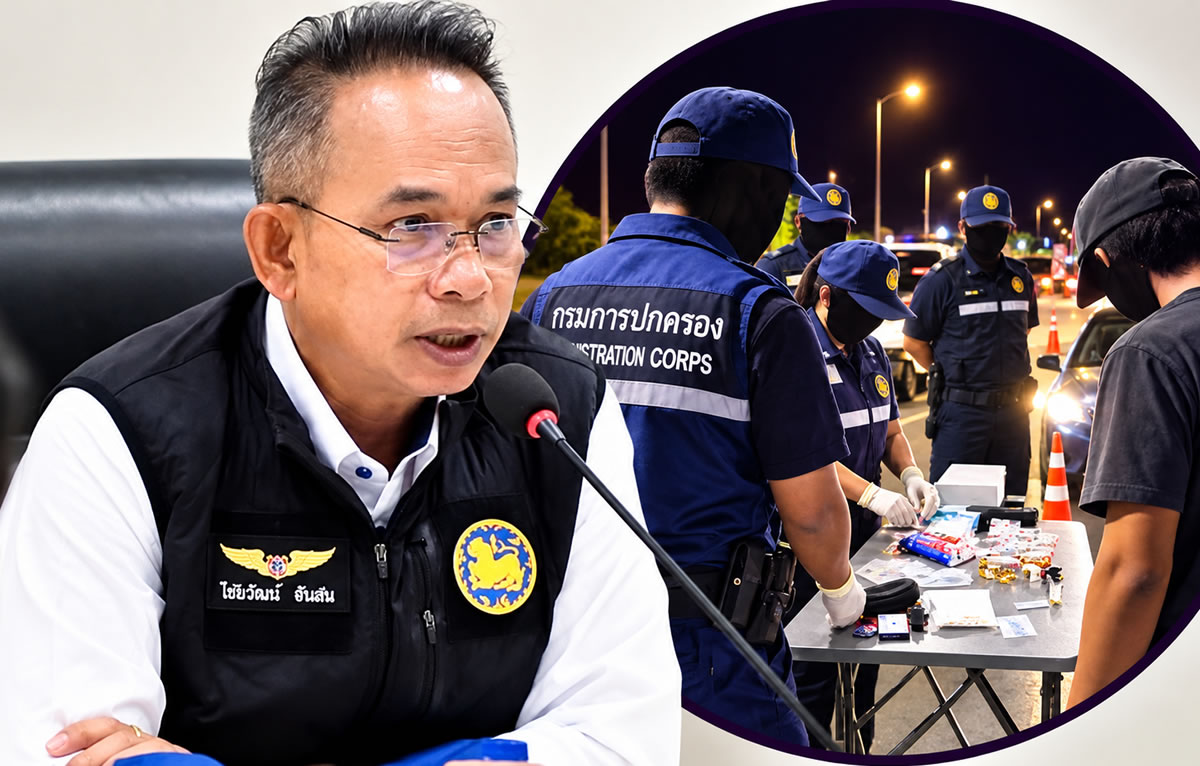
Phuket Governor Chotinrin Kerdsum has replaced an entire Volunteer Defence Corps team following serious extortion complaints in Thalang. The allegations concern villagers stopped and urine-tested for illegal drugs at a district checkpoint. Some complainants say personnel then demanded cash for their release. Reported demands ranged from ฿6,000 to ฿15,000.
In response, the original Thalang Volunteer Defence Corps team has been removed from those duties. Two replacement units, comprising about 30 personnel, have taken over. Meanwhile, provincial investigators are interviewing witnesses and gathering evidence. No finding of wrongdoing has yet been announced.
The case has reached the Interior Ministry and government headquarters in Bangkok. It also exposes the scale of the nationwide security operation behind the checkpoint. The Thalang team was working amid a national anti-drug campaign ordered by Prime Minister Anutin Charnvirakul. As Interior Minister, Anutin also commands the Volunteer Defence Corps.
Phuket checkpoint complaints expose cash demands as MP presses officials for answers over Thalang case
The controversy broke publicly on September 16. People’s Party Phuket MP Chalermpong Saengdee publicised complaints concerning a checkpoint in Bang Jo, Thalang. The operation reportedly took place near a convenience store. Complainants described black-uniformed personnel there as members of the Thalang Volunteer Defence Corps.
According to their accounts, motorists were stopped and subjected to urine tests. Those testing positive were reportedly taken to a building behind the Thalang District Office. There, some complainants say cash was demanded before they could leave. The reported sums varied considerably.
One complaint involved an initial demand for ฿15,000. However, that amount was reportedly negotiated down to ฿12,000. The person subsequently went through the court process and was reportedly fined ฿2,000. Another complaint concerned an elderly parent whose son had been caught at the checkpoint. The parent reportedly found ฿6,000 to secure his release.
Notably, the allegations concern what happened after people were stopped rather than the checkpoint itself. Drug testing and interception operations fall within the Corps’ established duties. The investigation instead concerns claims that personnel demanded money from people under their control.
Chalermpong subsequently called for a full investigation. He also sought answers about how long any such activity might have continued. Separately, questions arose over whether more senior officials knew about any wrongdoing. The complaints soon reached provincial and national officials.
Interior Ministry orders urgent Phuket probe as government promises action if checkpoint claims are proven
On September 17, Deputy Interior Minister Worasit Liangprasit ordered an urgent investigation. He instructed the Department of Provincial Administration and Phuket officials to establish the facts. Investigators were told to examine the incident and the conduct of personnel involved. Governor Chotinrin was also instructed to clarify the allegations.
As part of this, Phuket was required to report progress to the Interior Ministry. Worasit said wrongdoing would bring action regardless of the rank of anyone responsible. Conversely, officials said personnel should be cleared publicly if evidence failed to support the accusations. The investigation was therefore ordered to establish facts before conclusions were reached.
By Sunday, the government had intervened again. Deputy government spokeswoman Ploytalay Laksmisangchan confirmed another instruction from the Interior Ministry. She said Deputy Interior Minister Polpeera Suwannachawi had ordered urgent action over the complaints. Phuket’s governor and Thalang District Chief were told to investigate and publicly clarify the case.
At the same time, the government promised disciplinary action if wrongdoing was established. Officials described such conduct, if proven, as unacceptable for the organisation. They also restated the primary responsibilities of Volunteer Defence Corps personnel. Those duties include supporting administrative officers and police.
Phuket replaces Thalang team as investigators seek complainants and scrutiny turns to nationwide Corps
Governor Chotinrin has since confirmed that witnesses have already been questioned. Investigators are now seeking direct testimony from people who say money was demanded. Crucially, provincial officials say those statements are still required to complete the evidence. Investigators will then compare their accounts with other information already collected.
Operationally, Phuket has already acted. The previous team was disbanded for the checkpoint operation and replaced by two new units. Together, they comprise approximately 30 personnel. Public-order and security work will therefore continue while investigators examine the previous team.
The replacement also keeps the wider anti-drug campaign operating. Thailand’s Volunteer Defence Corps is not an informal neighbourhood organisation. Instead, it is a nationwide Interior Ministry paramilitary force with statutory security responsibilities. Its origins stretch back more than seven decades.
Known in Thai as Kong Asa Raksa Dindaen, the organisation is commonly abbreviated as Or Sor. It was established under the Volunteer Defence Corps Act of 1954. The Corps operates through the Department of Provincial Administration. Its structure reaches down through provincial and district administrations nationwide.
Importantly, the Interior Minister sits at the top of the organisation as commander. Corps members work alongside governors, district chiefs, administrative officers and police. Their responsibilities include public order and internal security. They also support narcotics suppression and other enforcement work.
Volunteer Defence Corps holds policing and security powers while checkpoint work forms part of mandate
Under Section 16 of the 1954 legislation, the Corps carries several statutory duties. Members can perform local policing functions alongside administrative officers or police. They can also protect important installations and transport routes. Intelligence gathering forms another part of their responsibilities.
Beyond that, Corps personnel can support Thailand’s armed forces when required. In emergencies or wartime, the organisation can serve as a paramilitary reserve supporting military operations. Its responsibilities therefore extend beyond routine policing. Public order and national security sit at the centre of its mandate.
Its modern enforcement role is similarly broad. Corps personnel support operations involving illegal drugs, firearms, human trafficking and illegal workers. They also assist campaigns against influential criminal figures. In practice, units regularly work alongside district officials and police.
Checkpoint operations are therefore established Corps work. Indeed, Volunteer Defence Corps training during 2026 specifically included checkpoints and interception points. Training also covered building searches, riot situations and counter-insurgency exercises. Narcotics suppression likewise appears within Interior Ministry operational guidance for Corps units.
Under those duties, members can help intercept drug transportation and support arrests. They also participate in drug treatment and rehabilitation programmes. Consequently, there was nothing unusual about Corps personnel appearing at a Thalang drug checkpoint. The dispute concerns their reported conduct after people were stopped.
Anutin’s 90-day anti-drug drive mobilises every province with checkpoints and special teams
More broadly, the checkpoint operated during a nationwide anti-drug mobilisation ordered from Bangkok. Anutin launched the current drive under the government’s Operation 90 Days programme. It began nationwide on July 1 and is scheduled to continue until September 30.
Interior Permanent Secretary Arsit Sampantharat formally launched the operation following instructions from Anutin. Governors across Thailand were ordered to mobilise their provinces simultaneously. Provincial and district administrations were consequently drawn into a coordinated national campaign.
The programme combines prevention, enforcement, treatment and rehabilitation. Yet its enforcement element has been highly visible. The Interior Ministry specifically called for checkpoints and interception points. Every province was also instructed to establish at least one special operations team.
Accordingly, the Thalang checkpoint was not an enforcement model invented by Phuket. It operated within a campaign extending across every province. Administrative officials, police and other security personnel were mobilised under the same national programme.
The government also adopted forceful language for the operation. Its slogan calls for officials to “Protect public peace, destroy drugs and defeat thugs.” The government has additionally described the campaign as a “decisive war on drugs.” Officials classify illegal narcotics as a national-security threat.
National anti-drug campaign targets trafficking networks as Phuket joins nationwide enforcement drive
In parallel, Bangkok has linked drug trafficking with transnational organised crime. Agencies were ordered to integrate intelligence, enforcement and border-security operations. International cooperation was also included. One stated objective is disrupting major trafficking networks operating through Thailand.
Another objective is preventing Thailand from becoming a transit route for international criminal organisations. Consequently, Operation 90 Days reaches beyond street-level possession cases. The campaign extends upwards into trafficking networks, financial structures and cross-border activity.
Preparations were already extensive before the July launch. In June, Interior Ministry figures covered 75,165 villages and communities nationwide. Of those, 55,192 had reportedly reached government drug-free community targets. That represented 73.43% of the total.
Under Operation 90 Days, three strands were then intensified. The first concentrated on preventing drugs from entering communities. The second targeted trafficking and associated criminal activity. Finally, the third concentrated on treatment and rehabilitation for drug users.
Phuket quickly became an active part of the campaign. On July 3, officials conducted an Operation 90 Days raid in Rawai. The Mueang Phuket District Special Operations Unit participated alongside Volunteer Defence Corps personnel. Two suspects were arrested and methamphetamine was seized.
Phuket roadside drug testing predates national drive. Thalang checkpoints and enforcement intensify
Even before July, roadside drug screening was established practice on the island. On March 31, a checkpoint operated outside Wat Baan Don in Thalang. District officials and Volunteer Defence Corps personnel participated. Village leaders, police and medical personnel joined them.
During that operation, vehicles were stopped and motorists underwent random urine testing. Fourteen people tested positive. Subsequently, 12 entered treatment programmes while two repeat offenders were arrested. The operation demonstrated the established role of administrative forces in roadside drug screening.
Elsewhere on Phuket, another checkpoint in Cherng Talay produced 19 positive urine tests. An operation on Nanai Road in Patong produced another nine. Thus, roadside testing already existed before Operation 90 Days began. The July campaign then placed those operations inside a larger national mobilisation.
Eleven days after the national launch, Polpeera travelled to Phuket. His July 11 visit came as enforcement intensified across the island. He joined Governor Chotinrin and Department of Provincial Administration officials during operations. Significantly, his programme included Thalang.
Officials inspected cannabis businesses and companies suspected of illegal operations. The government also linked the visit with Anutin’s wider enforcement agenda. That programme targeted drugs, illegal businesses and influential figures. Suspicious nominee business structures were another target.
Phuket becomes focus for Interior Ministry enforcement as Bangkok expands checkpoint operations
Phuket consequently became an active arena for several Interior Ministry campaigns at once. Drug suppression operated alongside investigations into illegal businesses. Officials were also examining nominee structures and other suspected breaches involving foreign interests.
On another front, Bangkok reinforced the checkpoint policy during August. Anutin addressed provincial administrative officials and police at a security workshop on August 13. He ordered agencies to continue Operation 90 Days within its timetable. Administrative officers and police were specifically told to establish checkpoints.
Those checkpoints were directed against illegal drugs and firearms. Anutin also ordered closer cooperation between provincial officials, district officers and police. District chiefs and police station commanders were therefore pushed towards joint enforcement operations.
The target list was extensive. It included illegal entertainment venues, human trafficking, online gambling and cybercrime. Illegal firearms were also included. Furthermore, officials were instructed to target influential figures and unlawful businesses.
Volunteer Defence Corps personnel supplied locally based manpower within this structure. Their nationwide organisation allows provincial and district administrations to deploy security personnel rapidly. As a result, Corps units have appeared in drug operations far beyond Phuket.
Volunteer Defence Corps joins drug raids nationwide as Phuket extortion claims remain locally confined
For instance, Corps personnel joined a narcotics operation in Bueng Kan in July. Police and other agencies also participated. That operation produced a seizure of 20 kilogrammes of crystal methamphetamine.
Separately, another Corps operation in Sakon Nakhon produced a drug arrest. Officers seized 2,020 methamphetamine tablets. Both operations took place during the intensified national campaign.
Other provinces mobilised larger combined forces. Rayong assembled about 200 personnel for its Operation 90 Days campaign. The deployment included administrative officials, police and narcotics officers. Military, health and local-government personnel also participated.
Samut Prakan launched the same national programme. The enforcement framework surrounding the Thalang checkpoint therefore extends throughout Thailand. The extortion accusations do not. There is no supplied evidence linking similar complaints to the nationwide campaign elsewhere.
That difference is central to the Phuket investigation. National policy authorised and encouraged drug checkpoints. It did not authorise demands for cash in exchange for release. The investigation therefore focuses on the conduct of personnel assigned to the Thalang operation.
Phuket keeps enforcement running with replacement teams as investigators examine claims
In practical terms, Phuket has separated that investigation from continuing enforcement. The old team has been removed. Two replacement teams are now carrying out the work. About 30 personnel are involved.
Meanwhile, investigators are building their case from witness accounts and supporting information. Several witnesses have already been interviewed. Direct testimony from complainants remains outstanding. Provincial officials say those statements are needed for a complete assessment.
The case also highlights the formal status of those under investigation. Although called volunteers, Corps members occupy a defined position within Thailand’s state security system. They operate beneath the Interior Ministry through the Department of Provincial Administration.
Moreover, Corps members performing their duties are treated as state officials under criminal law. They are therefore fundamentally different from civilian neighbourhood-watch volunteers. Their powers and responsibilities come with formal state status.
Their nationwide duties are also expanding in visibility. During August, the Department of Provincial Administration ordered district chiefs to intensify security operations. The instructions included additional checkpoints, interception points and patrols.
Volunteer Defence Corps takes wider security role as Anutin expands public-order operations nationwide
Volunteer Defence Corps members were among the personnel assigned to those operations. Administrative officials, village heads and village security teams were also involved. The operations covered illegal drugs and firearms. Public spaces, entertainment venues and other risk areas were included.
At the national level, Anutin has repeatedly placed drug suppression among his government’s enforcement priorities. He has also directed governors and district chiefs towards stronger public-order operations. The Corps provides an existing nationwide force for carrying out those instructions locally.
The organisation’s remit remains wider than crime suppression. Its statutory responsibilities include protecting important installations and transport routes. It also performs intelligence functions. Official duties additionally include protecting and honouring Thailand’s principal national institutions.
In southern Thailand, Corps members also operate in a much more dangerous security environment. Their role can include direct support for counter-insurgency and other security operations. Training during 2026 included counter-insurgency exercises alongside checkpoint work.
That structure places the Corps between civilian territorial administration, policing and national security. Its personnel can work beside police during routine enforcement. They can also support military forces when circumstances demand it.
Investigators focus on cash demands as Phuket replaces team but keeps national drug campaign running
Against that backdrop, the Thalang accusations involve a tightly defined question. Investigators must establish whether Corps personnel demanded money from people undergoing drug enforcement procedures. They must also establish who received any money.
Further, investigators must determine whether anyone else knew about the reported activity. The sums cited by complainants are specific. Demands reportedly ranged from ฿6,000 to ฿15,000.
One reported demand fell from ฿15,000 to ฿12,000 after negotiation. Another family reportedly found ฿6,000. Those accounts now require direct testimony and corroborating evidence.
For now, the accusations remain unproven. Nevertheless, Phuket has already made a complete operational change at the checkpoint level. The previous team is out. Two newly appointed teams are continuing their duties.
The timing is also significant. The investigation comes during the final weeks of Operation 90 Days. The nationwide campaign is scheduled to finish on September 30. Its enforcement machinery, however, remains active across the country.
Checkpoints and interception points are explicitly part of that machinery. Provincial special operations teams form another component. Volunteer Defence Corps personnel provide manpower alongside administrative officials and police.
Thalang complainants key witnesses as Phuket keeps checkpoints operating under new teams
In Phuket, the national campaign has now generated an investigation within its own enforcement structure. People stopped at the Thalang checkpoint are being sought as witnesses. The personnel who operated it have been removed from those duties.
For investigators, the next stage depends heavily on those complainants. Their statements must establish what happened after the urine tests. Investigators can then compare those accounts with existing witness evidence.
90 Day cannabis shop crackdown launched by deputy minister in Phuket as concerns about Pot sales spiral
Emirati bad boys broke through Phuket police checkpoint. One kicked a pursuing officer’s motorbike
For the government, the anti-drug operation continues without the former team. The checkpoint system has not been suspended. Instead, Phuket changed the personnel while retaining the enforcement structure.
Two operations are therefore proceeding simultaneously in Thalang. One is the nationwide campaign against illegal drugs. The other is the investigation into personnel assigned to enforce it.
Join the Thai News forum, follow Thai Examiner on Facebook here
Receive all our stories as they come out on Telegram here
Follow Thai Examiner here
Further reading:
Top Bhumjaithai Party figure defends the party’s position on cannabis. Only supported medical use