Thailand and Cambodia face off in Singapore over 26,000 sq km of Gulf waters and a potential $300 billion energy prize. Sihasak rejects Cambodia’s 1972 claim, blasts its narrative and insists Thai sovereignty over Koh Kut is not up for debate at all.
Thailand and Cambodia are going head-to-head in Singapore over 26,000 square kilometres of disputed Gulf waters potentially holding a $300 billion energy prize. With tensions already high, Deputy Prime Minister and Foreign Minister Sihasak Phuangketkeow drew a hard line: Koh Kut is not part of the dispute. Bangkok rejected Cambodia’s 1972 claim as legally baseless and accused Phnom Penh of hypocrisy and false narratives. Cambodia wants a maritime boundary, but also joint development if talks fail. Nearly 25 years after MOU 44 failed, both countries now face an international commission over waters estimated to hold vast gas and oil reserves.
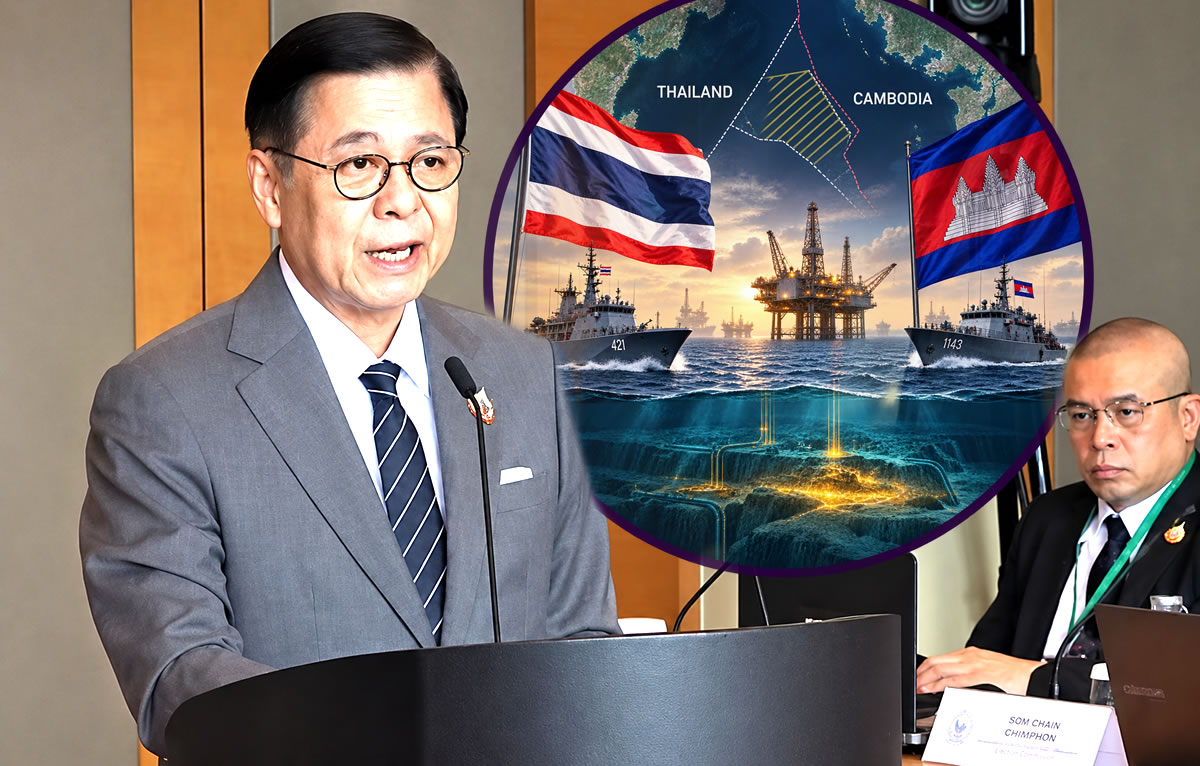
Thailand and Cambodia are now duking it out internationally over an energy-rich section of the Gulf of Thailand. Tensions between the neighbours are rising as a decades-old maritime dispute moves onto an international stage.
The competing claims cover about 26,000 square kilometres of sea. Beneath those waters could lie nearly 12 trillion cubic feet of natural gas. In addition, substantial oil reserves could be buried beneath the seabed. Estimates have valued the potential energy prize at approximately $300 billion.
Thailand, however, arrived in Singapore with one line firmly drawn. Koh Kut is not up for negotiation. Deputy Prime Minister and Foreign Minister Sihasak Phuangketkeow delivered that message before a five-member international Conciliation Commission. The panel is examining the competing maritime claims under United Nations law.
Koh Kut ruled out as Thailand rejects Cambodia’s 1972 claim and limits talks to maritime boundaries
“This conciliation process does not concern sovereignty over land, which includes the island of Koh Kut,” Mr Sihasak said. “Thailand rejects Cambodia’s 1972 continental shelf claim line, which is without legal basis.” His statement placed Koh Kut firmly outside the process initiated by Phnom Penh.
Koh Kut is an island district of Trat province in the eastern Gulf of Thailand. It lies close to Cambodia and the overlapping maritime claims. Cambodia unilaterally declared its continental shelf claim in 1972. Thailand followed with its own claim in 1973. As a result, the competing lines created the maritime dispute now before the commission.
Notably, Mr Sihasak has repeatedly insisted that Koh Kut belongs to Thailand. Before the Singapore meeting, he said maritime demarcation would clearly confirm Thai sovereignty over the island. Bangkok wants the proceedings restricted to maritime boundary delimitation. It rejects any attempt to turn conciliation into a sovereignty dispute over Koh Kut.
The first meeting runs from September 14 to 16 in Singapore. It is taking place at the Singapore office of the Permanent Court of Arbitration. The commission was established under the United Nations Convention on the Law of the Sea, or UNCLOS. Yet Tuesday’s opening exchanges quickly moved beyond technical arguments over maritime charts.
Mr Sihasak accused Cambodia of advancing claims that were “self-serving and contain elements of hypocrisy”. Separately, he accused Phnom Penh of repeatedly vilifying Thailand through false narratives. He said Cambodia had done so instead of pursuing bilateral dialogue.
Sihasak attacks Cambodia’s narrative as wider border tensions spill into Singapore maritime talks
“Cambodia has repeatedly vilified Thailand through false narratives,” Mr Sihasak told the commission. He then sharpened the attack. “And it does this by playing the role of a victim with a sense of self-righteousness aimed at claiming the moral high ground.”
The Foreign Minister also brought wider bilateral tensions directly into the hearing. He referred to a leaked private telephone conversation between the countries’ leaders. Furthermore, he cited Cambodian rockets which killed Thai civilians. He raised incidents involving Thai soldiers who lost their legs to landmines. Thailand says those mines were planted by Cambodia.
“We should recall the events that precipitated the conflict,” Mr Sihasak told the commission. He cited the leaked conversation, Cambodian rockets and the landmine incidents. “Where was respect for international law?” he asked. Thus, Thailand used its opening address to challenge Cambodia’s wider presentation of recent events.
Cambodian Deputy Prime Minister and Foreign Minister Prak Sokhonn offered a sharply different account. He described the process initiated by Phnom Penh as “a peaceful pathway” under international law. Both foreign ministers were allocated 15 minutes for their opening statements. Those addresses immediately exposed major differences over the purpose of the proceedings.
Cambodia seeks boundary treaty or joint development while Thailand insists talks stay on delimitation
Cambodia wants the process ultimately to produce a treaty establishing a single maritime boundary. If that fails, Phnom Penh has offered another route. Cambodia is prepared to negotiate joint development and an “equitable sharing” of resources. Alternatively, it wants commission recommendations which could underpin a later agreement.
Thailand is taking a considerably narrower position. Mr Sihasak said the proceedings should concern only maritime boundary delimitation between the two countries. Accordingly, Bangkok rejects bringing resource-sharing into the compulsory conciliation. Thailand wants the boundary question addressed first. Oil, gas and possible joint development would remain separate matters.
The disagreement therefore extends beyond where a line should cross the Gulf. The neighbours also dispute what the international process itself should accomplish. Cambodia wants joint development available if delimitation fails. Thailand insists the commission should focus solely on the maritime boundary.
In parallel, Bangkok and Phnom Penh are fighting over how the case reached Singapore. Cambodia says Thailand’s cancellation of their 2001 maritime memorandum forced it to seek another peaceful mechanism. Mr Sihasak strongly rejected that account. He called Cambodia’s version an “outright distortion of the facts”.
Thailand says Cambodia bypassed six months of direct talks before invoking compulsory UNCLOS process
Thailand says it offered Phnom Penh another route before Cambodia invoked UNCLOS. Mr Sihasak said Bangkok proposed six months of direct maritime boundary negotiations. If those failed, both countries could proceed jointly towards conciliation. Instead, Cambodia initiated the compulsory UNCLOS procedure.
That decision followed Thailand’s cancellation of the 2001 maritime memorandum. The agreement is widely known in Thailand as MOU 44. The number refers to Buddhist year 2544, corresponding to 2001. Thailand and Cambodia signed the memorandum in Phnom Penh on June 18 that year.
Crucially, MOU 44 covered both maritime delimitation and possible exploitation of offshore energy resources. The two countries intended to pursue separate objectives at the same time. First, they sought a mutually acceptable maritime boundary. That included territorial waters, continental shelf and exclusive economic zones.
At the same time, both sides planned negotiations towards joint development of hydrocarbons in part of the disputed area. The framework therefore attempted to address both the boundary and resources beneath the Gulf. It never produced a final settlement. Nor did it deliver the planned joint development arrangement.
MOU 44 sought a maritime boundary and joint energy development but delivered neither after decades
Instead, the dispute remained unresolved for almost 25 years. Prime Minister Anutin Charnvirakul and the Bhumjaithai Party later pledged to cancel MOU 44 during the election campaign. After taking office, the government followed through. The National Security Council resolved in April to terminate the memorandum. Thailand formally cancelled it in May.
Bangkok said the framework had failed to produce meaningful progress. It wanted a fresh negotiating structure. Mr Sihasak told the commission that only two rounds of official talks occurred during MOU 44’s existence. Earlier Thai government information had referred to five rounds. Either way, no final maritime boundary emerged.
Nor did Thailand and Cambodia begin jointly exploiting the potentially enormous hydrocarbon deposits. For almost a quarter-century, the resources remained locked beneath disputed waters. The failure left both delimitation and development unresolved when Bangkok finally abandoned MOU 44.
By then, Cambodia had made another significant move. Phnom Penh ratified UNCLOS in February 2026. It became the final ASEAN country to join the convention. Four months later, Cambodia activated the compulsory conciliation mechanism against Thailand.
On June 2, Phnom Penh notified Thailand and the United Nations Secretary-General of its decision. Cambodian Prime Minister Hun Manet said the move would protect Cambodia’s sovereignty and maritime rights through international law. Thailand formally responded on June 19.
Anutin government scraps MOU 44 as Cambodia turns to UNCLOS compulsory conciliation after 25 years
In response, Bangkok agreed to participate in the process. However, it expressly limited its understanding of the proceedings to maritime boundary delimitation. That restriction now lies at the centre of Thailand’s position before the Singapore commission.
The legal process also differs fundamentally from binding international arbitration. The commission cannot simply draw a maritime boundary and order both countries to accept it. Both countries excluded maritime delimitation from UNCLOS’s normal compulsory binding adjudication procedures.
Even so, the convention permits compulsory conciliation in certain circumstances. Cambodia can therefore require Thailand to participate. The commission can examine the competing claims and hear both governments. It can also help the parties seek an agreed settlement.
Eventually, the five conciliators can issue conclusions and recommendations. Those recommendations, however, are not binding. Bangkok and Phnom Penh must still negotiate any final agreement themselves. Thailand’s Foreign Ministry expects the process to take approximately 12 months.
As part of this, both governments selected international figures to sit on the five-member commission. Cambodia appointed Danish diplomat Peter Taksøe-Jensen and French international law scholar Jean-Marc Thouvenin. Thailand selected South African jurist Albert Hoffmann and German international law expert Rüdiger Wolfrum.
Thailand joins compulsory conciliation but stresses that the outcome cannot impose a final boundary
The four members then selected Australian diplomat and international lawyer Katrina Cooper as chairwoman. Ms Cooper brings direct experience of an earlier UNCLOS compulsory conciliation. She served as Australia’s co-agent during its maritime dispute with Timor-Leste.
That process began in 2016 following a long-running dispute between Australia and Timor-Leste. Ultimately, the two countries signed a maritime boundary treaty in 2018. The Thailand-Cambodia proceedings are therefore another rare test of the UNCLOS conciliation mechanism.
The economic stakes, meanwhile, are huge. Estimates for the contested area point to nearly 12 trillion cubic feet of natural gas. Significant quantities of oil may also lie beneath the seabed. The potential resources have been valued at around $300 billion.
Consequently, the dispute concerns more than competing lines across 26,000 square kilometres of water. A settlement could unlock access to huge offshore energy reserves. It could also determine how those resources are divided or developed.
For decades, two broad solutions have been available. One would establish an agreed maritime boundary. The other would postpone final delimitation and jointly develop the hydrocarbons. Under joint development, both countries could exploit resources while sharing the economic returns.
Katrina Cooper brings Timor-Leste experience as commission tackles Gulf claims and huge energy stakes
MOU 44 attempted to advance both approaches. Yet the framework produced neither an agreed boundary nor a joint development regime. Now Cambodia wants both possibilities available during the new process. Thailand is pushing back against that broader approach.
On another front, Phnom Penh says it wants a maritime boundary treaty as its primary objective. However, it is prepared to pursue joint development if delimitation proves impossible. Cambodia has also proposed an equitable sharing of resources.
Bangkok’s position is different. Thailand wants the compulsory conciliation confined to delimitation. Therefore, any later discussion about hydrocarbons or joint development would remain outside this process. That difference could become a central issue during the coming year.
Koh Kut adds another sensitive element. Cambodia’s 1972 continental shelf claim line included the area around the Thai island. Thailand rejects that line and says it lacks a legal basis. More importantly, Bangkok says sovereignty over Koh Kut itself is not disputed.
Mr Sihasak has now put that position directly before the commission. He also made clear that the Singapore proceedings cannot determine sovereignty over the island. For Thailand, maritime delimitation and ownership of Koh Kut are distinctly separate questions.
Thailand and Cambodia split again over joint process as Koh Kut remains outside conciliation talks
At the same time, the talks are unfolding amid strained relations between Bangkok and Phnom Penh. Those tensions were evident throughout Mr Sihasak’s opening statement. He did not restrict his remarks to technical maritime issues. Instead, he directly challenged Cambodia’s account of recent events.
The Thai minister accused Cambodia of hypocrisy and distortion. He also accused Phnom Penh of presenting itself as a victim while maligning Thailand. Cambodia, by contrast, portrayed its UNCLOS initiative as a peaceful application of international law.
Against that backdrop, the two neighbours arrived in Singapore with competing versions of both the past and future. Thailand says bilateral negotiations should have been tried first. Cambodia chose compulsory conciliation after Bangkok terminated MOU 44.
They also remain divided over what happens if delimitation fails. Cambodia wants joint development and equitable resource-sharing available as alternatives. Thailand wants the process limited to establishing a route towards a maritime boundary.
For now, the commission’s powers remain restricted. It can examine both positions, seek common ground and recommend a settlement. It cannot force either government to accept a final boundary. Ultimately, Bangkok and Phnom Penh must agree on any settlement.
Strained Thai-Cambodian relations deepen divisions over boundaries, resources and the route to settlement
The proceedings could continue for about one year. During that period, the commission will examine competing claims first advanced in 1972 and 1973. It will also confront governments entering the process amid rising bilateral tensions.
At stake are approximately 26,000 square kilometres of contested Gulf waters. Below them may lie natural gas and oil worth hundreds of billions of dollars. Yet the neighbours cannot even agree whether those resources belong inside the current process.
Nearly 25 years of negotiations under MOU 44 failed to settle that argument. Thailand has now discarded the old framework. Cambodia has responded by moving the dispute into an international conciliation process.
Tuesday’s opening exchanges showed that neither side entered Singapore quietly. Cambodia described conciliation as “a peaceful pathway”. Thailand responded with accusations of hypocrisy, false narratives and an “outright distortion of the facts”.
Year-long process opens over $300 billion energy prize as both sides remain divided on its proper scope
The dispute has therefore entered a new and potentially lengthy phase. It combines competing maritime claims, huge potential energy reserves and worsening relations between neighbouring states.
For Bangkok, however, one position was fixed before the first substantive exchanges began. Thailand rejects Cambodia’s 1972 continental shelf claim line. It also wants resource-sharing kept outside the compulsory conciliation.
Minister and security official prepare to bolster the kingdom’s defences with a new drone warfare centre
Prime Minister Anutin and Cambodian counterpart Hun Manet hold three way meeting at ASEAN summit
Above all, Mr Sihasak told the commission that Koh Kut is not part of the case. “This conciliation process does not concern sovereignty over land, which includes the island of Koh Kut,” he said.
Thailand says the island is Thai territory. Its sovereignty is not before the commission.
Join the Thai News forum, follow Thai Examiner on Facebook here
Follow Thai Examiner on Google here
Receive all our stories as they come out on Telegram here
Follow Thai Examiner here
Further reading:
Ex Energy Minister supports oil and arms supplies blockade against Cambodia in the Gulf of Thailand
War to continue says PM Anutin. Dismisses President Trump’s ceasefire talk as a ‘misunderstanding’
Confusion after Trump’s 20 minute phone call with PM Anutin. US side claimed a ceasefire was agreed