Anutin faces a gathering storm as Sondhi threatens street protests and the Senate collusion case nears a September 14 decision. With 229 people under scrutiny and a local exam corruption scandal growing, Bhumjaithai faces pressure on multiple fronts.
Prime Minister Anutin Charnvirakul faces a widening political storm as corruption allegations, a disputed Senate election and threatened street protests converge. Veteran activist Sondhi Limthongkul is preparing a new mobilisation against “grey capital”, while public distrust deepens. At the same time, the Election Commission must decide the explosive Senate collusion case on September 14 after two committees reached starkly opposing conclusions. The dispute covers 229 people, including 138 serving senators, while leaked investigative files fuel opposition attacks. Separately, serious claims surrounding local government recruitment examinations are drawing senior political figures and ministers into another major corruption controversy as public patience wears thin.
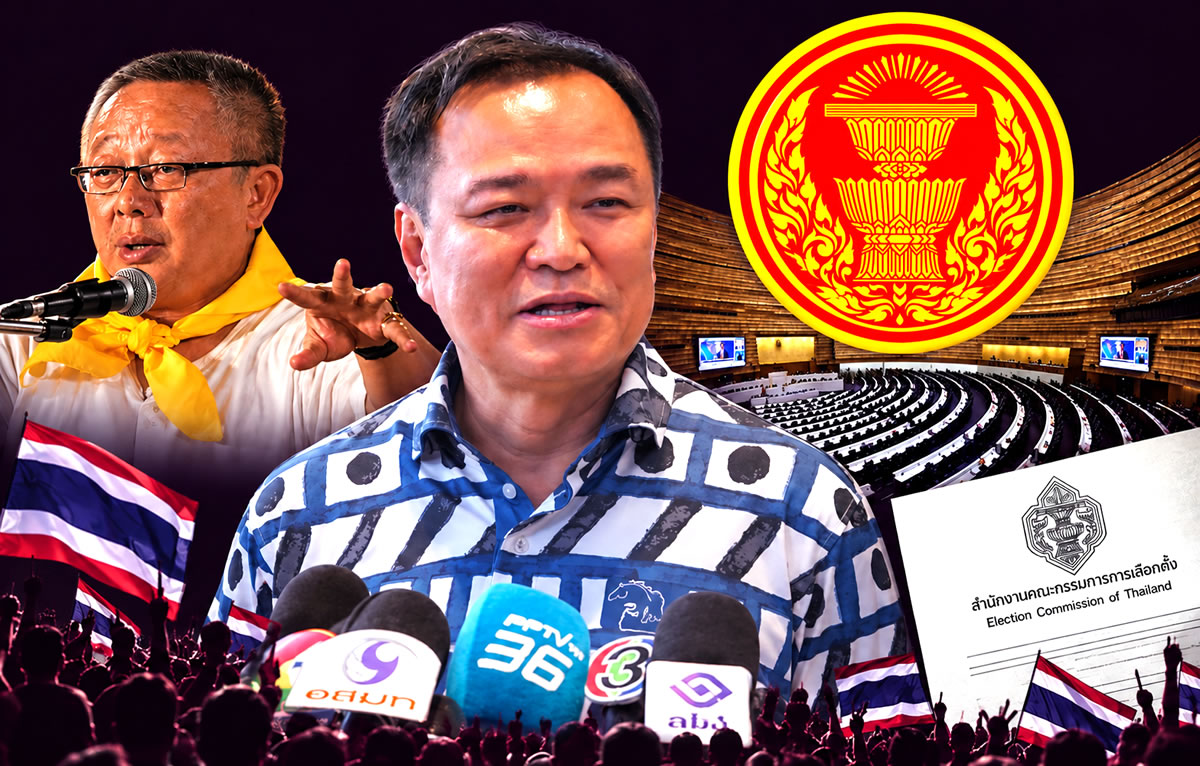
Prime Minister Anutin Charnvirakul on Sunday dismissed a growing political storm surrounding corruption and the disputed 2024 Senate election.
Meanwhile, veteran activist Sondhi Limthongkul is threatening fresh street mobilisation against the Bhumjaithai Party-led government. His intervention comes as public unease grows over several major corruption controversies. Most immediately, the Election Commission faces a crucial decision over alleged Senate collusion on September 14.
Separately, serious accusations continue to swirl around local government recruitment examinations. Those claims include suggestions of involvement by senior political figures and ministers. The scandal has become another major problem for the government. At the same time, Mr Sondhi is preparing a campaign explicitly directed against “grey capital”.
Anutin rejects Senate collusion claims as rival Election Commission findings deepen political pressure
Against that backdrop, Mr Anutin showed no sign of alarm on Sunday. Instead, he laughed when asked whether the Senate affair could shake his government. He firmly denied that Bhumjaithai had participated in Senate election collusion. Moreover, he attacked the People’s Party for continuing to pursue purported connections.
The Senate controversy concerns the unusual selection process used to choose Thailand’s upper house in 2024. Investigators examined claims that an organised network colluded to control the outcome. Subsequently, one investigative committee recommended action against 229 people. They included 138 serving senators and 91 political figures and others.
Notably, that first investigation was handled by Committee 26. It included Department of Special Investigation personnel and Election Commission appointees. The committee recommended prosecution of all 229 people examined. However, a later committee reached a dramatically different conclusion.
Committee 36 subsequently recommended no action against those it examined. Consequently, two investigative processes produced sharply conflicting outcomes. One sought prosecution of more than 200 people. The other recommended clearing those under examination.
Election Commission faces September 14 decision as leaked Senate files fuel a wider political dispute
For that reason, attention has increasingly shifted towards the Election Commission itself. Its final decision is scheduled for Monday, September 14. Until then, opposition politicians continue citing information from the investigative files. Government figures, however, are demanding explanations about how that confidential material was obtained.
In parallel, the dispute has developed beyond the original collusion allegations. One issue concerns whether the Senate selection was manipulated. Another concerns possible political connections behind the alleged network. A third concerns leaks of confidential investigative documents. Together, those disputes have intensified the political confrontation.
Mr Anutin entered that confrontation directly at 4.40 pm on Sunday. He spoke at Bhumjaithai Party headquarters after a party meeting. In response, he dismissed claims involving Committee 36 and the Advanced Political and Election Development Course. He said there was absolutely no link.
“I don’t know how to respond. There’s absolutely no connection whatsoever. They’re just making things up.”
He then turned his criticism towards People’s Party MP Parit Wacharasindhu. Specifically, Mr Anutin challenged Mr Parit over another dispute involving Napinthon Srisarppang. Mr Napinthon is Minister attached to the Prime Minister’s Office. The Prime Minister referred to an earlier broadcast exchange between the two men.
Anutin turns on Parit as he dismisses Senate links and points to his pre-election party directive
According to Mr Anutin, most viewers could already judge which participant had told the truth. He therefore told Mr Parit to settle that argument first. Then, he accused the opposition MP of redirecting his attack after losing the earlier exchange.
“Therefore, if you lose on that point, don’t go lashing out elsewhere. As a representative of the people, you must have maturity. This is like a sore loser picking a fight. That’s not acceptable.”
Mr Anutin also said each political group should concentrate on its own responsibilities. At present, he said, Bhumjaithai had no right to intervene in the Senate collusion case. Furthermore, he said he had repeated that instruction during Sunday’s party meeting.
As part of his defence, Mr Anutin pointed to a directive issued before the 2024 Senate election. The order prohibited Bhumjaithai members from interfering in the Senate selection. The process was supposed to remain independent of political parties. Accordingly, members were instructed to keep away.
Mr Anutin said the directive was issued before the Senate election. He complained that people had subsequently forgotten the instruction. Therefore, he said, the notice must be mentioned when reporters raise the allegations.
Anutin says 2024 Senate timeline rules out any link with governments formed later in 2025 and 2026
The Prime Minister also relied heavily on chronology. The Senate election took place in July 2024. At that time, Bhumjaithai was a coalition partner in the Pheu Thai-led government. Mr Anutin served as Deputy Prime Minister and Interior Minister.
By contrast, his first government as Prime Minister came to power in September 2025. His second government followed in March 2026. Thus, Mr Anutin argued, his premiership could not be connected chronologically with the Senate election.
“If you say that the Anutin government was involved in the collusion regarding the Senate elections, let me reiterate that Anutin’s first government came into power in September 2025, Anutin’s second government in March 2026, and the Senate election was in July 2024. Therefore, the timeline doesn’t make sense.”
However, criticism surrounding the affair extends beyond decisions made by his governments. Opposition figures have also raised possible involvement by individuals associated with Bhumjaithai. Mr Anutin rejected that proposition just as firmly.
“If you say that someone from the Bhumjaithai Party was involved, no one from the Bhumjaithai Party could be involved.”
Bhumjaithai says no member defied Senate order and insists the party never needed upper-house support
His argument again rested on the earlier party directive. Anyone participating would have disobeyed the party leader’s orders. So far, he said, Bhumjaithai had found no evidence that anybody had done that.
“Because if they were involved, they would be disobeying orders, and the Bhumjaithai Party hasn’t seen anyone disobey the party’s orders.”
Mr Anutin also said the party had no evidence supporting action against any member. Therefore, it could not conclude that somebody had violated his instruction.
“There’s also no evidence for the Bhumjaithai Party to accuse or conclude that anyone disobeyed the party leader’s orders in connection with the Senate elections.”
He then returned to the separate duties of politicians and senators. “It’s clear that we all have our duties as MPs; everyone has their position and responsibilities,” he said.
On another front, Mr Anutin argued that Bhumjaithai never needed Senate support for its political development. In 2024, the party already held positions within a coalition government. Its MPs and ministers were carrying out their existing duties. Accordingly, he said there was no original incentive to intervene.
Anutin credits electoral growth as corruption claims and Senate transparency concerns intensify further
Mr Anutin then traced Bhumjaithai’s political expansion from 2019. He said the party entered government through its own electoral strength. Subsequently, he cited growth from 50 seats to 70 and then 193 seats. He attributed that growth to serving voters.
“We did not rely on the Senate to become the government or to help us grow from 50 seats to 70 seats to 193 seats.”
“This came from serving the people and from the work of the Bhumjaithai Party.”
He then delivered his central denial. “Therefore, I would like you to understand that the Bhumjaithai Party has no involvement whatsoever in this matter.”
Yet the Senate controversy is developing as other corruption accusations gather political force. Most seriously, questions continue around local government recruitment examinations. The allegations include claims concerning senior figures and ministers. The supplied material describes the affair as one of Thailand’s biggest corruption scandals.
Meanwhile, public concern surrounding the Senate process had already emerged before the latest confrontation. A Suan Dusit Poll surveyed 1,211 people in May 2025. Of those respondents, 60.36% cited insufficient transparency surrounding the Senate selection.
Public distrust grows as Sondhi prepares a fresh mobilisation against corruption and grey capital
In addition, 56.73% said they lacked confidence in Thailand’s political system. Another 57.12% linked the affair with greater public distrust and ideological division. Significantly, 66.15% believed the Senate controversy could affect government stability.
Now, those concerns are colliding with conflicting Election Commission findings. Committee 26 recommended action against 229 people. Committee 36 subsequently recommended none. Meanwhile, confidential material from those investigations continues circulating politically.
Against this backdrop, Mr Sondhi’s reappearance adds an entirely different source of pressure. The 78-year-old media businessman plans a major press conference on September 7. He is expected to outline plans for a new political mobilisation. His campaign carries the slogan “reclaim Thailand from grey capital”.
Mr Anutin has already dismissed that slogan. On Thursday, he said Thailand already belonged to every Thai. Therefore, he argued, the country did not need to be “reclaimed”. Nevertheless, he acknowledged Mr Sondhi’s constitutional right to demonstrate within the law.
Mr Sondhi’s intervention carries weight because of his history in Thai street politics. He is not simply a media critic of the government. Previously, he helped organise mass movements which became central players during major national political crises.
Sondhi’s media power and yellow-shirt movement shaped major political confrontations in the 2000s
A journalist turned businessman, Mr Sondhi built the Manager media empire. His interests later expanded into newspapers and broadcasting, including ASTV. During the political conflicts of the 2000s, that network became a powerful communications platform.
Initially, Mr Sondhi was an enthusiastic supporter of former Prime Minister Thaksin Shinawatra. Later, however, the relationship collapsed. By 2005, he had become one of Mr Thaksin’s fiercest political opponents. He subsequently emerged as a leading figure in the People’s Alliance for Democracy.
The yellow-shirt movement then brought huge crowds onto Bangkok’s streets. Its demonstrations helped create the political crisis preceding the September 2006 military coup. That coup removed Mr Thaksin from office. Still, Mr Sondhi’s movement did not disappear.
Two years later, the People’s Alliance for Democracy returned against another Thaksin-linked government. Protesters occupied Government House during the confrontation. Later, they seized Suvarnabhumi and Don Mueang airports. The action caused major disruption and intensified Thailand’s political conflict.
Sondhi survived a 2009 assassination bid and now returns as September’s political calendar tightens
Then, in April 2009, Mr Sondhi survived an assassination attempt in Bangkok. Gunmen fired scores of rounds into his vehicle. He suffered serious head injuries but survived emergency surgery. Years afterwards, he was imprisoned following a securities-related conviction.
Mr Sondhi was subsequently released under a royal pardon in September 2019. Now, he is threatening another return to organised street politics. This time, his target is the government led by Mr Anutin and Bhumjaithai.
The timing places his campaign directly beside the Senate controversy. His September 7 announcement comes only seven days before the Election Commission’s scheduled decision. Furthermore, his campaign is explicitly framed around corruption and “grey capital”.
Political analysts Jatuporn Prompan and Thepthai Senpong have also highlighted September’s unusually crowded political calendar. They identified three major dates falling within 21 days. First comes Mr Sondhi’s September 7 intervention. Next comes the Election Commission’s September 14 Senate decision.
Finally, the Constitutional Court is scheduled to rule on September 28. That case concerns QR codes printed on ballot papers. It is separate from the Senate collusion investigation. Even so, all three politically sensitive events fall within the same month.
Election Commission remains under pressure as opposing Senate findings and leaked files dominate
The immediate institutional focus remains the Election Commission. Its investigators have delivered opposing recommendations in the Senate case. Committee 26 favoured action against all 229 people. Conversely, Committee 36 recommended no prosecution among the cases it examined.
In the meantime, opposition politicians continue drawing attention to the confidential investigative material. Government figures are pushing back against those disclosures. In particular, they want to know how sensitive case information reached political opponents.
Mr Anutin’s response is therefore built around several separate defences. First, his government came to power after the Senate election. Second, Bhumjaithai members had been expressly barred from participating. Third, he says no evidence shows that any party member ignored those orders.
Additionally, he rejects any suggestion that Bhumjaithai needed Senate support. The party, he argues, expanded through electoral support rather than upper-house influence. For that reason, he says there was no political incentive for interference.
Anutin rests defence on chronology, orders and his claim Bhumjaithai never needed the Senate
When reporters asked whether the Senate controversy could shake his government, Mr Anutin laughed. He again separated the Senate’s formation from his premiership. Then, he used two Bangkok roads to explain his argument.
“I’ve already answered that. When the government came into power, and when the senators came into power, there’s no way they can be linked or connected.”
He continued with a comparison. “It’s like Rama IV Road and Sukhumvit Road; you can talk about them, but they’ll never meet because they’re from different time periods and contexts. Okay?”
The opposition, however, has not accepted his explanation. Instead, it continues examining alleged links emerging from the investigation. At the same time, government figures continue challenging the provenance of leaked files.
Separately, the local government examination controversy continues generating accusations about corruption and senior involvement. Mr Sondhi is preparing his own campaign against “grey capital”. Thus, several politically damaging issues are arriving together.
For Mr Anutin, however, Sunday’s approach was openly combative. He ridiculed suggestions that Bhumjaithai had orchestrated the Senate process. He accused People’s Party figures of manufacturing links. Furthermore, he told them to show whatever additional evidence they claimed to possess.
Anutin laughs off government risk as Senate leaks, exam corruption and Sondhi pressure now converge
The coming week now carries two immediate political tests. Mr Sondhi will set out his plans on Monday, September 7. One week later, the Election Commission is scheduled to decide the Senate case.
Until then, the competing investigation findings remain unresolved. One process recommended prosecution of 229 people, including 138 serving senators. Another process recommended no action. Meanwhile, confidential case material continues fuelling the political fight.
Opposition alleging a potential whitewash by Election Commission on Friday over Senate election case
Thailand’s Manager Online newspaper to print its last edition on July 31st as business has moved online
Mr Anutin insists Bhumjaithai stayed outside the Senate selection. He says the party had formally ordered members to do exactly that. Moreover, he rejects any claim that the case threatens his government.
The People’s Party intends to continue examining the purported connections. Mr Sondhi, meanwhile, is preparing pressure outside parliament. On another front, corruption allegations surrounding local government examinations remain unresolved.
Asked whether opposition politicians should continue revealing whatever connections they believed they had found, Mr Anutin did not hesitate.
“Go ahead.”
Join the Thai News forum, follow Thai Examiner on Facebook here
Follow Thai Examiner on Google here
Receive all our stories as they come out on Telegram here
Follow Thai Examiner here
Further reading:
Opposition alleging a potential whitewash by Election Commission on Friday over Senate election case
Ex PM and Democrat Party leader urges politicians implicated in Senate Collusion files to come clean
Opposition and People’s Party leader attacks ‘blue regime’ on the 12th anniversary of the 2014 coup
Thammasat University legal scholar and 1992 protest leader warns another coup cannot be ruled out