Thailand faces a widening economic split as exports surge but SMEs buckle under falling sales, costly credit and rising bad debts. Growth potential has dropped to 2.7%, while the Bank of Thailand sees just 1.8% growth in 2027.
Thailand’s economic growth potential has almost halved in two decades, while SMEs remain locked in their worst credit squeeze since the 1997 crisis. The Bank of Thailand now puts potential growth at just 2.7%, with GDP forecast at 2.3% this year and 1.8% in 2027. Meanwhile, SME lending has contracted for 16 straight quarters, retail sales have fallen 7.1% and loan rejection rates have reached 86%. Yet exports and technology investment remain strong, exposing an increasingly divided economy. Assistant Governor Don Nakornthab warns that ageing, weak investment and slow productivity could drive Thailand’s economic ceiling lower still.
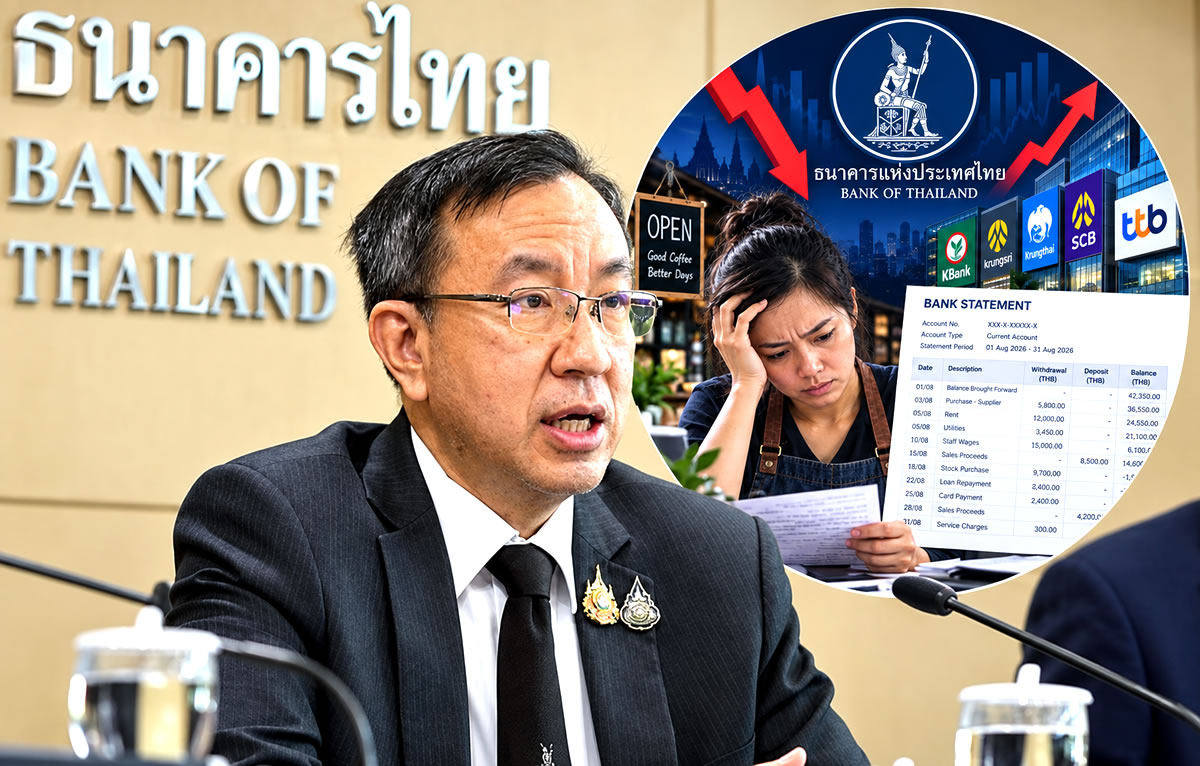
Thailand’s economic growth potential has fallen to 2.7%, while smaller businesses remain trapped in a four-year credit contraction. The Bank of Thailand now sees growth of 2.3% in 2026 and only 1.8% in 2027. Crucially, both rates sit below an economic potential which has itself fallen sharply.
Thailand’s potential growth stood near 5% between 2003 and 2007. After the global financial crisis, that rate fell to about 3.5%. Today, the central bank puts the figure at only 2.7%. Notably, this is not a growth target or a level the bank considers satisfactory.
Bank of Thailand Assistant Governor for Monetary Policy Don Nakornthab said Thailand could still grow. However, he warned that structural weaknesses were steadily reducing its capacity. Without stronger competitiveness, even the current 2.7% potential rate could fall further.
Thailand’s growth potential falls to 2.7% as ageing, weak investment and slow productivity bite hard
Three major forces are driving that decline. First, Thailand’s workforce is shrinking as the population ages. Second, overall investment has weakened from earlier levels. Finally, productivity and technology adoption have advanced too slowly.
Taken together, those pressures have lowered Thailand’s sustainable economic speed. Moreover, current GDP growth is struggling to reach even that reduced ceiling. The central bank forecasts 2.3% growth this year, followed by 1.8% next year.
Investment sits at the centre of the problem. Thailand needs investment approaching 30% of GDP to push growth sustainably above 3%. Yet overall investment remains below levels seen during stronger growth periods. At the same time, the composition of new investment has changed markedly.
Much of the latest investment is capital-intensive. Therefore, large projects do not necessarily create large numbers of jobs. Foreign labour has also become increasingly important in parts of the economy. In parallel, relatively low labour costs reduce pressure for some companies to invest heavily in productivity.
The structural list extends well beyond investment. High household debt continues to weaken consumption and financial resilience. An ageing society is shrinking the labour pool. Educational weaknesses also constrain the supply of higher-skilled workers.
Chinese competition, inequality and political instability weigh as technology exports drive growth
Separately, inequality in assets and opportunities remains another drag on economic participation. Competition from Chinese products is adding further pressure on Thai producers. Corruption and political instability are also among the weaknesses weighing on longer-term growth.
Despite that backdrop, parts of the economy remain strong. Exports continue to provide one of Thailand’s main growth engines. Recent export growth has reached double-digit rates, driven heavily by technology-related products.
Artificial intelligence-related demand is also supporting that technology cycle. Meanwhile, private investment has received a lift from investment-promotion applications. Digital businesses, data centres and software projects feature prominently among those applications.
Exports rose 22.3% year-on-year in July. Private investment, meanwhile, increased 12.9%. By comparison, industrial production advanced by only 0.5%. That contrast exposes the narrow base beneath some of Thailand’s stronger headline numbers.
Large companies and technology exporters are performing much better than many domestic firms. Consequently, strong export figures are not feeding evenly into wages, sales or household spending. Nor are new projects creating jobs on the scale seen in older industrial investment.
Weak household purchasing power hits SMEs as sales fall 7.1% and lending shrinks for four straight years
On another front, private consumption is slowing. Weak domestic purchasing power has become increasingly visible. Household debt continues absorbing income which could otherwise flow into shops, restaurants and other businesses.
Inflation has recently reached about 2.5%. Looking ahead, fresh food prices may rise towards year-end because of El Niño conditions. Even so, businesses have limited room to pass higher costs onto consumers.
Mr Don said most businesses cannot raise prices by more than 10%. Consumers simply lack the financial capacity to absorb such increases. As a result, companies face squeezed margins when their own costs climb.
This weakness hits smaller businesses particularly hard. SMEs rely heavily on domestic customers and household spending. Large exporters, by contrast, can draw substantial revenue from foreign markets. Accordingly, weak Thai purchasing power falls disproportionately on smaller firms.
The figures now show a severe divide. SME retail sales have fallen 7.1%. Large businesses, however, have recorded sales growth of 9.6%. The gap between the two groups exceeds 16 percentage points.
More significantly, SME lending has contracted for 16 consecutive quarters. That amounts to four straight years of shrinking credit. Such a prolonged contraction has not been seen since the 1997 crisis.
SMEs employ 70% of Thai workers but face bank loan rejection rates reaching 86% and far higher costs
SMEs remain central to employment. They employ approximately 13.6 million people, representing about 70% of total employment. Yet they generate only around 35% of Thailand’s GDP. That employment concentration makes their prolonged weakness economically significant.
SME economic growth has slipped towards 1%. Previously, smaller businesses expanded around 1.9% when national growth averaged closer to 3.5%. Thus, their deterioration has outpaced the broader decline in Thailand’s economic performance.
Credit conditions have intensified the pressure. Banks are rejecting around 60% to 70% of SME credit applications. For new businesses without established financial histories, rejection reaches 78%.
The situation is worse for firms already carrying bad-debt records. Their rejection rate reaches 86%. In effect, conventional bank credit becomes extremely difficult once financial problems appear.
Even stronger SMEs face tight financing conditions. Among the best-performing 30%, only 21% obtain credit. Large companies fare far better, with around 61% securing financing.
Borrowing costs widen the divide further. SMEs face average financing costs of around 6.9%. Large businesses pay approximately 3%. Hence, smaller firms pay more than twice the average financing cost faced by larger competitors.
SME bad debts mount as Stage 3 loans reach ฿195.7 billion while the banking system remains sound
At the same time, those businesses are dealing with weaker sales. Credit availability is also shrinking. Rising borrowing costs therefore strike companies already facing diminished domestic demand.
Bad debts show the accumulated strain. Approximately ฿195.7 billion of SME loans are classified as Stage 3. These loans are non-performing. Another ฿336.9 billion is classified as Stage 2.
Stage 2 loans have experienced a significant increase in credit risk. Together, the two categories show heavy financial pressure concentrated among smaller borrowers. They also help explain why banks remain cautious about extending new loans.
By contrast, Thailand’s banking system overall remains considerably stronger. Total non-performing loans stood at ฿534.8 billion during the second quarter. The overall NPL ratio was 2.82%. Banks also remain well capitalised.
Therefore, the central bank is not describing a system-wide banking crisis. Rather, financial weakness is concentrated among heavily indebted households and smaller companies. That distinction is critical to understanding Thailand’s uneven economy.
Smaller firms struggle for capital as closures rise and weak investment drags on national productivity
Large corporations retain much greater access to capital. SMEs, meanwhile, face falling sales, higher borrowing costs and stricter credit tests. In turn, those conditions restrict expansion, investment and working capital.
The Bank of Thailand’s SME survival figures add another measure of the pressure. Its research covered about 130,000 SME legal entities. Half had closed within ten years. Only around 30% survived for 25 years.
More recently established SMEs are also expanding more slowly than older generations. This creates another obstacle to stronger productivity growth. Thailand needs smaller businesses to invest, yet those businesses face growing financing barriers.
The problem becomes particularly sharp because SMEs employ most Thai workers. Investment is needed for machinery, software, technology and expansion. However, weaker earnings reduce creditworthiness and make banks less willing to lend.
In response, businesses postpone investment or abandon it. Working capital can also become harder to secure. Lower investment then restricts productivity gains across the SME sector.
At the national level, slow productivity directly affects Thailand’s potential growth. A shrinking workforce means each worker must generate more output. Without stronger productivity, demographic decline exerts an increasing brake on GDP.
Advanced investment grows in AI, data centres and software but remains too low to lift growth potential
Education is tied directly to that challenge. Advanced industries require more skilled employees. Technology adoption also demands workers capable of operating increasingly sophisticated systems. Yet educational quality remains among the structural weaknesses identified by the central bank.
Simultaneously, Thailand is attracting more advanced investment. Electronics, artificial intelligence, automation, data centres and software are drawing new capital. However, these sectors are often much more capital-intensive than traditional manufacturing.
Consequently, new investment can raise headline figures without producing equivalent gains in employment. That weakens the link between investment growth and household income. It also limits the immediate benefit for businesses dependent on local consumers.
There is another divide between foreign investment and domestic economic conditions. Promotion applications point towards stronger investment in selected modern industries. Overall investment, however, remains below the level required to lift potential growth substantially.
For that reason, the central bank has stressed productive investment. Thailand needs investment capable of raising output per worker. Merely adding capital without broader productivity gains will not restore earlier growth rates.
Household debt, shrinking credit and weak borrowers limit what lower interest rates can achieve alone
Household debt creates another major brake. Debt repayments absorb disposable income before households can spend it. Smaller businesses then receive less revenue from domestic consumers.
Thereafter, weaker business revenues reduce debt-servicing capacity. Non-performing loans rise and lenders become more cautious. New credit becomes harder to obtain. The 16-quarter SME lending contraction reflects that chain of financial pressure.
Monetary policy cannot resolve all these problems. Interest-rate reductions can lower some borrowing costs. However, they cannot expand the working-age population or directly improve education.
Likewise, lower rates cannot automatically make weak borrowers creditworthy. The policy interest rate currently stands at 1%. The Monetary Policy Committee held it there again on August 26.
Against this backdrop, Mr Don warned against expecting the central bank to carry the burden alone. “Don’t expect too much from the Bank of Thailand, because one agency can’t do much,” Mr Don said.
“If we rely solely on the Bank of Thailand, the country won’t progress,” Mr Don added. He said the central bank would continue performing its crucial role. However, stronger growth also requires government fiscal policy and private-sector action.
Bank of Thailand turns to SME credit support as Don warns monetary policy cannot carry growth alone
As part of this effort, the Bank of Thailand is developing targeted SME measures. Its SME Credit Boost programme seeks to reduce credit risks faced by lenders. A Credit Portal is also planned before the end of 2026.
The portal aims to connect smaller companies with alternative lenders. Additionally, a new credit-guarantee mechanism is being developed for 2027. Banks are also being encouraged to use alternative data when assessing borrowers.
That approach could help businesses without lengthy conventional credit histories. At present, those companies face rejection rates of 78%. Firms with existing bad-debt records face rejection rates of 86%.
Nevertheless, targeted credit programmes address only part of the wider weakness. Thailand’s larger problem is a sustained decline in underlying growth capacity. The economy’s potential has fallen from about 5% to 2.7% within two decades.
That decline has occurred alongside weaker investment, demographic change and slow productivity growth. Meanwhile, the economy has become increasingly divided between strong and weak sectors.
Technology exporters pull ahead as SME sales, lending and credit quality continue to deteriorate
At the top, technology exports and major corporations continue expanding. At the bottom, many SMEs remain squeezed by weak consumption and scarce credit. The sales figures capture that split clearly.
Large-business sales are up 9.6%. SME retail sales are down 7.1%. In contrast, exports rose 22.3% year-on-year in July. Industrial production rose only 0.5%.
This uneven pattern also appears in financing. Large businesses can obtain credit more easily and at much lower average costs. Smaller firms face rejection rates reaching 70% under ordinary applications.
For new businesses, almost four out of five applications are rejected. Among borrowers with bad-debt histories, nearly nine out of ten applications fail. Even the best-performing SMEs obtain credit at a much lower rate than large companies.
Meanwhile, non-performing SME loans continue rising. Stage 3 loans stand near ฿195.7 billion. Another ฿336.9 billion sits in Stage 2, where credit risk has increased significantly.
Private consumption is also weakening. Household debt remains high, while inflation has reached approximately 2.5%. Fresh food prices may add further pressure towards year-end.
Businesses face weak pricing power as capital-intensive investment creates fewer jobs and less spillover
Even then, businesses have limited pricing power. Consumers cannot easily absorb higher prices. Therefore, companies face higher costs without a straightforward way to protect margins.
From another angle, Thailand still has strong export momentum. Technology and AI-linked products are driving substantial overseas sales. Data centres and software investments are also attracting new capital.
Yet that strength is concentrated. New investment is often capital-intensive and less dependent on Thai labour. Thus, impressive investment figures may deliver fewer jobs than comparable spending once did.
The demographic picture makes that issue more urgent. Thailand has fewer workers available as the population ages. At the same time, low productivity growth limits gains from those who remain in employment.
To push sustainable GDP growth above 3%, investment would need to approach 30% of GDP. Current investment remains below that level. Therefore, Thailand has yet to rebuild the investment base needed for materially faster growth.
There is also an output gap left by previous weak growth. Merely returning to 2.7% would not immediately close it. Growth would probably need to stay around 3% for a period.
Growth is forecast to slow to 1.8% in 2027 as SME credit contraction exposes Thailand’s widening divide
The forecast instead points in the opposite direction. GDP growth is expected at 2.3% in 2026. It is then forecast to slow to 1.8% in 2027.
In other words, growth is falling below a potential rate which has already deteriorated sharply. That rate once stood near 5%. It later fell to 3.5%. It now stands at 2.7%.
At the same time, the businesses employing roughly 70% of Thai workers remain under intense pressure. Their lending has contracted for 16 straight quarters. Retail sales are down 7.1%, while large-business sales are up 9.6%.
Petrol and diesel rise as inflation for August comes in at 2.53%. However confidence is also seen rising
Finance Minister Ekniti outlines the government’s economic plan but behind the buzzwords are risks
Financing costs also remain heavily skewed. SMEs pay around 6.9% on average, against approximately 3% for large businesses. Credit rejection rates can reach 78% for new companies and 86% for troubled borrowers.
Thailand therefore enters the next year with a widening economic divide. Exports and selected technology investments remain strong. However, domestic purchasing power, SME lending and smaller-business sales remain weak.
Most importantly, the central bank’s 2.7% figure marks diminished economic capacity, not a target. The 2027 growth forecast stands even lower, at only 1.8%.
Meanwhile, four years of contracting SME credit continues beneath those headline numbers. That contraction reaches businesses employing around 13.6 million people across Thailand.
Join the Thai News forum, follow Thai Examiner on Facebook here
Follow Thai Examiner on Google here
Receive all our stories as they come out on Telegram here
Follow Thai Examiner here
Further reading:
60-day visa regime to be ended confirms Minister responding to rising industry security concerns
Tourism boss warns Thailand it is facing a Chinese blacklist if another security controversy erupts