Thailand and US head for a sweeping trade pact with Suphajee declaring the main battles settled. Anutin and Trump await the closing call as tariffs, US purchases, electronic payments, cross-border data and telecom ownership dominate the endgame.
Thailand and the United States are days from a sweeping trade deal reaching far beyond tariffs. Minister of Commerce Suphajee Suthumpun says every substantive issue is settled, with only legal drafting left. Prime Minister Anutin Charnvirakul is then expected to speak directly with US President Donald Trump to close the pact. The deal would secure access to Thailand’s largest export market after a threatened 36% tariff. In return, Bangkok has discussed billions in US agriculture, energy and aircraft purchases. However, the most far-reaching terms cover electronic payments, cross-border data and telecommunications. The final text will reveal how Thailand resolved US demands for greater telecom access while resisting 100% American ownership in sensitive sectors.
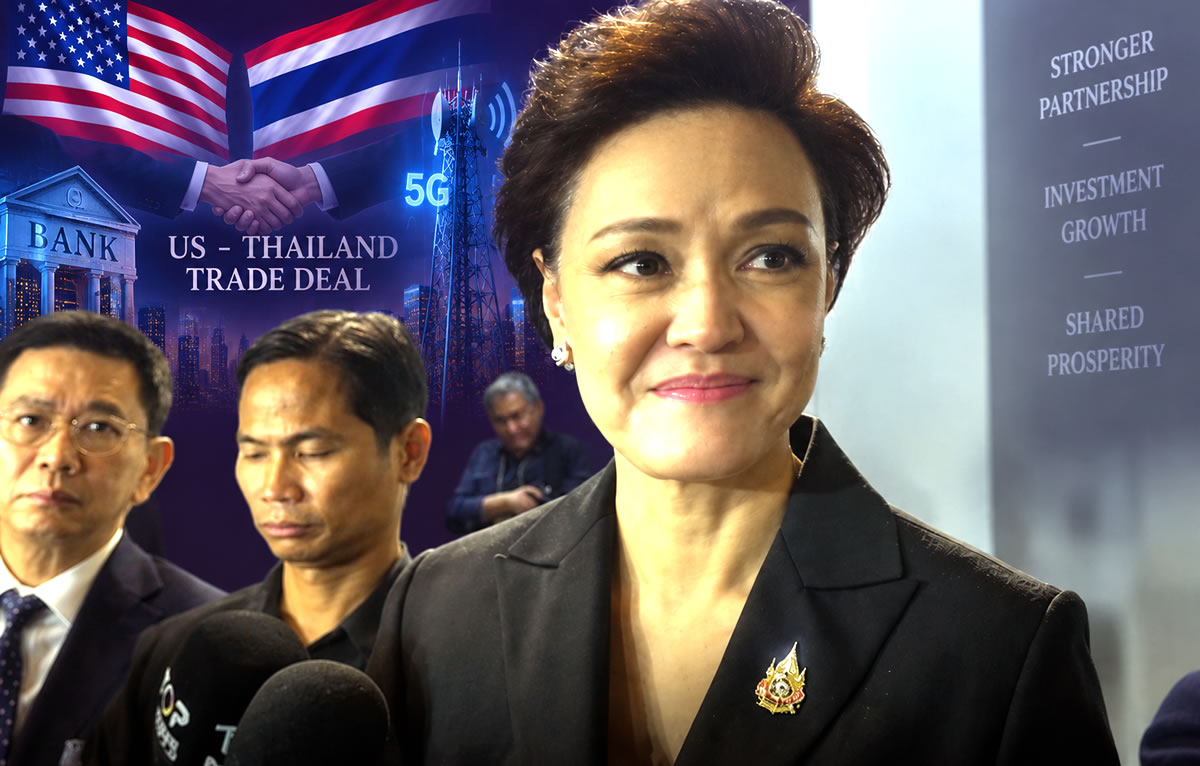
Thailand and the United States are closing in on a sweeping trade agreement after months of intensive negotiations. Minister of Commerce Suphajee Suthumpun says every major issue has now been settled. Only legal wording and technical details remain. Notably, she expects that work to be completed within about one week.
The next move could take the negotiations directly to the two national leaders. Prime Minister Anutin Charnvirakul is expected to speak with US President Donald Trump. That conversation would formally close the talks, according to Suphajee. However, the emerging agreement reaches far beyond tariffs on Thai goods.
At its core, the deal covers market access, investment, agriculture, energy and industrial trade. More significantly, it reaches into digital operations, electronic payments and telecommunications ownership. Washington has sought easier operating conditions for American companies in all three areas. Thailand, meanwhile, has defended restrictions covering sensitive sectors and national security.
Suphajee says all key trade issues are settled as final drafting moves towards an Anutin-Trump call
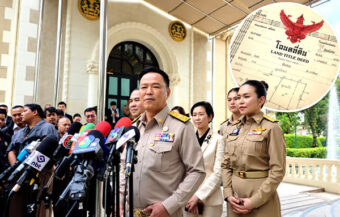
Suphajee gave her latest assessment at Parliament at 9.55 am on Tuesday, September 8. She said negotiations had progressed extremely well. In effect, the political bargaining has ended and technical drafting has begun.
“The negotiations have gone very well. We have settled all the key issues,” Suphajee said.
According to the minister, officials are now working on wording, language and technical details. She expects that process to finish within about one week. At that point, the completed material would move through the American trade process. Ultimately, it would be presented to President Trump.
Suphajee also thanked government agencies and the private sector for working together as Team Thailand. She credited Anutin with setting policy and directing the negotiating approach. In turn, she said that coordination helped bring the negotiations towards completion.
“I believe there should be no problems, and all essential issues have been resolved,” she said.
When reporters pressed her on timing, Suphajee said little substantive remained to discuss. Instead, officials were dealing with final details. She also expected the overall outcome to become clear during September. On exports, she said trade should continue normally after the agreement is finalised.
Thailand seeks stable US market access after tariffs shift from 36% threat to a 12.5% current rate
The target tariff figures should also follow agreements negotiated by Thailand’s previous government. That point matters because the talks began under a very different tariff threat. In April 2025, Thailand initially faced a proposed 36% reciprocal US tariff.
Negotiations under the former Thai government subsequently brought that threatened rate down to 19%. Yet the legal environment later changed sharply. In February 2026, the US Supreme Court struck down the legal basis for Trump’s IEEPA tariffs.
In response, Washington increasingly shifted towards other American trade-law mechanisms. Section 301 of the Trade Act of 1974 became particularly important. Thailand therefore had to protect its market access under a changed US legal structure.
At present, the tariff affecting Thailand stands at 12.5%. That consists of the 10% general rate and a 2.5 percentage-point Section 301 increase. The additional levy took effect on July 24.
At the same time, more than 2,120 Thai product lines have secured exemptions. Those lines represent roughly 60% of Thai exports to America. Consequently, Bangkok has effectively been fighting on two connected trade fronts.
One concerns completion of the Agreement on Reciprocal Trade. The other concerns Thailand’s exposure to existing or future Section 301 measures. Behind both stands an enormous Thai merchandise surplus with America.
The United States is now Thailand’s largest export market. In 2025, Thai exports there reached about ฿2.37 trillion, or US$74 billion. By comparison, American imports into Thailand totalled about ฿700 billion, or US$22 billion.
Thailand offers major US purchases as its massive American trade surplus drives the negotiations
The result was a Thai merchandise surplus of approximately ฿1.68 trillion. That was equivalent to roughly US$52 billion. Overall bilateral trade exceeded ฿3 trillion.
For Washington, that imbalance sits directly inside Trump’s wider trade policy. The US has pushed surplus countries to buy substantially more American goods. Thailand has therefore offered major purchases while seeking secure access for its own exporters.
As part of this, Bangkok discussed about US$2.6 billion annually in American agricultural purchases. These included feed corn, soybean meal and distillers’ grains. Separately, Thailand discussed approximately US$5.4 billion annually in American energy purchases.
That energy package includes liquefied natural gas, crude oil and ethane. On another front, Thailand discussed purchasing 80 American aircraft worth about US$18.8 billion. Together, those commitments would direct substantial additional spending towards American suppliers.
Yet the agreement is not simply an exchange of purchases for lower tariffs. Its provisions penetrate deeply into Thailand’s domestic commercial rules. Digital trade is one of the clearest examples.
The original framework required Thailand to avoid discriminatory digital-services taxes. It also called for trusted cross-border data transfers. In parallel, Bangkok agreed to support continued tariff-free treatment of electronic transmissions.
US trade framework reaches into electronic payments, data transfers and wider digital operating rules
That commitment concerns the World Trade Organisation moratorium on customs duties covering electronic transmissions. For American technology companies, the provision removes one possible barrier to digital trade.
The agreement also reaches directly into financial payments. The original framework required Thailand to remove domestic processing requirements for certain electronic-payment transactions. That clause concerns where some transactions and related information may be processed.
For US financial-services and payment companies, the issue is commercially important. Domestic processing rules can require transactions to remain within national systems. Removing them can give foreign operators greater flexibility across international networks.
More broadly, Washington has sought fewer restrictions on American digital operations inside Thailand. These involve data movement, payments, taxation and telecommunications access. Taken together, they represent a significant non-tariff component of the negotiations.
Cross-border data transfers are particularly important to technology and financial companies. The framework calls for trusted data to move across borders. As a result, some American companies could face fewer localisation requirements.
Digital tax and telecom ownership emerge as key tests as Thailand holds firm on national security
Digital taxation forms another strand. Thailand agreed to avoid discriminatory digital-services taxes. Meanwhile, the electronic-transmission commitment addresses customs treatment of digital trade. Neither measure concerns conventional manufactured goods.
Instead, they govern how companies operate across digital systems. That makes the final legal wording especially important. Small differences in drafting could determine the scope of those commitments.
Telecommunications, however, has become one of the most sensitive areas. The original October 2025 framework envisaged easier American investment access to Thai telecommunications. That raised an immediate question over foreign control of strategic Thai businesses.
Before the latest Washington negotiations, Suphajee identified three Thai red lines. The first concerned American pork containing beta-agonist growth promoters. The second concerned national security.
The third concerned 100% American ownership in sensitive Thai industries. Specifically, Suphajee identified telecommunications. That placed US telecom ownership squarely inside the final bargaining.
Washington had sought wider access for American investors. Thailand, by contrast, resisted unrestricted US ownership in sensitive industries. Even so, Suphajee now says all substantive disagreements have been settled.
Final telecom compromise will show how far Thailand opens US ownership while protecting security
That means the two sides appear to have reached a compromise on telecommunications. The supplied material does not disclose its precise terms. Accordingly, the final agreement will show how far Thailand moved.
One key question concerns foreign ownership ceilings. Another concerns the ability of American companies to enter or expand within Thai telecommunications. A third concerns the national security restrictions Thailand retained.
Operational freedom is also separate from legal ownership. An American company might gain investment access yet still face rules governing data or payments. Conversely, liberal operating rules could matter even without full foreign ownership.
For that reason, the telecom and digital provisions should be read together. The agreement addresses both corporate participation and daily commercial operations. It also reaches into the financial infrastructure supporting those activities.
Agriculture forms another major part of the trade package. Under the 2025 framework, Thailand agreed in principle to eliminate tariffs on about 99% of American goods. Those products included a wide range of industrial and agricultural imports.
US seeks wider farm access as Thailand balances pork restrictions with major American farm purchases
Washington also sought easier access for American meat and poultry. In addition, it pressed Thailand to recognise US regulatory certificates. The United States also sought science-based treatment of agricultural imports.
American horticultural products were included as well. Thailand additionally agreed to issue permits for US ethanol imports. Nevertheless, pork remained one of Bangkok’s declared red lines.
Thailand opposed overriding its sanitary standards for American pork containing beta-agonist growth promoters. Suphajee now says all essential matters have been resolved. The supplied information does not state the final pork arrangement.
Agricultural purchases also help address the trade imbalance. The same applies to energy and aircraft commitments. Collectively, these purchases would increase US sales into Thailand while Thai exporters retain American access.
Elsewhere, Washington has pursued the removal of non-tariff barriers affecting manufactured products. Automobiles provide one important example. Thailand agreed to accept American vehicles meeting US federal safety and emissions standards.
US standards gain wider access as Section 301 pressure turns towards Thailand’s industrial capacity
That could remove the need for duplicate Thai certification in covered cases. Medical products are another example. Thailand agreed to recognise certain US Food and Drug Administration certificates.
Previous US marketing authorisations could also satisfy Thai requirements for some pharmaceuticals and medical devices. Thus, market access extends beyond reducing customs duties.
Section 301 has added another layer of pressure. Washington launched an investigation into what it calls structural excess production capacity. The inquiry includes several Thai industrial sectors.
Among them are automobiles, auto parts, machinery, equipment, rubber products and pharmaceuticals. Thailand disputes the American assessment. The Commerce Ministry says capacity utilisation in questioned industries stands between about 75% and 95%.
Bangkok argues those levels contradict claims of large artificially supported excess capacity. Against that backdrop, Suphajee travelled to Washington around September 1. She met US Trade Representative Jamieson Greer.
Greer offers Thailand a fair tariff approach as forced labour concerns ease under new commitments
She also met Deputy US Trade Representative Rick Switzer. During those talks, Greer reportedly gave Thailand an important assurance. Any tariff arising from the excess-capacity investigation would be “fair and competitive” for Thailand.
That assurance reduced one major area of uncertainty. Soon afterwards, Suphajee’s public language became increasingly confident. By September 4, she said substantive negotiating issues had been resolved.
Forced labour created a separate Section 301 threat. Washington examined whether trading partners adequately block forced-labour goods from markets and supply chains. Thailand says its commitments have largely resolved that issue.
Consequently, more than 2,000 Thai products have secured tariff exemptions. Those exemptions represent approximately 60% of Thai exports to America. Thailand also accepted stronger enforcement commitments covering vulnerable sectors.
Those commitments concern both forced labour and child labour. They therefore form another non-tariff obligation inside the wider trade relationship.
China transshipment fears put Thai origin rules, local content and Asian supply chains under scrutiny
China remains a further concern behind the negotiations. Washington wants stronger safeguards against Chinese products entering America disguised as Thai goods. Transshipment has therefore become an important enforcement issue.
Under the earlier tariff structure, goods judged illegally transshipped could face a 40% US tariff. That compared with the 19% negotiated rate for Thai goods. Thailand responded by strengthening certificate-of-origin procedures.
It also established a special task force. In particular, industries using large quantities of Chinese components face greater exposure. Electronics and solar equipment are two examples.
The White House estimates third-country tariff evasion costs America US$19 billion to US$26 billion annually. Hence, Washington has focused heavily on Asian supply chains.
Rules of origin will therefore remain central for Thai manufacturers. Local-content verification will also matter. Anti-circumvention enforcement creates another layer of scrutiny.
Factories using Chinese inputs must prove exported products genuinely qualify as Thai. That requirement could be especially important for electronics and other integrated supply chains.
Trade pact extends into labour, environment and intellectual property as final drafting accelerates
The trade agreement also includes intellectual-property commitments. Thailand agreed to address counterfeit trademarks and copyright piracy. Patent backlogs are included as well.
Problematic copyright-collection organisations also fall within the package. Meanwhile, labour commitments cover freedom of association and collective bargaining. They also include stronger enforcement against forced labour and child labour.
Environmental provisions extend the agreement further. They cover illegal logging and fisheries subsidies. Additionally, they address illegal fishing and wildlife trafficking.
The emerging pact therefore reaches well beyond a conventional tariff settlement. It covers customs duties, regulatory barriers, investment access and industrial rules. It also addresses digital commerce, payment processing and telecommunications participation.
The chronology of the final negotiations has been rapid. Suphajee met senior US trade officials around September 1. By September 4, she announced that the substantive issues had been settled.
Then, on September 8, she went further. She said all key matters were resolved and only wording remained. That places the talks effectively at the legal-drafting stage.
Final US-Thai deal awaits technical drafting before Anutin and Trump move to close the negotiations
Suphajee also indicated that earlier tariff targets remain intact. She said exports should continue normally after completion. Furthermore, she linked the target tariff figures to agreements reached by the previous Thai government.
Formal completion, however, still requires several steps. Technical teams must finish the text. The completed package must then move through the American trade machinery.
After that, the process reaches Trump. Suphajee says arrangements will then be made for Anutin to speak with him. That leader-level conversation is intended to conclude the negotiations.
The agreement is therefore close but not formally finished. Its substantive bargaining appears complete, according to Suphajee. Yet the most sensitive details remain inside an unpublished text.
The electronic-payment provisions will be closely watched. So will language covering domestic processing requirements. Cross-border data provisions will determine conditions for American digital companies.
Telecom ownership, digital payments and data rules remain central as final US deal terms stay unseen
Telecommunications could draw even greater attention. The original framework sought wider American access. Thailand subsequently ruled out 100% US ownership in sensitive telecommunications businesses.
Suphajee now says that issue has been resolved. The final text should therefore reveal the ownership compromise. It should also show which national security safeguards survived.
Beyond ownership, the operating rules could prove equally significant. Washington has sought fewer restrictions on American digital and financial companies. Payments and data movement sit directly within that objective.
Meanwhile, Thai exporters will focus on the final tariff treatment. Manufacturers will scrutinise Section 301 exposure and rules of origin. Businesses reliant on Chinese inputs will study anti-transshipment requirements.
Thai agricultural interests will examine American market access. Energy buyers will face the proposed expansion of US purchases. Aircraft procurement adds another US$18.8 billion dimension.
Still, the deepest structural provisions may concern services rather than physical goods. They address how American firms invest, move data and process certain transactions. They also define access to Thailand’s telecommunications industry.
Bangkok and Washington balance US market access against Thai security limits in the final trade pact
For Bangkok, those provisions sit beside national security and ownership restrictions. For Washington, they form part of broader market access for American companies. The final legal language must reconcile both positions.
Commerce Minister to travel stateside in a make or break mission on the long awaited US Thai trade deal
Game changer US Thai trade deal approved at special cabinet meeting as 19% tariff rate warmly welcomed
Suphajee says that bargaining has now been completed. She expects the remaining drafting work within about one week. After that comes the Anutin-Trump endgame.
The talks began with a threatened 36% US tariff in April 2025. They are now ending with a much broader commercial settlement.
The final package covers tariffs, purchases, agriculture, manufacturing and regulation. More importantly, it extends into digital operations, payment systems and telecommunications investment.
Its unpublished wording will determine exactly how far those changes go. Suphajee’s position, however, is clear. The substantive deal has already been struck.
Join the Thai News forum, follow Thai Examiner on Facebook here
Follow Thai Examiner on Google here
Receive all our stories as they come out on Telegram here
Follow Thai Examiner here
Further reading:
Commerce Minister Suphajee talks about gold in an economy and world driven by US-China trade rivalry
Rate cut anticipated as outgoing Bank of Thailand governor attends last Monetary Policy Committee
Last minute tweaks in Bangkok as deal is finalised with U.S. However, Thailand may not match Vietnam