US drone factory reports collide with Bangkok’s denial as Thailand studies American UAV technology after a defence mission to the US. LUCAS, co-production and technology transfers are under review, while Anutin keeps trade and security apart.
Prime Minister Anutin Charnvirakul has firmly denied reports of a planned US drone production base in Thailand as sensitive tariff talks continue with Washington. Yet the Defence Ministry confirms American unmanned technology is under detailed study after a Thai military delegation visited the United States. Officials examined low-cost systems including LUCAS, technology transfers, co-production and possible domestic manufacturing. No agreement or factory has been approved. Meanwhile, Mr Anutin insists trade and security remain strictly separate following talks with US defence chief Elbridge Colby. Cobra Gold will proceed normally, while Commerce Minister Suphajee Suthumpun leads the separate tariff negotiations.
Prime Minister Anutin Charnvirakul has denied reports that the United States plans to establish a drone production base in Thailand. He said he had received no report confirming such a project. He also rejected claims that Washington was using security cooperation as leverage in tariff negotiations.
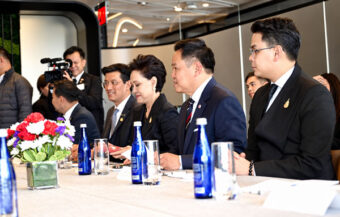
Mr Anutin, who also serves as Interior Minister, addressed the reports after high-level defence talks on August 13. US Under Secretary of Defence for Policy Elbridge Colby met the prime minister that day. Notably, Mr Anutin said a US drone production facility was not discussed during their meeting.
In response, the prime minister also rejected suggestions that military issues could influence ongoing trade negotiations. He insisted that security cooperation and trade were being handled through separate government channels. “Trade and tariffs are matters of trade, while security cooperation is a military matter,” Mr Anutin said. “The government will not allow the two to become involved with each other.”
Anutin says US defence talks excluded trade issues as Cobra Gold exercise remains firmly on schedule
Mr Anutin described his meeting with Mr Colby as having gone “very well”. Crucially, he said the senior American defence official raised no trade issues during their discussions. The prime minister said that separation reflected Washington’s established approach towards dealings with Thailand.
“The US has always been like this,” Mr Anutin said. “The Under Secretary of Defence did not have any trade-related issues to discuss.”
On another front, reporters questioned Mr Anutin about the future of the Cobra Gold joint military exercise. He confirmed that the longstanding exercise would proceed according to its normal schedule. He dismissed suggestions that recent reports could disrupt military cooperation between Thailand and Washington.
“It is normal. We have been doing this for decades,” Mr Anutin said. “I don’t know who started this issue because it does not exist.”
In parallel, Thailand remains engaged in negotiations with Washington over US trade tariffs. Deputy Prime Minister and Commerce Minister Suphajee Suthumpun is leading that government track. Mr Anutin said she had provided him with an update on the negotiations.
Defence Ministry says no US drone factory approved as tariff negotiations remain on separate track
Earlier, the government held a meeting on Monday to review the progress of those discussions. Mr Anutin said negotiations remained within the timeframe established by Thailand’s negotiating team. He gave no further details about the substance of the talks.
Separately, the Ministry of Defence has provided more detail about Thailand’s examination of US unmanned-system technology. The ministry confirmed that possible industrial cooperation is being studied. However, it stressed that no American drone manufacturing plant has been approved.
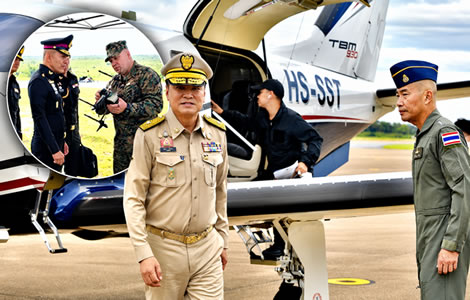
RAdm Surasant Kongsiri, spokesperson for the Ministry of Defence, clarified the position at the ministry on August 13. He said discussions remained firmly at the study stage. No agreement or binding commitment has been reached with the United States.
More significantly, Thailand has not agreed to manufacture any particular American unmanned system. Nor has approval been granted for a US drone manufacturing plant. Instead, defence officials are conducting detailed technical and economic assessments.
As part of this, officials are examining the feasibility of possible production arrangements. They are also conducting value-for-money assessments. In addition, the ministry is considering possible technology-transfer frameworks offering the greatest benefit to Thailand.
US visit examined low-cost drone technology but produced no manufacturing commitment
The examination follows a visit to the United States by Thailand’s Permanent Secretary for Defence. During the visit, Thai officials obtained information about American unmanned-system technology. They also viewed technology being considered for possible future development.
In particular, the visit provided information about low-cost unmanned systems such as LUCAS. Thai officials also assessed the country’s capacity to develop and support such technology. Yet the visit resulted in no production agreement or commitment.
RAdm Surasant stressed that Thailand remains under no requirement to manufacture any specific unmanned system. Equally, examining American technology does not amount to approving a US production operation. The ministry said every proposal remains subject to detailed assessment.
At the same time, the studies fit within Thailand’s existing policy of strengthening its domestic defence industry. Unmanned systems are among the technologies identified for potential development. Drones and other UAV technologies therefore form part of the wider industrial examination.
Thailand studies technology transfers and co-production to build long-term defence self-reliance
According to the ministry, defence industrial development is a high government priority. The stated objective is achieving “long-term self-reliance”. Consequently, officials are examining foreign technology and production methods that could strengthen domestic capabilities.
Against that backdrop, Thailand is considering several possible models for future defence cooperation. These include offset policies and technology transfers. Co-production arrangements are also being examined as another possible route.
Beyond that, officials are studying the possibility of establishing domestic production under the Defence Industrial Base model. Joint investment is another option under consideration. However, none of those models has been approved for the proposed US drone project.
Instead, the ministry is assessing which arrangements could provide the greatest benefit to Thailand. Any future model could involve technology, production or investment. Its stated purpose would be strengthening the armed forces and Thailand’s industrial sector.
For its part, the Defence Ministry has drawn a firm distinction between studying technology and approving a foreign manufacturing base. Thailand is gathering information about foreign unmanned systems and potential production arrangements. No commitment to an American factory has followed.
Anutin keeps defence and tariff talks separate as Cobra Gold military cooperation continues normally
Likewise, Mr Anutin has drawn a separate line between defence cooperation and negotiations over American tariffs. He said Mr Colby raised no trade issues during their August 13 meeting. Security matters therefore remained within the defence relationship.
Meanwhile, Cobra Gold will continue as scheduled. Thailand and the United States have conducted the joint military exercise for decades. Mr Anutin said there was no issue threatening its continuation.
By contrast, tariff negotiations are proceeding through the government’s economic team. Deputy Prime Minister and Commerce Minister Suphajee has briefed Mr Anutin on progress. The government has also formally reviewed the negotiations.
For now, Mr Anutin said those talks remain within the timeframe established by Thailand’s negotiating team. The negotiations therefore continue separately from military discussions with Washington.
Drone plans remain under assessment with no US factory approved as Bangkok maintains three tracks
Within the defence track, officials continue examining Thailand’s future requirements for unmanned systems. Their work covers feasibility, costs, technology transfer and potential co-production. Officials are also studying investment structures and domestic production capacity.
Even so, the ministry says the process has not reached the approval stage. No agreement has been signed with Washington. No particular unmanned system has been selected for production in Thailand.
Visit by US Under Secretary of State emphasises American Thai military alliance amid tense trade talks
Bangkok firm rules out using its US military alliance as leverage in tense trade talks with Washington
Furthermore, no US drone manufacturing plant has received government approval. The possibility remains part of a wider examination of defence technology and industrial development.
Ultimately, the government is pursuing three distinct tracks with Washington. Existing military cooperation continues, including Cobra Gold. Trade negotiations are progressing separately, while potential unmanned-system cooperation remains under detailed study.
Join the Thai News forum, follow Thai Examiner on Facebook here
Receive all our stories as they come out on Telegram here
Follow Thai Examiner here
Further reading:
Business lobby urges Anutin to improve climate for inward investment by axing old laws and red tape
Tax and welfare revolution as Thailand moves ahead with Negative Income Tax that expands reporting
Thumbs up from economic gurus for 2027 Negative Income Tax plan. It’s a game-changer for progress
Expert warns foreign tourism has become Thailand’s curse, fueling inertia and a widespread malaise