Bangkok is racing to seal a landmark US trade deal after Commerce Minister Suphajee met top White House and trade officials, with Section 301 tariff probes, a US$51.36bn surplus and tougher negotiations dominating the agenda.
Thailand has stepped up its push for a landmark reciprocal trade agreement with the United States after Deputy Prime Minister and Commerce Minister Suphajee Suthumpun held high-level talks with three of Washington’s most senior officials, pressing for faster negotiations as the two countries seek to bridge a US$51.36 billion trade imbalance, navigate sensitive Section 301 tariff investigations and strengthen one of Southeast Asia’s most important strategic economic partnerships, with Bangkok insisting it remains fully committed to securing a competitive deal while Washington weighs Thailand’s latest proposals.
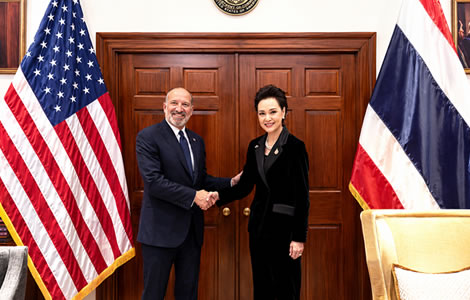
Deputy Prime Minister and Commerce Minister Suphajee Suthumpun has reaffirmed Thailand’s determination to conclude a reciprocal trade agreement with the United States following two days of high-level talks in Washington.
She urged faster progress on negotiations and said Bangkok remains committed to narrowing the trade imbalance while protecting Thailand’s interests. The discussions also reinforced broader economic and investment cooperation between the two countries.
Suphajee led the Thai delegation during meetings on July 15-16 with White House Chief of Staff Susie Wiles, US Secretary of Commerce Howard Luitnick and US Deputy Trade Representative Rick Switzer.
Thailand presses US for faster ART trade deal while reaffirming its role as a trusted strategic ally in Asia
The agenda focused on the proposed Thailand-US Agreement on Reciprocal Trade (ART), ongoing Section 301 investigations and wider commercial ties. As part of the visit, Thailand sought to advance negotiations as quickly as possible while maintaining momentum in bilateral relations.
According to Suphajee, the delegation’s primary objective was to accelerate the ART negotiations. It also aimed to follow up on the Section 301 investigations and strengthen economic cooperation.
She described the discussions as constructive and said both sides reviewed the remaining issues in detail. Notably, Thailand congratulated the United States on the 250th anniversary of its independence during the meetings. Thai officials also reaffirmed the country’s role as a trusted and reliable US ally in Southeast Asia.
Thailand updated the American delegation on the latest progress in the ART negotiations. Suphajee said Bangkok has responded positively to US requests and shown flexibility wherever possible.
However, every proposal remains subject to Thai law and government policy. She said officials have carefully considered each American request before submitting revised proposals. In turn, Thailand continues seeking solutions that deliver benefits for both countries rather than one-sided concessions.
Thailand says differing laws mean flexible talks focused on mutual benefit instead of fixed criteria
Suphajee said every country approaches trade negotiations from a different legal and policy position. Each government also operates within its own domestic framework.
Consequently, she said negotiations cannot be judged against identical benchmarks. Instead, the focus should remain on the overall outcome and whether both sides achieve their objectives through mutual benefit. Thailand, she added, remains committed to protecting its rights while continuing negotiations in good faith.
The US delegation welcomed Thailand’s intention to accelerate the negotiations. American officials also recognised Bangkok’s efforts to address the trade imbalance. Even so, they said additional time is required to study Thailand’s latest proposals.
Several outstanding issues still require further consideration before an agreement can be completed. In response, both sides agreed to continue discussions and work towards narrowing the remaining differences.
Commitments remain central as Thailand links investment and imports to reducing trade imbalance
Thailand continues to rely on commitments contained in the Joint Statement agreed in July 2025. That framework includes greater investment cooperation and increased imports of goods needed from the United States.
Both measures are intended to help reduce the bilateral trade deficit. Suphajee said those commitments remain central to Thailand’s negotiating strategy. At the same time, she reaffirmed Bangkok’s determination to secure a balanced outcome that protects national interests.
Separately, the discussions addressed two ongoing Section 301 investigations involving Thailand. One concerns structural overcapacity. The other relates to the implementation of measures prohibiting imports of goods produced using forced labour.
Suphajee said the United States continues using Section 301 investigations to maintain tariff measures affecting several countries. She said this approach follows a US Supreme Court ruling that tariffs imposed under the International Emergency Economic Powers Act, or IEEPA, violated legal principles.
US reviews Section 301 findings as tariff rates hinge on forced labour laws and future ART agreement
The United States is now reviewing the final findings of both investigations. Meanwhile, Washington has outlined an initial tariff structure linked to the cases. Countries without laws banning imports made with forced labour face an initial tariff of 12.5%.
That group currently includes 46 countries. By comparison, countries with such legislation or those that have concluded an ART agreement face an initial tariff of 10%. Fourteen countries currently fall within that category.
On another front, US officials continue examining the issue of structural overcapacity. Countries without an agreement could face comparatively higher tariff rates. The same applies to countries unable to comply with agreed commitments.
Suphajee acknowledged that several negotiating issues remain complex and may require more time. Nevertheless, she said Thailand remains fully committed to reaching a mutually beneficial conclusion. Every proposal, she added, will continue reflecting domestic law, international standards and the public interest.
The minister said Thailand’s objective is to secure an appropriate and competitive tariff rate. Bangkok also intends to protect its rights throughout the negotiations.
Thailand eyes competitive tariff outcome as US studies latest proposals before further trade negotiations
She said the US side acknowledged Thailand’s commitment and welcomed its determination to complete the agreement. American officials will now examine Thailand’s latest proposals point by point before the next round of discussions. Subsequently, both governments will continue working towards a speedy conclusion of the negotiations.
The Washington meetings also reflected Thailand’s broader strategy to deepen relations with the United States. Trade, investment and economic cooperation formed the core of those discussions. The proposed ART agreement remains the centrepiece of that effort. Moreover, Bangkok views stronger commercial ties as an important element of its long-term relationship with one of its largest export markets.
Setback for government as 40 baht meal deal pulled from cabinet amid a barrage of hostile feedback to the scheme
Commerce Minister Suphajee talks about gold in an economy and world driven by US-China trade rivalry
By 2025, the United States had become Thailand’s second-largest trading partner. Total bilateral trade exceeded US$93.65 billion. Thai exports reached US$72.51 billion, while imports totalled US$21.14 billion.
As a result, Thailand recorded a trade surplus of US$51.36 billion. That imbalance remains a central issue in the negotiations. Finally, Suphajee said Thailand would continue making every effort to conclude the ART agreement while Washington reviews the latest Thai proposals and prepares for further negotiations.
Join the Thai News forum, follow Thai Examiner on Facebook here
Receive all our stories as they come out on Telegram here
Follow Thai Examiner here
Further reading:
Business lobby urges Anutin to improve climate for inward investment by axing old laws and red tape
Tax and welfare revolution as Thailand moves ahead with Negative Income Tax that expands reporting
Thumbs up from economic gurus for 2027 Negative Income Tax plan. It’s a game-changer for progress
Expert warns foreign tourism has become Thailand’s curse, fueling inertia and a widespread malaise