Anutin’s flagship ฿40 Rice and Curry Project has been pulled before reaching Cabinet after a public backlash. Commerce Minister Suphajee Suthumpun admitted defeat as vendors, economists, opposition MPs and consumers united against the scheme.
The government’s flagship ฿40 Rice and Curry Project, launched in mid-June as a centrepiece of Prime Minister Anutin Charnvirakul’s cost-of-living agenda, has suffered a major political setback after being withdrawn before reaching the Cabinet following weeks of mounting criticism. Commerce Minister Suphajee Suthumpun admitted the retreat came after sustained opposition from restaurant operators, economists, vendors, opposition politicians and consumers, raising questions over the government’s economic strategy, the judgement behind one of its key policy initiatives and the political standing of its high-profile external ministers.
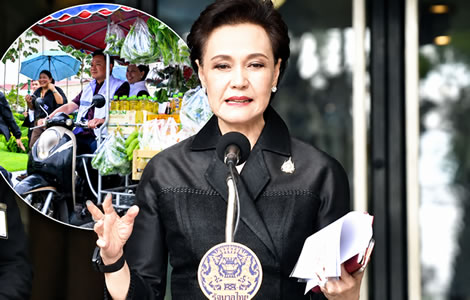
The government’s proposed ฿40 Rice and Curry Project has been shelved after days of sustained criticism from restaurant operators, economists, opposition politicians and consumers.
Deputy Prime Minister and Commerce Minister Suphajee Suthumpun confirmed on Tuesday that the proposal would not be presented to the Cabinet. The decision halted one of Prime Minister Anutin Charnvirakul’s flagship cost-of-living initiatives before ministers could formally consider it.
Ms Suphajee announced the reversal on her personal Facebook page shortly after Tuesday’s Cabinet meeting. She acknowledged that opinion had become sharply divided. “When there are diverse opinions both in favour and against, we are happy to listen and ready to review, so that government measures do not affect market mechanisms,” she wrote. Notably, she recognised that many people questioned whether the project was needed. Some argued affordable meals below ฿40 were already widely available. Others maintained the government should address problems beyond the Commerce Ministry’s responsibilities.
Government withdraws flagship affordable meal plan after public opposition before Cabinet meeting
In response, the ministry decided to withdraw the proposal from the Cabinet agenda. “As a result, we have suspended our plan to present this matter to the Cabinet meeting,” Ms Suphajee said. Even so, she insisted the government remained committed to reducing household living costs.
“Even though we have suspended the submission to the Cabinet, we are still open to all opinions, because this decision was made after we listened to everyone’s voices,” she wrote. At the same time, she said Thailand’s economic challenges required cooperation across every sector. “It must be emphasised that overcoming this double crisis requires cooperation from all sides. We cannot push through crucial measures amidst such diametrically opposed opinions.”
The proposal had been unveiled only days earlier as part of the Commerce Ministry’s wider affordability strategy. Specifically, it targeted low-income earners and salaried workers facing rising daily expenses.
The ministry argued prepared food prices remained elevated despite lower global energy costs. Officials blamed higher ingredient prices, wages, rents and cooking gas. As a result, they proposed subsidies rather than compulsory price controls.
Ministry planned subsidies and cheap supplies to support voluntary ฿40 meal scheme for restaurants
The scheme was built around the ministry’s existing Thai Helps Thai Plus programme. Restaurants nationwide would have been invited to participate voluntarily. Participating outlets would sell selected rice and curry dishes for about ฿40 per plate.
In addition, ready-to-eat meals would also qualify. Businesses joining the scheme would receive government support. The ministry also planned to help restaurants obtain cheaper ingredients. Alongside that, officials intended to link participating businesses directly with farmers. The objective was to reduce supply costs while maintaining food quality.
Officials argued the programme would reduce consumer prices without forcing restaurants to absorb losses. Initially, the Cabinet was expected to approve the initiative this month. The programme could then have begun as early as August.
Tens of thousands of restaurants were expected to participate nationwide. Officials believed the voluntary model would ease pressure on household budgets while protecting business viability.
Restaurant owners and economists challenged costs, subsidies and market impact as criticism intensified
However, criticism emerged almost immediately after details became public. Restaurant operators questioned whether a nationwide ฿40 selling price reflected commercial reality.
Costs differ significantly between provinces and business locations. Consequently, many vendors argued the proposal could not succeed across the country. Others questioned whether government subsidies would adequately offset shrinking profit margins. Several operators warned the scheme could become unsustainable once financial support ended.
Separately, economists challenged the proposal’s wider economic impact. Some warned subsidies could distort normal market competition. Others questioned whether government support should favour selected restaurants.
Critics also noted that many food stalls already sold meals below ฿40 without state assistance. For that reason, they argued the proposal offered consumers little that was genuinely new. Several analysts concluded the policy addressed symptoms rather than underlying economic pressures.
Vendors and opposition urge action on rising costs instead of subsidised meals as pressure mounts
Many vendors instead urged the government to tackle production costs directly. They called for stronger action on commodity prices instead of subsidising prepared meals.
In particular, they highlighted rising costs for raw ingredients, transport and cooking gas. Lower operating expenses, they argued, would naturally reduce menu prices. Under that approach, every restaurant could benefit rather than only participating outlets.
Meanwhile, opposition politicians intensified the pressure. People’s Party deputy leader and party-list MP Sirikanya Tansakul questioned the proposal’s effectiveness. She argued many Commerce Ministry programmes benefited only limited groups.
Moreover, she said such projects functioned more as public relations exercises than lasting economic solutions. Her criticism reinforced growing concern over the policy’s practical value.
Facing mounting opposition, Ms Suphajee later clarified that the ฿40 figure had been illustrative. It was never intended as a fixed nationwide price.
Public backlash forced review as minister defended proposal before withdrawing it from Cabinet
Nevertheless, public criticism continued to build. Debate widened across business groups, political circles and social media. Against that backdrop, ministry officials reviewed the proposal before Tuesday’s Cabinet meeting. The review ended with its complete withdrawal from the agenda.
The reversal represents an early political setback for Ms Suphajee. She is one of the government’s prominent outsider ministers. Earlier, she had faced speculation after reducing her public appearances.
She later rejected suggestions that she had disappeared from public life. Instead, she insisted she continued working every day. The meal proposal has nevertheless become her most controversial initiative since taking office.
The episode has also drawn attention to the government’s wider economic agenda. Food prices remain politically sensitive across Thailand. Accordingly, proposals affecting everyday living costs receive immediate public scrutiny. The Commerce Ministry says it will now reassess both the pricing model and the support mechanism. Looking ahead, officials will gather additional public feedback before considering any revised proposal. No timetable has been announced for its return.
Political setback raises fresh scrutiny of outside ministers as government reviews controversial plan
The controversy has also renewed scrutiny of the government’s team of outsider ministers. Ms Suphajee has faced heavier criticism than Deputy Prime Minister and Finance Minister Ekniti Nitithanpraphas and Deputy Prime Minister and Foreign Minister Sihasak Phuangketkaew.
Both have become central figures in handling difficult government issues. Beyond the immediate setback, attention is now turning to whether the episode will affect confidence in the three-woman team that helped Bhumjaithai secure its landslide victory in the February 8, 2026 general election.
Lower baht by 5-6% caused by US Iran War says Bank of Thailand. Officials monitor the unfolding crisis
Stark and disturbing data shows Thai households are losing out in an economy that is driving inequality
For now, one of the Anutin government’s most prominent cost-of-living initiatives has been stopped before reaching the Cabinet. Whether the proposal eventually returns in revised form remains uncertain. For the moment, sustained public opposition has halted the government’s first attempt to launch a nationwide ฿40 Rice and Curry Project before formal approval.
Join the Thai News forum, follow Thai Examiner on Facebook here
Receive all our stories as they come out on Telegram here
Follow Thai Examiner here
Further reading:
Business lobby urges Anutin to improve climate for inward investment by axing old laws and red tape
Tax and welfare revolution as Thailand moves ahead with Negative Income Tax that expands reporting
Thumbs up from economic gurus for 2027 Negative Income Tax plan. It’s a game-changer for progress
Expert warns foreign tourism has become Thailand’s curse, fueling inertia and a widespread malaise