Anutin rules out playing Thailand’s US military alliance as a card in tense trade negotiations. Bangkok wants a reciprocal deal quickly while expanding defence cooperation, tackling transnational crime and addressing Cambodia border tensions.
Prime Minister Anutin Charnvirakul has drawn a firm line between Thailand’s US military alliance and urgent trade negotiations with Washington. Bangkok wants a reciprocal trade deal quickly, but defence ties will not be used as leverage. At Government House, Mr Anutin and US Under Secretary of Defence for Policy Elbridge Colby also agreed to deepen military cooperation, modernise Thailand’s armed forces and expand defence industry links. The talks also covered transnational crime, FBI cooperation and Thailand-Cambodia border tensions, with Anutin thanking US President Donald Trump for supporting efforts to ease matters.
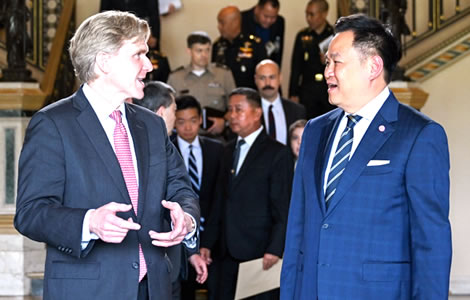
Prime Minister Anutin Charnvirakul has ruled out using Thailand’s US defence relationship as leverage in trade negotiations. He delivered the message directly to a senior Pentagon official at Government House on Thursday. Instead, Bangkok will keep security and trade negotiations firmly on separate tracks.
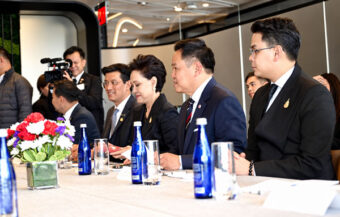
Mr Anutin, who also serves as Interior Minister, met US Under Secretary of Defence for Policy Elbridge Colby. The talks began at 3.30 pm on August 13 in the Thai Khu Fah Building. It was Mr Colby’s first official visit to Thailand. Prime Minister’s Office Spokesperson Ratchada Thanadirek later released details of the meeting.
At the outset, Mr Anutin welcomed Mr Colby and highlighted positive developments in Thai-US relations. He then set out Thailand’s position on the growing economic and security relationship. Defence cooperation remains a key pillar of ties between Bangkok and Washington. However, Thailand will not trade that cooperation for economic concessions.
Anutin rules out defence leverage as Bangkok pushes Washington to complete reciprocal trade agreement
“Trade and security discussions proceed on the basis of mutual interests and through the relevant mechanisms for each area,” Mr Anutin said.
Accordingly, Thailand will not make defence cooperation conditional on progress in its trade negotiations. Nor will military ties become a bargaining tool as Bangkok seeks a reciprocal trade deal. The government instead intends to negotiate each area through its established channels.
Notably, the declaration came as Thailand seeks to accelerate its economic negotiations with Washington. Mr Anutin reaffirmed Bangkok’s commitment to concluding an Agreement on Reciprocal Trade. He said Thailand wanted the negotiations completed as soon as possible. Yet security cooperation will remain outside that bargaining process.
The talks also focused heavily on the longstanding military relationship between both countries. Mr Anutin said Thailand and the United States had been allies for 193 years. Thailand has consistently valued its alliance and strategic partnership with Washington, he added.
Moreover, the Prime Minister said those ties had produced benefits beyond their bilateral relationship. He said the alliance had contributed significantly to regional peace, security and stability. Against that background, Bangkok wants the partnership strengthened rather than tied to commercial negotiations.
Thailand and US move to deepen military alliance as both sides confront changing security challenges
Looking ahead, Mr Anutin called for closer cooperation as the international environment continues changing. He pointed to emerging security threats and increasingly complex challenges. As a result, both governments need an alliance capable of adapting to those conditions.
Mr Colby responded by describing Thailand as an important US ally. He also stressed Washington’s strategic interest in the region. The United States prioritises cooperation with countries sharing similar principles and security goals, he said.
In response, the senior Pentagon official reaffirmed Washington’s commitment to strengthening security cooperation with Bangkok. He pointed to complex challenges and a rapidly changing security environment. Both governments subsequently agreed that their security relationship should deepen.
As part of this, the talks moved beyond broad statements about the alliance. Both sides discussed practical measures for strengthening their ability to handle modern security challenges. They also examined the continuing development and modernisation of Thailand’s armed forces.
In parallel, Bangkok and Washington agreed to expand cooperation between their defence industries. The discussions therefore covered military capabilities alongside the broader strategic relationship. Both governments identified stronger defence cooperation as necessary for dealing with new security challenges.
Anutin raises transnational crime and thanks Trump for supporting efforts to ease Cambodian tensions
Separately, Mr Anutin raised the growing problem of transnational crime. He referred specifically to his July meeting with Federal Bureau of Investigation Director Kash Patel. That meeting had focused on strengthening law enforcement cooperation between both countries.
During those discussions, Thailand and the United States examined measures against transnational criminal activity across the region. Both countries regard the issue as a priority. Thursday’s meeting therefore reinforced law enforcement cooperation alongside the established military relationship.
On another front, the Thailand-Cambodia border situation featured prominently in the talks. Mr Anutin thanked US President Donald Trump for supporting efforts to ease tensions. He described the American President’s role as constructive.
At the same time, Mr Anutin reaffirmed Thailand’s commitment to international law. Bangkok also remains committed to good-neighbourly relations with Cambodia. Furthermore, Thailand will continue seeking a peaceful resolution through bilateral mechanisms.
Specifically, the Prime Minister pointed to the implementation of the Kuala Lumpur Accords. Thailand remains committed to those arrangements, he said. The government’s stated objective is lasting peace, security and stability along the border.
Bangkok keeps trade and defence on separate tracks as talks span security, crime and border tensions
Turning back to economics, Mr Anutin stressed the urgency of Thailand’s trade negotiations with Washington. He reaffirmed Bangkok’s determination to complete a reciprocal trade agreement as quickly as possible. Nevertheless, the defence relationship will not form part of those negotiations.
That position establishes a clear division between two major elements of Thai-US relations. Bangkok wants deeper defence cooperation while simultaneously pursuing an economic agreement. Yet the government will not exchange progress in one area for concessions in another.
Under that approach, trade discussions will focus on economic interests and the reciprocal agreement. Meanwhile, defence negotiations will cover military cooperation, modernisation and emerging security threats. Law enforcement channels will separately address transnational criminal networks.
The meeting consequently covered a broad range of issues without merging their negotiating mechanisms. Discussions included trade, military modernisation, defence industries, transnational crime and regional security. The increasingly tense Thailand-Cambodia border situation also formed part of the agenda.
Thailand and US plan deeper military ties while Anutin keeps defence outside reciprocal trade talks
Beyond trade, both governments signalled plans for deeper military cooperation. Thailand wants stronger capabilities for responding to modern security challenges. It also plans further development and modernisation of its armed forces.
Additionally, defence industry cooperation emerged as another area for expansion. Neither side provided details of specific projects during the meeting. However, both agreed on the broader objective of increasing cooperation in the sector.
For Washington, Mr Colby used the visit to reaffirm Thailand’s importance as an American ally. He also emphasised the strategic importance Washington places on the wider region. Cooperation with countries sharing common security goals remains part of that approach.
For Bangkok, the talks provided an opportunity to restate the value placed on the American relationship. Mr Anutin repeatedly pointed to the alliance’s long history. He also linked its future to changing regional and international security conditions.
Crucially, however, the Prime Minister separated that strategic relationship from current economic negotiations. Thailand wants a reciprocal trade agreement completed quickly. It also wants stronger defence cooperation. But neither objective will become leverage for securing the other.
Anutin reinforces separate trade and security tracks as Washington backs deeper defence cooperation
The position was delivered directly to Washington’s senior defence policy representative during his first official Thai visit. It also came during discussions about expanding military and defence industry cooperation. Mr Anutin nevertheless made the separation between trade and security explicit.
Beyond military affairs, transnational crime has become another area of bilateral cooperation. Mr Anutin’s July meeting with FBI Director Kash Patel placed the issue directly on the agenda. Both sides discussed stronger measures to prevent and combat cross-border criminal activity.
Subsequently, Mr Anutin raised that cooperation again during Thursday’s talks. The discussion placed organised transnational threats within the wider security relationship. However, those efforts will continue through law enforcement mechanisms rather than trade channels.
Regional tensions provided another immediate element to the talks. The Thailand-Cambodia border situation has drawn US involvement through President Trump’s efforts to support de-escalation. Mr Anutin used the meeting to formally thank him.
Even so, Bangkok maintained its stated reliance on bilateral mechanisms with Cambodia. Thailand will continue observing international law and good-neighbourly principles, Mr Anutin said. It will also continue implementing the Kuala Lumpur Accords.
Military modernisation advances as Bangkok seeks faster US trade talks without linking defence ties
From the military perspective, both sides agreed that their alliance must respond to a changing security environment. Modernising Thailand’s armed forces will form part of that effort. Expanded defence industry cooperation will provide another element.
At the same time, both governments want stronger capabilities against modern security threats. Mr Colby described those challenges as increasingly complex. He reaffirmed Washington’s commitment to working with Thailand in response.
Economically, Bangkok is seeking faster movement towards an Agreement on Reciprocal Trade. Mr Anutin made clear that Thailand wants the negotiations concluded quickly. Still, defence cooperation will remain outside the trade negotiating process.
The meeting therefore produced two parallel messages from Bangkok. Thailand intends to deepen its security relationship with the United States. Simultaneously, it wants to accelerate negotiations over reciprocal trade.
Importantly, Mr Anutin rejected linking the two objectives. Thailand will not offer defence cooperation as a condition for economic concessions. Trade and security will instead proceed according to their respective interests and mechanisms.
Defence, crime and Cambodia remain key US ties as Bangkok maintains strict separation on trade talks
Within the defence relationship, the two governments identified several areas for further work. These include military modernisation, modern security threats and defence industry cooperation. They also reaffirmed their broader strategic partnership.
Within law enforcement, transnational crime remains a shared priority. Mr Anutin linked Thursday’s discussions directly with his July meeting with FBI Director Kash Patel. That earlier meeting focused on stronger cooperation against regional criminal threats.
Within regional diplomacy, the Cambodian border remains an immediate concern. Mr Anutin credited President Trump with playing a constructive role in efforts to ease tensions. Thailand, however, continues to emphasise bilateral mechanisms and the Kuala Lumpur Accords.
Bangkok firm rules out using its US military alliance as leverage in tense trade talks with Washington
Thai US military alliance discussed in meeting of Defence Minister with US Defence Secretary Hegseth
Finally, Mr Anutin said Thailand was ready to continue its longstanding relationship with Washington. He called for the Thai-US alliance to be strengthened further. He also sought wider cooperation benefiting people in both countries.
The two governments additionally stressed peace, security and stability across the region. Their security partnership is set to deepen as new threats emerge. Thailand’s trade negotiations with Washington will also continue.
Yet Bangkok has now drawn a firm boundary between them. Thailand wants stronger defence ties and a reciprocal trade agreement. It will pursue both, but it will not use one to bargain for the other.
Join the Thai News forum, follow Thai Examiner on Facebook here
Receive all our stories as they come out on Telegram here
Follow Thai Examiner here
Further reading:
Business lobby urges Anutin to improve climate for inward investment by axing old laws and red tape
Tax and welfare revolution as Thailand moves ahead with Negative Income Tax that expands reporting
Thumbs up from economic gurus for 2027 Negative Income Tax plan. It’s a game-changer for progress
Expert warns foreign tourism has become Thailand’s curse, fueling inertia and a widespread malaise