Police raid Bangkok’s luxury estates, targeting 94 homes worth ฿6 billion. Eleven foreigners arrested as Chinese murder fugitives and suspected nominee firms emerge. Police insist the crackdown targets criminal conduct, not lawful foreign homeowners.
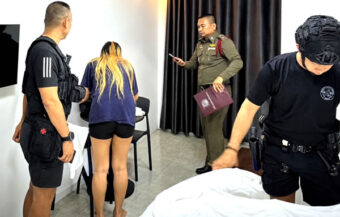
A massive police crackdown on foreign property ownership swept through Bangkok’s luxury housing estates on Saturday. National Police Commissioner Samran Nuanma led raids targeting 94 houses worth over ฿6 billion, with 11 foreigners arrested. Among the suspects were Chinese fugitives wanted for murder, international fraud and organised crime. Meanwhile, investigators uncovered 95 suspected nominee companies, eight intermediary firms and 156 Thai shareholders, some claiming identity theft. One Chinese murder suspect reportedly purchased a ฿43 million house for cash. Now, police and money laundering investigators are tracing property purchases, foreign criminal networks and possible asset seizures. The widening operation raises serious questions for foreign investors, although police insist legitimate ownership remains outside their targets.
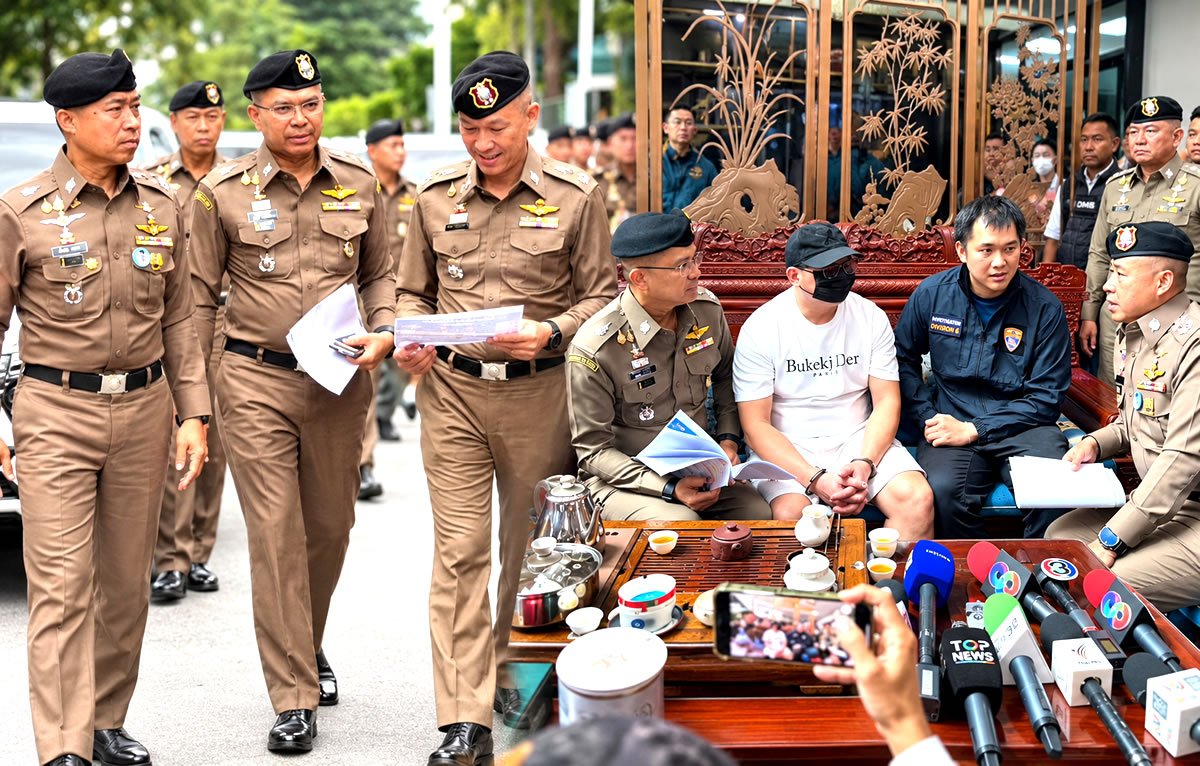
Thailand’s National Police Commissioner, Police General Samran Nuanma, led a massive crackdown on foreign property ownership in Bangkok on Saturday. More than 100 officers raided 17 locations across four luxury housing developments, targeting properties worth over ฿6 billion.
Eleven foreigners were arrested, including ten Chinese nationals and one American. Meanwhile, investigators identified 95 companies controlling 94 luxury houses through suspected Thai nominee shareholders.
The operation uncovered links to Chinese murder suspects, international fraud fugitives and online gambling networks in Burma. Police are also investigating eight intermediary firms and 156 Thai shareholders, some of whom claim their identities were stolen.
Police chief leads raids on four luxury Bangkok estates as 86 foreign arrest warrants target property
The operation on October 10 marked the eighth phase of a nationwide campaign against illegal foreign land ownership. This time, however, police concentrated on some of Bangkok’s most expensive residential estates.
The raids targeted luxury developments in Bang Na, Suan Luang, Rama IX, Srinakarin and Krungthep Kreetha. Individual houses were priced between ฿27 million and ฿98 million. In total, the properties covered more than 33 rai of valuable residential land.
Police General Samran personally supervised the operation alongside senior officers from the Immigration Bureau and Metropolitan Police Bureau. They included Police Lieutenant General Nopasil Phoolsawat, Commissioner of the Immigration Bureau, and Police Lieutenant General Siam Boonsom, Metropolitan Police Commissioner.
In addition, Police Major General Chotiwat Lueangwilai, Commander of the Metropolitan Police Investigation Division, participated. Police Major General Theerachai Chamnanmo, Deputy Commissioner of the Forensic Science Division, also joined the operation.
Investigators identified 96 suspects across 95 cases involving suspected illegal foreign ownership. Police had secured 86 arrest warrants for foreign nationals. However, only 11 suspects were arrested during Saturday’s raids. Ten were Chinese nationals, while the eleventh was an American citizen. Separately, officers identified 95 companies controlling 94 luxury houses and associated land worth approximately ฿6 billion.
Thai nominee companies face scrutiny as Chinese triple murder suspect emerges in Bangkok property probe
Police suspect foreign buyers used Thai-registered companies to acquire land they could not legally own directly. Under the arrangements being investigated, Thai shareholders held 51% of company shares. Foreign investors held the remaining 49%.
Crucially, investigators suspect many Thai shareholders had no genuine financial involvement in the businesses. Instead, some may have acted as nominees for foreign buyers. Others claim their identities were used without permission.
The investigation has also uncovered connections between luxury property ownership and internationally wanted Chinese criminals. Information supplied by the Chinese Embassy in Thailand helped police identify several fugitives connected with expensive Bangkok houses.
Among the principal suspects was a Chinese national identified as Li Chao. He reportedly held Chinese and Cambodian passports and was wanted in connection with a triple murder in China.
The killings occurred on January 30, 2018, at Chengcheng Square in Ulanhot, Inner Mongolia. According to investigators, three people were killed following a dispute connected with online gambling. Police said Li first entered Thailand in 2017, before becoming involved in the Chinese murder investigation.
Following the killings, he reportedly travelled to Cambodia and obtained a Cambodian passport. Investigators said he paid approximately $85,000, equivalent to around ฿2.8 million, for the document.
Chinese murder fugitive linked to ฿43 million cash house purchase and gambling operations across borders
Subsequently, Li returned to Thailand using his Cambodian passport. Police traced him to a company holding houses and land in a luxury residential development near Rama IX–Srinakarin. Properties in that development were valued between ฿50 million and ฿69 million.
Notably, investigators discovered that Li had reportedly purchased a Thai property for ฿43 million in cash during 2022. He told police that a property agent introduced him to a company which arranged the purchase.
Furthermore, Li claimed he did not know the Thai shareholders registered in the company’s ownership records. Investigators are examining the transaction, including the source of the cash and the company’s ownership structure.
On another front, police are tracing his movements through Cambodia, Sri Lanka and Thailand. According to Saturday’s briefing, Li admitted connections with online gambling operations in Myawaddy and Shwe Kokko in Burma.
Police are also examining suspected connections with scam operations operating across the region, including Cambodia. Sihanoukville is among the locations under consideration in the wider inquiry. Nevertheless, the precise nature of Li’s involvement in these operations remains under investigation. Officers are examining whether property purchases were connected with money generated through online gambling, fraud or other criminal activities.
Thai loan applicants say identities were used to register firms as police identify 156 suspected nominees
The case has also uncovered evidence suggesting Thai citizens’ identification documents were used to establish companies without their knowledge. One Thai individual registered as a shareholder in a company connected with Li told investigators they knew nothing about the business. The person said they applied for an online loan in 2022. As part of the application, they submitted copies of their identification card and other personal documents.
Subsequently, those documents appeared in company registration records. The individual reportedly discovered the situation after learning of an arrest warrant involving company shares valued at ฿400 million.
Police are investigating how the documents reached the company registration process. In response, officers are examining whether the individual knowingly participated or became a victim of identity misuse.
The discovery was not isolated. Investigators identified 156 Thai nationals suspected of acting as nominee shareholders in companies connected with the wider operation. However, several told police they had never knowingly invested in the businesses.
Some said they submitted identification cards and house registration documents while applying for online loans. Later, they discovered that companies had been established using their personal information.
Police examine stolen identity claims and trace Chinese fraud suspect to luxury homes in Krungthep Kreetha
Others told investigators they had never met the foreign shareholders involved. In some cases, the Thai individuals reportedly knew nothing about the companies until police began investigating.
Consequently, officers are examining company registration records alongside the original identification documents. They are also checking financial contributions, dividend payments and the actual control exercised by registered shareholders. Investigators are distinguishing between knowing participants and individuals whose identities may have been misused.
Meanwhile, police are pursuing legal and accounting firms suspected of arranging company registrations. Investigators believe some professional intermediaries supplied Thai shareholders to facilitate foreign property purchases.
The inquiry also involves suspected connections with Chinese fugitives wanted for fraud and organised criminal activity. Another suspect was identified as Gui, also named Chen in separate reports. He reportedly held passports from China, Turkey and Cambodia.
Chinese investigators wanted Gui over fraud and the unlawful recruitment or transportation of people across international borders. The case originated in Zhejiang province during April 2024. An arrest warrant was reportedly issued on April 23 that year. Police subsequently traced Gui to companies holding luxury residential property in Krungthep Kreetha. The properties were among the most expensive identified during Saturday’s raids.
Chinese fraud suspects and Interpol fugitives linked to multimillion-baht homes in two Bangkok estates
A third suspect was identified as Jian, also reported as Jiang. He reportedly held Chinese and St Kitts and Nevis passports. Chinese investigators wanted him in connection with an online fraud case in Henan province during December 2024.
A warrant was reportedly issued on December 4. Police said Gui and Jian were business partners in companies owning houses and land in Krungthep Kreetha. Properties in the development were valued between ฿77 million and ฿98 million. Both men were reportedly arrested under warrants during the investigation.
Separately, police identified two Chinese nationals connected with Interpol Red Notices. One was identified as Lin, also named Liu in another report. He was linked to a company holding residential property in the Rama IX–Srinakarin development.
An Interpol Red Notice was issued on March 3, 2024, following an investigation in Anhui province. The case involved suspected participation in an organised criminal group conducting online fraud.
Another Chinese national, identified as Bai, was linked to property in Krungthep Kreetha. He was the subject of an Interpol Red Notice dated August 19, 2022. The notice followed an investigation by police in Taiyuan, Shanxi province. Chinese investigators suspected his involvement in organised online fraud. Police are examining his company interests and the circumstances surrounding the acquisition of the residential property.
Chinese suspect wanted over customs offences linked to Bang Na property as police detail luxury estate
In addition, police identified another Chinese national, Huang, connected with property in the Bang Na–Outer Ring Road area. Huang was wanted under a warrant issued by the Phra Khanong Criminal Court on May 25, 2023.
The case involved several suspected offences, including importing goods without customs clearance. Other accusations concerned concealing or receiving goods connected with customs violations. Furthermore, Huang was wanted over suspected involvement in a criminal organisation and unlawful foreign land ownership.
Police identified corporate property interests connected with all six named suspects. However, available reports do not establish that every individual was among Saturday’s 11 arrests. Investigators are continuing to examine their companies, property purchases and financial arrangements.
The operation also involved cooperation with the Department of Business Development, the Department of Lands and the Revenue Department. Their inquiries identified four major luxury residential developments containing the 94 houses under investigation.
The first development was located in the Bang Na–Suan Luang area. Houses there were priced between ฿27 million and ฿55 million. Police identified 11 companies with combined registered capital of ฿50 million.
Together, these businesses controlled 11 houses on approximately 3 rai, 2 ngan and 20.7 square wah of land. The estimated property value reached ฿550 million. Meanwhile, arrest warrants covered 11 foreign suspects connected with the development, including ten Chinese nationals and one Cambodian.
Police identify dozens of firms holding expensive houses across three more luxury Bangkok developments
The second development was located in the Bang Na–Outer Ring Road area. Houses there were priced between ฿39.9 million and ฿52.5 million. Investigators identified 19 companies with combined registered capital of ฿145.5 million.
These companies controlled 19 houses covering approximately 6 rai and 59.3 square wah. The estimated property value reached ฿1.05 billion. Police obtained arrest warrants for 19 foreign suspects, including 17 Chinese nationals, one Cambodian and one Hong Kong national.
The third development was located in the Rama IX–Srinakarin area. Properties in this project were priced between ฿50 million and ฿69 million. Police identified 30 companies with combined registered capital of ฿774 million.
Together, these businesses controlled 29 houses on approximately 8 rai, 2 ngan and 18 square wah. The properties were valued at approximately ฿1.6 billion. Arrest warrants covered 30 foreign suspects, including 28 Chinese nationals and two Cambodians.
The fourth development was located in Krungthep Kreetha. Notably, this project contained some of the most expensive houses identified during Saturday’s operation. Individual properties were priced between ฿77 million and ฿98 million. Investigators identified 35 companies with combined registered capital of ฿1.6567 billion. These businesses controlled 35 houses on approximately 15 rai, 1 ngan and 72.9 square wah. The estimated property value reached ฿2.8 billion.
Police trace 95 companies and ฿6 billion in houses as money laundering office joins property investigation
Police reported warrants involving 36 foreign suspects connected with the Krungthep Kreetha development. They included 27 Chinese nationals, five Cambodians and one national each from Vanuatu, the United States and Burma.
Across all four developments, investigators identified 95 companies with combined registered capital exceeding ฿2.6 billion. The companies controlled 94 houses and associated land valued at approximately ฿6 billion.
However, the registered capital represents a different figure from the estimated value of the residential properties. Investigators are examining whether the companies conducted genuine commercial activities or existed principally to hold houses and land.
In parallel, officers are tracing the financial arrangements used to purchase individual properties. They are also reviewing whether company shareholders supplied their own capital or acted on behalf of foreign buyers.
The Anti-Money Laundering Office, or AMLO, joined the operation because of the substantial property values involved. Its involvement brings financial investigations alongside the police inquiry into company ownership.
Officers are examining property payments, shareholder investments and possible connections with proceeds from criminal activity. At the same time, investigators are assessing whether assets qualify for seizure or freezing under applicable legislation. The 94 houses were targeted for asset freezing or seizure during the operation.
Eight intermediary firms face scrutiny over luxury home purchases and suspected foreign nominee companies
However, the available reports do not establish that every property has been permanently confiscated. Police are continuing to examine the origins of funds used to acquire the houses. The investigation includes financial transactions involving foreign buyers, Thai shareholders and company registration agents. Officers are also checking whether the same intermediaries handled purchases for different foreign nationals.
The widening investigation has identified suspected networks of property agents, lawyers and intermediary businesses. Police identified eight law firms or intermediary firms suspected of arranging company registrations and property purchases.
These businesses operated in several Bangkok districts, including Ram Inthra and Saphan Sung. Other suspected intermediaries were connected with Bang Phli in neighbouring Samut Prakan province.
According to investigators, foreign buyers were introduced to legal firms after expressing interest in luxury residential property. The firms then allegedly arranged Thai companies through which the houses and land could be purchased. In some cases, the foreign buyers reportedly had no direct contact with the Thai shareholders.
Instead, professional intermediaries handled company registrations and property transactions. Police are examining whether these firms supplied Thai shareholders specifically to circumvent foreign land ownership restrictions.
Police examine 51% Thai shareholder structures as lawyers and accountants face widening investigation
The suspected arrangements commonly involved 51% Thai ownership and 49% foreign ownership. However, those percentages alone do not establish that a company complies with Thai law. Investigators are checking who supplied the capital and who exercised effective control over each business.
They are also examining whether foreign buyers paid intermediaries to arrange Thai shareholders. Separately, police are reviewing the roles of lawyers, accountants and company registration agents.
The inquiry includes possible offences involving participation in, or support for, unlawful corporate arrangements. Samran said officers were checking whether prominent lawyers or other well-known individuals were involved.
However, he did not identify any such figures as having committed offences. Police said proceedings had already begun against firms suspected of supporting the arrangements. Furthermore, investigators are using digital communications and company records to establish how the transactions were organised.
Financial evidence is also being examined to identify the actual sources of investment capital. Meanwhile, police have uncovered another unusual feature of the luxury property holdings. Some expensive houses were being rented to tenants, while others had been left vacant. One property reportedly commanded monthly rent of ฿350,000. Other houses were rented for approximately ฿50,000 and ฿40,000 per month.
Vacant luxury houses and unpaid rents raise questions as police examine foreign owners who left Thailand
However, investigators found that rent had not been collected at some properties for several months. In certain cases, payments reportedly remained outstanding for between three and five months.
Police also discovered luxury houses standing empty. Samran suggested that some foreign owners had left Thailand after becoming aware of earlier police operations. Investigators are examining whether suspects abandoned properties while attempting to avoid arrest.
In addition, officers are reviewing rental agreements and payment records connected with the houses. Some properties may have been acquired principally to hold valuable assets rather than generate rental income. However, police have not established that every purchase was connected with criminal proceeds.
Samran also acknowledged that the properties were not necessarily controlled by one criminal organisation. Different foreign buyers may have used similar intermediaries without belonging to the same network.
Consequently, investigators are examining each company’s ownership structure and financial transactions separately. Police are also checking whether the same Thai shareholders appeared repeatedly across different companies. The inquiry extends to property agents who introduced foreign buyers to legal and corporate service providers.
According to Samran, some suspects were using Thailand as a refuge and a location to hold valuable assets. He distinguished these arrangements from legitimate foreign investment in Thai businesses.
Police widen foreign property crackdown after seven earlier phases targeted over ฿3 billion in land assets
On another front, investigators are examining whether some property purchases were connected with fugitives wanted for crimes overseas. The criminal origins of funds used in individual transactions remain subject to investigation.
Saturday’s operation followed seven earlier phases of the nationwide campaign against illegal foreign nominee ownership. Those investigations concentrated on major tourist destinations and areas attracting substantial foreign property investment.
Before the Bangkok raids, police had examined 297 companies and 309 plots of land. The properties covered more than 217 rai and were valued at approximately ฿3.039 billion. In addition, courts had issued 238 arrest warrants during those earlier operations. Police reported 118 arrests, while 20 cases had already been adjudicated. The latest operation therefore represents a substantial expansion into Bangkok’s high-value residential market.
The ฿6 billion in property under investigation is almost twice the value identified during the previous seven phases. Together, the two sets of operations concern property valued at more than ฿9 billion. However, these figures represent different stages of investigation, seizure and enforcement. They should not be treated as a confirmed total of permanently confiscated assets. Police are now pursuing the remaining foreign suspects named in arrest warrants.
Investigators pursue remaining foreign suspects and trace money as police promise further nominee raids
Meanwhile, investigators are examining whether additional properties were acquired through the same legal and commercial intermediaries.
The inquiry also involves continuing cooperation with Chinese officials concerning suspects wanted for crimes committed in China. AMLO is examining the financial circumstances surrounding the property acquisitions. Officers are tracing beneficial ownership, investment capital and possible transfers between related companies.
Separately, police are investigating whether Thai shareholders knowingly participated in nominee arrangements. Where identity misuse is suspected, investigators are tracing how personal documents reached company registration agents.
Further inquiries concern property developers, estate agents, accountants and professional service providers. Police have not published a complete list of the 11 foreigners arrested on Saturday. Nor have the available reports established individual charges, bail decisions or remand arrangements for every suspect.
Samran confirmed that the campaign would continue against foreign buyers using unlawful ownership structures. He said investigations would also target Thai nominees, brokers and legal intermediaries involved in illegal arrangements.
Furthermore, any public officials found to have participated could face proceedings. The Royal Thai Police stressed that legitimate foreign investment was not the target of the campaign. Instead, enforcement would concentrate on unlawful landholding arrangements and associated criminal offences.
Foreign property owners face scrutiny over Thai nominee companies as police distinguish lawful investment
For foreign property owners and investors, Saturday’s raids highlight the distinction between lawful ownership and arrangements using Thai nominee shareholders. Thai law restricts direct foreign ownership of land, while genuine corporate investment remains subject to separate legal requirements.
Consequently, the ownership percentages recorded in company documents are not the only consideration. Investigators are examining who supplied the purchase money, who controls the companies and whether Thai shareholders genuinely participate.
Importantly, the police operation does not establish that every foreign-owned or foreign-invested property is under suspicion. Samran acknowledged that the targeted houses were not necessarily connected to one criminal organisation. Equally, the investigation has not established that all 94 properties were acquired using criminal proceeds.
Nevertheless, the authorities are pursuing companies suspected of disguising foreign ownership, including arrangements facilitated by professional intermediaries.
The implications extend beyond the 11 foreigners arrested on Saturday. Police have identified 86 foreign arrest warrants, 95 companies and eight suspected intermediary firms in the Bangkok operation. In addition, 156 Thai nationals face scrutiny over their involvement as possible shareholders. Some have already told investigators that their personal documents were used without permission.
Foreign buyers face questions over corporate control and funding as nationwide property crackdown continues
The central issue for foreign buyers is therefore the legal substance of their property arrangements, not simply their nationality. Police are examining whether Thai companies genuinely own and control their assets or merely hold property for foreign beneficiaries.
At the same time, AMLO is investigating the financial origins of purchases linked to suspected criminal activity. These are separate questions, although both feature in Saturday’s operation.
Justice Minister and other cabinet members lead raids on Jewish centres in Bangkok as financial case grows
Probe into 11,000 firms linked to foreigners holding 85 billion baht in property to be complete by Sept 30th
Samran has confirmed that the nationwide crackdown will continue. The first seven phases covered 309 plots worth over ฿3 billion, while Saturday’s Bangkok operation targeted another ฿6 billion. Yet the police chief has stressed that legitimate foreign investment remains outside the campaign’s stated targets.
For foreigners holding property through Thai companies, the immediate issue is whether their ownership arrangements comply with Thai law. That distinction now lies at the centre of one of Thailand’s largest investigations into foreign-controlled residential property.
Join the Thai News forum, follow Thai Examiner on Facebook here
Follow Thai Examiner on Google here
Receive all our stories as they come out on Telegram here
Follow Thai Examiner here
Further reading:
Department of Business Development (DBD) contacts 43 foreign embassies on nominee shareholder firms
Frenchman’s Koh Samui business empire enmeshed in knotty police probe of nominee firms and pot farm
Drive against foreign owned property and business on Koh Samui and Koh Phangan now targets leases
International reservations system used by hotels targeted in latest Koh Phangan swoop by ministers
Anutin visits Koh Phangan as nominee crackdown shows 68% of firms with foreign ownership links
Blitzkrieg on foreign firms and enterprises on Koh Phangan continues with French owned resort busted