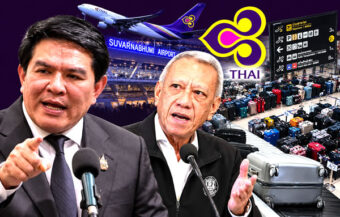
Thai Airways clears its baggage crisis, but a bigger boardroom battle erupts over suspended CEO Chai Eamsiri. Industry figures question the move as Chai faces a 30-day inquiry and fiercely rejects corruption claims over an ฿800m wine deal.
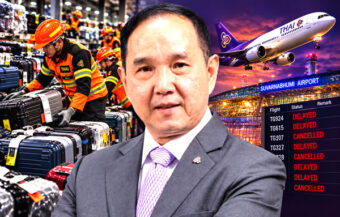
Thai Airways has beaten its baggage crisis, but a bigger battle is raging inside the national carrier. Aviation figures are challenging the suspension of chief executive Chai Eamsiri, who helped restore THAI to profitability. Former Nok Air boss Patee Sarasin calls the move wrong and warns against renewed bureaucratic control. Meanwhile, the Finance Ministry remains the dominant shareholder and its permanent secretary chairs the board. Chai now faces a 30-day inquiry into the airport breakdown and a separate storm over an ฿800 million wine procurement. He fiercely denies corruption and welcomes any investigation. Yet flights and cargo are back to normal, with only 562 delayed bags remaining.
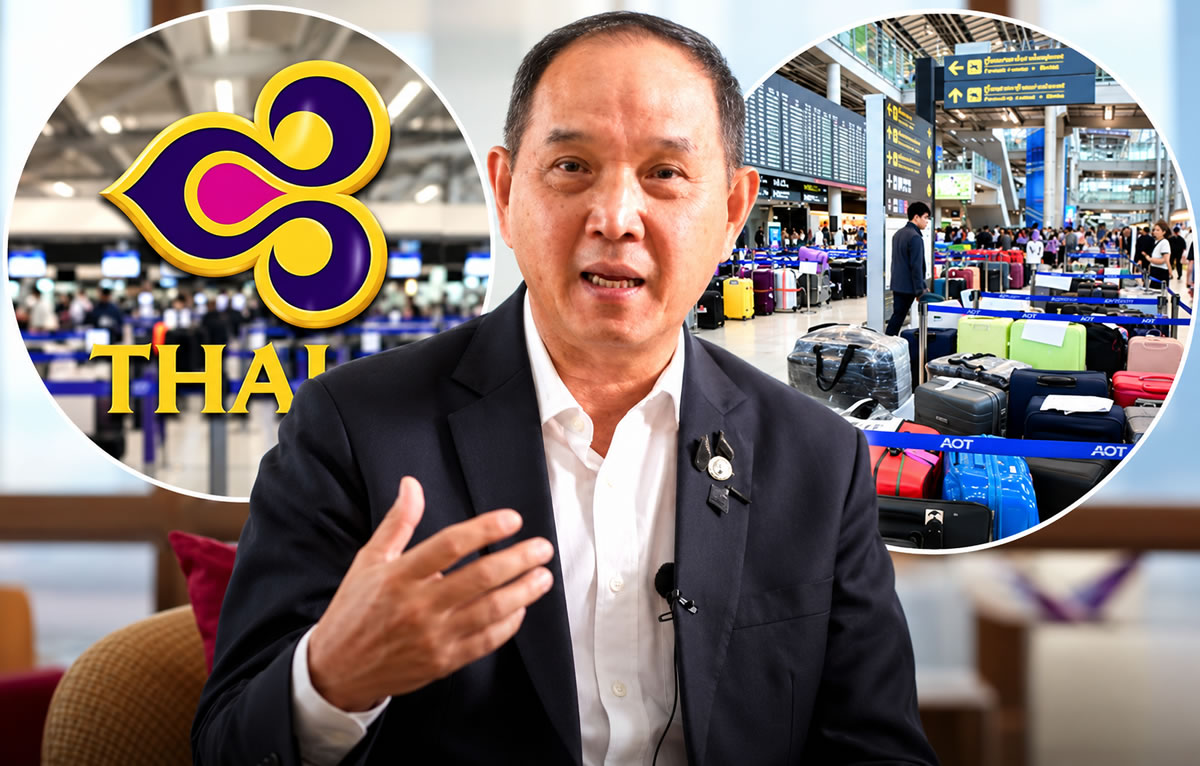
Concern is mounting across Thailand’s aviation industry over the suspension of Thai Airways chief executive Chai Eamsiri. Leading industry figures are questioning the board’s decision after his role in the carrier’s financial recovery. More broadly, the dispute has revived questions over government influence at the recently rehabilitated airline.
The corporate fight is intensifying even as the operational crisis rapidly disappears. Thai Airways said all inbound and outbound flights were operating normally by Sunday. Cargo operations had also cleared their entire backlog. Meanwhile, only 562 delayed bags remained from more than 12,000 caught in last week’s disruption.
Thai Airways is tracing those remaining bags and arranging their return. Crucially, passengers will not have to return to Suvarnabhumi Airport to retrieve them. The airline will deliver outstanding luggage and absorb the costs. Affected travellers can also seek reimbursement under its published delayed-baggage procedures.
Industry backlash grows as Thai Airways recovery shifts attention from baggage crisis to its boardroom
Yet the airline’s rapid recovery has failed to settle the argument surrounding Mr Chai. Instead, attention has shifted from Suvarnabhumi’s baggage halls to the Thai Airways boardroom. The focus now includes management independence, board oversight and the government’s position as the largest shareholder.
Former Nok Air chief executive Patee Sarasin has publicly described the decision against Mr Chai as wrong. Notably, Mr Patee said he viewed what happened as more political than operational. He also highlighted Mr Chai’s contribution to the management team which returned Thai Airways to profitability.
Mr Patee warned against allowing the airline to return to bureaucratic management. His intervention reportedly attracted substantial support from figures within Thailand’s aviation industry. As a result, the controversy has moved beyond questions about one week of serious airport disruption.
Separately, an aviation industry insider cited by Prachachat pointed to earlier tensions inside Thai Airways. According to the source, friction between Mr Chai and directors existed before the baggage crisis. The source traced those tensions to changes involving the size and composition of the airline’s board.
Expanded Thai Airways board and Finance Ministry role revive concerns over professional management
Thai Airways previously had 11 directors. Subsequently, the Finance Ministry pushed for the board to expand to 15 members. Persistent friction reportedly developed between the expanded board and Mr Chai. The industry source also warned that interference in professional management could damage the airline’s competitiveness.
The confrontation comes at a sensitive stage in Thai Airways’ corporate recovery. The carrier resumed trading on the Stock Exchange of Thailand on August 4, 2025. That milestone followed years of restructuring under court-supervised business rehabilitation.
Before rehabilitation, Thai Airways had suffered heavy losses and accumulated substantial debts. The carrier also lost its state-enterprise status in 2020. It later restructured its finances, workforce and operations before returning to profitability.
Despite that transformation, the Thai government retains a powerful position through its shareholding. The Finance Ministry remains Thai Airways’ dominant shareholder with 38.90%. In addition, Finance Ministry Permanent Secretary Lavaron Sangsnit chairs the airline’s board.
There is no evidence that government ministers instructed directors to suspend Mr Chai. Thai Airways also remains a listed public company rather than a state enterprise. Even so, the boardroom confrontation has revived an older industry debate over government and bureaucratic influence.
Thai Airways governance debate returns as baggage breakdown exposes old concerns over outside influence
That argument existed long before Thai Airways completed rehabilitation. Historically, political and bureaucratic involvement repeatedly became an issue surrounding the flag carrier. An academic examination of its governance has also considered the effects of such influence on professional management.
Against this background, the latest dispute carries significance beyond the baggage breakdown. The immediate trigger, however, was a severe operational failure at Suvarnabhumi Airport. Thousands of bags accumulated after Thai Airways’ ground-handling system became overwhelmed.
Flooding around Bangkok initially prevented staff from reaching the airport. At the same time, defective baggage carts aggravated the problem. Thai Airways’ ground operation was severely affected, while two rival handlers continued operating normally.
Consequently, luggage began accumulating rapidly. Some passengers waited between four and six hours for bags which never appeared. Others eventually boarded flights without their belongings. The backlog then continued growing as ground staff struggled to restore normal operations.
At its height, the crisis involved thousands of stranded bags. Thai Airways eventually faced almost 10,000 pieces requiring urgent handling. Thousands remained outstanding even after emergency measures began.
Flight operations then came under pressure. At one stage, Thai Airways cut capacity by as much as 40%. On one day, 37 flights were cancelled while another 34 suffered delays. Earlier cancellations had already added to the disruption.
Thai Airways drafts staff and military help before flights and cargo operations return to normal
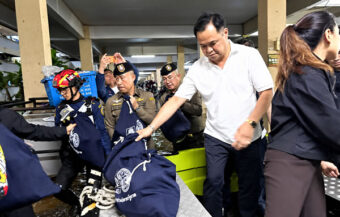
Cargo operations also came under growing pressure. The problems threatened the airline’s wider ground-handling operation as manpower was diverted towards passenger baggage. Thai Airways responded by drafting office employees into frontline airport duties.
In parallel, military personnel were deployed to reinforce the workforce. At one stage, 131 military personnel were assisting the operation. Transport Minister Phiphat Ratchakitprakarn also became directly involved as the crisis deepened.
The operational picture has since changed dramatically. By October 5, Thai Airways reported its flight schedule had returned to 100% normal capacity. The carrier was operating 122 inbound flights and 123 outbound flights.
Cargo operations had also cleared all outstanding inventory. At the same time, Thai Airways pushed staffing above its original manpower plan. The carrier deployed 1,348 employees against a planned workforce of 1,278.
Accordingly, manpower reached 105.48% of the planned requirement. The baggage figures showed an equally sharp recovery. Thai Airways had recorded 7,175 delayed bags from outbound and connecting services.
By Sunday, only 150 of those bags remained outstanding. On the inbound side, 5,423 pieces had been caught in the disruption. Only 712 remained within the system by the latest count.
Thai Airways cuts baggage backlog to 562 as passengers are promised free delivery and compensation
Of those, 300 had already been claimed by their owners. That left 412 inbound bags requiring further action. Together with 150 outbound and connecting bags, the remaining backlog stood at 562 pieces.
Thai Airways is continuing to identify owners and return their property. In response, Mr Phiphat has said passengers will not need to collect luggage themselves. The airline will arrange delivery and pay the associated costs.
Compensation procedures are also available for disrupted passengers. Thai Airways’ published delayed-baggage policy provides reimbursement for necessary expenditure in qualifying circumstances. Payments, however, depend upon individual circumstances and supporting documentation.
For international journeys, the published ceiling is $100 per passenger for each delayed bag. The corresponding domestic ceiling is $25. Passengers generally require a Property Irregularity Report together with receipts supporting their expenses.
Under the published procedure, claims normally must be submitted within 21 days after delayed baggage is delivered. On another front, Thai consumer representatives have demanded compensation for costs caused by the disruption. They argue that returning the baggage alone does not settle the carrier’s responsibilities.
While passengers receive their luggage, the corporate consequences continue to develop. The Thai Airways board is proceeding with a formal investigation into the operational breakdown. Deputy National Police Chief Pol Gen Thatchai Pitaneelaboot is being assigned to chair the inquiry.
Thirty-day Thai Airways inquiry will examine baggage failures, staffing, cancellations and outsourcing
Pol Gen Thatchai is also a Thai Airways director. His committee will examine the baggage backlog and subsequent flight cancellations. Investigators will also scrutinise the airline’s crisis response and ground-handling staffing structure.
As part of this, outsourcing through Wingspan Services will come under examination. That issue concerns the manpower structure supporting Thai Airways’ airport operations. The committee has 30 days to report progress to the board.
Mr Chai, however, has not been dismissed from Thai Airways. Directors instead ordered him to cease performing chief executive duties while investigators establish the facts. Board director Sumrid Sumneing has taken over as acting chief executive.
Mr Chai’s employment contract remains valid until January 31, 2027. Initially, he said he considered the board’s action unfair. Nevertheless, he acknowledged the governance reasoning behind the decision. He also declined to accuse the government of political interference.
Since Friday, the dispute surrounding Mr Chai has widened considerably. He has issued a forceful public denial of separate corruption claims involving wine procurement. Importantly, those allegations are separate from the baggage and operational investigation.
Chai rejects separate corruption claims as scrutiny turns to ฿800 million Thai Airways wine procurement
The disputed procurement reportedly involves approximately 860,000 bottles of wine worth more than ฿800 million. Reports have claimed Mr Chai interfered with the procurement process. Other claims suggested he personally took control of the matter.
Claims linking the procurement to corruption also circulated publicly. In response, Mr Chai rejected those accusations emphatically. He addressed them directly on his personal Facebook account on Saturday.
Mr Chai said he normally avoided using social media to address such controversies. This time, however, he said the accusations required an answer. He specifically rejected claims of interference, manipulation and corruption involving the wine procurement.
According to Mr Chai, Thai Airways’ wine purchases followed detailed procedures and established regulations. He said those procedures could be examined at any time. He also pointed directly towards the airline’s existing internal safeguards.
“If there were grounds for concern, the internal audit department and audit committee have a duty to investigate,” Mr Chai said.
He then pointed to his 41-year career at Thai Airways. Throughout that period, he said he had never faced a corruption scandal. Some journalists subsequently challenged the relevance of his previous record.
Chai challenges corruption claims, invites investigation and points to his 41-year Thai Airways career
Mr Chai acknowledged their argument directly. “Just because there’s no past wrongdoing doesn’t mean we won’t do it in the future,” he quoted journalists as saying.
His answer was equally direct. “My answer is that it’s the duty of a straightforward audit process, not something the media is making up.”
Mr Chai then drew a clear distinction between criticism of his management and accusations of corruption. “I’m open to hearing about other things, but I absolutely cannot accept accusations of corruption.”
He also opened his conduct to examination beyond Thai Airways. “I welcome any agency in this country to investigate me,” he said.
His statement represented a marked hardening from his comments immediately after Friday’s suspension. Earlier, Mr Chai had said he considered the board’s action unfair. However, he stopped short of accusing political figures of orchestrating his removal.
The wine controversy has nevertheless added another layer to the dispute. Thai Airways’ procurement records confirm that a wine tender was conducted before the present confrontation.
The airline issued a request for proposals covering red wine, white wine and other wine for 2026. The procurement process opened in October 2025. Bids were accepted from October 10 until November 21, 2025.
Wine tender records emerge as Chai insists procurement followed rules and remains open to examination
Mr Chai did not identify the media organisations he accused of circulating corruption claims. Likewise, his Facebook statement provided no detailed breakdown of the reported 860,000-bottle purchase. Instead, he insisted that the procurement process was open to examination.
He also made clear that corruption was the accusation he would not accept. His final warning was equally pointed. “If that happens, I will not accept any gift baskets,” he wrote.
The wine controversy and baggage inquiry remain distinct. The operational investigation concerns what happened at Suvarnabhumi and how Thai Airways responded. It covers baggage, cancellations, staffing, crisis management and outsourcing.
By contrast, the wine dispute concerns earlier procurement decisions and accusations now firmly rejected by Mr Chai. Both matters, however, are unfolding during a broader confrontation over leadership at the airline.
That confrontation follows one of Thailand’s largest recent corporate restructurings. Thai Airways entered rehabilitation after years of financial difficulties. Extensive changes subsequently reshaped its finances, workforce and operating structure.
The carrier then returned to profitability. Finally, its shares resumed trading on the Stock Exchange of Thailand in August 2025. The return marked another major stage in Thai Airways’ rehabilitation.
Finance Ministry shareholding and board role return to focus as aviation figures question Chai suspension
The Finance Ministry nevertheless retained its position as the largest shareholder. Consequently, relations between shareholders, directors and professional management remain closely watched within the aviation sector.
Mr Patee’s intervention has now brought those concerns into sharper public focus. His comments carry weight because of his extensive experience in Thailand’s airline industry. He directly challenged the decision to remove Mr Chai from executive control.
At the same time, he warned against returning Thai Airways to bureaucratic management. Another industry source separately warned about interference in professional airline operations. That source also linked existing friction to the expansion of the board.
Neither account establishes that government ministers ordered Mr Chai’s suspension. The formal decision was made by the Thai Airways board chaired by Mr Lavaron. Directors have linked the action to establishing facts surrounding last week’s crisis.
The board also wants Thai Airways’ crisis-management procedures examined. Its investigation now has 30 days to report progress. The inquiry will determine how the baggage breakdown developed and how management responded.
For passengers, however, the emergency has largely ended. Flights are operating normally, cargo is cleared and staffing exceeds planned requirements. Only 562 bags remained from more than 12,000 delayed pieces by Sunday.
Thai Airways restores normal operations as its boardroom dispute over Chai’s suspension intensifies
Thai Airways is arranging their return directly to passengers. Reimbursement procedures are also available for qualifying expenses. Therefore, the operational problems which triggered the boardroom confrontation are rapidly disappearing.
The management dispute is moving in the opposite direction. Mr Chai remains suspended while investigators examine last week’s breakdown. Separately, he is fighting corruption claims surrounding the airline’s wine procurement.
Thai Airways boss fired by the board chaired by Finance Ministry chief on Friday over baggage crisis
Government takes a stronger hand as Thai Airways crisis at Suvarnabhumi Airport worsened Wednesday
Industry figures are also questioning the board’s decision. Meanwhile, the Finance Ministry remains Thai Airways’ largest shareholder and its permanent secretary chairs the board.
The baggage crisis has therefore receded while the corporate confrontation has widened. Thai Airways is again flying its full schedule and its cargo backlog has vanished. Passengers are also being reunited with their luggage.
Yet the suspension of a chief executive closely associated with the carrier’s rehabilitation has opened a larger boardroom battle. That dispute now centres on management, oversight and the future direction of Thailand’s flag carrier.
Join the Thai News forum, follow Thai Examiner on Facebook here
Follow Thai Examiner on Google here
Receive all our stories as they come out on Telegram here
Follow Thai Examiner here
Further reading:
Thai Airways boss fired by the board chaired by Finance Ministry chief on Friday over baggage crisis
Government takes a stronger hand as Thai Airways crisis at Suvarnabhumi Airport worsened Wednesday
Bangkok airports open and flights running but there are delays and baggage issues at Suvarnabhumi
Engineers work through night after Sunday’s fire on Bangkok’s Blue Line saw more damage than thought
Arrested man linked with Chatuchak building collapse now tells police he is a Chinese state employee