Thailand races to resolve 11,000 company probes by September 30 as ฿85 billion in land and assets come under scrutiny. Investigators are tracing property transfers, shareholder changes and suspected foreign control behind Thai nominee structures.
Thailand is racing against the clock to unravel suspected foreign nominee landholdings before September ends. More than 11,000 companies face investigation, with ฿85 billion in land and assets under scrutiny. That figure has surged by ฿20 billion in two weeks. Meanwhile, officials have detected attempts to move assets, switch shareholders and alter company structures as investigators close in. The crackdown stems from a wider screening of 36,277 foreign-linked companies holding more than 305,000 land plots. Another 7,082 companies hold over 76,000 condominium units. Deputy Interior Minister Polpeera Suwannachawi says the outstanding cases must be resolved by month-end. Police and government departments are now tracing ownership, money and control before more assets change hands to avoid the closing dragnet.
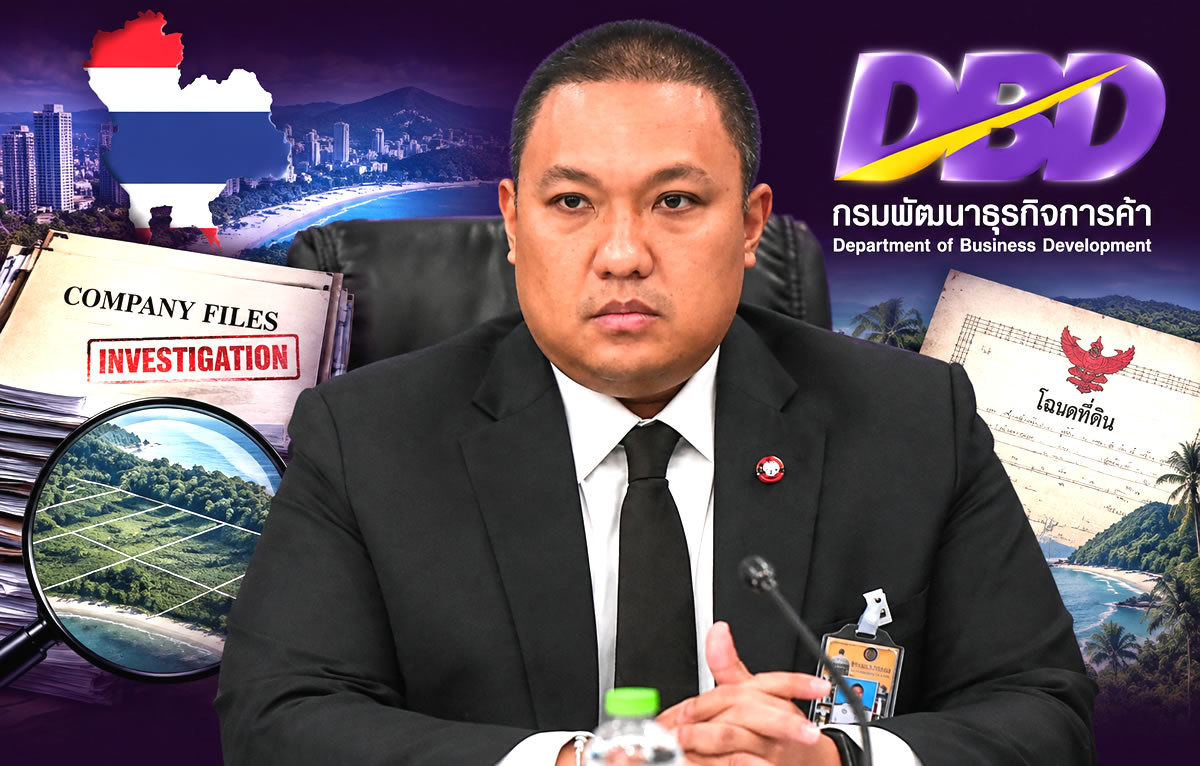
Thailand is racing to investigate more than 11,000 companies over suspected foreign-linked landholdings before September ends. Officials have already detected attempts to transfer property and other assets during the nationwide crackdown.
Investigators are also tracking changes to shareholder lists, company structures and bank accounts. In response, the government has imposed a firm end-of-September deadline for completing the outstanding investigations.
At the centre of the operation are land and assets currently valued at approximately ฿85 billion. Notably, the estimate stood at only ฿65 billion two weeks ago. Another ฿20 billion has therefore entered the investigative picture within roughly a fortnight. That represents an increase of almost 31% as officials widen their examination.
Polpeera orders faster nominee checks as officials trace asset transfers and shifting company ownership
Deputy Interior Minister Polpeera Suwannachawi revealed the figures after a high-level Government House meeting on Tuesday. He said officials had discovered improper activity involving transfers of ownership. Some people involved were transferring assets before attempting to leave. As a result, agencies have been ordered to accelerate investigations into illegal landholdings and nominee structures.
The deadline now leaves investigators less than two weeks to complete thousands of company checks. In parallel, several government agencies are pooling corporate, financial and landholding information. They include the Department of Lands and the Department of Business Development (DBD). The Royal Thai Police and Department of Provincial Administration are also directly involved.
Together, those agencies must determine which companies are legitimate and which involve unlawful nominee arrangements. Crucially, the 11,000-plus companies have not all been established as illegal operations. They form an investigative pool requiring deeper examination. Officials must identify companies using Thai shareholders to conceal prohibited foreign ownership or control.
The operation now reaches far beyond current shareholder registers. Investigators can examine previous shareholders, former directors and changes in registered capital. They can also trace financial statements and sources of investment funds. In turn, those records can be compared with landholding and personal registration databases.
Investigators reconstruct company ownership as ministries pool land, corporate and financial records
This approach allows officials to reconstruct company ownership over time. For example, shareholders or directors may have changed after the original registration. Registered capital may also have increased before property was acquired. As part of this, investigators can examine who supplied the money behind those transactions.
The latest acceleration followed a Government House meeting beginning at approximately 2.15 pm on September 15. Prime Minister and Interior Minister Anutin Charnvirakul ordered the joint government effort. He assigned Deputy Prime Minister and Commerce Minister Suphajee Suthumpun to chair the discussions. Justice Minister Police Lt Gen Rutthaphon Naowarat also attended.
Polpeera joined senior representatives from agencies involved in the investigations. The talks covered nominee structures, suspicious funds and connections with scam operations. However, Polpeera described the gathering mainly as an informal discussion about working methods. Several government agencies are already handling cases which overlap with investigations elsewhere.
The Interior, Commerce and Justice ministries are among the agencies involved. Meanwhile, the Royal Thai Police are conducting related investigations. Officials discussed problems arising when one agency needs information held by another. Traditional procedures can require written requests and physical documents before information changes hands.
Justice officials said that process could take too long. Accordingly, senior officials have established direct back-end communication channels between participating agencies. An executive-level LINE group will handle urgent information requests. Officials can then exchange critical information while formal procedures continue where required.
More agencies may join as ฿85 billion land probe targets 2,200 companies for faster investigation
On another front, additional agencies could enter the operation as individual investigations develop. The Ministry of Labour is expected to join further discussions. The National Anti-Corruption Commission could also become involved. Likewise, the Ministry of Finance may participate where cases involve taxation or company finances.
The immediate pressure, however, comes from information already uncovered by investigators. Polpeera said officials had discovered improper activities involving transfers of ownership. Some people involved were moving assets before attempting to leave. Against that backdrop, he said the government wanted nominee and illegal landholding cases accelerated.
Figures exchanged during Tuesday’s meeting highlighted approximately 2,200 companies in a significant landholding category. According to Polpeera, foreign shareholdings in those companies exceed holdings by Thai nationals. The position involving those companies is already clearer, he said. The Department of Lands is consequently accelerating investigations into the properties involved.
Where illegal foreign landholding is established, compulsory disposal procedures can follow. That can ultimately require the land to be sold. In addition, legal proceedings can follow where investigators establish breaches of Thai law. The government is therefore moving faster on cases where the evidence is already more developed.
The financial scale has also increased sharply. Two weeks earlier, officials placed the initial value at approximately ฿65 billion. By Tuesday, that estimate had climbed to approximately ฿85 billion. Put another way, the figure increased by ฿20 billion within about 14 days.
More than 11,000 companies face deeper checks as officials trace shareholders, funding and control
Polpeera said the revised numbers would be presented to Prime Minister Anutin Charnvirakul. Yet the investigation extends far beyond the approximately 2,200 clearer cases. Another group has attracted attention over possible shareholder or bank-account changes. The information supplied places that group at more than 1,100 companies.
Beyond that, more than 10,000 companies still require screening and investigation. Thus, the wider pool requiring examination exceeds 11,000 companies. Police will work alongside the DBD, Department of Lands and Department of Provincial Administration. Their task is to determine the status of every targeted company.
Investigators must establish whether Thai shareholders are genuine investors. They can examine whether those shareholders supplied their own investment capital. At the same time, officials can investigate whether foreigners exercise effective control behind nominal Thai ownership. The source of money used to acquire land can also be traced.
Those checks are particularly important where company structures have changed repeatedly. A shareholder list alone may not reveal who ultimately controls a business. Similarly, registered capital does not necessarily identify who provided the underlying funds. Investigators are therefore comparing corporate records with financial and property information.
Where breaches are established, proceedings can follow against those involved. Separately, land found to be unlawfully held can enter compulsory disposal procedures. The Department of Lands will handle that process. The immediate challenge remains completing the outstanding investigations before the month closes.
End-of-September deadline drives review of 11,000 firms drawn from nationwide foreign land screening
Reporters specifically asked Polpeera about the timetable. His answer was unequivocal: the work must be finished by September’s end. According to Polpeera, the position involving approximately 2,200 companies is already clearer. Even so, the remaining 10,000-plus companies must be processed within the same deadline.
The end-of-month target now drives the wider inter-agency operation. At the same time, investigators are watching for further transfers while those checks continue. Shareholder changes and bank-account alterations are also under examination. This means company structures can change while officials are still reconstructing their histories.
The investigation sits inside a far larger nationwide examination of foreign-linked property holdings. Earlier this month, the Commerce and Interior ministries agreed to integrate major government databases. The agreement linked corporate information with land records and personal registration data. Subsequently, officials identified 36,277 companies with foreign participation holding Thai land.
Those companies were connected with 305,838 separate plots. Combined, the holdings covered 1,064,265.38 rai. The figures created a vast nationwide screening pool. Still, foreign participation alone does not establish that a company has broken Thai law.
Neither are the 36,277 businesses confirmed nominee companies. Instead, the database allows officials to identify corporate structures requiring deeper examination. The new 11,000-plus figure represents a narrower group requiring more intensive scrutiny. Within that pool, officials are now separating legitimate businesses from suspected nominee arrangements.
Condo holdings enter nationwide review as investigators trace corporate ownership and investment funds
The nationwide data exercise has also reached condominium holdings. In a separate finding, 7,082 foreign-linked companies were identified holding condominium property. Those companies were connected with 76,840 units. Combined, the properties covered more than 4.1 million square metres.
The wider examination therefore reaches beyond companies holding conventional land. For now, however, the latest enforcement push is concentrated heavily on landholding structures. Thai law restricts foreign ownership of land while permitting foreign investment within defined limits. The central issue is whether company structures comply with those restrictions.
The new data-sharing arrangements give investigators more ways to test those structures. Previously, a current shareholder register provided only a snapshot of company ownership. Now, officials can work backwards through corporate histories. DBD records can reveal former shareholders, directors and changes in registered capital.
Financial statements provide another investigative trail. Moreover, officials can examine the source of investment funding behind company operations and property purchases. Those findings can be matched against Department of Lands records. Personal information held by the Department of Provincial Administration provides another cross-check.
DBD widens scrutiny beyond incorporation as shareholder changes and asset transfers raise new concerns
This allows investigators to examine what happened after incorporation. A company may have changed shareholders after completing its initial registration. Directors can also change, while registered capital may rise substantially. Subsequently, land may be acquired after those corporate changes.
The DBD has already tightened scrutiny at that stage. Since August 1, checks have expanded beyond newly incorporated businesses. Changes involving shareholders and directors at existing companies now receive closer examination. The measure targets questionable structures which appear after initial registration.
Against this background, the latest evidence of shareholder changes carries added importance. Investigators are not dealing only with static company records. Instead, some ownership structures appear to be changing while the investigation continues. More significantly, officials have detected attempts to transfer assets.
That has compressed the timetable further. Investigators must establish where assets moved and when transfers occurred. They must also identify changes involving shareholders and financial arrangements. Meanwhile, those corporate records must be matched with the underlying landholdings.
The nationwide push follows several substantial foreign-linked land cases in tourist provinces. Koh Phangan has already become one important focus. There, officials flagged 112 entities over foreign shareholding concerns. Those cases involved 124 land plots covering approximately 86 rai.
Koh Phangan and Krabi cases show how nominee investigations can trigger compulsory sales of Thai land
Eight cases had already produced court judgments. Furthermore, nine plots involving eight entities were ordered sold. Those cases show how corporate investigations can lead directly to compulsory land disposal. They also demonstrate the process available once unlawful ownership is established.
Krabi has produced another significant case. In July, Polpeera announced action involving 22 plots on Koh Por in Koh Lanta district. Together, those properties covered more than 126 rai. Officials valued the land at approximately ฿2.146 billion.
Investigators identified three interconnected companies. According to officials, the businesses operated through a circular shareholding structure. Investigators said the arrangement gave a British national effective control. Consequently, the land was frozen while compulsory disposal proceedings moved forward.
That case demonstrated the importance of examining control behind registered share percentages. Rather than stopping at company documents, investigators examined links between the businesses. They also looked at the underlying ownership structure. That approach is now being applied across the broader nationwide exercise.
The crackdown has coincided with a steep fall in high-risk company registrations. In August 2025, officials recorded 894 registrations carrying nominee-risk characteristics. By August 2026, the number had fallen to 163. Overall, the recorded figure dropped by 81.77% over the 12-month period.
Existing companies pose tougher challenge as Polpeera separates landholding offences from deportation
The current operation presents a different challenge. Most of the targeted companies and properties already exist. Hence, officials must reconstruct historic transactions as well as examine current registrations. Corporate ownership histories, property purchases and investment funding can all require separate checks.
Bank account changes can add another trail. Shareholder alterations can also complicate the picture. For that reason, investigators need information held across several ministries and departments. The new direct communication system is intended to shorten those delays.
Alongside the land investigation, Polpeera clarified possible immigration consequences for foreigners involved in unlawful activity. He drew a distinction between landholding violations and deportation. Illegal landholding does not automatically trigger deportation. He also said the government’s deportation powers were not intended for indiscriminate use.
Instead, immigration consequences depend upon the offence and individual circumstances. Foreigners convicted of relevant offences can face deportation proceedings. Other cases can produce different immigration action. To illustrate this, Polpeera pointed to a recent case involving five foreigners in Bangkok’s Huai Khwang district.
That case involved a pub and had already reached court. The court imposed fines on those involved. Nevertheless, officials did not pursue deportation proceedings. Their visas were revoked instead, and they were required to leave Thailand.
Officials race to trace asset transfers as more than 36,000 foreign-linked landholding firms are screened
Immigration enforcement will therefore remain separate from landholding action where appropriate. Companies operating legally will also be distinguished from unlawful structures. By contrast, nominee arrangements established through evidence can lead to legal proceedings. Illegally held land can also be forced onto the market.
The immediate priority is stopping time from working against investigators. Officials are already dealing with signs of asset transfers and ownership changes. In some cases, company records may now differ from those available when investigations started. Each subsequent change must therefore be traced.
Investigators must establish where land has moved and who ultimately controls each company. They must also determine where investment capital originated. Beyond this, shareholder changes and bank-account activity can require separate examination. All of those checks now face the same September deadline.
The scale of the wider exercise remains substantial. More than 36,000 foreign-participation companies holding land appeared in the nationwide screening. Together, they hold more than 305,000 plots covering over one million rai. Another 7,082 foreign-linked companies hold more than 76,000 condominium units.
฿85 billion probe narrows to 11,000 companies as agencies race against ownership and asset changes
Within that vast dataset, the immediate focus has narrowed to more than 11,000 companies requiring deeper examination. About ฿85 billion in land and assets is now under scrutiny. Two weeks earlier, the comparable estimate was only ฿65 billion. The financial exposure identified by officials has therefore expanded rapidly.
More importantly, the investigation is unfolding while some corporate structures continue changing. Officials have found attempts to transfer ownership and move assets. They are also examining shareholder and bank-account changes. The September 30 deadline has consequently become more than an administrative target.
The Interior, Commerce and Justice ministries are now working across normal departmental boundaries. Police are operating alongside land, business registration and provincial administration officials. Elsewhere, tax, labour or corruption agencies could join particular investigations as evidence develops. Faster information exchange is intended to keep those inquiries moving.
September deadline puts 11,000 company checks and ฿85 billion in land and assets under growing pressure
For now, the order remains fixed. More than 11,000 company investigations must be resolved by the end of September. At the same time, approximately ฿85 billion in land and assets remains under scrutiny. Officials must determine which businesses are lawful and which involve prohibited nominee structures.
The approximately 2,200 clearer landholding cases are already being accelerated. Where unlawful ownership is established, the Department of Lands can force property sales. Police can pursue offences where the evidence supports prosecution. Other companies will be cleared if their ownership and operations comply with Thai law.
Nationwide probe targeting over 36K foreigner linked firms with land and a further 7k which own condos
Frenchman’s Koh Samui business empire enmeshed in knotty police probe of nominee firms and pot farm
The nationwide operation has therefore moved from broad database screening into intensive company-by-company investigation. Officials are reconstructing ownership, financing and landholding histories across thousands of businesses. Simultaneously, they are watching for fresh transfers and changes to corporate structures. Everything must now be resolved against the rapidly approaching end-of-September deadline.
Join the Thai News forum, follow Thai Examiner on Facebook here
Follow Thai Examiner on Google here
Receive all our stories as they come out on Telegram here
Follow Thai Examiner here
Further reading:
Frenchman’s Koh Samui business empire enmeshed in knotty police probe of nominee firms and pot farm
Drive against foreign owned property and business on Koh Samui and Koh Phangan now targets leases
International reservations system used by hotels targeted in latest Koh Phangan swoop by ministers
Anutin visits Koh Phangan as nominee crackdown shows 68% of firms with foreign ownership links
Blitzkrieg on foreign firms and enterprises on Koh Phangan continues with French owned resort busted
Russian-Chinese Koh Phangan alliance to sell drugs to foreigners. Accused entered Thailand illegally
Crackdown aimed at upending foreign business trade moves from Koh Phangan to Phuket. Four arrested
Crackdown to wipe out foreign business abuses and ownership on Koh Phangan & Koh Samui intensifies