Ekniti pitches an AI-powered revival at the IMF–World Bank summit as Thailand’s debt crisis bites. Public borrowing nears its ceiling, SMEs struggle for loans and Fitch warns of bad debt in the banking system. A proposed ฿1,000 departure tax sparks tourism industry fury.
Thailand’s Finance Minister Ekniti Nitithanpraphas has championed an AI-driven economic revival at the IMF–World Bank meetings as the existing economy buckles under debt. Public borrowing has hit ฿13.19 trillion, nearing the 70% GDP ceiling, while household debt stands at 85.2%. Meanwhile, a ฿898.8 billion fiscal deficit exposes mounting pressure on government finances. Fitch Ratings warns of persistent bad loans as small businesses struggle for credit, despite banks earning ฿247 billion. Adding to the turmoil, Ekniti faces fierce industry opposition to a proposed ฿1,000 departure tax. Thirty-five years after Thailand hosted the meetings during an economic boom, former Finance Minister Korn Chatikavanij warns the kingdom risks becoming the “sick man of Asia”. Ekniti promises a second economic take-off while mounting debts and shrinking credit cripple the existing economy.
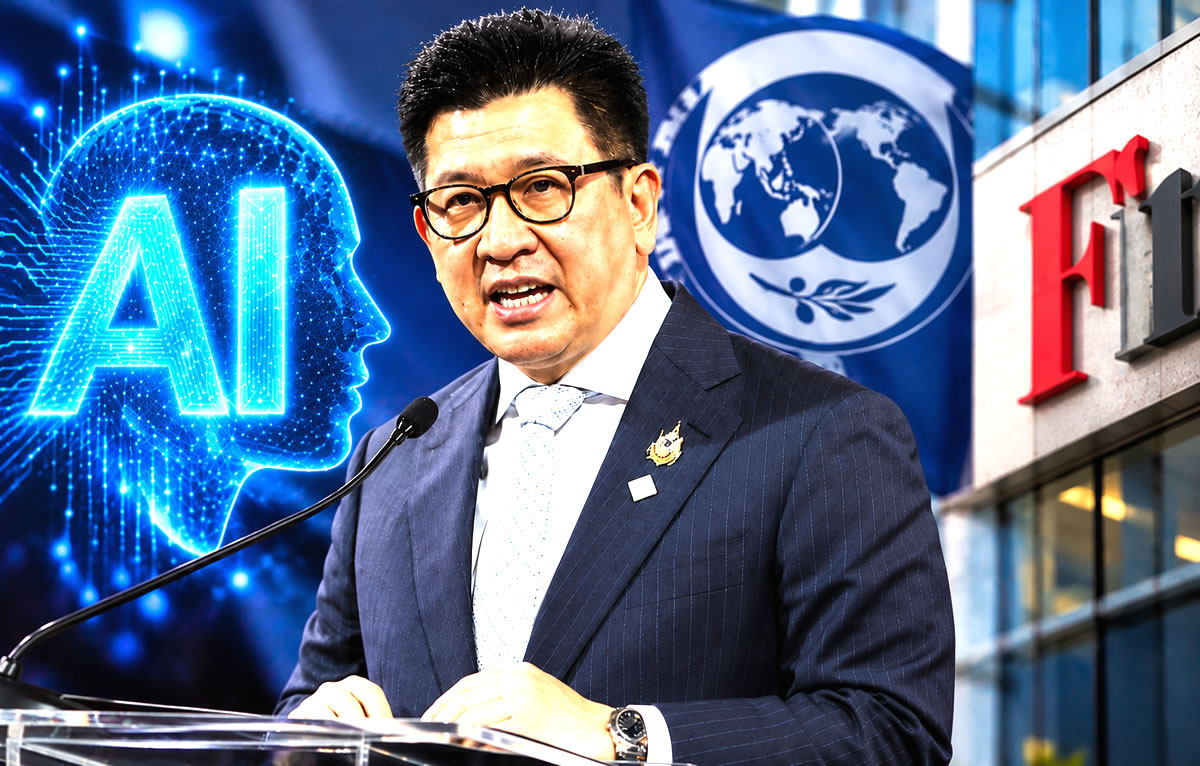
Thailand’s Finance Minister Ekniti Nitithanpraphas is promoting an AI-driven economic revival as the country’s existing economy struggles under mounting debt. Speaking at this week’s IMF–World Bank Annual Meetings in Bangkok, he outlined plans for a second economic take-off.
However, public debt is approaching Thailand’s statutory ceiling, while household borrowing remains above 85% of GDP. The government is also running enormous budget deficits as smaller businesses struggle to obtain bank credit.
Meanwhile, Ekniti’s ministry faces fierce tourism industry opposition to a proposed ฿1,000 departure tax. Adding to the pressure, Fitch Ratings has warned that bad loans will remain stubbornly high. The contrast is stark: Thailand is planning a technological transformation while its existing financial problems continue to deepen.
Ekniti promotes AI-led growth as public debt nears its ceiling and household borrowing remains severe
On Monday, October 12, Ekniti addressed the World Bank’s flagship forum, “Small AI: More and Better Jobs”, in Bangkok. He promoted artificial intelligence as a means of raising productivity, creating employment and strengthening Thailand’s competitiveness.
His proposals centred on technology investment, workforce development and expanding opportunities for smaller businesses. However, the country’s financial position presented a markedly different picture.
Thailand’s public debt reached ฿13.19 trillion at the end of August 2026, equivalent to 67.94% of GDP. That left just 2.06 percentage points beneath the statutory debt ceiling of 70%. Furthermore, the government’s fiscal 2025 accounts recorded a deficit of ฿898.8 billion.
Another deficit of ฿788 billion is planned under the ฿3.788 trillion budget for fiscal 2027. Consequently, the Finance Ministry faces substantial borrowing requirements while its remaining fiscal room continues to narrow.
The deterioration extends beyond the government’s accounts. At the end of June, Thai households owed approximately ฿16.43 trillion, equivalent to 85.2% of GDP.
Meanwhile, smaller businesses faced increasingly restrictive lending conditions as banks sought to protect their balance sheets. Bad debts remained elevated, while consumer spending continued to suffer under the weight of existing borrowing. These conditions have accompanied Thailand’s prolonged period of weak economic growth.
World Bank warns of rising debt servicing costs as Thailand faces shrinking room for fiscal spending
According to the World Bank, public debt has increased by more than 20 percentage points of GDP since the pandemic. Moreover, government debt servicing relative to revenue has reached its highest level since 2006.
Persistent deficits require continued borrowing, while weak economic expansion constrains revenue growth. The result is a tightening fiscal position, with fewer resources available for additional expenditure.
Nevertheless, the World Bank continues to regard Thailand’s public debt as sustainable. Most borrowing remains domestically financed, while foreign-currency exposure is comparatively limited.
The country’s financial position therefore differs substantially from the circumstances surrounding the 1997 crisis. Even so, the government faces diminishing borrowing capacity beneath its existing statutory ceiling. Its immediate challenge involves financing continued deficits without breaching that limit.
Finance Ministry faces travel industry backlash over proposed ฿1,000 tax on international departures
Against this background, the Finance Ministry has become embroiled in a fierce dispute with Thailand’s travel industry. The controversy centres on a proposed ฿1,000 outbound travel tax covering Thai and foreign passengers departing by air.
The Revenue Department opened public consultations on September 30, with submissions accepted until October 29. Ekniti has defended the proposal partly as an incentive for Thai residents to holiday domestically. His argument centres on retaining more consumer spending within Thailand rather than allowing it to flow overseas.
However, the Association of Thai Travel Agents and the Thai Hotels Association have raised serious objections. Both organisations have warned about the potential consequences for airlines, passengers and tourism businesses. Their concerns extend beyond the immediate financial burden on departing travellers. Industry representatives argue that higher departure costs could discourage international travel and reduce passenger demand.
In turn, lower passenger volumes could weaken airline route profitability and affect flight frequencies. Reduced services could also limit seat availability, pushing fares higher for international passengers.
Significantly, industry representatives warn that inbound tourism could suffer alongside outbound travel. Thailand depends heavily on international visitors for foreign earnings, employment and business activity. The proposed tax has therefore triggered opposition extending across several parts of the tourism industry.
Combined passenger charges could reach ฿2,570 as tourism groups challenge new departure tax plans
The controversy becomes sharper when existing and proposed passenger charges are considered together. Currently, international departures from Airports of Thailand facilities carry a passenger service charge of ฿1,120. Separately, the government is considering a ฿450 entry fee for foreign tourists.
Adding the proposed ฿1,000 outbound tax produces a potential combined charge of ฿2,570 for an eligible foreign visitor. However, only the airport passenger service charge is currently collected. Both additional measures remain proposals.
Nevertheless, the potential combined cost has become central to industry objections. On October 13, international financial reporting connected the departure tax proposal with Thailand’s prolonged fiscal deficits.
The Finance Ministry is seeking additional revenue while existing economic activity remains weak. At the same time, tourism businesses warn that further charges could damage passenger demand and airline services. The dispute has placed the government’s revenue requirements against concerns about one of Thailand’s principal foreign-earning industries.
Ekniti unveils three AI programmes to boost productivity and improve credit access for small firms
While the tax controversy intensified, Ekniti was presenting a markedly different economic agenda to international financial leaders. His proposals centred on artificial intelligence, digital infrastructure, foreign investment and workforce development. Specifically, he outlined three programmes described as “AI in All”, “All in AI” and “AI for All”. Each addresses a different part of Thailand’s proposed technological transformation.
The first programme, AI in All, aims to raise productivity among existing businesses. Ekniti highlighted an AI assistant called Nok Krasip, or Whispering Bird, operating through the Thung Ngern application.
The technology helps small merchants monitor stock, calculate profits and manage business information. Additionally, it uses financial data to improve their prospects of obtaining formal credit. Nearly one million small merchants have reportedly used the system.
The initiative addresses an immediate weakness in Thailand’s economy: restricted access to financing among smaller enterprises. Many businesses face difficulties obtaining conventional bank loans despite continuing operational requirements.
Ekniti presented AI-assisted financial information as a means of improving their access to lending. However, the broader credit problems facing smaller businesses remain substantial. Commercial banks have become increasingly cautious about financing borrowers with weaker financial positions.
Data centre investment and worker training anchor Ekniti’s plans for new jobs and safer AI adoption
His second programme, All in AI, seeks to convert technology investment into employment opportunities. Ekniti identified data centres and cloud infrastructure as potential sources of new economic activity.
Importantly, he stressed that these investments must create quality jobs for Thai workers. The government’s SkillBridge initiative aims to connect workforce training with employers’ requirements. In addition, the programme seeks to reduce AI access costs for SMEs and startups.
The third programme, AI for All, concentrates on workers and businesses struggling to adapt to technological change. Ekniti also addressed the risks accompanying wider AI adoption, particularly digital crime and fraud.
He called for cooperation between the World Bank, IMF, multilateral development banks and national governments. Such cooperation would support technological development while strengthening safeguards against emerging financial and digital threats. His remarks did not, however, establish a specific new Thai AI regulatory framework.
Ekniti revisits Thailand’s 1991 economic boom and calls for a second take-off driven by private firms
The Finance Minister returned to Thailand’s economic prospects on Tuesday, October 13, during another major Bangkok seminar. Entitled “Bangkok 1991–2026: Thailand’s Path to Resilient and Inclusive Growth”, the discussion examined 35 years of economic development.
Bangkok last hosted the IMF–World Bank Annual Meetings in 1991, during a period of rapid expansion. Foreign investment, industrial development and international trade were then transforming Thailand’s economy.
Ekniti acknowledged that opening Thailand to foreign investment and global production networks had driven substantial growth. However, he also recognised weaknesses in that expansion, which contributed to the 1997 financial crisis.
He argued that Thailand’s next economic take-off must rest on stronger foundations. His proposed second expansion would concentrate on productivity, digital technology and participation in global supply chains. Regulatory reform would also play a central role.
Notably, Ekniti said Thailand was prepared to reduce business regulations to encourage private investment. Using a football comparison, he described the private sector as the forward responsible for scoring goals.
The government would operate as a midfielder, supporting businesses and creating opportunities. Economic stability would serve as the defender, providing the foundations for sustained expansion. His comparison placed private enterprise at the centre of Thailand’s proposed economic revival.
SME lending contracts as Fitch warns of persistent bad loans and widening gaps in access to credit
Yet the existing economy faces considerably different conditions from those prevailing during the early 1990s. Household debt remains exceptionally high, while smaller businesses are experiencing tighter credit conditions.
Bank lending to SMEs contracted by 4.6% during the second quarter of 2026. By contrast, lending to large corporations increased by 6.6% over the same period. The figures expose a sharp division between financing conditions for large companies and smaller enterprises.
Furthermore, Thailand’s National Economic and Social Development Council reported non-performing SME loans reaching 9.12% at the end of 2025. These difficulties have attracted renewed scrutiny from international credit rating agencies.
On September 30, Fitch Ratings warned that bad debts would remain elevated across Thailand’s banking sector. The assessment added to concerns about weak credit growth and persistent financial pressure among smaller borrowers.
Parson Singha, head of Thailand Financial Institutions at Fitch Ratings Thailand, outlined the agency’s findings. Fitch expects non-performing loans to remain between 3% and 4% over the next one to two years. That level is considerably higher than those recorded among several regional peers. In particular, the agency identified smaller businesses as a vulnerable category of borrowers.
Thai banks earn ฿247 billion despite weak lending and mounting financial pressure on smaller firms
Approximately 9% of SME loans were non-performing in June 2026. Comparatively, the corresponding figure was around 3% for retail borrowers and just 1% for corporations. These differences reveal the concentration of financial difficulties among smaller enterprises.
Meanwhile, commercial banks have tightened lending standards for borrowers with weaker financial positions. The result has been increasingly restricted access to credit across vulnerable sections of the economy.
The slowdown is not confined to recent months. Annual bank lending growth averaged only 1% between 2020 and 2025. During 2010–2015, by comparison, lending expanded by approximately 10% annually.
Credit growth has therefore fallen sharply from the rates recorded during the previous decade. This has occurred despite Thailand’s commercial banks remaining profitable and maintaining substantial capital reserves.
Indeed, the banking sector generated approximately ฿247 billion in profits during 2025. Banks also retained substantial capital buffers, providing protection against potential financial losses. Fitch has consequently distinguished between deteriorating lending conditions and the financial strength of individual institutions.
The agency does not expect another banking collapse comparable to the 1997 crisis. Instead, it anticipates prolonged weak credit growth, persistent bad debts and continuing pressure on vulnerable borrowers.
Household debt restricts consumer spending as small businesses face tighter credit and weaker demand
The distinction is important. Commercial banks remain profitable, yet smaller businesses are struggling to obtain financing. Furthermore, heavily indebted households have limited capacity to increase consumption.
The Bank of Thailand has acknowledged that household indebtedness remains a major structural obstacle to stronger economic growth. These conditions have persisted despite a decline in the household debt ratio from earlier peaks.
Crucially, that reduction does not necessarily indicate stronger household finances. Restrictions on new borrowing have also contributed to the lower ratio. Many households therefore continue servicing substantial existing obligations while facing limited access to fresh credit.
Consequently, less disposable income remains available for spending on goods and services. Businesses dependent on domestic consumption face corresponding pressure from weaker demand.
The problem is particularly acute among smaller enterprises. These businesses face restricted working capital while serving customers whose spending remains constrained by debt.
Additionally, banks have become more cautious about extending loans to borrowers with existing financial difficulties. This has left smaller enterprises facing pressure from both weak consumer demand and limited financing.
Government deficits and debt servicing squeeze public finances despite stable sovereign rating outlook
The government’s financial problems have developed alongside these private-sector difficulties. Public debt remains close to the statutory ceiling, while substantial annual deficits require continued borrowing.
Meanwhile, debt servicing absorbs revenue that would otherwise remain available for government expenditure. The World Bank’s warning about debt servicing reaching its highest relative level since 2006 highlights this pressure.
Even so, international assessments do not indicate an imminent collapse of Thailand’s financial system. Commercial banks remain well capitalised, while government debt is predominantly domestically financed.
Fitch has also revised Thailand’s sovereign rating outlook from negative to stable, citing improved resilience and policy predictability. Nevertheless, the revision does not eliminate concerns about persistent deficits, weak lending growth or household indebtedness.
The government’s fiscal 2027 budget still provides for a deficit of ฿788 billion. Public debt, meanwhile, has reached ฿13.19 trillion, equivalent to 67.94% of GDP. That leaves a narrow margin beneath the existing 70% statutory ceiling. At the same time, household borrowing remains above 85% of GDP, while SME lending continues to contract.
Korn warns Thailand risks becoming the sick man of Asia as Ekniti seeks a new investment-led expansion
Former Finance Minister Korn Chatikavanij has also warned that Thailand risks becoming the “sick man of Asia”. His warning reflects concerns about the country’s weak economic performance and declining competitiveness.
The comparison with 1991 has consequently gained significance during this week’s international meetings. Thirty-five years ago, Thailand was expanding its industrial base and attracting substantial foreign investment.
Today, the country is seeking another investment-led expansion under considerably tighter financial conditions. Ekniti’s proposals focus on productivity, digital infrastructure, artificial intelligence and stronger participation in global supply chains.
However, these measures represent longer-term economic objectives rather than immediate remedies for existing debts and deficits. The Finance Minister has acknowledged that investment commitments associated with the meetings will not immediately improve household conditions.
In parallel, the proposed outbound travel tax has exposed tensions between government revenue requirements and tourism industry concerns. The Revenue Department’s consultation continues until October 29, while industry organisations maintain their objections.
Travel industry warns of higher fares and fewer flights while banks report continued SME loan problems
Their warnings focus on passenger demand, airline capacity, ticket prices and potential consequences for inbound tourism. The proposal remains under consideration, with no final decision established in the supplied information.
On another front, Fitch’s banking assessment has highlighted persistent financial problems among smaller borrowers. Non-performing SME loans remain far higher than those recorded among corporate borrowers.
Lending to smaller enterprises has contracted, while credit to large corporations continues expanding. Meanwhile, commercial banks remain profitable, recording ฿247 billion in sector earnings during 2025.
Thailand’s financial pressures therefore extend across government accounts, households and businesses. Public debt is nearing the statutory ceiling, while fiscal deficits continue requiring substantial financing. Household borrowing remains exceptionally high, and smaller enterprises face increasingly restrictive access to credit. These conditions provide the immediate economic background to Ekniti’s proposals for a second economic take-off for Thailand.
Ekniti’s AI-driven ambitions collide with rising debt, fiscal deficits and opposition to departure tax
The Finance Minister has presented artificial intelligence as a means of improving productivity, creating employment and attracting investment. His plans also include regulatory reform, workforce training and stronger participation in global production networks. However, Thailand’s existing financial position remains constrained by substantial debts, weak credit growth and persistent budget deficits.
The contrast has dominated the economic backdrop to this week’s IMF–World Bank meetings in Bangkok. Ekniti is promoting a new technology-driven growth model while his ministry confronts mounting fiscal pressure. Simultaneously, the proposed ฿1,000 departure tax has triggered opposition from an industry central to Thailand’s foreign earnings.
Tax grab targeted at outbound passengers is opposed by travel industry as ministry pushes a new agenda
Thailand struggles economically even with revised World Bank GDP growth for 2026 coming in at 2% for 2026
Thirty-five years after Bangkok hosted the same international institutions during an economic boom, Thailand faces markedly different circumstances. Public debt has reached almost 68% of GDP, household borrowing exceeds 85%, and smaller businesses struggle to secure loans. Meanwhile, the government continues running substantial deficits as banks report persistent problems among vulnerable borrowers.
Ekniti’s proposed second economic take-off now stands against those existing financial conditions. His ministry is pursuing an AI-driven future while managing an economy burdened by enormous debts, restricted business lending and continuing fiscal deficits.
Join the Thai News forum, follow Thai Examiner on Facebook here
Follow Thai Examiner on Google here
Receive all our stories as they come out on Telegram here
Follow Thai Examiner here
Further reading:
60-day visa regime to be ended confirms Minister responding to rising industry security concerns