Thailand plans another hit on air travel with a ฿1,000 departure tax covering foreigners and Thais. Combined with AOT’s new ฿1,120 airport charge and a planned ฿450 tourist entry levy, foreign visitor charges could reach ฿2,570.
Thailand is lining up a fresh wave of travel charges that could eventually cost a foreign air tourist ฿2,570 per trip. A new ฿1,000 departure tax would hit “travellers of every nationality”, including foreign holidaymakers, under a Finance Ministry-backed proposal. It comes after AOT raised its international passenger charge 53.4% to ฿1,120 in June. Meanwhile, the government is advancing a separate ฿450 foreign-tourist entry levy. Finance Minister Ekniti Nitithanprapas has defended the departure proposal, while the tourism industry is preparing to fight it. If both planned levies proceed, foreign visitors could face new charges entering and leaving Thailand, alongside the sharply increased airport fee.
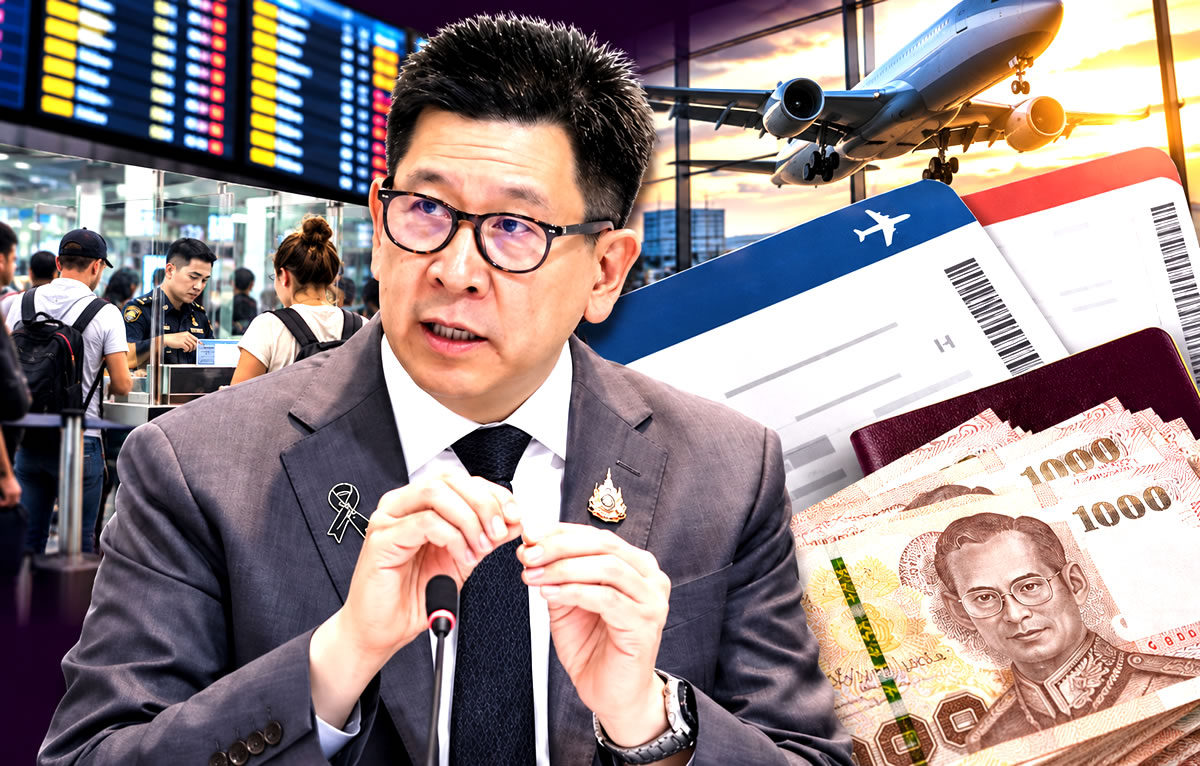
Thailand is moving towards another major travel charge, with a ฿1,000 departure tax now under formal consideration. Crucially, the Finance Ministry-backed proposal would cover foreign tourists as well as Thais. It would apply whenever a qualifying passenger flies out of Thailand. Meanwhile, another ฿450 charge is being prepared specifically for foreign tourists entering the kingdom.
The latest proposal has moved well beyond earlier speculation. The Revenue Department formally opened public consultation on new departure tax legislation on September 30. Consultation runs until October 29.
Notably, the department says the proposed law would apply to “travellers of every nationality”. That wording would bring ordinary foreign tourists directly into Thailand’s departure tax system.
Departure tax would widen 1983 law to all nationalities with a ฿1,000 initial charge for air travel
The change would substantially widen the existing departure tax law. The current legislation dates from 1983 and covers Thais and foreign permanent residents. However, ordinary foreign tourists fall outside that system. Under the proposed replacement, the tax base would expand to include visitors regardless of nationality.
Initially, the government proposes charging ฿1,000 for each qualifying departure by air. Yet the proposed legislation provides scope for significantly higher rates. Specifically, it would establish a statutory ceiling of ฿5,000 for each departure. Thus, the initial rate would stand at only one-fifth of that legal maximum.
The tax would normally be collected through airlines when passengers purchase tickets. Consequently, travellers would not necessarily make a separate payment at the airport. Instead, the departure tax could become another component of the ticket price. Furthermore, the levy would apply to each qualifying departure rather than through an annual payment.
Several exemptions are contained in the proposal. Children aged two years or younger would not pay. Likewise, transit passengers would be exempt from the charge. Certain official categories of travellers would also receive exemptions. In addition, tickets purchased before the legislation became effective would escape the new tax.
Ekniti backs departure tax as tourism industry calculates foreign visitor charges could reach ฿2,570
For now, the proposal remains some distance from implementation. The Revenue Department is collecting public responses until October 29. If ultimately approved, the legislation would take effect 180 days after Royal Gazette publication. Accordingly, passengers leaving Thailand today are not paying the proposed ฿1,000 tax.
Deputy Prime Minister and Finance Minister Ekniti Nitithanprapas has now publicly defended the measure. His explanation has focused heavily on Thais taking holidays overseas. Ekniti says the government wants more Thai travellers spending their holidays inside the kingdom. As part of this, it wants more holiday spending circulating through Thailand’s domestic economy.
The proposal is therefore partly aimed at keeping Thai holiday spending inside the country. Nevertheless, the draft reaches considerably beyond outbound Thai travellers. Foreign visitors would also become liable when leaving Thailand. In effect, the same ฿1,000 initial rate would apply regardless of nationality.
That wider reach has quickly attracted attention from the tourism industry. The Association of Thai Travel Agents is preparing a formal objection. ATTA secretary-general Dr Adith Chairattananon has highlighted the cumulative charges facing foreign visitors. In response, the association calculates that three separate measures could eventually cost a foreign air traveller ฿2,570.
AOT airport charge jumped 53.4% in June and would remain separate from proposed ฿1,000 departure tax
One of those charges is already in force. Airports of Thailand increased its international Passenger Service Charge from ฿730 to ฿1,120 on June 20. The increase added ฿390 to the cost of an international departure. In percentage terms, the charge climbed approximately 53.4%.
The higher rate applies to international departures through Airports of Thailand’s six major airports. These include Suvarnabhumi and Don Mueang, Thailand’s two principal international gateways. Earlier, the increase had been announced and reaffirmed before its introduction. The new ฿1,120 rate formally took effect on June 20, 2026.
Passengers generally do not hand over the ฿1,120 separately at airport counters. Instead, the Passenger Service Charge is incorporated into airline tickets. As a result, affected international travellers already pay it through their fares. Importantly, that charge would remain entirely separate from the proposed ฿1,000 departure tax.
The distinction is central to the emerging cost structure. The ฿1,120 payment is Airports of Thailand’s Passenger Service Charge. It relates to airport facilities and services. By contrast, the proposed ฿1,000 levy would be a government departure tax created under separate legislation.
Therefore, the proposed tax would not replace the existing airport charge. Rather, an affected passenger could ultimately pay both. Combined, those two departure-related charges alone would reach ฿2,120. That figure would apply before considering the government’s separate foreign-tourist entry proposal.
Separate ฿450 tourist entry fee could combine with airport and departure charges to total ฿2,570
On another front, Thailand is preparing a ฿450 entry charge for qualifying foreign tourists. Tourism and Sports Minister Surasak Phancharoenworakul is pushing that proposal forward. Currently, it is moving towards consideration by the National Tourism Policy Committee and Cabinet. Air arrivals are expected to become the first group charged if approval follows.
The ฿450 measure would also include insurance protection for eligible foreign visitors. That protection would cover medical expenses and death benefits under the proposed scheme. Unlike the departure tax, however, the measure specifically targets foreign tourists. Thai travellers would therefore not face that particular charge.
Taken together, the measures create three separate potential costs for a foreign air visitor. First, the traveller could face the ฿450 tourism fee when entering Thailand. Later, the existing ฿1,120 airport charge would apply when flying home. Finally, another ฿1,000 could be added through the proposed departure tax.
The combined figure would reach ฿2,570. Significantly, ATTA has independently made exactly the same calculation. Dr Adith argues that the measures overlap and could add further pressure on tourism businesses. The association is now preparing a formal objection to the departure tax.
ATTA’s board is due to discuss the proposal on October 8. Separately, the Revenue Department consultation will remain open for another three weeks. Interested parties have until October 29 to submit their responses. After that, further government and legislative stages would still be required.
Three travel charges move on separate tracks as ministries pursue different fees with different purposes
The timing has brought Thailand’s different travel charges sharply into focus. Only months ago, passengers departing AOT airports internationally faced a ฿730 service charge. Since June, that figure has stood at ฿1,120. Now, the Finance Ministry-backed proposal could add another ฿1,000 to each qualifying air departure.
In parallel, the Tourism and Sports Ministry is advancing the separate ฿450 tourist levy. Consequently, three different charges are moving along separate tracks. One is already operating, while two remain proposals. Yet all three could ultimately affect the same foreign traveller.
The charges also originate from different parts of the state. Airports of Thailand imposes the existing ฿1,120 Passenger Service Charge. Elsewhere, the Tourism and Sports Ministry is driving the proposed ฿450 foreign-tourist fee. The Revenue Department and Finance Ministry are advancing the departure tax proposal.
Their stated purposes are also different. The airport charge relates to airport facilities and services. Meanwhile, the planned tourism fee includes medical and death insurance protection. Ekniti has linked the departure tax to domestic tourism and retaining more Thai spending inside Thailand.
Foreign tourists could face repeated ฿1,000 departure taxes under draft allowing rates as high as ฿5,000
For affected foreign travellers, however, the arithmetic is straightforward. If all three measures operate, their combined value would reach ฿2,570. Of that amount, ฿1,120 is already collected from relevant international passengers. Another ฿1,450 depends upon two measures that have not yet received final approval.
The proposed departure tax would also transform the reach of Thailand’s existing 1983 legislation. At present, ordinary foreign holidaymakers are outside that system. Under the proposed replacement, travellers of every nationality would fall within its scope. Consequently, short-term tourists could become liable when flying home.
Moreover, the charge would apply each time a qualifying traveller left Thailand. Frequent travellers making several trips could therefore face repeated payments. Each qualifying air departure could attract another ฿1,000 under the initial proposed rate. The legislation would also permit a considerably higher rate later.
The draft places the statutory ceiling at ฿5,000 for each departure. Even so, nothing supplied indicates plans to impose that maximum immediately. The initial proposed air departure rate remains ฿1,000. Any future increase would therefore be separate from the rate currently under consultation.
Ekniti defends departure tax as ATTA prepares objection while three travel charges come into sharper focus
Ekniti’s October 7 defence has placed the proposal firmly into public view. He has stressed the government’s aim of encouraging Thais to holiday domestically. In turn, officials want more spending circulating through the country’s economy. The proposed law, though, would also collect the tax from foreigners leaving Thailand.
At the same time, ATTA’s planned objection provides an immediate industry response. Its concerns focus on the accumulation of separate travel charges. The organisation is considering the issue only months after the airport fee jumped 53.4%. Additionally, the industry is preparing for the proposed ฿450 foreign-tourist charge.
The sequence of measures has developed rapidly during 2026. The airport service charge rose from ฿730 to ฿1,120 on June 20. More recently, the government advanced the ฿450 foreign-tourist entry proposal. Now, the Revenue Department has formally opened consultation on the separate ฿1,000 departure tax.
For foreign tourists, the possible charges would therefore operate at both ends of their journeys. On arrival, qualifying visitors could face the proposed ฿450 tourism levy. On departure, the existing airport charge and proposed tax could total another ฿2,120. Altogether, those charges would reach ฿2,570.
There remains an important distinction between proposals and charges already operating. At present, only the ฿1,120 Passenger Service Charge is being collected. The ฿450 tourist fee has not received final Cabinet approval. Equally, the ฿1,000 departure tax remains under public consultation.
Departure tax still faces consultation and legislation while only the ฿1,120 airport charge is in force
Even after consultation, the new departure tax would require further steps before collection began. The proposal would have to become law and appear in the Royal Gazette. Subsequently, 180 days would pass before commencement under the current plan. Tickets purchased before that point would remain exempt.
For the moment, therefore, travellers leaving Thailand do not pay the proposed ฿1,000 tax. Foreign visitors also do not currently pay the proposed ฿450 entry fee. However, passengers using relevant AOT airports already face the increased ฿1,120 international service charge.
New tourist tax of 450 baht a step closer with officials targeting early 2027 after Cabinet approval is obtained
End of 2026 or early 2027 for tourist levy which has risen to 450 baht and will apply to incoming air passengers
The immediate timetable now centres on two dates. ATTA’s board is due to discuss its formal objection on October 8. Subsequently, the Revenue Department consultation continues until October 29. Those processes will determine the next stage for Thailand’s proposed new departure tax.
Join the Thai News forum, follow Thai Examiner on Facebook here
Follow Thai Examiner on Google here
Receive all our stories as they come out on Telegram here
Follow Thai Examiner here
Further reading:
60-day visa regime to be ended confirms Minister responding to rising industry security concerns
Tourism boss warns Thailand it is facing a Chinese blacklist if another security controversy erupts
Visa waiver scheme questioned with another China Crisis for foreign tourism driven by security fears
Tourism cryptocurrency sandbox payment plan is bound to face stiff opposition from the central bank