Thailand’s economy delivers a Manila surprise: GDP up 2.9%, investment soaring 16.2% and growth forecast lifted to 2.5%. Anutin prepares to sign a Trump trade statement on Tuesday. Yet no final tariff deal is signed and smaller firms face pain and debt.
Prime Minister Anutin Charnvirakul hailed a double economic breakthrough from Manila on Monday as Thailand’s third-quarter GDP growth hit 2.9% and private investment surged 16.2%, its strongest performance in almost 14 years. Flanked by Deputy Prime Minister Ekniti Nitithanprapas and Deputy Prime Minister Suphajee Suthumpun, Anutin welcomed the upgraded annual growth forecast from 2.5%. Meanwhile, Foreign Minister Sihasak Phuangketkeow confirmed that Anutin and US President Donald Trump will sign a landmark trade statement on Tuesday evening. The breakthrough follows months of tough tariff negotiations and Chinese Premier Li Qiang’s visit to Thailand. However, the American deal remains unfinished, its final tariff terms undisclosed, while Thailand’s economic recovery continues to leave smaller businesses behind in an economy choked by rising prices and debt.
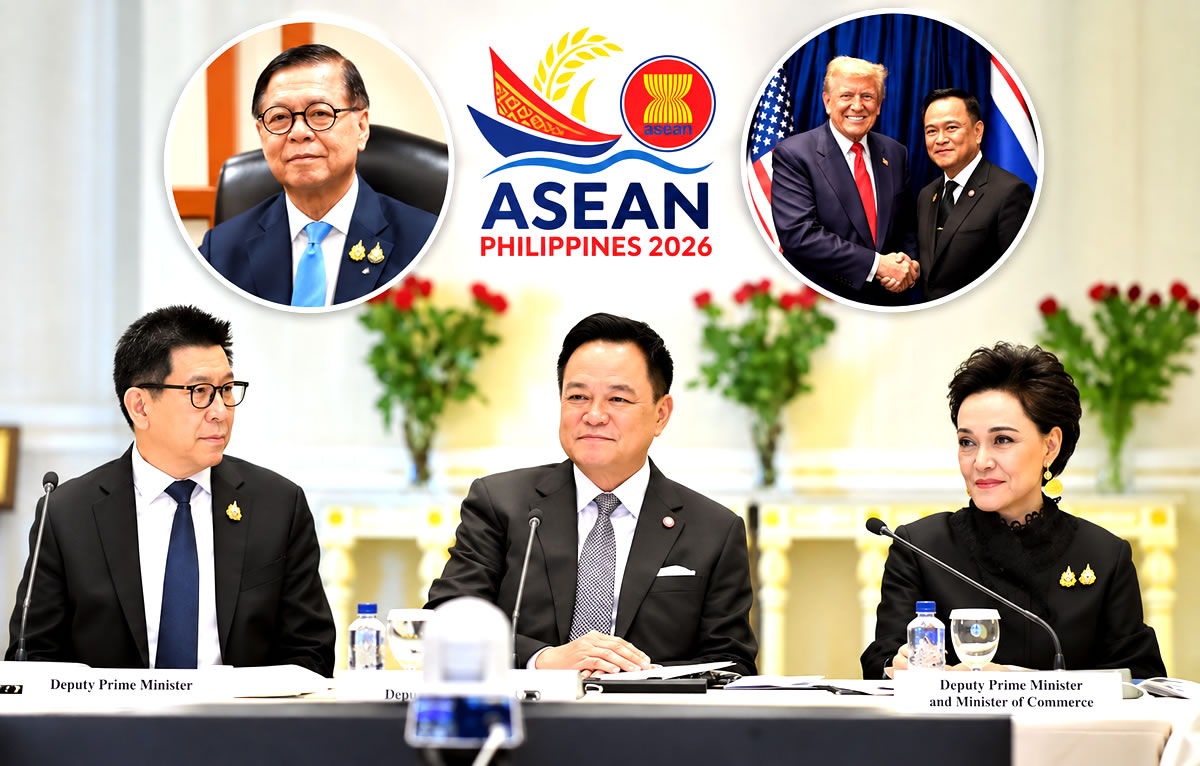
Prime Minister Anutin Charnvirakul received a double economic boost in Manila on Monday as Thailand reported stronger growth and progress on US trade.
Third-quarter GDP expanded by 2.9%, while private investment surged 16.2%, its strongest performance in almost 14 years. Separately, Deputy Prime Minister and Minister of Foreign Affairs Sihasak Phuangketkeow confirmed that Thailand will sign a trade statement with US President Donald Trump.
The ceremony is scheduled for Tuesday evening during the ASEAN Summit in the Philippine capital. However, the final trade agreement remains unsigned, with tariff schedules and legal procedures still outstanding.
Thailand reports stronger GDP growth as revised figures reveal a surge in private sector investment
The announcements followed months of economic uncertainty, international trade tensions and disruption linked to the Middle East conflict. Thailand’s economy recorded stronger annual growth despite pressure from energy prices and international commercial restrictions.
Meanwhile, Bangkok secured agreement with Washington on the principal elements of a proposed reciprocal trade arrangement. Both developments followed Chinese Premier Li Qiang’s three-day visit to Thailand, which produced eight cooperation agreements.
On Monday, November 16, the National Economic and Social Development Council (NESDC) released Thailand’s third-quarter economic figures. Gross domestic product expanded by 2.9% year on year, compared with 2.4% during the previous quarter.
Private investment delivered the most striking result, climbing 16.2% as businesses increased spending on machinery and equipment. The NESDC also raised its full-year growth forecast to 2.5%, following stronger performance during the first nine months.
The figures were calculated using the NESDC’s revised national accounts methodology. This incorporates updated economic data, classifications and statistical calculations.
Consequently, comparisons with older GDP estimates require care because revisions can change previously reported economic performance. The annual figures nevertheless showed faster growth, although the underlying quarterly expansion remained modest.
Private investment surges to a 14-year high despite modest quarterly GDP growth and uneven output
Thailand’s seasonally adjusted GDP increased by just 0.3% between the second and third quarters. In addition, the NESDC revised second-quarter growth on this basis to 0.0%. The 2.9% headline figure therefore represents annual growth rather than expansion over three months. That distinction remains important when assessing the strength of the latest recovery.
Notably, private investment reached its highest growth rate in almost 14 years. Investment in machinery and equipment jumped 20.5%, reflecting substantial business spending on productive assets.
The overall investment increase was also the strongest in 55 quarters. Furthermore, Finance Minister Ekniti Nitithanprapas reported three consecutive quarters of double-digit investment growth.
Industrial production also strengthened, expanding by 3.6%, compared with 2.3% during the preceding quarter. Services maintained growth of 2.6%, while agricultural growth eased slightly from 1.4% to 1.3%.
In parallel, private consumption improved from 2.1% to 2.5%, providing another indication of stronger domestic demand. Purchases of durable consumer goods rose 12.6%, including a 20.9% increase in vehicle purchases.
Anutin welcomes stronger growth figures from Manila but warns of global risks and economic pressures
Across the first nine months of 2026, Thailand’s economy expanded by 2.8%. The NESDC subsequently increased its full-year forecast to 2.5%.
Nevertheless, officials continued to identify international trade restrictions, geopolitical instability and energy prices as major risks. The Middle East conflict remained particularly important because of its impact on energy markets and international commercial activity.
Prime Minister Anutin Charnvirakul welcomed the figures in a Facebook statement issued from Manila on Monday. He published a photograph alongside Deputy Prime Minister and Minister of Finance Ekniti Nitithanprapas.
Deputy Prime Minister and Minister of Commerce Suphajee Suthumpun also appeared in the photograph. The Prime Minister presented the figures as evidence of stronger economic performance following a difficult period.
Anutin cited geopolitical volatility, the Middle East conflict, energy price pressures and uncertainty surrounding international trade. He said Thailand had faced serious economic challenges throughout 2026.
Despite those pressures, the latest figures showed faster annual growth and a substantial increase in private investment. However, he stressed that the sources of growth mattered more than the headline GDP figure alone.
Prime Minister points to technology investment and stronger spending while smaller firms still struggle
The Prime Minister wanted to establish which sectors were improving and whether the benefits were reaching ordinary households. He highlighted the 16.2% investment increase and the 20.5% rise in machinery and equipment spending.
According to Anutin, businesses were investing in technology, digital industries, artificial intelligence and manufacturing. These sectors featured prominently in his assessment of the latest economic figures.
The investment surge also coincided with stronger private consumption. Household spending increased from 2.1% to 2.5%, while vehicle purchases recorded a particularly sharp rise.
Even so, Anutin acknowledged that stronger national figures did not mean every business or household was recovering. Smaller enterprises, service operators and ordinary households continued to face financial difficulties.
In response, the government would maintain measures addressing immediate economic pressures while pursuing longer-term investment. These included efforts to reduce living costs and improve access to finance for smaller businesses.
Anutin also identified energy, technology and basic industries as priorities for future investment. The administration would continue seeking foreign capital while supporting domestic employment and commercial activity.
Government seeks Thai jobs and technology transfers as Ekniti highlights sustained investment growth
Another priority involves ensuring that foreign investment benefits Thai suppliers and workers. Anutin wants international investors to purchase more Thai products for their supply chains.
He also identified employment of Thai personnel and technology transfers as government objectives. As part of this approach, foreign companies would be encouraged to share technical knowledge and strengthen domestic industrial capabilities.
The Prime Minister welcomed the NESDC’s upgraded 2.5% growth forecast but warned against overlooking external risks. International trade measures, energy costs and geopolitical developments remained serious uncertainties.
Accordingly, the government would continue addressing household financial pressures while attracting investment into strategic industries. Anutin linked these efforts to employment, incomes and Thailand’s longer-term economic competitiveness.
Finance Minister Ekniti Nitithanprapas separately welcomed the latest investment figures. He said Thailand’s investment-led economic policy was beginning to produce measurable results. Private investment had recorded double-digit growth for three consecutive quarters, reaching its strongest rate in 55 quarters. The figures showed substantial business expenditure despite continuing financial difficulties elsewhere in the economy.
Ekniti warns of uneven recovery as Thailand and the United States reach agreement on trade principles
Yet Ekniti acknowledged that the recovery remained uneven. Large companies were benefiting from increased investment, while many smaller enterprises continued to struggle.
He described the situation as a K-shaped recovery, with different parts of the economy moving in different directions. Strong investment growth had therefore not eliminated financial pressures among smaller businesses and households.
The Finance Ministry was working with the Bank of Thailand on additional financial support. Measures included improved credit access and debt relief for smaller enterprises. In a separate initiative, Ekniti was preparing to lead a private-sector delegation to Japan from November 17 to 21. The mission would pursue investment and commercial opportunities across seven targeted industries.
On another front, Manila delivered a significant development in Thailand’s negotiations with Washington. Deputy Prime Minister and Minister of Foreign Affairs Sihasak Phuangketkeow confirmed progress on Sunday, November 15.
He announced that Thailand and the United States had agreed on the main principles of a reciprocal trade arrangement. The announcement cleared the way for a joint statement involving both countries’ leaders.
Anutin and Trump prepare for Manila signing after both governments settle main terms of trade talks
Prime Minister Anutin Charnvirakul and US President Donald Trump were scheduled to sign the statement on Tuesday, November 17. The ceremony was planned for 7.30 pm Philippine time, equivalent to 6.30 pm in Bangkok.
It would take place during Trump’s participation in the special ASEAN–US summit. The signing would formally acknowledge progress following lengthy negotiations over tariffs and market access.
According to Sihasak, both governments had reached agreement on the broad terms of the proposed arrangement. He said the negotiations had reached a position satisfactory to both sides.
Moreover, he dismissed suggestions that Trump might use the Manila meeting to demand additional tariff concessions. The American president had other matters to discuss during the summit, the Foreign Minister explained.
Sihasak identified market access as a central issue throughout the negotiations. Washington sought commitments covering additional Thai purchases of American goods. Discussions also addressed Thai investment in the United States and greater American access to Thai service markets. Together, these issues formed the principal commercial elements identified by the Foreign Minister.
Washington presses Thailand over trade surplus as Bangkok fights to protect exports and lower tariffs
The negotiations reflected Washington’s concerns about its substantial trade deficit with Thailand. Thailand runs a considerable trade surplus with the United States, creating pressure for changes in bilateral commerce.
Consequently, American negotiators sought increased exports and wider access to Thailand’s economy. Bangkok concentrated on preserving its export market while securing the lowest possible tariffs.
Sihasak acknowledged the importance of the United States as a destination for Thai exports. He maintained that Thailand had defended its commercial interests throughout the discussions.
Nonetheless, he recognised that continued access to the American market required an agreed arrangement. The negotiations therefore involved difficult decisions concerning imports, investment and service-sector access.
The Foreign Minister said both governments had reached agreement on the substantive elements. However, the detailed commitments remained unpublished on Monday.
The proposed statement would acknowledge the negotiating outcome without immediately implementing every commercial provision. Further legal procedures would be required before the full agreement could take effect.
Suphajee confirms US trade statement is not a final deal as legal scrutiny and consultations remain
Deputy Prime Minister and Minister of Commerce Suphajee Suthumpun confirmed the signing arrangements on Monday. She also clarified the status of the document following reports describing Tuesday’s ceremony as a trade deal signing.
The White House had characterised the event in those terms. However, Suphajee stressed that the document would not constitute the completed Agreement on Reciprocal Trade.
Instead, the statement would confirm agreement on the principal elements of the negotiations. The full agreement would still require legal examination and completion of domestic procedures. Thailand’s Cabinet had already approved the joint statement on November 10. That approval, however, did not eliminate the remaining requirements for the final agreement.
The outstanding procedures include legal scrutiny, further Cabinet consideration, public consultation and relevant parliamentary processes. The United States must also complete its own domestic requirements.
Thai reporting indicated that legal examination could take at least one or two months. Consequently, Tuesday’s ceremony would not immediately establish every tariff rate or commercial obligation.
No new US tariff rate confirmed as Anutin cites 19% expectation and earlier agreement on American imports
Crucially, no new American tariff rate was confirmed in Monday’s announcement. The joint statement was expected to acknowledge the negotiating outcome without publishing all substantive commitments.
Businesses must therefore await the completed agreement before the full commercial consequences become clear. The final document must establish tariff schedules, product coverage and implementation dates.
Earlier, on November 5, Anutin said Thailand expected a tariff of approximately 19% under the proposed arrangement. He also indicated that existing tariff arrangements would continue until the principal agreement was signed.
However, the 19% figure remained an expectation rather than a newly confirmed rate on Monday. The final agreement must clarify the treatment of affected Thai exports.
The negotiations build on a framework announced by Anutin and Trump in October 2025. Under that framework, Thailand agreed to eliminate tariffs on approximately 99% of American goods. This represents a substantial proposed opening of the Thai market to American imports. Nevertheless, the changes depend on the final agreement taking effect.
Exporters await final US tariff schedules as Bangkok seeks protection against further US trade measures
Lower import duties could apply to numerous American products under the arrangement. However, the detailed schedules and implementation dates had not been published. The agreement must also establish how different categories of Thai exports will be treated. Individual products may face different rates or exemptions under American trade measures.
The supplied trade bulletin also identified a 12.5% tariff affecting Thai goods under Section 301 of American legislation. That rate had reportedly applied since July 24, with approximately 2,120 Thai product lines exempt.
However, the precise treatment of individual products remains subject to applicable American measures and the final agreement. A headline tariff figure does not necessarily apply uniformly across every export category.
Bangkok also hopes progress towards the agreement will strengthen its position in future American tariff decisions. These include measures concerning excess industrial production capacity and trade practices.
Meanwhile, purchasing commitments under discussion could increase American exports to Thailand. Thai investment in the United States formed another important negotiating element, alongside access to Thai service markets.
Trade breakthrough follows Chinese premier’s visit but major rice purchase and railway issues remain open
The immediate achievement was agreement on the principal negotiating terms. Nevertheless, the commercial obligations remain subject to the final document and its implementation.
The statement would therefore mark a political agreement rather than completion of every legal requirement. Exporters and importers must still await the published tariff schedules and product-specific provisions.
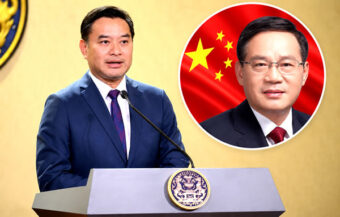
The developments followed Chinese Premier Li Qiang’s three-day visit to Thailand. That visit produced eight cooperation agreements covering security, electric vehicles, agriculture and industrial development.
The agreements included automotive manufacturing, batteries and industrial supply chains. However, several major proposed commercial arrangements remained outstanding after the Chinese premier’s departure.
These included a proposed Chinese purchase of 500,000 tonnes of Thai rice. Questions concerning railway financing also remained unresolved.
Consequently, Anutin’s Manila programme followed significant economic engagement with both Beijing and Washington. China remains deeply involved in Thailand’s manufacturing and industrial supply chains, while the United States represents a major export market.
Thailand balances Chinese investment and US market access while recovery leaves smaller businesses behind
The two relationships involve different but substantial commercial interests. Beijing’s latest agreements focused partly on industrial cooperation and manufacturing. Washington’s negotiations concentrated on tariffs, market access, purchases and investment commitments. In each case, Bangkok is seeking commercial arrangements involving major economic partners.
The timing placed Thailand’s domestic economic performance alongside its international trade negotiations. Private investment was accelerating while Bangkok pursued new commercial commitments abroad.
However, the NESDC’s figures also exposed limits to the recovery. Annual GDP growth improved, but seasonally adjusted quarterly expansion remained modest at 0.3%.
Industrial production and private consumption recorded stronger performances, while services maintained their previous growth rate. Agricultural growth eased slightly. Furthermore, the investment surge was not matched by equivalent improvements across every sector. Ekniti’s warning about smaller businesses reinforced the uneven nature of the recovery.
Large companies were expanding investment, but many smaller enterprises continued to face credit and debt pressures. The Finance Ministry’s proposed measures reflect those continuing difficulties. Anutin also acknowledged the problem in his Manila statement.
He said the government would continue supporting household incomes, employment and smaller businesses while attracting further investment.
Anutin heads for Trump signing with stronger GDP but final tariffs and legal terms still unresolved
For the remainder of 2026, the NESDC’s revised 2.5% forecast provides the latest official economic projection. Thailand’s economy had expanded by 2.8% during the first nine months.
Nevertheless, international energy prices, geopolitical instability and trade restrictions remained risks identified by the government. The Middle East conflict and uncertainty surrounding global commerce featured prominently in Anutin’s assessment.
Tuesday’s scheduled signing with Trump represents the next stage in negotiations with Washington. It will formally acknowledge agreement on the main principles of the proposed trade arrangement.
However, final tariff schedules, market-access commitments and implementation dates remain outstanding. Both governments must complete their domestic procedures before the agreement can take effect.
Chinese PM flies in Friday for high level talks with Anutin before Thailand signs a US trade communiqué in Manila
Thailand’s GDP may get a bump up from the 3rd quarter after recent economic agency talks with PM Anutin
The immediate results from Manila were substantial but clearly defined. Thailand recorded faster annual GDP growth, a 16.2% investment surge and an upgraded economic forecast.
At the same time, Bangkok secured confirmation of a planned trade statement with the American president. The announcement followed lengthy negotiations covering tariffs, purchases, investment and access to service industries.
For Anutin, Monday delivered stronger economic figures and a confirmed diplomatic engagement with Trump. However, the final American trade agreement remains unfinished, while the domestic recovery remains uneven.
The Prime Minister enters Tuesday’s ceremony with investment growth at a 55-quarter high and annual GDP growth of 2.9%. The remaining trade process must establish final tariffs, commercial obligations and implementation dates before the agreement becomes effective.
Join the Thai News forum, follow Thai Examiner on Facebook here
Follow Thai Examiner on Google here
Receive all our stories as they come out on Telegram here
Follow Thai Examiner here
Further reading:
Three Chinese nationals rescued by police in Tak province near Burma. Police top brass want answers
Tourism chiefs furious as another Chinese abduction and a spat with the Embassy threaten bookings
Thailand losing appeal to Chinese tourists despite a gain in numbers from last year as Vietnam rises