Political heat rises over Thailand’s arsenic crisis as grim ‘zombie fish’ images fuel public outrage. Pollution hits 28 times the limit, while mining spreads in Burma and Laos. Protesters target Beijing as Anutin faces a November 22 showdown in Chiang Rai.
Political pressure is mounting on Prime Minister Anutin Charnvirakul as Thailand’s worsening arsenic pollution crisis fuels growing public anger. Shocking images of diseased “zombie fish” have intensified fears over toxic contamination spreading through the Mekong River. Meanwhile, more serious protests are planned as the crisis widens to include suspected gold mining operations in neighbouring Laos. Arsenic readings have reached 28 times permitted levels, while water supplies, fisheries and agriculture face growing threats. Opposition politicians are demanding direct intervention by China over mining operations in Burma and Laos linked to Chinese investment and mineral demand. However, Bangkok has secured no agreement to close suspected polluting mines. With a major protest scheduled for November 22, the government faces mounting demands for action before crucial talks with Burma and China.
Thailand faces mounting political pressure over a worsening arsenic contamination crisis threatening the Mekong River and its northern tributaries. Toxic readings have reached 28 times permitted levels, disrupting water supplies and threatening agriculture and fisheries.
Meanwhile, photographs of diseased fish have intensified public alarm over heavy-metal pollution. Environmental groups blame expanding mining operations in Burma and Laos, with Chinese investment and mineral demand under scrutiny.
Opposition politicians and senators are demanding direct intervention by Beijing. However, Prime Minister Anutin Charnvirakul’s government has secured no confirmed agreement to close the suspected polluting mines. A major demonstration is planned for November 22 as affected communities demand concrete action.
Contaminated Chiang Rai rivers expose expanding Burma mines and growing Chinese mineral trade links
The crisis is particularly severe in Chiang Rai, where contaminated rivers flow into Thailand from Burma’s Shan State. Mining operations are expanding across the frontier, including territories beyond the central government’s effective control.
Notably, the Sai, Kok and Ruak rivers have recorded serious contamination. Environmental campaigners have also identified further mining activity along the Mekong opposite Laos. The dispute has brought mounting pressure from residents, opposition politicians, senators and environmental organisations.
China is increasingly central to the confrontation. Chinese investors have been linked to regional mining operations, while Chinese industry purchases substantial quantities of extracted minerals.
In parallel, Thailand participates in the mineral supply chain through ore imports and chemical exports. Opposition politicians are consequently demanding investigations into Thai companies, Chinese investors and mineral shipments. They also want Beijing to intervene directly against operations responsible for contamination.
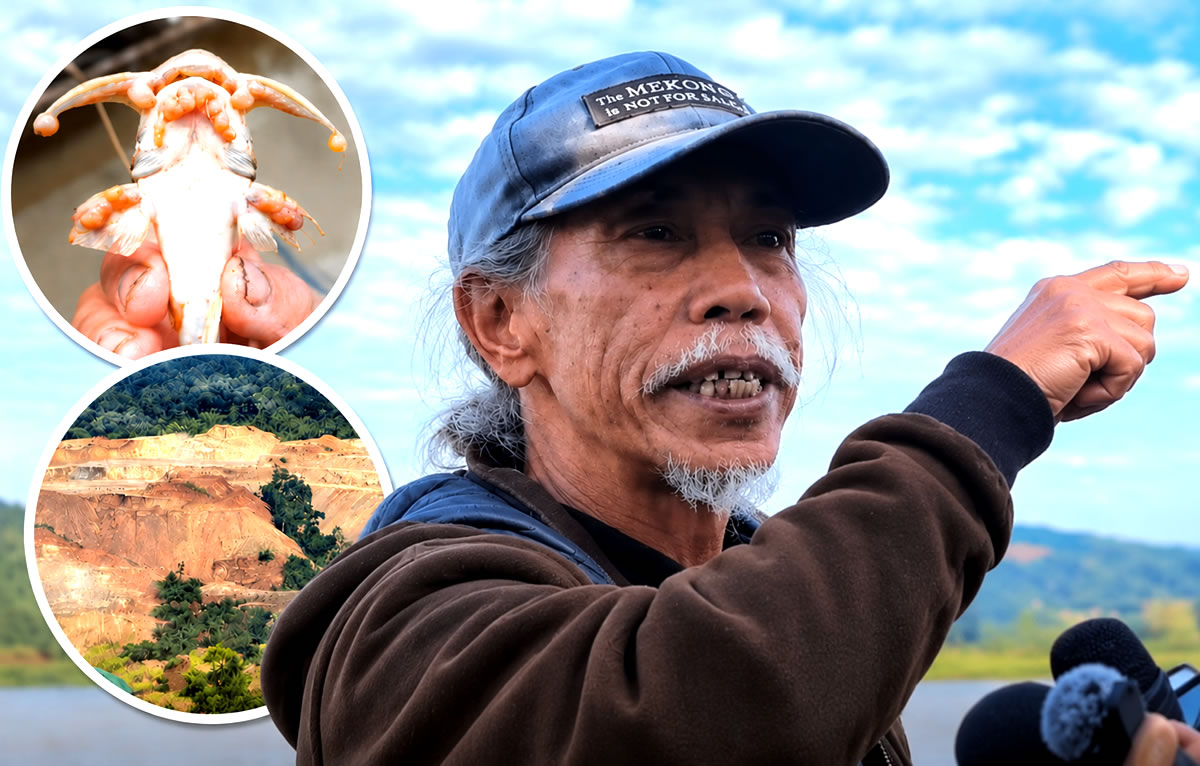
The latest alarm followed photographs of badly affected Mekong catfish circulated by environmental activist Aombun Thipsuna on November 14. The fish, known locally as pla khae, displayed swollen blisters, open sores, unusual growths and discoloured fins. Some residents have begun calling them “zombie fish”.
Diseased Mekong catfish raise fresh fears as fishermen report blisters, sores and worsening symptoms
According to Aombun, fishermen have reported similar abnormalities since the period following the Covid-19 pandemic. She suspects prolonged heavy-metal contamination may be weakening the fish’s immune systems and increasing their vulnerability to disease.
However, scientists have not established that arsenic or other heavy metals caused the abnormalities. Disease, parasites and other environmental factors remain possible explanations. Aombun said she and local fishermen collected nearly 60 fish for examination at Naresuan University.
Of those, around six displayed pronounced blisters and sores. Another 30 to 40 showed earlier symptoms, including reddened fins and tails. Some had developed small blisters, while others appeared seriously affected.
The findings have intensified concern about the health of Mekong fish populations. The pla khae is a valuable species that can grow to 60 kilogrammes. Aombun warned that seriously affected fish could die before reaching maturity.
Separately, monitoring by Pollution Control Department Region 9 in Udon Thani has identified rising heavy-metal concentrations since 2023, according to Aombun. She said contamination increased more sharply between 2024 and 2026.
Arsenic reaches 28 times the limit as Mae Sai waterworks cuts production and 14 villages lose supplies
In August, arsenic measurements in parts of Loei and Nong Khai reportedly reached three to four times Thailand’s standard. The permitted concentration is 0.01 milligrams per litre. By comparison, readings in northern rivers have been considerably higher.
Senator Nantana Nantavaropas reported arsenic concentrations reaching 28 times the permitted level. The contamination has already disrupted water infrastructure in Chiang Rai, raising concerns about the security of local supplies.
On November 5, the Provincial Waterworks Authority’s Mae Sai branch encountered exceptionally polluted raw water from the Sai River. Turbidity reportedly reached 14,000 nephelometric turbidity units, overwhelming conventional treatment equipment.
As a result, water production fell to 60% of normal capacity. Disruptions affected 14 villages between November 5 and 8. The authority subsequently increased monitoring and assured residents that treated tap water remained safe.
Officials are testing raw and filtered water for arsenic and turbidity every 30 minutes. Despite those assurances, residents have reported discoloured tap water and skin irritation. Some have switched to bottled water and stopped eating locally caught fish.
Health screening finds elevated arsenic readings as Mekong irrigation raises fears for farms and markets
On another front, health authorities have identified elevated arsenic measurements among people screened during 2026. Figures released on November 16 showed that 10,711 people had undergone screening, with officials collecting 1,269 urine samples.
Of those tested, 94 individuals recorded total arsenic concentrations above reference values. However, these findings do not establish arsenic poisoning or identify a particular mine as the source. Further investigation is required to determine the significance of the results.
Beyond household water supplies, the contamination has raised concerns across Thailand’s agricultural sector. Communities throughout the northeast depend heavily on the Mekong for irrigation.
Aombun said nearly 2,500 pumping stations along the Mekong supply agricultural water across seven northeastern provinces. Produce grown in these areas reaches major markets, including Talad Thai and Si Mum Mueang.
Accordingly, campaigners are demanding extensive testing of irrigation water, agricultural produce, fish and river sediment. In parts of Nong Khai, Aombun also reported water-quality problems affecting communities in Sangkhom and Phon Phisai districts.
Burma’s fragmented control leaves Thai authorities struggling to reach expanding mines across the border
The findings have increased pressure on the government to identify contamination sources and prevent further discharges. Yet the suspected mining operations lie outside Thai territory. Many are situated in Shan State, where ethnic armed organisations exercise substantial territorial control. The United Wa State Army controls extensive territory. Its possible involvement in mineral supply chains has become a focus of opposition scrutiny.
Consequently, agreements with Burma’s central government may not provide effective control over mines operated under other authorities. An August 2026 United Nations human rights report identified environmental damage associated with poorly regulated extraction in Burma.
The report linked downstream contamination indicators to upstream mining activity. It also highlighted weak governance and expanding unregulated extraction following Burma’s military coup.
Fresh observations suggest mining activity near the Thai border is continuing to expand. On November 14, Deputy Interior Minister Jeseth Thaiseth inspected operations across the frontier from Chiang Rai.
He travelled to Ban Phaya Phrai in Thoet Thai subdistrict, Mae Fa Luang district. From the Thai side, Jeseth examined mining around Doi Ko Wan and Mong Kan in Shan State. Previously, he had studied satellite images of the mining areas.
Deputy minister warns Burma mines could double as Bangkok examines Chinese links and mineral shipments
The deputy minister reported seeing at least ten additional cleared sites. He warned that the operations could double in size within a year. Large areas of land remained available for expansion, he said.
Furthermore, several mining sites were situated close to villages and streams feeding the Sai River. The inspection followed instructions from Prime Minister Anutin Charnvirakul, who also serves as interior minister.
Anutin ordered officials to investigate mining companies, processing plants, chemicals and mineral transport routes. He also demanded information about possible involvement by Thai individuals and businesses.
Jeseth said preliminary findings suggested some ore from the area entered Thailand. However, rare earth minerals and gold appeared to be transported elsewhere, particularly towards China. He also referred to information linking Chinese investors with mining operations in neighbouring countries.
In response, the deputy minister called for Thailand and China to examine mineral supply chains together. According to Jeseth, the Cabinet had discussed applying commercial pressure alongside diplomatic negotiations.
One possibility involved greater scrutiny of companies importing minerals from neighbouring countries. Nevertheless, the government had not decided on specific legal measures. Jeseth said further information and consultations with Chinese and Burmese authorities were necessary.
Thai ore imports surge as claims of Chinese-backed mines and chemical exports prompt fresh investigations
The findings were scheduled for discussion with Chinese officials during talks running from November 16 to 18. Separately, environmental and health academic Sonthi Kotchawat raised concerns about Thailand’s involvement in the mineral trade.
In a Facebook statement on November 13, Sonthi claimed more than 50 Thai companies purchased ore from Burmese mines. He said many mining operations were leased to Chinese investors.
According to Sonthi, minerals were transported through Thailand and shipped from Laem Chabang port to China. He also claimed Thailand exported more than $100 million worth of mining chemicals to Burma annually.
These included sodium cyanide and industrial acids. The claims have added another dimension to demands for government action. Opposition politicians want authorities to examine mining operations and the companies supplying chemicals, transporting ore and handling exports.
Official import figures show a dramatic increase in Thailand’s antimony ore trade. Imports rose from just 76 tonnes in 2023 to 42,217 tonnes in 2024. They climbed further to 68,919 tonnes in 2025.
Crucially, those figures do not establish that the imported minerals originated from polluting mines. Nevertheless, the scale of the increase has strengthened opposition demands for greater scrutiny of mineral supply chains.
Opposition takes mining evidence to Chinese ambassador as protesters clash with police in Chiang Mai
People’s Party MP Pattharapong Leelaphat has called for investigations into mineral shipments, their origins and the companies involved. He also wants authorities to examine operations in territories controlled by the United Wa State Army.
Additionally, Pattharapong has urged Thailand, Burma, China and Laos to cooperate on inspections and water-quality monitoring. The opposition has already taken its complaints directly to Chinese diplomatic representatives.
On July 15, People’s Party leader Natthaphong Ruengpanyawut and Pattharapong submitted evidence to Chinese Ambassador Zhang Jianwei.
Their submission included water and sediment measurements, research findings and coordinates identifying 2,676 mining sites across the region. They demanded an investigation into possible Chinese involvement. The opposition also requested a written response that could be communicated to affected Thai communities.
Earlier demonstrations had already brought the dispute to Chinese diplomatic missions. On July 6, environmental campaigners marched towards the Chinese Consulate-General in Chiang Mai.
They demanded action against suspected Chinese-backed mining operations in Burma. However, police erected barriers and intercepted the procession. Two protesters were injured during clashes, including one who suffered a dislocated shoulder.
Chinese embassy faces protests as senator attacks offials over missing mining deal and water shortages
Campaigners demanded investigations into investors, mineral shipments and environmental damage. They also called for mine inspections and compensation for affected communities.
Elsewhere, protests outside the Chinese Embassy in Bangkok prompted a formal response from Beijing. The embassy acknowledged concerns about environmental contamination and public health. However, it called for a joint Thailand-Burma investigation based on scientific evidence. China has not publicly accepted responsibility for the pollution.
Political pressure intensified during Chinese Premier Li Qiang’s November visit to Thailand. On November 16, Senator Nantana Nantavaropas criticised the government’s handling of the crisis during a statement at Parliament.
She noted that Thailand and China had signed eight agreements during Li’s visit. Yet none addressed rare earth mining in Shan State or its effects on northern Thai rivers, she said.
Nantana demanded direct negotiations with Beijing. She argued that Chinese investment in mining operations made China’s involvement essential to resolving the dispute.
The senator also criticised ministers for concentrating on public demonstrations of water-treatment equipment. She said only two reverse-osmosis machines were available, while more than 20,000 households in Mae Sai required water. Nantana accused ministers of prioritising publicity over practical solutions.
Chiang Rai residents challenge Chinese testing laboratory as Thailand seeks fresh talks with Burma
The senator said arsenic readings reaching 28 times the permitted level threatened water production. Moreover, she argued that negotiations with China were essential because of Chinese involvement in mining operations.
Her criticism followed public objections to a proposed Thailand-China pollution-testing laboratory at Mae Fah Luang University. On November 12, Chiang Rai residents questioned the value of another testing facility without action against the mines.
The proposed laboratory would improve monitoring capacity. However, it would not provide authority to close mining operations across the border. Meanwhile, Foreign Minister Sihasak Phuangketkeow has pursued negotiations with Burma.
On November 12, the Deputy Prime Minister and Minister of Foreign Affairs travelled to Naypyidaw. He met Burma’s leader Min Aung Hlaing and senior officials. Their discussions covered river contamination, border security and other bilateral issues.
Subsequently, both governments agreed to accelerate their Joint Working Group on Water Quality Management. The next meeting is scheduled for November 25 and 26. Officials are expected to discuss mining pollution, monitoring stations and possible participation by representatives from Shan State.
Thailand also wants Chinese technical assistance and greater access to information about upstream operations. However, Sihasak acknowledged that any temporary suspension of mining would require further discussion.
No mine closures agreed as campaigners identify suspected gold dredging sites across the Lao Mekong
No confirmed agreement to close suspected polluting mines emerged from the talks. Accordingly, the government remains dependent on further negotiations to secure controls over mining operations beyond its borders.
On another front, the dispute is widening along the Mekong opposite Laos. On November 14, journalists and environmental campaigners surveyed the river between Ban Muang Kan and Chiang Khong. They identified machinery and dredging activity on the Lao side.
Niwat Roikaew, chairman of the Rak Chiang Khong group, said the operations involved gold extraction rather than ordinary sand dredging. Known locally as Kru Tee, Niwat described backhoes excavating riverbed material onto conveyor belts.
The material was then washed to separate gold. According to Niwat, the equipment moved between locations and excavated sections of the riverbed.
At Haad Hae, opposite Ban Muang Kan, operations had reportedly stopped two days before the inspection. Nevertheless, Niwat said the machinery and extraction methods identified during the survey were consistent with gold mining. Environmental groups have identified at least 15 suspected dredging sites between Bokeo and Pak Beng.
Lao authorities have reportedly described some operations as sand extraction. However, the observations have not independently established that every site is mining gold or causing arsenic contamination.
Mekong dredging raises sediment fears as satellite survey identifies hundreds of mines across the basin
Niwat warned that disturbing riverbed sediment could release contaminants. He identified arsenic, mercury and cadmium among the substances requiring investigation. Furthermore, the activist raised concerns about the proposed Pak Beng Dam.
He said slower water flows could allow contaminated sediment to accumulate in the reservoir. The prospect has added another concern for communities already facing uncertainty about the river’s condition.
Pienporn Deethes, Secretary-General of the Community and Mountain Area Development Foundation and Rivers and Rights, reported extensive regional mining activity. She cited satellite imagery analysed by the United States-based Stimson Centre.
According to Pienporn, the analysis identified more than 800 mining sites within the Mekong basin. Nearly 3,000 sites were identified across the wider region. Some operations reportedly continue around the clock.
Pienporn said monitoring by Pollution Control Department Region 1 had detected heavy metals along the Thai-Lao border. Arsenic contamination was recorded from Sop Ruak and Sop Kok towards Chiang Khong.
Mekong water supplies face arsenic risk as campaigners demand wider talks and prepare Mae Sai protest
The affected Mekong stretches supply raw water for regional, municipal and village water systems. Consequently, Pienporn called for discussions involving Thailand, Laos and the Mekong River Commission. She also questioned whether certain mining activities should require prior consultation because of possible cross-border impacts.
The Mekong River Commission provides a framework for cooperation among lower-basin countries. However, Pienporn said existing arrangements did not adequately address pollution originating in the upper basin.
She also criticised the limited effectiveness of the China-led Lancang-Mekong Cooperation framework in resolving the contamination dispute. Civil society groups have already sent protest letters to the Prime Minister and Foreign Minister.
They have also contacted the Department of Treaties and Law and the National Water Resources Office. In addition, provincial authorities have begun using diplomatic channels and border mechanisms to raise complaints with neighbouring countries.
A fresh public demonstration is scheduled for November 22 at the Mae Sai border checkpoint. Niwat said participants would gather from 1 pm to demand urgent action against toxic river contamination.
River Resistance campaign spreads as fishing and farming losses deepen pressure on Thai government
The planned protest follows months of complaints, diplomatic submissions and community campaigns. Environmental organisations have also expanded their activities beyond northern Thailand.
The River Resistance initiative has brought together artists from Thailand and ten other countries. Its exhibitions and performances have highlighted mining pollution and its effects on riverside communities. Activities have also extended to the Bangkok Art and Culture Centre.
Beyond the protests, fishermen report difficulty selling catches because consumers fear contamination. Farmers face uncertainty about irrigation water, while local authorities must fund additional monitoring and alternative supplies.
The growing economic consequences have widened the dispute beyond environmental organisations. Residents want reliable water supplies, while businesses and agricultural communities face continuing uncertainty about contamination levels.
For Bangkok, the approaching diplomatic meetings will take place against growing demands for enforceable measures. Thailand can monitor contaminated rivers, expand treatment capacity and investigate domestic mineral trading.
However, it cannot directly regulate mines operating inside Burma or Laos. That requires cooperation from neighbouring authorities, including those exercising effective control over individual mining territories.
China’s involvement remains central to the political dispute because of reported Chinese investment and demand for extracted minerals. Nevertheless, ownership of individual mines and responsibility for specific pollution releases remain under investigation.
Bangkok faces crucial Burma talks and further protests without agreement to shut suspected polluting mines
The November 25–26 meeting with Burma will therefore face close scrutiny. So will the outcome of Thailand’s latest discussions with Chinese officials.
Residents are demanding identification of the mines responsible, controls on discharges and reliable water supplies. Opposition politicians are pressing for investigations into investors, mineral buyers and transport companies.
Meanwhile, the November 22 demonstration will provide another indication of public dissatisfaction. The government has announced monitoring initiatives, diplomatic discussions and possible commercial restrictions.
Chiang Rai river basin findings ramp up the pressure on Thailand to act over poison flowing from Burma
Bangkok protest anger over northern rivers poisoned by Chinese-backed firms near the Thai border erupts
Chiang Mai MP raises alarm about government inactivity in the face of an arsenic river poisoning crisis
Yet no confirmed mine closures or enforceable cross-border pollution controls have been announced. Mining operations are reportedly expanding near the border, while arsenic contamination has already disrupted water supplies.
At the same time, photographs of diseased fish have raised fresh questions about the condition of the Mekong’s aquatic life. Chinese diplomatic missions have already faced protests, while opposition politicians are demanding direct answers from Beijing.
The government has opened discussions with China and Burma. However, the central issue remains unresolved. No agreement has yet been confirmed that would stop the suspected polluting operations or prevent further contamination from entering Thailand. With another demonstration approaching and fresh diplomatic meetings scheduled, Bangkok faces increasing pressure to produce measurable results.
Join the Thai News forum, follow Thai Examiner on Facebook here
Follow Thai Examiner on Google here
Receive all our stories as they come out on Telegram here
Follow Thai Examiner here
Further reading:
River Kok in Chiang Rai poisoned with arsenic from Wa state-controlled gold mining across the border
Rangsiman Rome MP calls for stiffer response to Myanmar’s junta over the jailing of Thai sailors
Myanmar Junta meltdown threatens to end Bangkok’s condominium sales boom as Kyat currency fails