Arsenic in Chiang Rai farmland raises the stakes for Bangkok. Tests find 20% of sampled soils over limits and another 50% requiring checks. Farmers face crop changes and no compensation plan as pollution linked to mining in Burma evades Thai control.
Thailand’s arsenic pollution crisis has spread from northern rivers into farmland, with alarming new tests finding 20% of sampled agricultural soils in the Chiang Rai river basin above safety limits and another 50% requiring monitoring. Farmers now face possible crop restrictions without compensation, while ministers face mounting pressure over food safety and contaminated irrigation water. The suspected pollution originates from mining across the Burmese border, including territory controlled by the powerful United Wa State Army. Meanwhile, Chinese demand for rare earth minerals and Thailand’s role in the mineral trade complicate the response. With arsenic in the Sai River measured at 28 times the reference level, Bangkok faces a worsening crisis beyond its direct control.
Fresh evidence of widespread arsenic contamination in Chiang Rai’s farmland has intensified pressure on the Thai government to act. Preliminary findings released on Saturday show 20% of tested agricultural soils exceeding acceptable arsenic limits.
Another 50% requires monitoring, leaving only 30% within normal limits. The findings extend Thailand’s northern pollution crisis from rivers into farmland used for food production. Meanwhile, mining operations in territory controlled by the United Wa State Army (UWSA) remain under scrutiny.
Chinese demand for rare earth minerals adds another complication. Ministers now face questions over food safety, compensation and cross-border enforcement. However, Thailand cannot directly regulate the mining operations suspected of contaminating its rivers.
Chiang Rai tests find arsenic in farmland across three river basins as contamination spreads beyond water
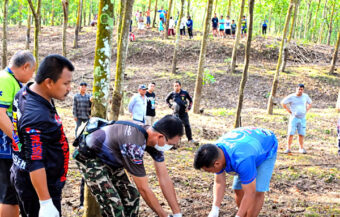
The findings were released on Saturday, October 10, by the Chiang Rai Land Development Station. They cover agricultural areas in the Kok, Sai and Ruak river basins. Director Parinyanon Thongkham confirmed that more than 200 soil and water samples had been collected.
The Chiang Rai Irrigation Office funded the investigation. Its purpose was to establish how contamination had spread through agricultural ecosystems surrounding the three rivers.
Significantly, the investigation found arsenic in agricultural soils, not simply in contaminated river water. Approximately one-fifth of the sampled areas exceeded the Department of Land Development’s arsenic standard.
Half required continued monitoring, while only three in ten fell within normal limits. The percentages apply to sampled agricultural areas, not all farmland across Chiang Rai. Nevertheless, the findings establish substantial contamination in land used for agricultural production.
Investigators collected samples at depths of 15–20 centimetres, where plant roots absorb nutrients. Testing covered locations between 100 metres and two kilometres from riverbanks.
This allowed researchers to examine contamination beyond the immediate river channels. Arsenic was the principal focus. The department then classified the samples according to three concentration thresholds, determining the level of monitoring required.
Arsenic thresholds put one-fifth of sampled farmland in red zones as officials plan repeated testing
Under those classifications, green-zone soil contains less than 14 milligrams of arsenic per kilogram. Yellow-zone soil contains between 14 and 25 mg/kg and requires continued monitoring. Red-zone soil exceeds 25 mg/kg, placing it above the department’s acceptable standard. Saturday’s findings put 20% of tested agricultural areas in the red category. A further 50% fell into yellow, leaving 30% classified as green.
In response, officials plan regular follow-up testing across affected agricultural areas. Red-zone locations will undergo fresh sampling every two to three months. Yellow-zone land will be checked every six months.
The programme will track arsenic concentrations and changes in contaminated soils. However, the results have already prompted officials to consider changes to agricultural production before further testing is completed.
The Chiang Rai Land Development Station is working with the Department of Agricultural Extension on alternative planting arrangements. Farmers in high-risk areas are being advised to avoid certain food crops.
Particular concern surrounds crops grown for their leaves or fruits. Instead, officials are examining alternatives less likely to accumulate contaminants, including energy crops. Such changes would alter established farming practices along the affected waterways.
Farmers face crop changes as irrigation uncertainty and missing contamination maps deepen concerns
Many farmers have traditionally cultivated rice and maize close to the rivers. Their operations depend on irrigation systems and established access to water. Consequently, changing crops presents immediate financial and practical difficulties.
Parinyanon acknowledged that farmers could struggle to abandon traditional agricultural production. Limited government budgets also restrict the response. Furthermore, agencies lack clear criteria for suspending irrigation intake when river water becomes heavily clouded with sediment.
The absence of those criteria creates another difficulty for agricultural management. Officials must assess contaminated water while determining whether irrigation can continue. Meanwhile, restrictions on food crops could affect farmers before compensation arrangements are established. The latest findings therefore extend beyond environmental monitoring into agricultural production, household incomes and government expenditure.
Assistant Professor Sathian Chanta, from Chiang Rai Rajabhat University’s Faculty of Science and Technology, has demanded detailed contamination maps.
He wants the government to publish information identifying red, yellow and green agricultural zones. Farmers need to establish which classification applies to their properties. Notably, Sathian criticised the Department of Land Development for failing to make detailed soil-testing results publicly available.
Researchers demand crop restrictions and compensation as Suchart faces scrutiny over poisoned farmland
He said green-zone land could continue to be farmed normally. Yellow zones, however, require clear guidance on suitable crops and cultivation methods. Non-food crops capable of generating income should also be considered.
In contrast, Sathian said food crops should not be grown in red zones. Contaminated soil also requires treatment to prevent further accumulation of heavy metals.
Beyond agricultural restrictions, Sathian raised the question of compensation. He urged officials to consider financial assistance for farmers unable to cultivate their traditional crops. The academic compared the situation with government support for areas affected by severe PM2.5 air pollution.
However, no new compensation programme arising from Saturday’s findings has been confirmed. Farmers therefore face possible production changes without an established financial assistance arrangement.
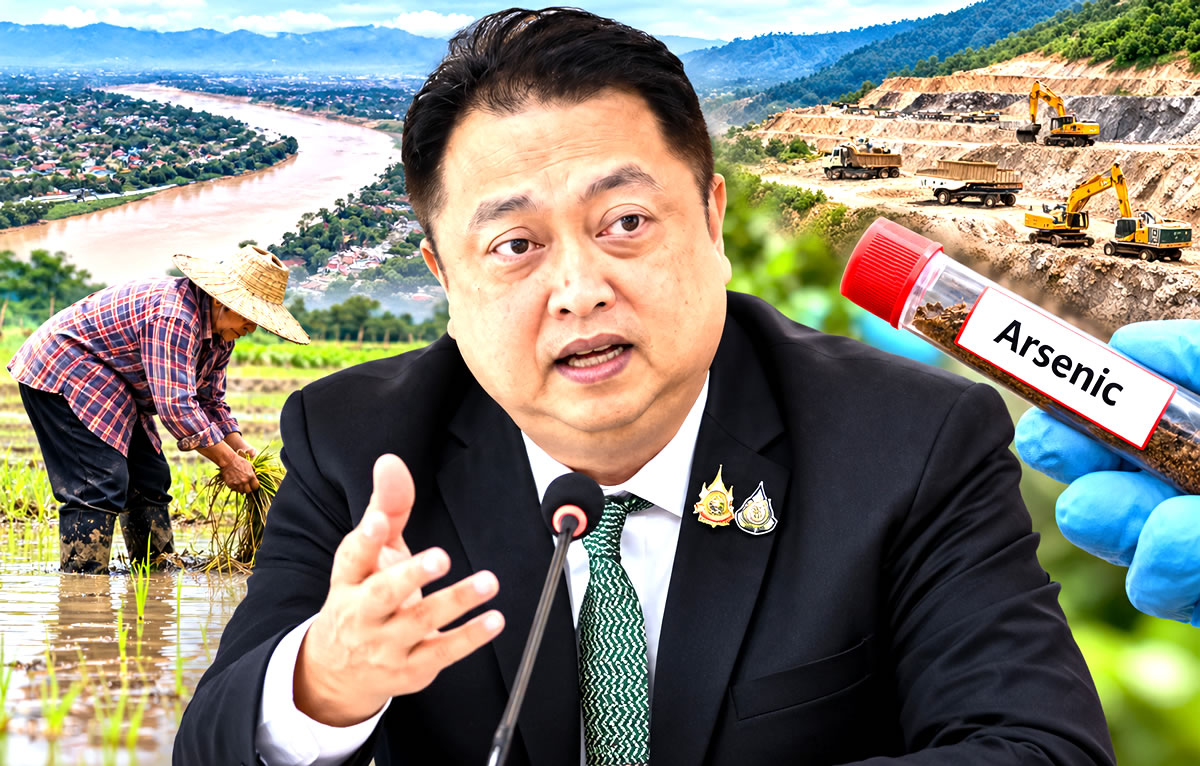
The findings have increased scrutiny of Minister of Natural Resources and Environment Suchart Chomklin. His ministry supervises the Pollution Control Department, which monitors contaminated waterways across northern Thailand. Suchart previously visited Chiang Rai and Chiang Mai to inspect the pollution crisis. In July, he instructed officials to raise transboundary environmental cooperation through the Thailand–Burma High-Level Committee.
Agriculture and health ministries face growing questions as Mae Sai residents receive river water warnings
Despite those interventions, substantial arsenic contamination remains present in agricultural areas. The problem now involves farmland alongside rivers and irrigation systems. Suchart’s ministry consequently faces questions about environmental monitoring, contamination management and efforts to address pollution originating abroad. The latest findings also involve agencies outside his direct ministerial responsibility.
Minister of Agriculture and Cooperatives Suriya Juangroongruangkit faces responsibility for the agricultural consequences. His ministry oversees the Land Development Department responsible for Saturday’s investigation.
It also supervises agencies advising farmers on crop production. Accordingly, agricultural restrictions, alternative planting and potential assistance fall within its responsibilities. The latest results place those matters directly before the Agriculture Ministry.
On another front, the Public Health Ministry faces questions about exposure through contaminated water and agricultural products. The Department of Disease Control issued another warning on Thursday, October 8. Residents in five Mae Sai subdistricts were advised against drinking or cooking with untreated Sai River water. The department also warned against consuming aquatic animals caught in the river.
Sai River arsenic reaches 28 times the reference level as mining expands across the border in Burma
Those warnings followed earlier evidence of substantial arsenic and lead contamination in northern waterways. An investigation published by Transborder News on October 4 documented expanding mining near the Sai River’s headwaters.
The areas included territory controlled by Wa forces and Burmese military units. Separately, the Pollution Control Department reported arsenic concentrations reaching 0.284 milligrams per litre in the Sai River.
That measurement was 28.4 times the reference level. Lead concentrations also exceeded the applicable standard fivefold. The figures added to concerns about contaminated runoff entering Thailand from mining areas across the border.
However, investigators have not identified the precise mine responsible for contamination at each affected agricultural location. The available evidence establishes serious pollution, while source attribution remains incomplete.
The wider problem has developed alongside expanding mineral extraction in Burma. A communication published through United Nations human rights mechanisms in 2026 identified UWSA-controlled mining areas as reported pollution sources.
It also referred to operations elsewhere in Burma. The communication described rapidly expanding rare earth extraction since 2023, alongside gold mining and deforestation. Contaminated runoff was reported to be entering rivers flowing towards Thailand.
Wa army control and Chinese demand complicate Thailand’s diplomatic response to mining pollution
Crucially, the UWSA controls an autonomous territory in eastern Burma, beyond Thailand’s jurisdiction. The Wa army maintains territorial control over areas where mining operations have attracted scrutiny.
Thai officials cannot directly enforce domestic environmental regulations inside those areas. Furthermore, the UWSA’s autonomy complicates engagement through Burma’s central government. Bangkok therefore faces a pollution problem whose suspected sources remain outside its direct enforcement powers.
The mining industry’s commercial connections create additional diplomatic difficulties. China is a major destination for critical minerals extracted in Burma. Chinese demand forms part of the commercial setting surrounding the expansion of rare earth extraction.
At the same time, mineral shipments pass through Thailand towards Chinese markets. The pollution dispute consequently involves cross-border environmental damage alongside regional mineral trade.
Deputy Prime Minister and Minister of Foreign Affairs Sihasak Phuangketkeow holds responsibility for the diplomatic dimension. His ministry handles Thailand’s relations with Burma and China. These relationships are central to discussions concerning mining pollution originating outside Thai territory. However, no new intervention by Sihasak specifically responding to Saturday’s soil findings has been confirmed.
Thai mineral imports from Burma expose trade links as Bangkok struggles to control upstream pollution
Thailand must therefore pursue discussions involving governments that do not directly control every mining area concerned. The Wa army’s territorial autonomy adds a separate obstacle.
In parallel, Chinese involvement in regional mineral supply chains complicates the commercial and diplomatic setting. Domestic environmental agencies can monitor contamination, but they cannot independently stop upstream mining in Burma.
A separate investigation published by Mongabay in October raised further questions about Thailand’s position in the mineral trade. It identified more than 50 Thai-registered companies importing critical minerals from Burma. The investigation also described mineral shipments passing through Thailand towards China. This places Thai commercial infrastructure within the wider supply chain associated with mineral extraction across the border.
Importantly, those findings do not establish wrongdoing by the Thai-registered companies. Nor do they prove that every imported mineral originated from an environmentally damaging operation. Nevertheless, the investigation has introduced another issue for parliamentary examination. Thailand is managing pollution entering its territory while Thai businesses participate in regional mineral imports.
People’s Party MP presses for mineral import controls under Thai law as customs checks face questions
People’s Party MP Phattarapong Leelaphat, who represents Chiang Mai, has pressed for stronger controls on those imports. He chairs a parliamentary subcommittee investigating transboundary water pollution.
His proposals extend beyond monitoring contaminated rivers and agricultural soils. In particular, he has called for Section 104 of Thailand’s Minerals Act of 2017 to be used.
The provision could provide a mechanism for regulating or prohibiting imports associated with environmentally harmful mining. Phattarapong has also questioned whether customs officials can reliably distinguish mineral shipments and verify their origins.
That issue directly affects efforts to identify minerals linked to damaging extraction practices. Without reliable origin verification, import controls would face practical enforcement difficulties.
His proposals have introduced mineral trade restrictions into the parliamentary debate over northern Thailand’s contamination crisis. Such measures would operate within Thailand’s jurisdiction rather than directly regulating mines across the border.
However, no new prohibition on relevant mineral imports following Saturday’s findings has been confirmed. The government has therefore not established a new trade restriction arising from the latest soil investigation.
No-confidence motion targets Suchart amid fresh questions over ministerial handling of arsenic pollution
The findings have also emerged during a separate political challenge to Prime Minister Anutin Charnvirakul’s government. On October 8, the People’s Party and allied opposition MPs submitted a no-confidence motion. It targeted Anutin and 17 ministers, including Suchart Chomklin. The motion includes accusations concerning political interference and government management.
There is no confirmation that Chiang Rai’s contamination crisis forms a specific charge against Suchart in that motion. Nonetheless, Saturday’s results provide further evidence for parliamentary questions about environmental management.
They also expose the division of responsibilities between several ministries. Environment officials monitor pollution, agricultural agencies assess farmland, and public health officials issue exposure warnings. Meanwhile, the Foreign Ministry handles the international dimension.
The government’s responsibilities extend to contaminated soil and sediment disposal. The Pollution Control Department and Siam Cement Group have examined mixing contaminated material into cement-based products. The proposal involves processing polluted soil and sediment for potential construction uses. Sathian said this could provide one method of managing contaminated material. However, he questioned how the resulting products would be used.
Contaminated sediment proposals face scrutiny over construction use and potential environmental risks
He said their intended applications must be clearly identified and assessed. In particular, testing must establish whether the products could pose risks to housing or the environment. The proposal introduces another technical issue alongside agricultural contamination. Material removed from rivers and farmland would still require appropriate handling after collection.
Dr Suebsakul Kitnukorn, a social innovation academic at Mae Fah Luang University, also called for transparency. He said government agencies, academics, businesses and affected communities should participate from the outset.
Additionally, he urged continuous monitoring of environmental conditions and agricultural products. His concerns included contaminated sediment recovered through several existing operations in Mae Sai.
These include dredging sites, sediment traps and material collected during water treatment. Sediment recovered through the Provincial Waterworks Authority’s treatment processes also requires assessment. Further research would establish whether such material can be safely incorporated into construction products. The work concerns both contamination management and the possible reuse of polluted sediment.
Mae Sai irrigation contamination raises food safety questions as farmers face uncertain crop restrictions
Sathian separately identified the Mae Sai irrigation system as particularly concerning. Reports of arsenic and lead exceeding standards have raised questions about agricultural contamination.
Crops can absorb contaminants from soil and water, potentially transferring them into the food chain. Consequently, researchers have called for continued testing of agricultural products alongside environmental monitoring.
The latest findings also leave unresolved questions about the financial consequences for farmers. Some agricultural areas may require different crops, while others face continued monitoring. Red-zone land could require treatment before normal food production resumes.
Furthermore, farmers switching to non-food crops would face different commercial arrangements. The bulletin identifies no established compensation programme covering those changes.
There is also no confirmed new Cabinet-level emergency response following Saturday’s findings. Nor has a new mineral-import ban been established. The government has undertaken ministerial inspections, environmental monitoring and preparations for diplomatic engagement. Yet substantial contamination remains documented in agricultural areas, with further testing scheduled over the coming months.
Seven in ten sampled agricultural areas need monitoring or action as upstream mining remains beyond reach
The results are particularly significant because they identify contamination beyond the most severely affected locations. While 20% of tested agricultural soils exceeded the arsenic standard, another 50% requires monitoring.
Only 30% fell within normal limits. The investigation therefore places seven in ten sampled areas within categories requiring either monitoring or more serious attention.
At the same time, the suspected upstream sources remain outside Thailand’s direct regulatory control. Mining operations in Burma include areas controlled by armed groups, notably the UWSA. The mineral trade also connects extraction in Burma with Thai importers and Chinese markets. Those circumstances complicate efforts to address contamination at its reported source.
For Suchart, the immediate issue concerns environmental management and cross-border cooperation. Suriya faces the agricultural consequences, including planting restrictions, soil treatment and possible farmer assistance. Sihasak handles diplomatic relations involving Burma and China. Separately, Phattarapong’s proposals have brought mineral-import controls into parliamentary scrutiny.
Farmers await contamination maps and compensation while ministers face unresolved cross-border pollution
For Chiang Rai’s farmers, the figures are more immediate. One-fifth of sampled agricultural soils exceeded the department’s arsenic threshold. Another half recorded concentrations requiring continued monitoring.
Researchers are demanding detailed maps, while officials consider changes to crop production. Compensation arrangements remain unresolved, and contaminated soil requires further assessment.
Chiang Mai MP raises alarm about government stasis in the face of a chronic arsenic river poisoning crisis
River Kok in Chiang Rai poisoned with arsenic from Wa state-controlled gold mining across the border
The October 10 findings leave the government confronting a problem extending from foreign mining operations into Thai farmland. Environmental monitoring has established the presence of arsenic across substantial portions of the sampled agricultural areas.
However, the suspected mining sources remain beyond Thailand’s direct control. Meanwhile, ministers face continuing questions over agricultural production, food safety, compensation and the regulation of mineral imports.
Join the Thai News forum, follow Thai Examiner on Facebook here
Follow Thai Examiner on Google here
Receive all our stories as they come out on Telegram here
Follow Thai Examiner here
Further reading:
River Kok in Chiang Rai poisoned with arsenic from Wa state-controlled gold mining across the border
Rangsiman Rome MP calls for stiffer response to Myanmar’s junta over the jailing of Thai sailors
Myanmar Junta meltdown threatens to end Bangkok’s condominium sales boom as Kyat currency fails
Tyrant of Nay Pyi Taw’s days are numbered as Karen soldiers burn the hated Myanmar flag in Myawaddy
Outgoing Foreign Minister defends his two days of regional dialogue with Myanmar held in Pattaya
Hated Burmese junta regime seeks peace talks as its grip on power across the country unravels