Thailand’s flagship ฿1.6 billion AI scheme hits 1.5 million users as scrutiny mounts and Phase Two loses ฿900 million. Chaichanok pushes ahead with wider AI access while AIS steps in with unlimited AiPASS data for ฿29 monthly.
Thailand’s ฿1.6 billion TH-AI Passport has surged past 1.5 million registrations, but the flagship AI project is now under mounting pressure. Growth has slowed far short of its five-million capacity, active-user figures face scrutiny and inaccurate answers have triggered complaints. Meanwhile, People’s Party MP Rukchanok Srinork has taken procurement concerns to the NACC, while the proposed ฿900 million second phase has lost funding. Against that backdrop, Digital Economy and Society Minister Chaichanok Chidchob is pressing ahead. AIS has offered a ฿29 monthly AiPASS data package for five million users, while talks continue with NT. The government is also widening AI training and preparing separate rules for data centres and AI factories.
Thailand’s controversial ฿1.6 billion TH-AI Passport has passed 1.5 million registrations, weeks after its nationwide launch. Yet the flagship artificial intelligence project remains well short of its original five-million capacity. At the same time, procurement scrutiny is intensifying and its proposed second phase has lost planned funding.
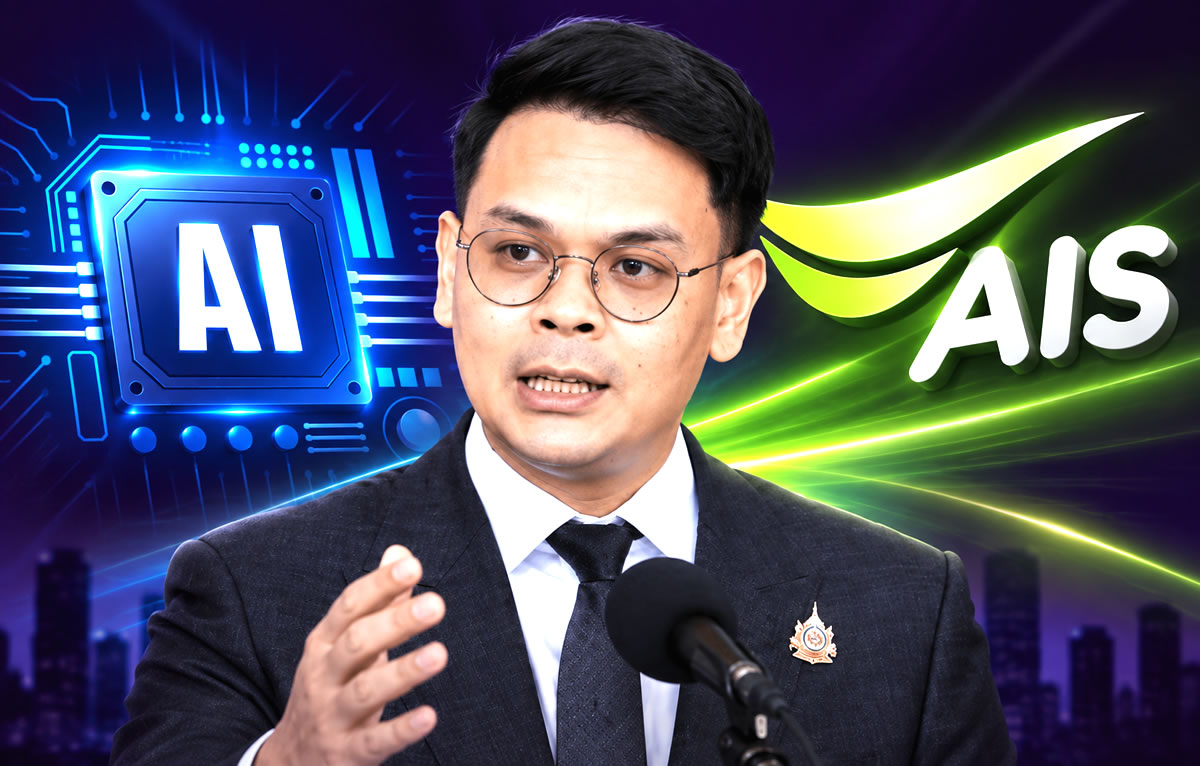
Digital Economy and Society Minister Chaichanok Chidchob released the latest figures on September 12. He also unveiled a new effort to tackle mobile internet costs. Advanced Info Service Public Company Limited (AIS) has proposed a dedicated AiPASS package costing just ฿29 monthly.
Under the proposal, AIS customers would receive unlimited internet use inside the AiPASS application. The charge works out at less than ฿1 daily. Notably, AIS says it can support five million packages for one year. That matches the maximum number of TH-AI Passport entitlements.
AIS steps in with ฿29 AiPASS package after students raise concerns over rising mobile data costs
The proposal followed government fieldwork outside Bangkok and discussions with MPs and students. Officials found internet availability was not always the main problem. Instead, students worried that frequent AI use would consume significantly more mobile data. Prepaid customers were particularly concerned about rising charges.
In response, AIS approached the ministry with its own proposal. Chaichanok said it was the first telecommunications provider to offer such assistance. The government had not ordered the company to provide the package.
“Many students want to use the service but are concerned about the increased internet costs,” Chaichanok said. “They do have internet access, it’s not that they don’t, but when using AI, internet usage increases rapidly. We have to thank AIS for contacting us themselves; they were the first to say they wanted to help alleviate this problem.”
Under the model being discussed, existing AIS customers would retain their normal internet service. They could then add unlimited AiPASS data for another ฿29 monthly. Importantly, the offer would not be restricted to students. Other AIS customers could also subscribe under the proposed arrangement.
The model resembles existing mobile packages providing dedicated data for specified applications or internet addresses. Further details are expected once discussions are completed. AIS says its existing policies already support wider artificial intelligence adoption in Thailand.
Chaichanok opens talks with NT as TH-AI Passport registrations pass 1.5 million following launch
Separately, Chaichanok has held discussions with National Telecommunications Public Company Limited. Those talks covered possible similar measures for users. However, no equivalent agreement has been reached with True Corporation.
Chaichanok said the government could not compel private telecommunications companies to provide subsidised packages. Such measures carry substantial costs for operators. Even so, the ministry remains prepared to negotiate with companies willing to participate.
The telecommunications push comes as the TH-AI Passport tries to build on its initial surge. According to official figures, 1.52 million people registered between August 19 and September 11. During that period, users generated 8,720,807 artificial intelligence prompts.
Furthermore, 1,297,924 users completed at least one lesson through the programme. By comparison, 139,519 completed all required coursework and received certificates. Wetang Puangsap, Secretary-General of the Digital Economy and Society Commission, released the figures.
Earlier, Chaichanok reported particularly heavy activity during the programme’s first week. More than 500,000 people used the system concurrently, according to the minister. Around four million prompts were submitted during that opening period.
TH-AI Passport growth slows after early surge as government expands courses and global AI partnerships
By September 11, the number of prompts had more than doubled. Still, registrations remained well below the five-million capacity promoted for the project. The government is now trying to broaden participation while reducing the cost of regular use.
TH-AI Passport opened fully on August 31 after pre-registration began on August 19. The project offered professional artificial intelligence services to as many as five million Thais. Users gained access to more than 14 providers and over 30 AI models.
By September 3, registrations had reached about 1.45 million. However, Chaichanok acknowledged that the pace was already slowing. He had expected the five-million allocation to fill much faster following the launch.
Eight days later, the total stood at 1.52 million. Thus, most registrations were secured during the programme’s initial push. The government is now looking to telecommunications support and educational promotion to extend its reach.
In parallel, the ministry is expanding Learn to Earn, the educational component of TH-AI Passport. Chaichanok said its content had attracted more than one million views. The programme currently provides more than 96 courses, with further additions planned.
Major international technology companies are participating in course development. They include OpenAI, Microsoft and Google. Nvidia is expected to join the programme later. Activities involving those companies and programme participants are also being planned.
Government widens TH-AI Passport promotion as questions grow over active users and regular usage
“What I want is for more people to use it,” Chaichanok said. “I want understanding of AI not to be concentrated only among those who can afford it. This project helps people understand various AI models better. I think this is important and not something that is easily found.”
As part of this expansion, the BDE is seeking support across government. Wetang said state agencies had been asked to promote TH-AI Passport more widely. Students and people using artificial intelligence for the first time remain important target groups.
The programme combines access to AI services with structured educational material. Accordingly, the BDE has requested help from the Ministry of Higher Education, Science, Research and Innovation. The Ministry of Education has also been asked to participate.
On another front, other state agencies are being drawn into the promotional campaign. They include the Ministry of Public Health. The effort is aimed at students, lecturers, teachers and other educational personnel nationwide.
Despite the registration growth, questions have emerged over the number of people regularly using the service. Registered accounts and continuing active users are not the same measure. That distinction became important within days of the nationwide launch.
Contractor stops daily active-user figures as complaints emerge over inaccurate AI platform answers
On September 3, reports said the contractor had stopped providing daily active-user figures to the BDE. No explanation was given at the time. The last publicly cited figure was approximately 450,000 active users on August 31.
Subsequently, the government developed a public monitoring dashboard. The active-user figure also carries direct financial importance. Under the revised contract, government payments depend on qualifying active users rather than registrations alone.
Service quality has also come under examination. Some users and reporters complained about inaccurate answers or results weaker than direct commercial AI services. One reported test asked the system to identify Thailand’s current prime minister.
Instead, the platform returned former Prime Minister Srettha Thavisin. Chaichanok acknowledged problems with some answers. He stressed, however, that TH-AI Passport does not develop the underlying artificial intelligence models.
Rather, the platform provides access to systems supplied by participating private technology companies. Following those complaints, the ministry moved towards providing greater access to higher-level professional AI services.
Rukchanok takes TH-AI Passport procurement claims to NACC as contract specifications face scrutiny
More significantly, the project remains caught in a separate dispute over how its contract was awarded. People’s Party MP Rukchanok Srinork submitted evidence to the National Anti-Corruption Commission on September 1.
Her complaint sought scrutiny of Chaichanok and four other people connected with the project. Digital Economy and Society Permanent Secretary Patchara Anuntasilpa was included. BDE Secretary-General Wetang was also included.
In addition, the complaint concerned the chairman of the terms-of-reference drafting committee. A representative connected with Human Intelligence Company Limited was also named. The claims concern the design of the procurement specifications.
Specifically, questions have been raised over whether those specifications restricted competition or favoured particular private interests. Those claims remain under examination. The successful bidder was TH Consortium.
The consortium comprises Turnkey Communication Services Public Company Limited and Human Intelligence Company Limited. Rukchanok has focused particularly on advertising requirements contained in the terms of reference.
Among them was a reported requirement for at least 400 outdoor billboard locations. The specifications also called for advertising screens inside at least 1,500 convenience-store branches. Those locations were expected to provide at least 6,000 screens.
NACC scrutiny widens as Rukchanok seeks examination by DSI, police, auditors and money-laundering office
Rukchanok argued that requirements on that scale could restrict the number of businesses capable of competing. Her September 1 submission, however, was not the first complaint concerning the procurement.
Previously, the NACC had begun examining another complaint. On August 20, NACC Secretary-General Surapong Intrathaworn confirmed that the case was under consideration. It concerned claims that specifications had been designed to favour a private company.
Consequently, the September submission added another layer to scrutiny already under way. It also placed Chaichanok directly among those Rukchanok wanted examined by the anti-corruption body.
Beyond the NACC, calls for scrutiny have spread to other state bodies. Earlier parliamentary examination produced moves to refer concerns to the Office of the Auditor General. The Department of Special Investigation was also identified for examination.
Additionally, Rukchanok has sought scrutiny involving the Central Investigation Bureau and Anti-Money Laundering Office. The project therefore faces questions extending beyond its user numbers and technical performance.
House scrutiny continues as ฿900 million Phase Two budget is cut while existing project stays active
The political confrontation continued on September 10. Rukchanok convened another House committee meeting examining the TH-AI Passport. The committee was also scrutinising the Digital Economy and Society Development Fund.
At that meeting, she complained that Chaichanok and several other invited figures did not attend. Invitees included senior ministry figures and people connected with the contractors. Rukchanok again questioned the project’s procurement, performance and value.
Crucially, that hearing came less than two weeks after the full launch. Starting the service therefore did not end parliamentary examination. Instead, scrutiny continued while users were already registering and generating millions of prompts.
Future funding has also suffered a setback. A proposed ฿900 million allocation for TH-AI Passport Phase Two was removed during scrutiny of the 2027 budget. Wetang confirmed that the entire proposed allocation was cut.
That decision does not terminate the programme already operating. Rather, it removes the planned ฿900 million allocation for its proposed follow-on phase. The existing project continues under its current contract.
Revised contract ties government payments to active users as data handling faces further scrutiny
Meanwhile, that contract has undergone an important financial change. Earlier criticism focused on possible government exposure to the full ฿1.6 billion contract value. The arrangement was subsequently changed to payment based on active users.
The BDE placed the cost at approximately ฿24.6951 for each qualifying active user monthly. As a result, payments depend on actual qualifying usage. Registration numbers alone do not determine the amount paid.
The distinction is significant because the ฿1.6 billion represents the maximum contract value. It does not represent money already spent. Lower qualifying usage would therefore reduce government payments under the revised model.
For that reason, active-user reporting has financial consequences beyond measuring the project’s popularity. The number of qualifying users helps determine payments under the contract. This makes accurate usage figures central to assessing expenditure.
Data handling has generated another line of scrutiny. The ministry says users’ personal information is processed inside Thailand. Sensitive information is also filtered before prompts are passed to foreign artificial intelligence providers.
Chaichanok links TH-AI Passport to national AI strategy and separate rules for data centres and factories
Beyond TH-AI Passport, Chaichanok is linking the programme to a much larger national AI strategy. He said the project represents only one part of the country’s artificial intelligence programme. The National AI Board is driving the broader effort.
That strategy covers planning, education, industrial promotion and investment. It also covers regulations and legislation for rapidly developing artificial intelligence industries. Chaichanok said the different components must advance together.
Against this background, the government is considering separate regulatory frameworks for data centres and AI factories. Chaichanok argues that the two sectors have different requirements. Their markets, benefits and resource demands also differ.
Data centres require examination of how existing regulations should be modified. By contrast, AI factories perform artificial intelligence processing and machine learning. Chaichanok wants different rules for companies entering that market.
Thailand seeks faster data centre and AI factory rules while building domestic computing capacity
The distinction is becoming important as Thailand seeks further digital investment. Investors also require clarity over the rules governing new infrastructure. Yet permanent legislation can take considerable time to complete.
“The goal is to enable the government to quickly formulate measures,” Chaichanok said. At the same time, he said the private sector needs clarity before investing.
During the legislative process, the government could use other mechanisms. These include committees, prime ministerial announcements and ministerial announcements. Permanent legislation would proceed alongside those measures.
Chaichanok said data centre legislation would become an important part of the framework. The government also wants to increase domestic computing capacity. That effort is linked to Thailand’s wider development of artificial intelligence capabilities.
Conventional data centres primarily provide computing, storage and related digital infrastructure. In contrast, AI factories undertake intensive artificial intelligence processing and machine learning. Their infrastructure requirements can therefore differ substantially.
Likewise, their demands on resources and commercial markets are different. Chaichanok argues that separate regulation would give prospective investors clearer rules. The government wants those rules developed while wider legislation proceeds.
AIS offers five million low-cost AiPASS packages as ministry seeks wider voluntary telecom support
“All of this requires cooperation from various sectors,” Chaichanok said. He said the different elements must connect with Thailand’s overall direction on artificial intelligence.
For TH-AI Passport itself, the immediate operational push is now moving towards cheaper mobile access. Provincial discussions identified data costs as a barrier despite widespread internet availability. Prepaid users were especially concerned about heavier consumption.
AIS has responded with the first dedicated telecommunications proposal. Its planned ฿29 package would ring-fence AiPASS usage from customers’ normal mobile data. The offer would cover students and other AIS users.
Paying AI users in Thailand had a nightmare week online just as the government waded into the market
People’s Party firebrand attacks flagship TH AI project launched this week with corruption agency filing of claims
If finalised, AIS says it can support five million packages for one year. That capacity matches the original five-million entitlement envisaged for TH-AI Passport. The ministry has not required rival operators to match it.
Instead, Chaichanok says private participation must remain voluntary because of the costs involved. Talks with NT have already started over possible similar measures. No agreement has yet been reached with True.
The ministry remains prepared to discuss further proposals from telecommunications operators. For now, AIS is the first company offering a dedicated answer to the mobile-cost problem identified among prospective users.
Join the Thai News forum, follow Thai Examiner on Facebook here
Follow Thai Examiner on Google here
Receive all our stories as they come out on Telegram here
Follow Thai Examiner here
Further reading:
Paying AI users in Thailand had a nightmare week online just as the government waded into the market
Ministry fails to halt ฿25.4 billion payment order to Hong Kong based firm linked to 1990 contract
Microsoft accepts charges of corrupt payments in Thailand as it makes a deal with US investigators
Provincial agency boss arrested in Mukdahan after trying to extort ฿2 million from a businessman