Airport ground gives way beneath Emirates superjumbo at Suvarnabhumi. A China Airlines jet was trapped five days earlier. Two other incidents are reported but unverified. Minister Phiphat orders runway closure as aviation chiefs probe saturated soil.
An Emirates A380 was stranded at Bangkok’s Suvarnabhumi Airport on Monday night after taxiway pavement collapsed beneath it. The Dubai-bound superjumbo required towing before departing 71 minutes later. It was the second confirmed aircraft ground failure in six days, following a China Airlines incident on October 28. However, two further reported incidents suggest four aircraft ground problems within a month. Deputy Prime Minister and Minister of Transport Phiphat Ratchakitprakarn ordered emergency repairs, shutting a runway for 13 hours and a taxiway for 61 hours. Meanwhile, aviation regulators are investigating waterlogged ground as engineers reconstruct 1,950 square metres of damaged pavement.
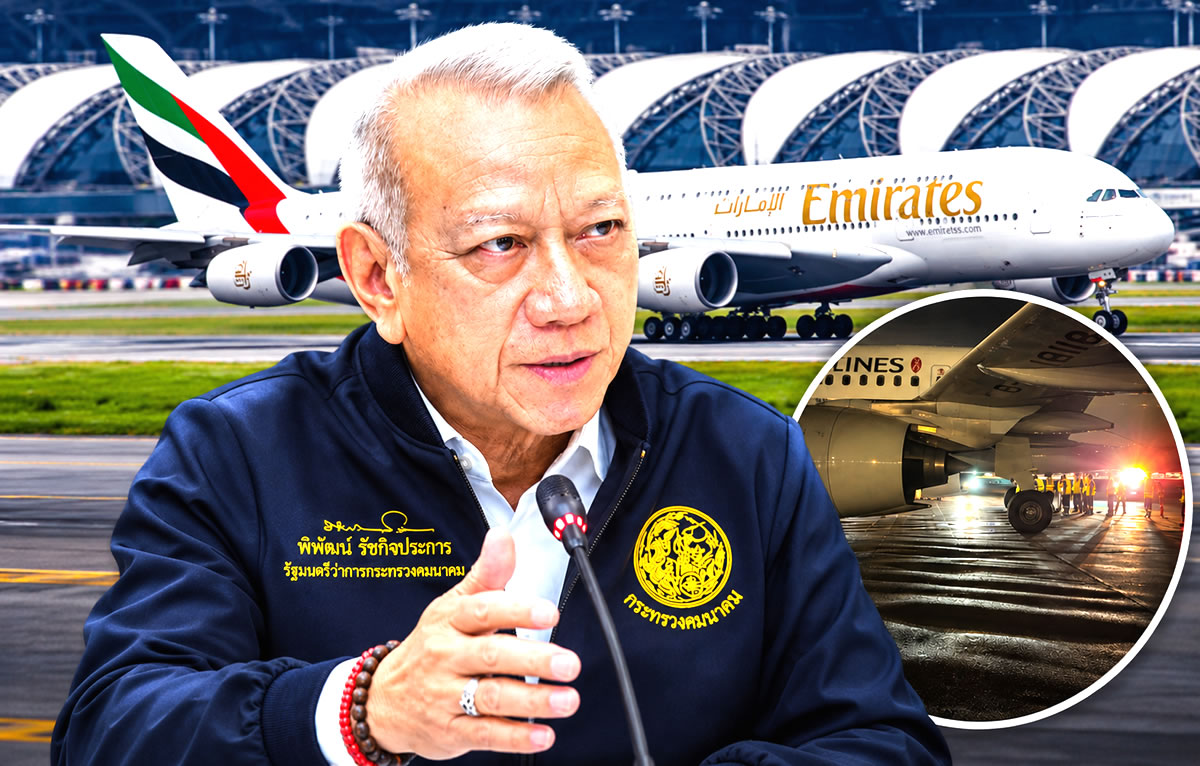
An Emirates Airbus A380 superjumbo became stranded on a damaged taxiway at Bangkok’s Suvarnabhumi Airport on Monday night. The Dubai-bound aircraft was trapped after pavement deteriorated beneath it, forcing ground crews to bring in a towing vehicle.
It was the second confirmed aircraft ground failure near the same runway in six days. However, reports of two further China Airlines incidents suggest four aircraft may have encountered ground difficulties since October 8.
The failures have triggered emergency runway closures, extensive repairs and a government-ordered investigation into Thailand’s principal international airport.
Emirates A380 stranded for 67 minutes after taxiway pavement fails under Dubai-bound jet at Suvarnabhumi
The latest incident struck at 9.11 pm on Monday, November 2, as Emirates flight EK373 prepared to depart for Dubai. The giant Airbus A380 became immobilised on Taxiway E21, near the threshold of runway 02R.
Airport controllers and ground-handling personnel immediately responded. Meanwhile, Bangkok Flight Services (BFS) was summoned to provide equipment capable of towing the aircraft clear.
The recovery operation lasted more than an hour. At 10.18 pm, ground crews finally removed the aircraft from the damaged section. Just four minutes later, the A380 took off for Dubai at 10.22 pm. In total, the aircraft had been immobilised for 67 minutes. Its departure came 71 minutes after the airport first reported the problem.
Airport authorities confirmed that the pavement had deteriorated beneath the aircraft during departure movements. However, the incident did not involve a reported engine failure or emergency landing. Instead, the problem arose while the aircraft was taxiing towards departure. No emergency passenger evacuation was reported, and the aircraft subsequently continued its journey.
Airport investigates saturated ground as China Airlines jet becomes trapped near the same runway earlier
Officials have not disclosed how many passengers or crew were aboard flight EK373. Equally, no confirmed assessment of possible damage to the aircraft has been released. Its registration has not been independently verified. Nor have officials disclosed any passenger compensation, missed connections or a formal Emirates response.
The Airbus A380 is the world’s largest passenger airliner. Depending on its configuration, it can accommodate approximately 484 to 615 passengers. Its maximum take-off weight can reach approximately 575 tonnes, depending on the variant. Nevertheless, authorities have not suggested that the Emirates aircraft exceeded permitted pavement loading limits.
Instead, investigators are examining the ground supporting the airport’s paved surfaces. Suvarnabhumi officials identified prolonged rainfall and flooding as contributing factors. Water had accumulated beneath sections of pavement, weakening the supporting ground. Consequently, the surface became vulnerable to deterioration under aircraft movements.
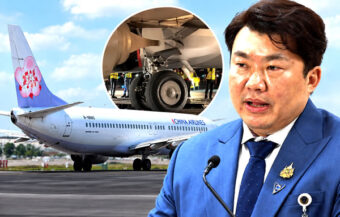
The latest failure followed a similar incident involving China Airlines on Wednesday, October 28. That aircraft, a Boeing 737-800, was operating flight CAL840 to Kaohsiung, Taiwan.
At approximately 7.20 pm, its main landing gear became trapped in damaged pavement near runway 02R. The aircraft was preparing to depart when the ground problem stopped its movement.
China Airlines disruption delays five flights as engineers find waterlogged ground beneath pavement
Airport personnel subsequently arranged for the aircraft’s removal and temporary repairs. However, the disruption extended beyond the affected China Airlines service. Aviation reports indicated that four other aircraft were blocked. Additionally, five flights suffered delays of approximately two hours as airport operations were affected.
Following the incident, Airports of Thailand (AOT) chief executive Paweena Jariyathitipong disclosed preliminary engineering findings. Inspections had identified soft ground containing substantial moisture beneath the airport’s paved infrastructure.
The initial assessment linked the deterioration to water accumulation following heavy rainfall. Yet another aircraft became immobilised nearby just five days later.
The Emirates A380 encountered trouble close to the earlier China Airlines incident. However, officials have not established whether the same repaired pavement failed again. Both confirmed incidents occurred during departure movements near runway 02R. Moreover, each involved damaged pavement associated with moisture-saturated supporting ground.
The aircraft involved were substantially different. The first was a China Airlines Boeing 737-800, while the second was an Emirates Airbus A380. Nevertheless, both became immobilised on airport surfaces normally used for aircraft movements. In each case, airport personnel had to intervene before operations could continue.
Two more China Airlines incidents reported in October as questions grow over aircraft ground difficulties
Fresh reporting has since widened the account of recent ground difficulties at Suvarnabhumi. On Tuesday, November 3, MGR Online reported claims concerning two additional China Airlines incidents during October. These accounts emerged through social media and remain unconfirmed. If verified, they would bring the reported total to four incidents within 26 days.
The first additional account concerns China Airlines flight CI839 on October 8. According to the reports, the aircraft had arrived from Kaohsiung, Taiwan. It reportedly encountered wheel difficulties while approaching its parking stand. However, no independent official confirmation of the incident has been established.
A second account concerns China Airlines flight CI837, arriving from Taipei on October 26. The aircraft reportedly suffered a rear-wheel incident involving drainage infrastructure at Suvarnabhumi. According to the claims, a wheel became trapped near or within a drain. Subsequently, its return service, flight CI838, was reportedly delayed by nearly three hours.
These accounts remain separate from the two officially confirmed pavement failures. Neither has been independently verified through the available official material. Furthermore, investigators have not established whether either reported incident involved subsidence or the same underlying ground conditions. The October 26 account specifically describes difficulties involving drainage infrastructure rather than a confirmed pavement collapse.
Government orders emergency repairs and 13-hour runway closure after second confirmed pavement failure
Nevertheless, the two additional reports place the confirmed failures within a wider sequence of reported aircraft ground difficulties. The October 8 account concerns an arriving aircraft approaching its stand. The October 26 report also involves an arriving China Airlines aircraft. By contrast, the confirmed October 28 and November 2 incidents occurred during departure movements.
The latest confirmed failure prompted an immediate government response. On Tuesday, November 3, Deputy Prime Minister and Minister of Transport Phiphat Ratchakitprakarn ordered urgent repairs and further engineering examinations.
The intervention followed confirmation of another damaged airport surface near runway 02R. In response, authorities announced closures affecting both the runway system and Taxiway E21.
Runway 02R/20L was scheduled to close for 13 hours, beginning at 7 pm on Tuesday. The closure was due to end at 8 am on Wednesday, November 4. Engineering teams were assigned to reconstruct a damaged section measuring approximately 15 metres by 100 metres. The work required excavation to a depth of approximately 33 centimetres.
Taxiway E21 shut for 61 hours as airport excavates damaged pavement and diverts aircraft movements
Separately, Taxiway E21 faced a substantially longer closure. Airport authorities scheduled restrictions lasting 61 hours, beginning at 7 pm on Tuesday. The taxiway was due to reopen at 8 am on Friday, November 6. Its damaged section measures approximately 10 metres by 45 metres, with excavation again reaching approximately 33 centimetres.
The longer taxiway closure includes time for the replacement pavement to develop sufficient strength. Together, the two repair areas cover approximately 1,950 square metres. Both require damaged material to be removed before the surfaces can be reconstructed. The programme therefore involves more extensive work than temporary repairs to the visible pavement.
Despite the closures, AOT maintained that scheduled airport operations could continue. Suvarnabhumi’s two remaining operational runways were expected to handle aircraft movements during the restrictions.
Aeronautical Radio of Thailand (Aerothai) indicated that the available capacity could accommodate planned flights. Airport authorities therefore expected to manage the maintenance programme without significant disruption to overall operations.
Meanwhile, aircraft movements were redirected through nearby Taxiway E19. However, that alternative route also requires pavement-strength examinations. Engineers must assess whether neighbouring surfaces have suffered deterioration similar to the damaged section. The checks form part of the broader examination following the two confirmed aircraft immobilisations.
Taxiway extension awaits regulatory approval as aviation authority demands answers over repeated failures
On another front, AOT is preparing to introduce a newly completed extension of Taxiway D. The additional infrastructure could provide another route for aircraft movements. However, the extension remains subject to inspection by the Civil Aviation Authority of Thailand (CAAT). It has not been cleared for use in the supplied reports.
The airport’s closure arrangements were also reflected in a formal aviation notice. NOTAM A4361/26 confirmed that Taxiway E21 was closed for maintenance until November 6. The notice provided operational confirmation of the restriction. Meanwhile, the runway closure was scheduled to finish earlier, following overnight repairs.
By Wednesday morning, November 4, runway 02R/20L was due to reopen at 8 am. However, the available material did not independently confirm that operations resumed at the scheduled time. Taxiway E21 remained subject to its longer repair programme. Thai PBS World reported on Wednesday that repairs were continuing, with completion expected on Friday morning.
The repeated failures have also drawn direct intervention from Thailand’s aviation regulator. CAAT director Air Chief Marshal Manat Chawanaprayoon demanded explanations from AOT and measures to prevent further incidents. The regulator wants stronger procedures for detecting weaknesses beneath airport surfaces. Its examination covers runways, taxiways and aircraft parking areas.
Aviation regulator seeks technology to detect pavement weaknesses and prevent further aircraft incidents
In particular, CAAT wants technology capable of identifying deterioration before pavement failures occur. The proposed measures extend beyond visual inspections and temporary repairs. Instead, they involve examining the strength of supporting ground beneath operational surfaces. Officials are also considering methods for detecting locations vulnerable to subsidence.
CAAT officials were expected to inspect the affected infrastructure during the week beginning November 2. The regulator will work with AOT and airport engineering personnel. Together, they will examine pavement conditions, supporting ground and the areas surrounding the confirmed failures. The findings will inform further discussions with the Transport Ministry.
According to Deputy Prime Minister and Minister of Transport Phiphat Ratchakitprakarn, those discussions are expected the following week. The government has directed attention towards longer-term maintenance and preventive work. This includes structural-strength assessments and examinations of drainage and pavement conditions. However, the full extent of any additional work remains undetermined.
AOT chief executive Paweena Jariyathitipong has acknowledged the heavy stresses experienced by particular airport surfaces. These include aircraft turning areas, runway thresholds and taxiway exits. Such locations experience repeated aircraft movements and concentrated loading. Additionally, she identified moisture-saturated soft soil beneath the airport as a problem requiring attention.
Airport expands inspections after repairs fail to prevent another aircraft from becoming stranded nearby
The preliminary engineering findings connect pavement deterioration with water accumulation beneath the airport’s surfaces. However, the reports do not establish how extensively those conditions affect the wider airport. Neither have officials confirmed whether similar weaknesses exist beneath other operational areas. Further inspections are intended to examine those conditions.
The October 28 China Airlines incident had already prompted temporary repairs before operations resumed.
Yet the Emirates A380 became immobilised nearby on November 2. The available evidence does not establish that the original repaired section failed again. Nevertheless, a second confirmed pavement failure occurred within the same general operational area.
Consequently, the airport’s response has expanded beyond repairs to individual damaged sections. Engineering teams are examining neighbouring pavement while preparing alternative aircraft routes. In parallel, CAAT is seeking explanations and preventive measures from AOT. The regulator’s involvement introduces further scrutiny of the airport’s inspection and maintenance arrangements.
Officials distinguish confirmed pavement failures from unverified reports involving China Airlines jets
No official finding of negligence, defective construction or regulatory non-compliance has been established in the supplied reports. Likewise, the available material does not identify a confirmed structural defect affecting the entire airport.
The established findings concern damaged pavement, moisture-saturated supporting ground and repeated aircraft immobilisations. The wider engineering assessment remains incomplete.
The additional China Airlines accounts also require separate verification. The October 8 report concerns flight CI839 arriving from Kaohsiung. Meanwhile, the October 26 account involves flight CI837 arriving from Taipei. The latter also includes a reported delay of nearly three hours to return service CI838. Neither incident has been independently confirmed.
By comparison, the October 28 China Airlines and November 2 Emirates incidents are supported by official airport accounts. Both involved aircraft becoming immobilised during departure movements. Both occurred near runway 02R, although officials have not established that the same repaired pavement failed twice. The confirmed incidents also required direct ground intervention.
China Airlines and Emirates incidents leave aircraft damage and flight disruption questions unanswered
The October 28 failure trapped the main landing gear of a Boeing 737-800. Subsequently, airport personnel removed the aircraft and carried out temporary repairs. Four aircraft were reportedly blocked, while five flights experienced delays of approximately two hours. The disruption extended beyond the affected China Airlines service.
Five days later, the Emirates A380 required towing from Taxiway E21. Bangkok Flight Services was called to assist with the recovery. The aircraft remained immobilised until 10.18 pm before departing four minutes later. However, the available Emirates reports do not provide a comparable breakdown of delays affecting surrounding flights.
Questions also remain about the condition of the Emirates aircraft following its removal. The official account establishes that flight EK373 departed for Dubai. However, it does not identify any damage to the landing gear or other components. Nor does it establish whether engineers inspected the aircraft before departure.
No passenger injuries were reported in the reviewed accounts. Equally, no emergency evacuation was reported during the Emirates incident. The number of passengers aboard remains undisclosed. There are also no confirmed details concerning missed connections, compensation or disruption after the aircraft departed Bangkok.
Airport faces Friday taxiway reopening deadline as engineers inspect nearby surfaces and ground strength
The aircraft’s successful departure nevertheless marked the end of the immediate towing operation. Ground crews had removed the A380 from the damaged section after 67 minutes. Four minutes later, the flight was airborne. The airport subsequently turned its attention towards repairs and inspections of the affected infrastructure.
The immediate maintenance programme involves two separate damaged areas near runway 02R. Engineers must reconstruct approximately 1,950 square metres of pavement. Both sections require excavation to a depth of approximately 33 centimetres.
However, the taxiway faces a longer closure because the replacement surface requires additional time to develop strength.
Operational arrangements also extend beyond the damaged sections. Taxiway E19 requires further pavement-strength checks. Separately, the newly completed Taxiway D extension awaits CAAT inspection. Airport authorities are therefore examining alternative aircraft routes while repairs continue.
The central runway’s scheduled reopening on Wednesday morning represented the first major deadline. The second concerns Taxiway E21, which is scheduled to reopen at 8 am on Friday.
Meanwhile, CAAT’s engineering examinations will determine the next stage of maintenance discussions. Those findings are expected to address the condition of the supporting ground and neighbouring surfaces.
Two confirmed aircraft ground failures trigger repairs and regulatory scrutiny at Suvarnabhumi Airport
The reported incidents span different aircraft types and operational circumstances. Two involve confirmed pavement failures during departure movements. Another two concern unverified accounts of China Airlines wheel difficulties during arrivals. However, the available evidence does not establish a common cause across all four reports.
The confirmed record remains substantial. A China Airlines Boeing 737-800 became trapped near runway 02R on October 28. Then, on November 2, an Emirates Airbus A380 became immobilised on Taxiway E21. Both incidents required airport intervention, while the second triggered extensive emergency repairs.
In response, Deputy Prime Minister and Minister of Transport Phiphat Ratchakitprakarn ordered further examinations. CAAT director Air Chief Marshal Manat Chawanaprayoon demanded explanations and stronger preventive measures.
Flights delayed and passengers deboarded after subsidence under China Airlines jet at Suvarnabhumi
Thai Airways now says baggage failure was five times worse than admitted. Board orders compensation
AOT chief executive Paweena Jariyathitipong identified moisture-saturated supporting ground and heavily stressed airport surfaces as areas requiring attention.
The government-ordered repairs are scheduled to continue until Friday morning. Meanwhile, runway operations are being managed around the maintenance restrictions. Further inspections will examine the condition of the pavement and supporting ground. The regulator’s findings are expected to shape subsequent maintenance planning.
For now, two aircraft immobilisations within six days have been officially confirmed near the same runway. Two earlier China Airlines incidents remain unverified. The Emirates A380 departed for Dubai after ground crews removed it from the damaged taxiway. However, the investigation into repeated pavement failures at Suvarnabhumi Airport remains open.
Join the Thai News forum, follow Thai Examiner on Facebook here
Follow Thai Examiner on Google here
Receive all our stories as they come out on Telegram here
Follow Thai Examiner here
Further reading:
Flights delayed and passengers deboarded after subsidence under China Airlines jet at Suvarnabhumi
Thai Airways now says baggage failure was five times worse than admitted. Board orders compensation
Thai Airways boss fired by the board chaired by Finance Ministry chief on Friday over baggage crisis
Government takes a stronger hand as Thai Airways crisis at Suvarnabhumi Airport worsened Wednesday
Bangkok airports open and flights running but there are delays and baggage issues at Suvarnabhumi
Engineers work through night after Sunday’s fire on Bangkok’s Blue Line saw more damage than thought
Arrested man linked with Chatuchak building collapse now tells police he is a Chinese state employee