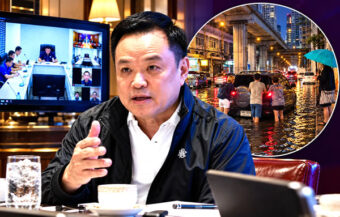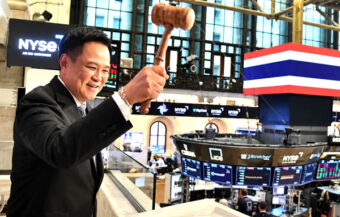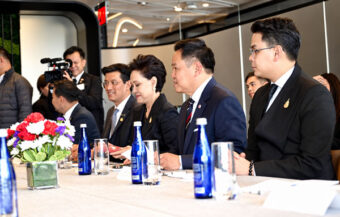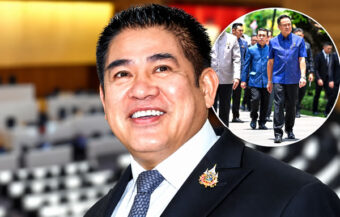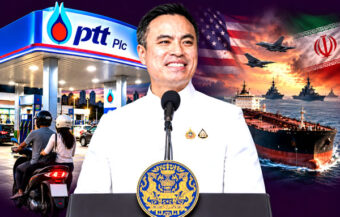
Ekniti sounds the alarm as Thailand confronts four economic threats: global power rivalry, AI upheaval, volatile energy and a shrinking workforce. The Finance Minister says a deepfake investment scam even fooled him and led to a police report.
Thailand faces a four-front economic challenge as geopolitical rivalry, AI, energy shocks and a shrinking workforce close in. Finance Minister Ekniti Nitithanprapas warned that US-China divisions are already hitting trade, while cheap oil may never return. Meanwhile, Thailand’s ageing population is driving greater reliance on foreign labour. AI brings another upheaval, transforming business while fuelling sophisticated deepfake fraud. Mr Ekniti revealed that he himself was targeted by an AI investment scam and went to the police. Now, he says Thailand must stay geopolitically neutral, embrace AI and clean energy, while its judges prepare for increasingly complex international and technology-driven cases.
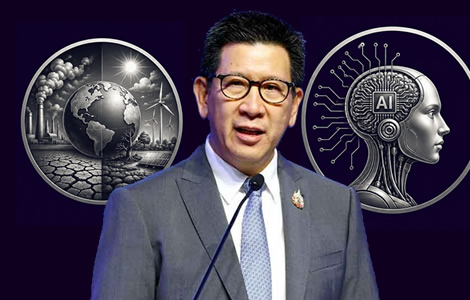
Deputy Prime Minister and Finance Minister Ekniti Nitithanprapas has warned that Thailand faces four major economic challenges. They cover geopolitics, artificial intelligence, energy pressures and a shrinking workforce. Together, the forces are reshaping trade, investment, employment and Thailand’s justice system.
Mr Ekniti delivered the warning during a special lecture on Thailand’s economic transition. The address was titled “The Thai Economy in Transition and New Challenges for the Justice System.” Notably, he linked global economic upheaval directly with challenges facing Thai judges.
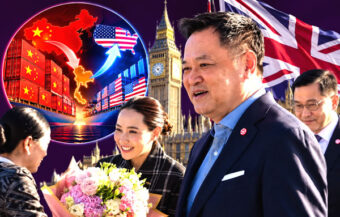
First, Mr Ekniti highlighted the growing geopolitical and geoeconomic divide. The United States and China increasingly form competing economic poles. As a result, smaller economies can face pressure to choose sides during trade negotiations.
Thailand feels tariff pressure as Ekniti urges neutrality while seeking reputable foreign investment
Thailand is already experiencing the effects of this harder trading environment. Mr Ekniti cited a 12.5% US import tariff increase linked to forced-labour allegations. In response, Thailand must carefully manage its position between competing international powers.
Mr Ekniti said Thailand should remain neutral while continuing to attract foreign investment. However, neutrality does not mean accepting every investor seeking access to the country. Instead, Thailand must select reputable investors and avoid shady business dealings.
Second, artificial intelligence is advancing at extraordinary speed. Mr Ekniti described AI as a new industrial revolution. Moreover, he said the transformation was larger and faster than the internet era.
Thai companies must therefore move into the AI economy. Mr Ekniti cited the “Thai Helps Thai Plus” project as one example. The project uses an AI system called “Whispering Bird” to assist small market vendors.
Specifically, the technology automatically analyses sales and costs for traders. That brings AI directly into the daily operations of small businesses. In parallel, the same technological revolution is producing sophisticated new forms of crime.
Deepfake fraud reaches Ekniti as AI means new challenges for police, prosecutors and judges
Deepfake technology can imitate human faces and voices with increasing accuracy. Consequently, fraudsters can create convincing digital versions of real people. Such technology presents new problems for investigators, prosecutors and judges.
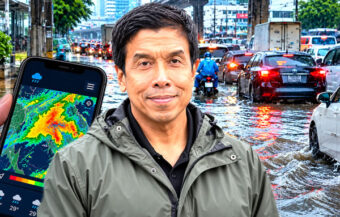
Mr Ekniti revealed that he had personally encountered an investment scam involving an AI-generated avatar. He subsequently filed a police report over the incident. Significantly, he said the fabricated face and voice closely resembled those of the genuine person.
“Regarding AI technology, you see a lot of fraud cases because AI is very smart these days,” Mr Ekniti said.
“I was even tricked into investing by an AI that created its own avatar. I recently filed a police report.”
“The face and voice were very similar, but it wasn’t the same. If you knew the real person, you would know it wasn’t the same,” he said.
On another front, environmental pressures are increasingly influencing international commerce. Mr Ekniti said environmental issues were being used as grounds for trade and investment barriers. Meanwhile, wars have intensified instability across international energy markets.
Ekniti warns cheap oil era may be over as Thailand remains heavily exposed to imported energy
He warned that the era of cheap oil might never return. For Thailand, that carries particular economic consequences because the country depends heavily on imported energy. Global conflicts can therefore transmit energy shocks rapidly into the domestic economy.
Mr Ekniti said Thailand relies heavily on imported natural gas. Separately, the country does not produce its own vehicle fuel and depends on imports.
“Today, Thailand imports 65% of its electricity, primarily from imported natural gas. We also don’t produce fuel for vehicles domestically and must import it,” Mr Ekniti said.
Accordingly, Thailand remains exposed to sharp energy-price movements whenever international conflicts disrupt global markets. Mr Ekniti said the country must accelerate its transition towards clean energy. The shift would reduce exposure to volatile imported oil and natural gas.
Fourth, Thailand faces a deepening labour shortage driven by its demographic structure. The population is ageing while the birth rate has turned negative. Consequently, the domestic workforce is contracting.
Shrinking workforce drives reliance on neighbouring labour and more complex international cases
Thailand must increasingly hire workers from neighbouring countries to fill the resulting labour gaps. At the same time, that dependence adds another international dimension to the economy. More foreign workers will also create more complicated legal issues.
Mr Ekniti said these four pressures have direct implications for Thailand’s judiciary. In particular, he highlighted judges working in specialised appeals courts. Increased foreign investment and labour movements will produce more complex international litigation.
Foreign capital can bring disputes involving overseas investors and cross-border business activity. Likewise, greater reliance on neighbouring workers adds another international element to legal cases. Courts will therefore encounter an economy increasingly connected to people and capital from overseas.
AI creates a different challenge for judges. Deepfakes can produce fabricated faces and voices that closely resemble genuine individuals. Hence, courts could increasingly encounter technologically generated material in fraud and other technology-related cases.
Mr Ekniti said judges must become technologically savvy to handle those developments. Yet he also urged them to use AI as a working tool. Artificial intelligence could assist with analysing information and detecting discrepancies between judgments.
Ekniti urges judges to embrace AI tools as courts face more complex technology and international cases
As part of this, AI could help accelerate judicial work. Judges could use the technology to process information more efficiently. Nevertheless, they must possess enough technological knowledge to understand the systems they use.
The four challenges also overlap across Thailand’s economy. Geopolitical rivalry is changing trade negotiations and investment decisions. Simultaneously, AI is transforming commercial activity while providing fraudsters with increasingly sophisticated tools.
Energy represents another pressure point. Wars can drive sharp movements in international oil and natural gas prices. Thailand’s dependence on imported energy leaves it exposed when those markets become volatile.
Thailand faces overlapping shocks from geopolitical rivalry, AI, volatile energy and labour shortages
Demographics add a longer-term constraint. Thailand’s ageing society and negative birth rate are reducing the available labour force. In turn, businesses must increasingly look across national borders for workers.
Against this backdrop, Mr Ekniti set out several areas requiring faster adjustment. Thailand should remain geopolitically neutral while seeking reputable international investment. Businesses should also move further into the AI era.
In addition, the energy transition must accelerate as imported oil and natural gas remain vulnerable to global shocks. Labour shortages will continue pushing Thailand towards workers from neighbouring countries.
For the justice system, those shifts mean more complicated cases. Foreign investment can generate international litigation, while overseas labour adds cross-border legal dimensions. Meanwhile, AI-generated fraud introduces evidence capable of closely mimicking genuine people.
Ekniti’s own deepfake case highlights AI risks as judges are urged to use the technology themselves
Mr Ekniti’s own experience illustrated the speed of that technological shift. An AI avatar reproduced a face and voice closely enough to feature in an investment scam. He later took the case to police.
Beyond fraud, Mr Ekniti said AI could itself become part of judicial work. Judges could use it for data analysis and comparisons between judgments. Such systems could also flag discrepancies and reduce the time needed for some tasks.
Something gone wrong in the business world as confidence plummets to a three year low in survey
Bangkok firm rules out using its US military alliance as leverage in tense trade talks with Washington
Ultimately, Mr Ekniti tied the changing role of the courts to Thailand’s wider economic position. Judges must understand the global forces surrounding increasingly complex cases. They must also recognise technological changes affecting evidence, businesses and international disputes.
He said courts that understand these challenges can strengthen confidence in Thailand’s economy. Finally, he described the judiciary as a crucial foundation for the country’s long-term economic stability.
Join the Thai News forum, follow Thai Examiner on Facebook here
Follow Thai Examiner on Google here
Receive all our stories as they come out on Telegram here
Follow Thai Examiner here
Further reading:
Something gone wrong in the business world as confidence plummets to a three year low in survey
Now the government’s crackdown targets unlicensed hotels. Five managers arrested in Phuket raids
Top Bhumjaithai Party figure defends the party’s position on cannabis. Only supported medical use